
Real Estate Website Design Templates vs Custom Builds for Agents
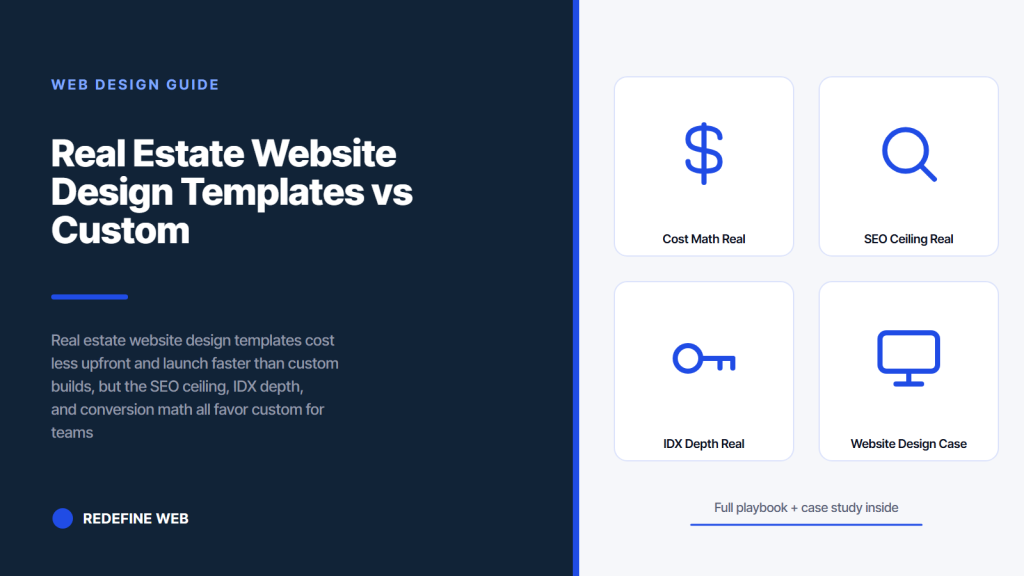
- Templates fit under 20 to 60 transactions per year.
- Custom wins the 24-month cost math above 60 closings.
- SEO ceiling on templates caps at brand-only searches.
- IDX render speed decides mobile conversion 3x on templates.
- Segment-specific design gaps favor custom every time.
- Cost math on real estate website design templates vs custom
- SEO ceiling on real estate website design templates
- IDX depth in real estate website design templates and custom builds
- Conversion rate math on real estate website design templates vs custom
- Real estate website design case study: McCarthy Court
- Real estate website design templates vs custom comparison table
- Who should pick real estate website design templates
- Who should pick custom real estate website design
- Hybrid real estate website design templates plus custom sections
- Real estate website design templates vs custom pitfalls
- What to decide on real estate website design templates vs custom this week
Real estate website design templates ship in 2 weeks for $500 to $2,400. A custom real estate website design takes 8 to 16 weeks and costs $8,500 to $60,000. The gap looks obvious on paper. The gap looks different once you price the SEO ceiling, the IDX integration depth, the conversion rate math, and the 24-month lifetime cost of each choice. This guide walks the tradeoffs so agents, teams, and brokerages pick the right side of the line the first time.
You will get the cost math over 24 months, the SEO ceiling by choice, the IDX depth each option supports, the conversion rate benchmark, and the segment framing that decides which agents belong on templates and which need custom. Read this against your last 90 days of Google Analytics before you sign a template subscription or brief a custom build because the specific numbers below make the call for you.

Cost math on real estate website design templates vs custom
The upfront cost gap is clear. A real estate website design template runs $500 to $2,400 setup plus $30 to $150 per month on Placester, Real Geeks, iHomefinder, or Squarespace with an IDX add-on. A custom real estate website design runs $8,500 to $60,000 setup plus $150 to $600 per month for managed hosting.
The 24-month total cost of ownership tells a different story. A template subscription at $150 per month runs $3,600 over 24 months plus the $2,400 setup, for a total of $6,000. A custom real estate website design at $18,000 setup plus $300 per month runs $25,200 over 24 months. The 24-month cost gap is $19,000. That gap matters until you price the pipeline math: a custom site that converts 3 percentage points higher on 2,000 monthly sessions produces 60 more leads per month, which at a 15 percent close rate is 9 more closed transactions per year at a $6,000 average commission.
The 24-month template plus custom cost gap breaks even at 40 to 60 additional closed transactions attributable to the site design. For a solo agent closing 8 to 20 transactions per year, the template usually wins the math. For a team closing 60+ transactions per year, the custom site starts winning. For a brokerage with 25+ agents, the custom site wins decisively. See our Real Estate Website Design Services for the custom build scope.
SEO ceiling on real estate website design templates
The SEO ceiling is where real estate website design templates quietly cap the agent’s growth. Templates ship with a fixed URL structure, limited schema markup, and shared theme code across thousands of other real estate sites. Google’s helpful content and site quality signals penalize sites that look duplicative to the crawler. Templates hit that penalty automatically.
Custom real estate website design lets the developer control every URL, every schema markup type, and every internal linking pattern. That control is what unlocks the neighborhood-page SEO play. A custom site with 12 neighborhood pages, each ranking on its neighborhood name plus “homes for sale”, produces 400 to 1,200 organic sessions per month at a 3 to 6 percent conversion rate. A template site with the same 12 neighborhoods usually caps at brand-only search visibility because the neighborhood pages inherit the shared template structure that Google ignores.
Structured data support also splits the two. Custom sites wire schema.org RealEstateListing, LocalBusiness, and BreadcrumbList types into every relevant page from launch. Template sites either don’t ship those schemas or ship a shared version that Google marks as generic. See Google’s Real Estate Listing structured data guide for the schema types worth wiring at launch. Templates that skip these schemas cap the listing’s Google rich-result eligibility.
Neighborhood page SEO on real estate website design templates
Neighborhood pages carry the SEO argument for custom real estate website design. Each page needs a unique URL, a keyword-rich H1, a photograph from the actual neighborhood, and 400 to 900 words of local market commentary. Template sites usually generate neighborhood pages from a shared JavaScript filter and cap ranking at brand-only searches. Reference Google’s search fundamentals for why the shared-template pattern loses.
IDX depth in real estate website design templates and custom builds
IDX integration is where templates and custom builds split hardest. Templates ship with a single IDX vendor tied to the platform. Placester ships iHomefinder. Real Geeks ships their own IDX layer. Squarespace requires a third-party IDX add-on that renders inside an iframe. Every template’s IDX layer is fixed. The agent picks the platform and inherits the IDX vendor.
Custom real estate website design gives the agent every IDX vendor as an option. Showcase IDX, iHomefinder, IDX Broker, dsIDXpress, and the newer Homes.com IDX all plug into a custom site. Each has different search UX, different render speed, and different data update cadence. The agent picks the best one for their market and their board’s IDX policy. That flexibility saves 20 to 40 percent on IDX renders and produces cleaner search UX on mobile.
IDX render speed decides mobile conversion. Templates that render IDX inside an iframe or a heavy shared JavaScript layer take 4 to 6 seconds on mobile. Custom sites with a properly integrated IDX layer render in 1 to 2 seconds. That 3-second gap costs the template agent 20 to 40 percent of mobile leads. Real estate website design templates that ship an inline IDX still lose to custom on the render speed test on a 2-year-old iPhone SE over LTE. Also worth testing: the IDX search UX on a slow connection, since real buyers browse on the go and evaluate response time as a proxy for the agent’s professionalism.
If you closed under 20 deals last year, custom won't pay back inside 24 months. Templates rank fine for hyperlocal. Save the gap for photography and Facebook.
Conversion rate math on real estate website design templates vs custom
The conversion rate benchmark separates the two more than any other number. Real estate website design templates on Placester, Real Geeks, and Squarespace with IDX add-ons converting organic and paid traffic at 0.4 to 1.6 percent on buyer intent, 0.8 to 2.4 percent on seller intent. Custom real estate website design sites converting at 3 to 6 percent on buyer intent, 5 to 9 percent on seller valuation forms.
The conversion gap comes from four places. Faster IDX render on mobile. Segment-specific hero copy (luxury, urban team, solo, investor). Custom lead form placement above the fold. Named agent proof with real credentials, not stock photos. Templates that skip any one of those lose the conversion gap. Custom builds that skip any one of them lose it too, so the framework matters more than the template-or-custom decision.
Segment-specific design is the biggest lever. Luxury real estate leads with a full-bleed property hero and a private consult CTA. Urban team leads with a compact IDX search above the fold. Solo agent leads with a personal-brand hero. Investor leads with a cash-offer form. Real estate website design templates usually ship a single blended design that fits none of the four segments and converts 40 to 60 percent below the segment-fit benchmark. See our Real Estate Marketing Agency for the segment framing behind every custom build.
Real estate website design case study: McCarthy Court
McCarthy Court runs a small luxury residential portfolio in the London market with 7 units. The pre-project state was a static page with a contact email and no property inventory display. Templates were considered and set aside because none of the luxury real estate website design templates on the market handled the specific portfolio structure or matched the brand’s luxury positioning.
Redefine Web ran a custom web design and web development engagement. The site used a custom post type for the 7 luxury units, a photography-first hero, a booking plugin for viewings, and a CRM webhook so every inquiry fired straight to the property manager’s HubSpot pipeline. The design pattern followed the luxury segment brief: full-bleed property photography, minimal hero copy, and a single primary CTA per page.
The custom pattern that worked at McCarthy Court would not have worked on a template. Templates ship a fixed layout, a fixed IDX render, and a fixed conversion pattern. Luxury real estate needs the flexibility to lean fully into the property photography, the brand voice, and the specific booking flow. Every luxury real estate agent or team facing the same choice ends up with the same answer: custom for luxury, template for entry level or side hustle. McCarthy Court also invested in professional architectural photography for the 7 units at the same time as the site build, which paid back inside 60 days on the viewing conversion rate.
Real estate website design templates vs custom comparison table
The two options each fit a different agent profile, transaction volume, and market. The table below sizes the tradeoffs across cost, SEO ceiling, IDX depth, and conversion rate benchmark. Match the row to the actual business, not the row that feels aspirational.
| Dimension | Template | Custom | Winner for team of 30 plus |
|---|---|---|---|
| Setup cost | $500 < $2,400 | $8,500 > $60,000 | Template |
| Monthly cost | $30 > $150 | $150 > $600 | Template |
| SEO ceiling | Brand only | Neighborhood plus commercial | Custom |
| IDX vendor choice | 1 fixed | 5 > options | Custom |
| Conversion rate | 0.4 < 2.4% | 3 > 9% | Custom |
| Segment fit | Blended | Segment-specific | Custom |
The template wins on upfront cost and monthly cost. The custom build wins on every dimension that actually decides pipeline. That is why the 24-month cost math tilts custom for teams past 60 transactions per year. Pick the row that matches the transaction volume, not the row that matches the current cash flow. Cash flow is a real constraint, but planning the switch-to-custom milestone at 40 to 60 transactions per year prevents 2 years of pipeline capped by the template.
The comparison also shows where the segment framing lands each dimension. A luxury solo agent closing 15 transactions per year usually still picks custom because the brand voice matters more than the transaction volume math. An investor flipping 40 properties per year usually still picks templates because the paid-ad landing pages carry the conversion outside the site infrastructure. Use the comparison as a starting frame, then adjust for segment. Reference the NAR Technology Survey for the wider real estate agent web behavior data behind the choice.
Who should pick real estate website design templates
Real estate website design templates fit specific agents well. Solo agents closing under 20 transactions per year in a single market. Side-hustle agents keeping the full-time job. Newly licensed agents inside year one. Buyer-only agents in a competitive market where the template’s IDX is good enough. Investor agents running direct-response paid ads that carry the conversion outside the template.
The template also fits the agent testing a new market before committing to custom. Buy the template, run it for 6 to 12 months, learn what works in the market, and then commission the custom build with the learnings baked in. That sequence saves 20 to 40 percent of the custom scope because the segment and the neighborhood focus are already known.
The best real estate website design templates in 2026 are Placester, Real Geeks, iHomefinder, and Squarespace with an IDX add-on. Each handles the base agent website need. Placester carries the deepest IDX. Real Geeks carries the fastest lead capture. iHomefinder carries the most flexible search UX. Squarespace carries the cleanest visual design. Pick the template that fits the market and the segment, not the one that shows up first in a Google search for real estate website design templates. Also check the template vendor’s contract term and cancellation policy before subscribing so an agent can migrate off the template without paying a 12-month exit fee.
Who should pick custom real estate website design
Custom real estate website design fits teams, brokerages, and solo agents past the volume threshold. Teams closing 60 to 200 transactions per year. Brokerages with 25+ agents. Luxury or commercial real estate agents who need brand-specific visual identity. Investor and flipper businesses running deep landing page proliferation across paid ads. Agents building a real personal brand with content and video.
Custom also fits the agent chasing SEO seriously. Neighborhood pages, buyer-guide pages, seller-valuation pages, market-report pages, and school-district pages each rank on informational and commercial-investigation searches that templates cap at brand-only visibility. An agent running a custom site with 30+ neighborhood and market-report pages produces 800 to 3,000 organic sessions per month at a 3 to 6 percent conversion rate. That organic pipeline is the reason custom wins over 24 months.
Custom builds also carry the retainer motion. A monthly retainer at $1,500 to $6,000 per month keeps the neighborhood content fresh, watches Core Web Vitals as the market data feed updates, and expands the internal link graph as new neighborhoods launch. Template sites can’t run the same retainer motion because the theme code is shared and the CMS is closed. See our Monthly Website Maintenance Packages for the custom retainer scope. The retainer also carries the paid channel wiring, so the ad campaigns and the SEO content grow together instead of drifting apart 6 months post launch.
Hybrid real estate website design templates plus custom sections
Some agents pick a hybrid: a template for the base site plus a custom section for the deep SEO play. Placester or Real Geeks as the platform, plus a custom subdomain running a WordPress or Webflow site for the neighborhood pages, market reports, and buyer guides. That hybrid captures the template’s low cost plus a real SEO ceiling on the custom subdomain.
The hybrid works well for solo agents scaling toward a team. The template handles the base agent site during the transition. The custom subdomain handles the SEO content that carries the growth. Once the team hits 60+ transactions per year, migrate the base site to custom too and consolidate. That two-stage rollout costs less than jumping straight to a full custom build and preserves the template’s monthly savings during the growth phase.
One solo agent we know spent 4 years upgrading her Placester template with plugin add-ons, custom CSS injections, and third-party form scripts. By year 4, the template site had 27 add-ons, 3 broken CSS overrides, and load times north of 8 seconds on mobile. As she put it, “I tried to turn a template into a custom site and ended up with a Frankenstein.” She scrapped everything, commissioned a custom build, and the site paid back in 8 months. Pick the pattern that fits, not the pattern that saves $150 per month.
Real estate website design templates vs custom pitfalls
First pitfall: assuming a template scales with the team. Templates cap out somewhere between 60 and 100 transactions per year. Every team pushing past that ceiling on a template is leaving pipeline on the floor because the SEO, IDX, and conversion patterns can’t stretch further.
Second pitfall: jumping to custom too early. A solo agent closing 8 transactions per year on a template has a 24-month payback timeline on custom that runs into year 3 or 4. The math doesn’t support custom until the transaction volume justifies it. Start on the template, hit the ceiling, then switch.
Third pitfall: picking custom based on visual polish without wiring the IDX, SEO, and analytics. A custom real estate website design without a proper IDX integration, schema markup, and CRM webhook underperforms the template it replaced. The visual polish is not what wins the pipeline. The infrastructure decisions behind the polish are.
Fourth pitfall: no measurement plan before launch. Every agent switching from a template to a custom build needs a baseline set of numbers to compare against: sessions, conversion rate, lead volume, and closed transactions attributable to the site. Skip the baseline and the ROI argument stays anecdotal for the life of the site. Wire Google Analytics 4, a call tracking number, and a CRM webhook before launch. Log the numbers monthly for the first 12 months.
What to decide on real estate website design templates vs custom this week
Three actions before signing either path. Count the closed transactions from the last 12 months. Pull the last 90 days of Google Analytics from the current site. List the 3 competitor sites in your market that keep showing up on the neighborhood searches. Those three inputs decide the answer for you.
The transaction count decides the volume threshold. The analytics baseline decides the current conversion ceiling. The competitor scan decides the SEO gap you need to close. Real estate website design templates vs custom is a math problem, not a preference. Every agent running the three inputs above ends up with a clear answer inside 30 minutes. Pick the path the numbers support, not the path the CRM vendor recommends. For teams ready to run the custom scoping call, review our Web Design and Development Services.
Frequently asked questions
Should agents pick real estate website design templates or a custom build?
Solo agents closing under 20 transactions per year should pick a template. Teams closing 60 or more transactions per year should pick a custom build. The 24-month cost math flips around the 40 to 60 transaction threshold because a custom site converts 3 to 6 percent on buyer intent versus 0.4 to 1.6 percent for templates. That conversion gap produces 60 more leads per month at 2,000 sessions, which translates to 9 more closed transactions per year at a $6,000 commission. Solo agents on the volume ceiling should start with a template and switch to custom once the transaction volume justifies the 24-month payback.
What are the best real estate website design templates in 2026?
The best real estate website design templates in 2026 are Placester, Real Geeks, iHomefinder, and Squarespace with an IDX add-on. Placester carries the deepest IDX integration for agents in MLS-heavy markets. Real Geeks carries the fastest lead capture and works well for buyer-focused agents running direct-response ads. iHomefinder carries the most flexible search UX and pairs with WordPress if the agent wants a hybrid setup. Squarespace carries the cleanest visual design and fits the personal-brand agent who wants a magazine-quality feel with a plug-in IDX. Pick the template that fits your market, your segment, and your IDX preferences, not the one that shows up first in Google.
How much does a custom real estate website design cost in 2026?
Custom real estate website design projects run $8,500 for a solo agent build, $18,000 to $38,000 for a team or brokerage build, and $48,000 to $120,000 for a luxury or multi-market brokerage build with custom IDX integration, market-insight content, and CRM wiring. Monthly hosting and maintenance runs $150 to $600 depending on traffic and IDX vendor. A monthly SEO plus content retainer of $1,500 to $6,000 keeps the neighborhood and market-report pages fresh over time. Total 24-month cost of ownership sits between $25,000 and $180,000 depending on the scope and the retainer level.
What is the SEO ceiling on real estate website design templates?
Real estate website design templates cap at brand-only search visibility because the URL structure, schema markup, and internal linking patterns are shared across thousands of other real estate sites on the same platform. Google's helpful content and site quality signals penalize duplicative site structures at the crawler level. Custom real estate website design lets the developer control every URL, every schema markup type, and every internal linking pattern. That control is what unlocks the neighborhood-page SEO play. Custom sites with 30+ neighborhood and market-report pages produce 800 to 3,000 organic sessions per month at a 3 to 6 percent conversion rate.
Can I upgrade from a template to a custom real estate website design later?
Yes, most agents start on a template and switch to custom once the transaction volume justifies the 24-month payback. The migration usually runs 8 to 12 weeks and includes 301 redirect mapping, IDX vendor switch, schema markup wiring, and neighborhood content porting. Some agents run a hybrid approach: a template as the base site plus a custom subdomain for the SEO content pages during the growth phase. That two-stage rollout captures the template's monthly savings while a custom SEO layer carries the growth. Once the transaction volume hits 60 or more per year, consolidate the base site to custom too.
What is the biggest mistake in the real estate website design templates vs custom decision?
The biggest mistake is assuming a template scales with the team past the 60 to 100 transaction ceiling. Every team pushing past that number on a template is leaving pipeline on the floor because the SEO, IDX, and conversion patterns can't stretch further. The second biggest mistake is jumping to custom too early. A solo agent closing 8 transactions per year on a template has a 24-month payback timeline on custom that runs into year 3 or 4. Start on the template, hit the ceiling, then switch. The math decides the path, not the visual preference.
Book your free 30-minute strategy call.
No spam, no sales rep. We use your email to schedule your call with a senior strategist. That is it.
More from the blog
View all articles → Web Design
 Core Web Vitals Healthcare Websites Actually Need to Book Patients
Read article Web Design
 Professional Services Website Design Best Practices for 2026
Read article Web Design