
Beauty Marketing Ideas That Grow DTC Revenue Fast in 2026
- Ingredient-first paid creative converts 1.6 to 2.4 times higher.
- Three-tier influencer stack beats macro-only concentration.
- SEO content compounds cheapest cost per first order by month 12.
- Seven-flow email plus SMS drives retention at 8 to 14 times paid CAC.
- Community plus loyalty programs push repeat rate to 62 to 82 percent.
- Retail buyer pursuit enters only after four evidence benchmarks hit.
- Ingredient-first paid creative leads modern beauty marketing ideas
- Three-tier influencer partnerships anchor beauty marketing ideas
- Problem-plus-ingredient SEO content compounds beauty marketing ideas
- Seven-flow email plus SMS retention across beauty marketing ideas
- Beauty marketing ideas ranked by cost per first order
- Community and loyalty programs among top beauty marketing ideas
- Trial size sampling programs in beauty marketing ideas
- UGC repurposing pipelines in modern beauty marketing ideas
- Category education video series across beauty marketing ideas
- Retail buyer readiness pursuit in mature beauty marketing ideas
- Stage-based pairing across beauty marketing ideas by revenue
- Beauty marketing ideas to skip in favor of the ranked twelve
- Where beauty marketing ideas fit the full brand growth plan
Beauty marketing ideas get pitched at every industry conference and most collapse the first time a brand tries to scale past $80,000 monthly DTC revenue. The Instagram giveaways that added 4,000 followers in a week produced 22 first orders. The paid influencer post that reached 800,000 accounts produced 180 first orders and zero repeat purchases. The Instagram Reel that hit 3 million views produced 640 first orders and a support inbox jammed for two weeks. Beauty brands that grow past $250,000 monthly revenue do so by picking the beauty marketing ideas that produce measurable cost per first order and repeat purchase rate, not the ideas that produce measurable engagement numbers.
This guide walks twelve tested beauty marketing ideas our team applies on real growing DTC beauty brands through 2026. Ingredient-first paid. Three-tier influencer partnerships. SEO content. Seven-flow email plus SMS. Community and loyalty. Trial size sampling. UGC repurposing. Category education video. Retail readiness pursuit. Plus the pairing profile that decides which four to six ideas a brand runs at each revenue stage.
Ingredient-first paid creative leads modern beauty marketing ideas
Ingredient-first paid creative sits at the top of the beauty marketing ideas list because beauty buyers in 2026 shop by ingredient chemistry, not by brand marketing message. A creative that opens with 5% Niacinamide versus 2% Retinol as a comparison hook converts 1.6 to 2.4 times higher than a creative that opens with brand storytelling. The gap holds across Meta, TikTok, and YouTube because the ingredient-first framing matches how beauty buyers search Google, TikTok, and Amazon in the same purchase session before clicking any ad.
The working ingredient-first creative structure runs three seconds of hook, five seconds of demonstration, five seconds of transformation, and two seconds of CTA. Hook names the ingredient and the specific percentage (Contains 5% Niacinamide + 2% Zinc). Demonstration shows the product being applied on real skin. Transformation shows the before-and-after on the same skin at 4-week and 8-week intervals. CTA drives to a landing page with the same ingredient framing, not a generic home page. The beauty skincare PPC page covers the ingredient-first paid framework we apply on premium DTC beauty brands.
The Beauty & Skincare · Premium D2C · Mumbai, IN brand grew monthly online sales 3.5 times across a 360-degree paid plus organic rebuild that led with ingredient-first creative. Paid ROAS held at 5.2 times through the segmented paid plus micro-influencer combination inside 90 days. Organic traffic grew 220 percent as topic clusters and problem-led content captured product-question intent. The ingredient-first framing paired across every channel is what produced the compound outcome rather than the individual creative wins on any single platform.
Three-tier influencer partnerships anchor beauty marketing ideas
Three-tier influencer partnerships anchor beauty marketing ideas because concentration on any single tier produces measurably worse economics than a balanced three-tier stack. Beauty brands running only macro creators pay $6,000 to $24,000 per partnership and produce 40 to 180 first orders per partnership at $150 to $480 cost per first order. The same monthly budget spread across 30 nano and micro creators produces 240 to 640 first orders at $28 to $88 cost per first order. Same total investment. Roughly six times the return on the balanced tier stack across the beauty category.
The working three-tier structure runs like this. Tier one is nano and micro creators (5,000 to 50,000 followers) at 30 to 60 partnerships per month at a $80 to $220 gifted-plus-fee structure per creator. Tier two is mid-tier creators (50,000 to 250,000 followers) at 5 to 12 partnerships per month at a $600 to $2,400 fee structure. Tier three is macro creators (250,000 to 1M followers) at 1 to 3 partnerships per quarter at $6,000 to $24,000 per partnership. That mix produces 45 to 90 percent of monthly DTC customer acquisition across the first 18 months for premium beauty brands.
The Beauty & Skincare · Australian Naturals · India Awareness brand reached 1.9 million unique Indian accounts through coordinated influencer plus marketplace content targeting the Indian market as first entry point for the Australian brand. Engagement hit 303,000 accounts (moving past passive reach into active consideration). Three-marketplace coverage (Amazon India, Myntra, Flipkart) with consistent narrative and A-plus content held the message aligned across the retail stack. The three-tier structure paired with marketplace consistency is what makes influencer marketing produce measurable revenue rather than measurable impressions that never convert.
Problem-plus-ingredient SEO content compounds beauty marketing ideas
Problem-plus-ingredient SEO content compounds beauty marketing ideas across 12 to 24 months at a cost per first order that no paid channel can match at maturity. A buyer searching for how to fade dark spots is at the top of the funnel and worth capturing with a 2,400-word content piece that ranks in positions 3 to 8 and drives 800 to 3,200 monthly organic sessions. A buyer searching for best 5 percent niacinamide serum for oily skin is deeper in the funnel and worth capturing with a product comparison page that ranks in positions 1 to 4 and drives 45 to 220 monthly first orders.
The working content cadence runs three pieces per week across the two content types. One long-form ingredient education piece (2,000 to 3,500 words) covering science, use cases, product pairing, and buyer FAQs for a single active ingredient. One long-form skin concern piece (1,800 to 3,000 words) covering the problem, the routine, the ingredient stack, and the product recommendations. One product comparison piece (1,200 to 2,200 words) covering the brand’s product versus the top 3 to 5 competitors on the same use case. That cadence produces 90 to 140 pieces per year and generates 40,000 to 180,000 monthly organic sessions by month 18 for premium beauty brands.
The SEO layer supports the content layer through five workstreams. Technical health under 2.5 seconds LCP. On-page optimization with proper schema markup. Link building through digital PR to beauty publications. International SEO with hreflang tags for multi-region brands. Product schema across the full catalog. The beauty skincare SEO page covers the full framework. Reference the Google product structured data documentation for the schema markup that produces rich results on beauty product SERPs.
'5% Niacinamide' outconverts brand storytelling 2x. Rewrite one hook this week and split test against your current top creative for 7 days.
Seven-flow email plus SMS retention across beauty marketing ideas
Seven-flow email plus SMS retention drives the biggest ROI in the beauty marketing ideas stack at a cost per repeat order 8 to 14 times lower than paid acquisition. Beauty is a repeat-purchase category by nature. A serum bottle lasts 6 to 10 weeks. A cleanser lasts 8 to 12 weeks. A moisturizer lasts 8 to 14 weeks. Every beauty brand that skips the automated flow structure loses 35 to 55 percent of annual revenue because the acquisition budget keeps buying first orders while the existing customer base gets no reorder nurture and gradually lapses.
The seven automated flows run through Klaviyo, Attentive, or Postscript on Shopify. Welcome flow (4 emails over 10 days). Post-purchase flow (3 emails plus 1 SMS over 21 days). Reorder reminder flow (2 emails plus 1 SMS timed to typical bottle-empty date). Winback flow (5 emails over 45 days for customers past expected reorder date). Cart abandonment (3 emails over 24 hours with progressive discount ladder). Browse abandonment (2 emails over 48 hours). Birthday and anniversary (1 email and 1 SMS per customer per year). Each flow produces measurable revenue tied to specific customer stages.
The compound math on email plus SMS looks small on any given month and considerable across a year. A beauty brand with 22,000 email subscribers and 8,400 SMS subscribers running the seven-flow stack typically produces $80,000 to $220,000 monthly retention revenue at a marketing cost under $2,400 monthly for platform fees plus flow-writing work. That is a 33x to 91x return on the retention channel, which is roughly 10 times the return the acquisition channels produce on the same monthly spend. Beauty brands that measure ROI channel by channel see retention as the highest-return line item in the marketing plan every quarter.
Beauty marketing ideas ranked by cost per first order
The twelve beauty marketing ideas below rank by blended cost per first order at month twelve, assuming the brand funds each idea at the working floor for the full window. Numbers reflect DTC beauty brands with $50,000 to $500,000 monthly revenue. Enterprise beauty brands running $2M-plus monthly see idea economics shift as scale kicks in and category-leader brand equity produces free organic demand that reduces reliance on paid channels below the numbers shown here across every beauty marketing stack.
| Beauty marketing idea | Cost per first order | Repeat purchase rate | Compound curve at month 12 |
|---|---|---|---|
| Ingredient-first paid creative | $28 to $58 | 32 to 48 percent | Flat with rotation |
| Three-tier influencer partnerships | $18 to $88 | 34 to 52 percent | -22 percent cheaper |
| Problem-plus-ingredient SEO content | $12 to $32 | 48 to 62 percent | -68 percent cheaper |
| Seven-flow email plus SMS | $4 to $12 | N/A retention | Flat by design |
| Community and loyalty programs | $8 to $22 | 62 to 82 percent | -38 percent cheaper |
| Trial size sampling | $22 to $58 | 44 to 62 percent | Flat |
| UGC repurposing pipeline | $14 to $38 | 36 to 52 percent | -28 percent cheaper |
| Category education video series | $18 to $48 | 42 to 58 percent | -42 percent cheaper |
| Amazon marketplace strategy | $42 to $92 | 18 to 32 percent | Flat |
| Retail buyer readiness pursuit | $28 to $68 | 22 to 38 percent | Flat |
| Google Ads branded plus ingredient | $52 to $118 | 38 to 55 percent | Flat |
| Pop-up and in-person events | $62 to $148 | 44 to 62 percent | Flat |
The table looks static but the pairing profile decides which four to six ideas a specific brand should run at each revenue stage. A brand at $50,000 monthly revenue should run ingredient-first paid plus three-tier influencer plus seven-flow email plus SMS plus UGC repurposing. A brand at $200,000 monthly should add SEO content plus community plus trial sampling. A brand at $500,000 monthly should add Amazon plus category education video. The beauty skincare marketing retainer page covers the paired stacks we run at each revenue tier.
Community and loyalty programs among top beauty marketing ideas
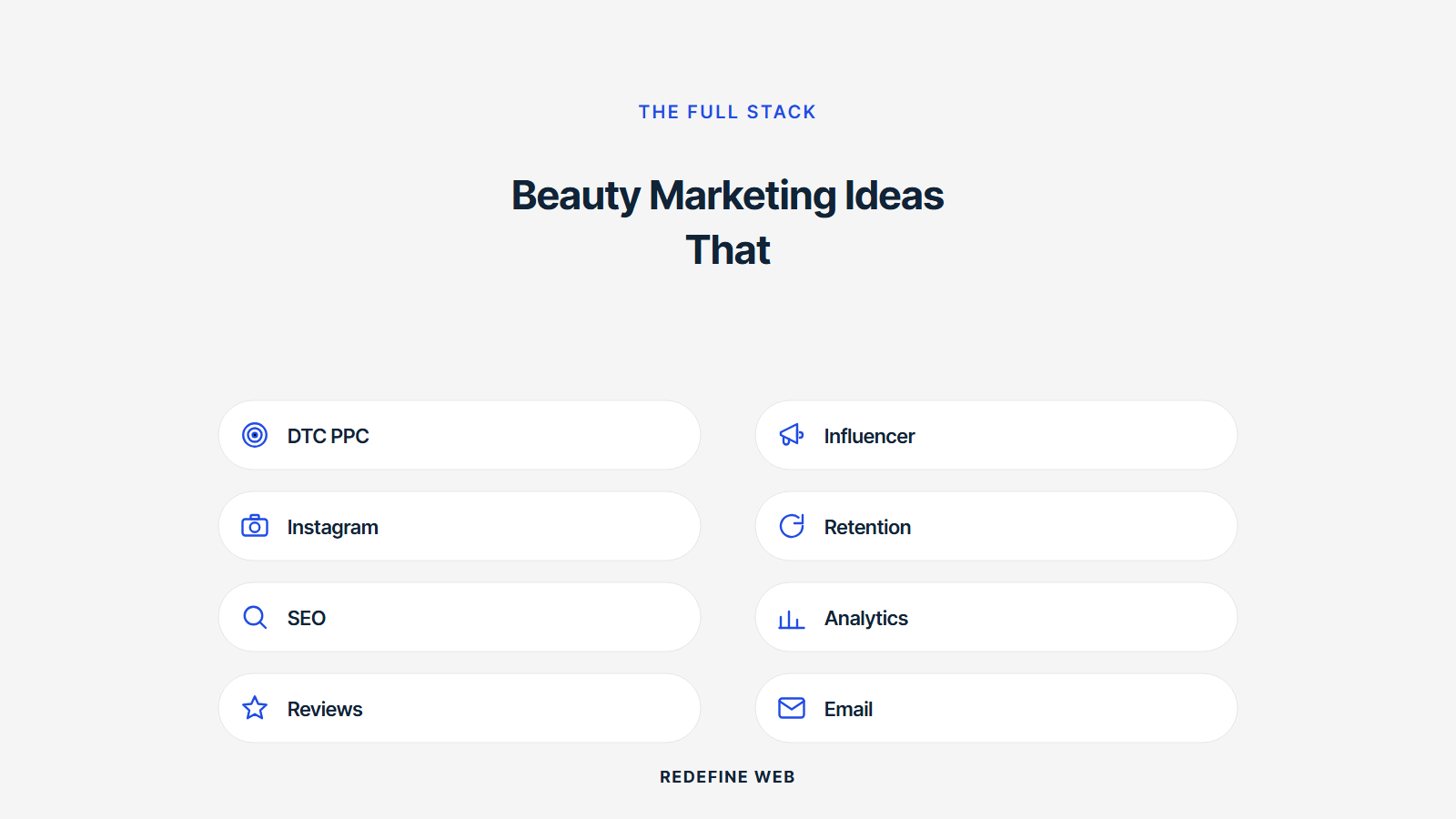
Community and loyalty programs sit near the top of the beauty marketing ideas list on repeat purchase rate (62 to 82 percent versus 32 to 48 percent for paid acquisition) and near the bottom on cost per first order ($8 to $22 versus $28 to $58 for paid). The pattern is one of the most consistent findings across our beauty brand engagements through 2026. Beauty buyers who join a real community stay in the brand for 24 to 60 months with average annual repeat spending 3 to 5 times the beauty category baseline. Beauty buyers acquired through paid alone churn at 18 to 30 months with average annual spending at the category baseline.
The working community program runs three layers. Layer one is a members-only content and community platform through Circle, Mighty Networks, or a private Discord server. Layer two is a tiered loyalty program through Smile.io, LoyaltyLion, or Yotpo Loyalty with points earned per purchase, per review, per referral, and per community engagement action. Layer three is exclusive product access (early access to launches, member-only limited editions, member-only ingredient concentrations) that produces the specific reason for buyers to stay engaged month after month rather than lurking in the background.
Every beauty founder has heard the loyalty program pitch about adding points earning on purchases and calling the job done. The pitch never mentions the part where points loyalty programs without exclusive access components produce 4 to 8 percent engagement rates and zero measurable LTV difference from customers without a loyalty account. Then the founder wonders why the $18,000 loyalty program annual subscription produces flat repeat purchase rate quarter over quarter. Points without exclusivity is a table stakes feature. Exclusive access is the real driver.
Trial size sampling programs in beauty marketing ideas
Trial size sampling programs sit among the underused beauty marketing ideas in 2026 because most brands assume the production cost outweighs the acquisition math. The math actually works when the trial size costs under $2.80 per unit to produce, the shipping cost is under $3.80 per unit (via Bag Compliance USPS Ground Advantage), and the conversion rate from trial to full-size first order runs above 34 percent. Beauty brands hitting those three benchmarks see trial size sampling produce first orders at $22 to $58 with a repeat purchase rate of 44 to 62 percent on the eventual full-size buyer.
The working trial sampling program runs three distribution channels. Channel one is a free trial with paid shipping offer on the brand website (customer pays $4.80 shipping, receives 7-day trial size). Channel two is a partnership with subscription box services (Ipsy, BoxyCharm, Allure Beauty Box) delivering 800 to 4,000 trial samples per month with a code that ties back to the brand for follow-up remarketing. Channel three is direct sampling at events, pop-ups, and retail buyer meetings with QR-coded packaging that links back to a landing page for follow-up conversion tracking.
The compound effect of trial size sampling shows up in the retention data at month 6 and beyond. Full-size buyers who first tried the brand through a trial size have 22 to 34 percent higher repeat purchase rate than full-size buyers acquired through paid ads alone because the trial period built product familiarity and routine incorporation before the full-size commitment. That familiarity gap costs $22 to $58 upfront in trial size unit economics and returns $180 to $420 in incremental LTV across the following 18 months of repeat purchases from the same customer.
UGC repurposing pipelines in modern beauty marketing ideas
UGC repurposing pipelines are among the highest-return beauty marketing ideas because the raw material comes free from customer-generated content and the labor cost is confined to editing plus rights clearance. The working UGC pipeline runs four workstreams. Workstream one is UGC discovery through TikTok, Instagram, and email inbox monitoring for customer-created content mentioning the brand. Workstream two is rights clearance through a two-touch outreach automation. Workstream three is editing and rebranding through in-house or outsourced video editors. Workstream four is deployment across paid ads, organic social, email, and product pages.
A boutique beauty brand can produce 40 to 90 pieces of finished UGC per month through a properly-run pipeline at a total cost of $2,400 to $6,800 monthly (compensation payments to creators plus editor time plus rights clearance overhead). The same output would cost $18,000 to $48,000 monthly if produced through professional studio shoots. UGC also outperforms studio-shot creative on Meta and TikTok click-through rate by 22 to 48 percent because the authenticity signals read stronger to both platform algorithms and beauty buyers scrolling the feed.
Rights clearance is the piece of the UGC pipeline that trips up most beauty brands. Legally clearing UGC for paid ad use requires explicit written permission (via a rights clearance form or a signed contract) from the original creator, not just a repost on the brand’s own social channels. Skipping the rights clearance step exposes the brand to legal action from creators whose content shows up in paid ads without permission. Tools like Bazaarvoice, Yotpo Visual UGC, or the built-in Instagram Creator Marketplace all handle rights clearance through their platform features with the correct legal structure. Reference the FTC endorsement guides for the current-year disclosure rules around UGC use in paid advertising across the beauty category.
Category education video series across beauty marketing ideas
Category education video series enter the beauty marketing ideas stack at month 9 to 12 once the brand has enough revenue to fund the production cost. A single 8 to 12 minute category education video costs $3,400 to $8,800 to produce at broadcast-quality standards. The video ranks on YouTube search for category-plus-question queries (how does niacinamide work, best routine for oily skin, ceramide vs hyaluronic acid) where search intent is educational-to-transactional and drives 12 to 42 first orders per video across the following 12 months at a cost per first order between $18 and $48.
The compound curve on category education video runs stronger than any other content format because YouTube videos rank on both Google Search and YouTube Search across the same query. A single video ranking in position 1 on the ceramide vs hyaluronic acid comparison query typically produces 4,000 to 18,000 monthly YouTube views for the first 12 months and continues producing 2,000 to 8,000 monthly views for 24 to 36 months after publication with minimal maintenance. Read the YouTube Creator Academy documentation for the current-year ranking factors on category education content across the beauty vertical.
The working category education video series runs one video per month covering the top 12 category questions beauty buyers search on YouTube for the brand’s product category. Video length runs 8 to 14 minutes for full ranking optimization. Video structure runs 15-second hook, 60-second problem statement, 4 to 6 minute deep dive, 90-second product recommendation, 30-second CTA. Series completion produces roughly 12 videos ranking on the top 12 category questions with combined monthly organic YouTube traffic of 40,000 to 220,000 views by month 24 depending on category competition and query volume.
Retail buyer readiness pursuit in mature beauty marketing ideas
Retail buyer readiness pursuit enters the beauty marketing ideas stack at month 12 to 18 once the brand has enough DTC proof to pitch Sephora, Ulta, Credo, Target, and regional specialty retailers. The pitch to retail buyers requires four pieces of evidence. DTC revenue trajectory showing 6 to 12 months of month-over-month growth. Repeat purchase rate above 40 percent on the flagship product. Review count above 800 with 4.5-plus star average on the brand website. Social engagement above 2 percent on Instagram and TikTok combined across the last 90 days.
Brands hitting all four benchmarks typically land Sephora Accelerate, Ulta Sparked, or Credo Sustainable Beauty program placement within 6 to 12 months of the first buyer meeting. Brands missing two or more benchmarks get deferred to the next quarterly review cycle without a pass or a fail. Pursuing retail placement before hitting the four benchmarks typically burns 6 to 9 months of runway and produces zero placement while the founder team could have been building the DTC foundation that would qualify the brand at the next attempt.
The economics of retail placement change the DTC economics after launch. Retail placement typically cannibalizes 12 to 28 percent of DTC revenue in the first 90 days because retail buyers who would have discovered the brand DTC now discover it in-store. That cannibalization stabilizes at month 6 as retail becomes a discovery channel driving future DTC repeat orders for buyers who prefer subscription models over trip-to-store models. Plan the DTC revenue forecast to dip in months 1 through 6 after retail launch and recover through months 7 through 18 as the cannibalization inverts into a discovery flywheel.
Stage-based pairing across beauty marketing ideas by revenue
Stage-based pairing matters as much as which beauty marketing ideas the brand picks. Stage one brands (revenue $0 to $80,000 monthly) should run ingredient-first paid plus three-tier influencer plus seven-flow email plus SMS plus UGC repurposing across $8,000 to $22,000 monthly marketing spend. Stage two brands ($80,000 to $200,000 monthly) should add SEO content plus community and loyalty plus trial sampling across $18,000 to $48,000 monthly. Stage three brands ($200,000 to $350,000 monthly) should add Amazon plus category education video across $32,000 to $78,000 monthly.
Stage four brands ($350,000 to $500,000 monthly) should add retail buyer readiness pursuit plus Google Ads branded defense across $52,000 to $128,000 monthly marketing spend. Blended CAC across the four stages typically follows a curve. Stage one runs $34 to $48 blended. Stage two drops to $28 to $42. Stage three holds at $28 to $42 as Amazon and community reduce reliance on paid. Stage four climbs to $32 to $48 as retail launch and Google Ads branded defense carry higher fixed costs before the revenue kicks in. LTV at 18 months typically climbs from $92 stage one to $198 stage four.
Beauty brands that skip stages produce short-run wins with no compounding. A brand that launches at $80,000 monthly and jumps straight to retail placement pursuit at month 8 typically fails the four-evidence-benchmark test and burns 6 to 9 months of runway trying to land placement it was not ready for. Better to stay in the current stage until the revenue floor of the next stage becomes stable and then move to the next stack. The beauty and skincare marketing agency page covers the stage transition framework we run on premium DTC beauty brands.
Beauty marketing ideas to skip in favor of the ranked twelve
Every beauty marketing consultation surfaces the same short list of ideas that appear in pitches and produce measurably worse ROI than the twelve ranked above. Instagram giveaways run by external growth agencies produce 22 to 44 first orders per 4,000-follower gain because the followers are contest-hunters, not target buyers. Print magazine ads produce zero measurable attribution and burn $8,000 to $24,000 monthly on impressions the brand cannot track back to first orders. Groupon and daily-deal partnerships produce first-time customers who never rebook at full price and cost the brand 50 percent commission on top of the discounted price.
- Instagram giveaways from external growth agencies producing contest-hunter followers
- Print magazine and beauty publication ads with no measurable attribution
- Groupon and daily-deal partnerships producing non-rebooking customers
- Single-tier macro-only influencer partnerships without the three-tier balance
- Points-only loyalty programs without exclusive access components
- Instagram Stories ads without the ingredient-first creative hook structure
- Broad-match Google Ads without proper negative keyword lists
- Meta ads recycling three stock images across every audience for six months
Every idea on the skip list gets replaced by one of the twelve ranked ideas above. The compound effect runs across every subsequent month of the marketing year. A brand that replaces the eight ideas on the skip list with the twelve ranked ideas in a 90-day sprint typically sees blended CAC drop 24 to 42 percent and LTV climb 18 to 34 percent across the full channel stack, and the movement holds through the following 12 months barring major auction or category shifts that require a fresh audit and adjustment cycle.
Where beauty marketing ideas fit the full brand growth plan
Beauty marketing ideas sit inside a broader brand growth plan alongside product formulation, packaging design, supply chain, and community engagement. Marketing ideas drive first-touch discovery and reorder nurture. Product formulation decides whether the brand can deliver on the marketing claims. Packaging design decides whether the unboxing moment produces the UGC that feeds future creative rotation. Supply chain decides whether the brand can serve demand at scale without stock-outs. Community engagement decides whether customers become advocates who drive organic growth beyond paid.
Brands that pick beauty marketing ideas without the surrounding workstreams produce short-run wins with no compounding. Brands that get all five workstreams running together turn every twelve-month investment into a compounding revenue channel that scales past $500,000 monthly. The stage-based pairing framework in this guide is the specific discipline of picking four to six beauty marketing ideas that pair well together at the current revenue stage, funding each at the working floor for the full 12-month window, and running the weekly rhythm across every idea consistently.
Beauty marketing ideas are the specific discipline of picking four to six tactics that pair well together at the current revenue stage, funding each at the working floor for the full 12-month window, and running the weekly rhythm across every tactic consistently. Get the pairing profile locked to the current stage, install the reporting layer, run the weekly rhythm, and let the compound effect play out over 90 to 730 days across the four scaling stages. That is the whole plan and Monday is when the plan starts.
Frequently asked questions
What beauty marketing ideas work best for a brand under $80,000 monthly revenue?
Four ideas anchor the stage-one stack. Ingredient-first paid creative on Meta and TikTok. Three-tier influencer partnerships (nano and micro at 30 to 60 partnerships monthly, mid-tier at 5 to 12 monthly, macro at 1 to 3 per quarter). Seven-flow email plus SMS retention through Klaviyo, Attentive, or Postscript. UGC repurposing pipeline covering discovery, rights clearance, editing, and deployment across paid ads and organic social. Total monthly spend runs $8,000 to $22,000 with a blended CAC of $34 to $48 by month six on properly-run accounts across the four stage-one beauty marketing ideas.
How much do the top beauty marketing ideas cost to run monthly?
Costs scale with brand revenue stage. Stage one brands (under $80,000 monthly revenue) run $8,000 to $22,000 monthly across four ideas. Stage two brands ($80,000 to $200,000) run $18,000 to $48,000 across seven ideas including SEO content and community programs. Stage three brands ($200,000 to $350,000) run $32,000 to $78,000 across nine ideas including Amazon and category education video. Stage four brands ($350,000 to $500,000) run $52,000 to $128,000 across the full twelve-idea stack including retail buyer readiness pursuit and Google Ads branded defense.
Which beauty marketing ideas produce the fastest first orders?
Ingredient-first paid creative on Meta and TikTok produces the first orders 3 to 10 days after campaign launch on a properly-set-up account. Three-tier influencer partnerships produce first orders 5 to 21 days after the first creator posts go live. Seven-flow email plus SMS produce immediate repeat-order revenue on any existing customer list from day one of the automated flow rollout. UGC repurposing produces first orders 7 to 14 days after the pipeline starts delivering finished creative into paid ad rotation. SEO content and community programs take 6 to 12 months to compound into stable first-order volume.
Should beauty brands invest in Instagram giveaways as a marketing idea?
No. Instagram giveaways run by external growth agencies produce 22 to 44 first orders per 4,000-follower gain because the followers are contest-hunters, not target beauty buyers. The follower count boost looks good on the dashboard for 30 to 60 days and produces zero measurable long-term ROI once the contest-hunters unfollow after the winner announcement. Better to spend the giveaway budget on the twelve ranked beauty marketing ideas above which produce measurable cost per first order, repeat purchase rate, and LTV numbers that hold up in the reporting stack across 12 to 24 months.
How long before beauty marketing ideas compound into stable revenue?
Paid channels compound inside 60 to 90 days as smart bidding calibrates against real conversion data. SEO and content marketing compound inside 6 to 12 months as ranking positions climb into positions 1 through 4 on transactional queries. Email plus SMS produce immediate ROI on any existing customer list. Community and loyalty programs compound inside 9 to 18 months as the referral flywheel spins up. Category education video series compound inside 12 to 24 months as YouTube ranking positions accrue. Full multi-idea stack reaches stable ROI at month 12 to month 24 depending on which stage the brand starts inside.
When should a beauty brand pursue retail placement as a marketing idea?
Month 12 to 18 for premium DTC beauty brands. Retail buyer readiness pursuit requires four pieces of evidence. DTC revenue trajectory showing 6 to 12 months of month-over-month growth. Repeat purchase rate above 40 percent on the flagship product. Review count above 800 with 4.5-plus star average. Social engagement above 2 percent on Instagram and TikTok combined. Brands hitting all four benchmarks land Sephora Accelerate, Ulta Sparked, or Credo Sustainable Beauty placement within 6 to 12 months. Brands missing two or more benchmarks get deferred to the next quarterly review cycle.
Book your free 30-minute strategy call.
No spam, no sales rep. We use your email to schedule your call with a senior strategist. That is it.
More from the blog
View all articles → Digital Marketing
 Dental Marketing Tips That Compound Into New Patients
Read article Digital Marketing
 Ecommerce Marketing Strategies That Drive Real DTC Revenue
Read article Digital Marketing