
Your Amazon dashboard shows the shampoo pouch moving 41 units a day at a 3.8 return on ad spend. Your Shopify store shows the same shampoo moving 62 units a day at a 1.9 return. The Amazon channel earns you more per unit, yet it gets the least attention on your growth calendar. An amazon pet products marketing agency exists so that pattern stops repeating on the next DTC pet brand we audit. The right partner rebuilds the listing, the ad structure, and the review pipeline as one integrated program, not three side-by-side vendors. Amazon captures 41% of category unit volume and delivers the strongest retail margin a pet brand can hold, and most founder teams treat it as a side project so paid social eats the strategy hours. The result is a listing set ranked position 14 for a keyword that should sit at position 2, plus an Amazon Ads account burning budget on branded defense.
This guide walks the seven workstreams a specialist Amazon shop runs for a DTC pet brand. Seller Central operations, listing and A+ content, Sponsored Products, Sponsored Brands, Sponsored Display, review acquisition, and Amazon DSP retargeting. Every number below comes from real pet brand accounts our team operated across 2024 and 2025.
A+ content and Brand Store for pet brands
A+ content sits under the buy box on every branded product detail page and pulls conversion 3% to 8% higher than the plain description block. Any pet Amazon operator worth the retainer builds A+ once, then iterates it quarterly on the SKUs that carry revenue. The Brand Store is your owned shelf inside Amazon, the branded landing page that Sponsored Brands campaigns route into.
A+ content that pulls conversion
Five A+ modules move the needle for pet brands. A comparison chart placing your SKU next to two adjacent SKUs. An ingredient callout mapping each natural or safe ingredient to a real pet benefit. A size and coat-type selector for shampoo and grooming SKUs. A founder story block explaining why the brand exists. An FAQ block answering three real buying questions. Skip the hero banner. Amazon buyers scroll past hero banners at a 78% bounce rate and spend their time reading the comparison chart and ingredient callouts.
Brand Store architecture
A Brand Store for a pet brand runs four to six subpages. A home page anchored on the hero SKU. One subpage per product line (shampoo, treats, dental, supplements). One subpage per pet type (dog, cat, senior). One subpage for the seasonal or new-arrival stack. Each subpage points at 4 to 8 SKUs with Add to Cart and List Price on-screen. Traffic reaching a well-built Brand Store converts at 15% to 22%, roughly double the 8% to 12% you see on a raw product detail page. Sponsored Brands campaigns pointed at the Brand Store instead of a single SKU pull 34% lower cost per acquisition.
Sponsored Products, Sponsored Brands, and Display for pet brands
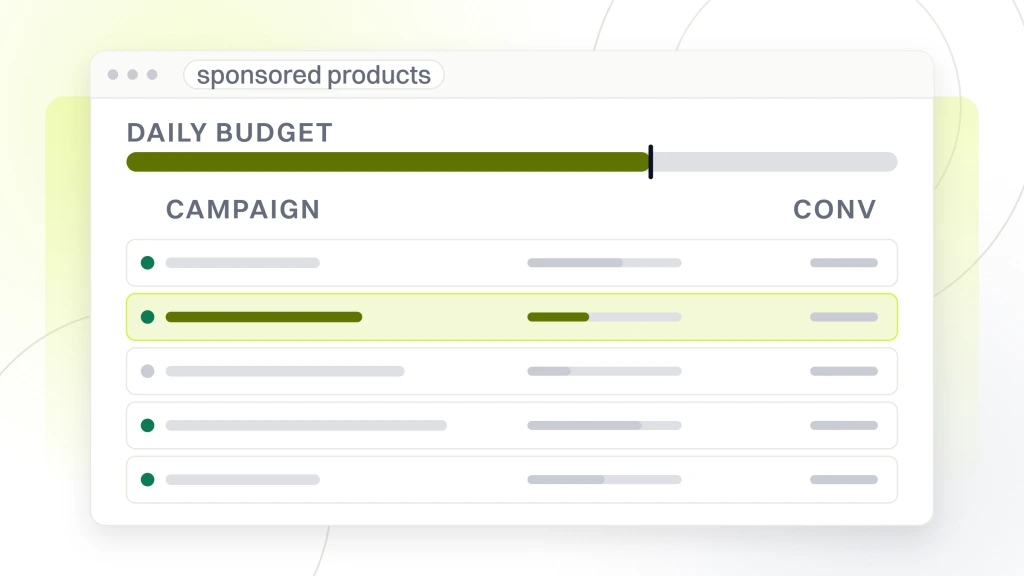
Amazon Ads runs three campaign types inside Seller Central. Sponsored Products, the workhorse, targets by keyword and by product. Sponsored Brands stacks a headline banner over a three-SKU carousel routing into the Brand Store. Sponsored Display owns the product-detail-page placement and the off-Amazon retargeting. A working pet-brand shop runs all three concurrently with a defined budget split, not one at a time.
Budget split by campaign type
A pet brand running $80K to $220K monthly on Amazon holds the budget at 62% Sponsored Products, 23% Sponsored Brands, and 15% Sponsored Display. Sponsored Products captures the search-intent buyer at the strongest return, targeting 3.8 to 5.2 depending on category. Sponsored Brands defends the brand SERP and drives Brand Store traffic, targeting 3.0 to 4.0. Sponsored Display picks up cart abandoners and runs the SKU-versus-competitor conquest play, targeting 2.4 to 3.4.
Campaign structure for pet brands
Sponsored Products campaigns break into three structures per hero SKU. An auto campaign mines new keywords at 10% of the SKU budget. A manual exact-match campaign runs the top 8 to 15 keywords surfaced by the auto campaign at 55% of the SKU budget. A manual product-targeting campaign attacks competitor ASINs and category ASINs at 35% of the SKU budget. Rotate the auto-campaign harvest into manual exact match on a monthly cycle. On a functional-treat SKU our team ran through Q3 2024, that auto-to-manual harvest cadence pulled a 41% drop in cost per acquisition over 90 days. Deeper internal reading on the harvest workflow sits in our proven Amazon PPC management services with real ACoS wins playbook.
Amazon review acquisition for pet products
Reviews are the trust signal that decides whether the ad click turns into a purchase. A pet SKU sitting under 30 reviews converts at roughly half the rate of a SKU above 100 reviews. A working Amazon partner runs a Terms-of-Service-compliant review acquisition program that lands 4 to 8 fresh reviews per week per hero SKU.
Programs that stay compliant
- Vine. Amazon’s own program charges up to $200 per parent product to enroll as many as 30 units for review by vetted Vine Voices.
- Request a Review button. A one-click Seller Central trigger sent 4 to 30 days post-delivery.
- Follow-up email through Feedback Genius or Feedback Whiz. Automated post-purchase message inside program rules.
- Insert card asking for a review. A paper insert in FBA shipments (must not offer incentive).
- Amazon Posts and Live. Social proof surface that drives review reads and second-visit conversions.
What breaks the program
Incentivized reviews, review swaps, and reviews from linked accounts all violate Amazon’s Community Guidelines and trigger a review audit on the account. That audit strips the affected SKU of 40% to 90% of its review count overnight, cuts the star rating by one or two full stars, and tanks the SKU’s Amazon SEO position. A working Amazon partner will refuse to run any incentivized review program regardless of what the founder heard on a podcast. The one-time reputation hit is never worth the short-term velocity gain.
Amazon DSP retargeting for pet brands
Amazon DSP is the demand-side platform that runs display and video across Amazon-owned inventory (IMDb, Fire TV, Twitch, Prime Video) plus off-Amazon programmatic. Pet brands sitting under $2 million Amazon revenue rarely run DSP so the minimum spend commitment lands between $15K and $50K monthly. Brands above $3 million revenue run DSP to defend the buy box and retarget cart abandoners.
DSP audience segments that work
The three DSP audience segments that pull real return for pet brands are cart abandoners (users who added to cart but did not check out), detail-page viewers (users who visited the product page but did not add to cart), and competitor conquest (users who bought a specific competitor SKU in the last 30 days). Cart abandoners pull the highest return at 4.8 to 7.2. Detail-page viewers pull 2.4 to 3.6. Competitor conquest pulls 1.8 to 2.4 but drives incremental new customers who never would have found the brand organically.
Creative for DSP pet campaigns
DSP creative for pet brands runs three formats. Static display (300×250, 728×90, 160×600 for programmatic reach). Responsive display (Amazon builds the sizes from a single asset upload). Video (15 or 30 seconds, autoplay muted, pet interaction demo). Video pulls 2.1x the click-through rate of static, and 1.4x the conversion rate on the click. The mistake most pet brands make with DSP is running a single static creative for six months and blaming DSP when the audience fatigues. Refresh creative every 45 to 60 days at minimum.
Amazon pet products marketing agency pricing tiers
Pricing for an amazon pet products marketing agency sits in five tiers, sorted by the brand’s revenue stage and the workstream scope. Every legitimate shop prices on retainer plus a small share of Amazon ad spend, not on a pure percentage of revenue. A pure percentage-of-revenue model creates the wrong incentives, pushing the agency toward discount promotions that hit the number and cost the brand margin.
| Brand revenue tier | Retainer range | Ad spend share | Scope | Typical outcome year one |
|---|---|---|---|---|
| Under $500K Amazon annual | $1,800 to $3,200 monthly | 0% (retainer only) | Listing plus Sponsored Products | +45% to +80% revenue |
| $500K to $2M Amazon annual | $3,500 to $6,500 monthly | 0% to 4% of ad spend | Full Sponsored trio plus A+ plus reviews | +55% to +110% revenue |
| $2M to $8M Amazon annual | $6,500 to $14,000 monthly | 4% to 7% of ad spend | Everything plus Brand Store plus DSP prep | +30% to +65% revenue |
| $8M to $25M Amazon annual | $12,000 to $28,000 monthly | 5% to 8% of ad spend | Full DSP plus Vine plus Vendor negotiation | +22% to +45% revenue |
| $25M+ Amazon annual | Custom (SOW) | 3% to 6% | Multi-country plus Vendor Central plus Prime Day | +15% to +32% revenue |
The table above assumes a 12-month engagement. Shorter engagements price 20% to 35% higher so the setup cost amortizes over fewer months. Redefine Web runs pet brands on PPC retainers at $999, $1,499, $2,499, and from $4,500 per month, with ad spend billed separately and 6-month contracts as the standard commitment. The entry tier covers listing optimization and Sponsored Products for a single hero SKU. Brands ready to layer Sponsored Brands, Sponsored Display, and A+ content typically move to the $1,499 or $2,499 tier after the first quarter. Scope detail lives on our pet products marketing retainer page.
Reporting cadence from an amazon pet products marketing agency
Reporting cadence is the single biggest tell of an amazon pet products marketing agency’s operational maturity. Weekly numbers, monthly strategic reviews, quarterly business reviews. Any partner who reports monthly with no weekly touchpoint is a media buyer running blind between reports. Any partner who reports daily with no monthly synthesis is churning tactics and losing the strategic view.
Weekly report contents
The weekly report covers ad spend, revenue, TACOS (total advertising cost of sales, meaning ad spend divided by total Amazon revenue, not just ad-attributed revenue), organic revenue split, Buy Box percentage per SKU, in-stock rate, and the top 5 keyword ranking shifts. TACOS is the metric that matters most so it captures whether ad spend is growing organic share or just buying revenue that would have landed anyway. A healthy Amazon pet brand holds TACOS at 8% to 14%. Under 8% and you are under-investing in growth. Over 18% and the account is over-reliant on paid.
Quarterly business review
The quarterly business review from an Amazon partner covers the last 90 days of performance against the plan, the next 90 days of experiments and workstreams, competitor share shifts on the top 20 keywords, and any Amazon program changes (new placement types, DSP audience updates, Vine program updates). QBR meetings run 90 minutes and include the brand founder, marketing lead, and inventory lead. The best QBRs surface an inventory problem the marketing team did not know about, which usually explains why a Sponsored Products campaign underperformed the month before.
Amazon inventory and FBA hygiene for pet brands
Inventory management inside FBA (Fulfillment by Amazon) is the workstream that separates a paid-media shop from a full-scope Amazon operator. A stockout on your hero SKU during a Sponsored Products push tanks campaign cost per acquisition by 60% to 90% and requires 30 to 60 days to recover the organic search rank. Every ad-dollar decision has to check inventory first. Our broader pet products marketing hub covers the shared inventory and retention infrastructure across channels.
Inventory rules an agency should own
Four inventory rules the retained agency owns jointly with the brand’s ops team. Rule one, hold 45 days of cover on every hero SKU at all times. Rule two, pull any SKU sitting under 21 days of cover from Sponsored Brands and Sponsored Display. Rule three, stock seasonal SKUs at 90 days of cover heading into Q4 to protect Prime Big Deal Days and Cyber Week. Rule four, launch new SKUs with 60 days of cover on the first PO so Amazon’s algorithm demotes any listing that stocks out inside the first 45 days. Miss those rules and paid spend evaporates into an unrecoverable rank drop.
Hiring questions for an amazon pet products marketing agency
Every pet-brand Amazon agency pitch deck reads the same. The five questions below separate the shops that can run a pet brand well from the shops that will cost you money across 12 months.
- How many pet accounts have you retained past 24 months. 24 months is the honesty gate. Anything under is churn.
- Show me a Sponsored Products harvest report from a real account. Proves they run the auto-to-manual workflow in production instead of describing it in a deck.
- What is the current TACOS on your best-performing pet account. A number in the 8% to 14% range shows a healthy account. Anything above 20% shows over-reliance on paid.
- How do you handle Vine, Request a Review, and follow-up sequences. Any answer that dodges Amazon Community Guidelines is a disqualifier.
- What is the ownership boundary with our Shopify DTC media plan. The answer must draw a clean line between Amazon and Shopify budgets.
Reference calls to demand
Ask for three pet-brand references. One at your revenue stage, one below, one above. Call all three and ask the same direct question. What did the agency do in month six that surprised you, either good or bad. Month six is when the honeymoon phase ends and the working relationship shows its real shape. A reference call that returns a warm generic answer is a weak reference. A reference call that returns a real story about how the agency handled a stockout, a review audit, or a Prime Day miss is a strong reference, regardless of whether the story landed well or poorly.
Amazon versus Shopify budget split for pet brands
Most DTC pet founders build the Shopify DTC channel first and treat Amazon as an afterthought. The math almost always says the opposite is the right call. Amazon holds 41% of category unit volume, converts at 3x the rate of a cold Shopify visitor, and rewards operators who commit to the channel with organic search compounding. A working Amazon partner will push the brand to reweight budget accordingly. Our related read on the pet product marketing agency playbook covers the multi-channel picture across DTC and treats.

Budget reallocation math
A pet brand running 65% of revenue on Shopify and 25% on Amazon at similar margin should reallocate paid media budget toward a 35% Shopify, 45% Amazon, 20% brand-defense split inside two quarters. The Amazon return math is stronger at this stage and the incremental new customer is cheaper on Amazon. Bark and Native Pet operators have published peer notes supporting the same pattern. The Shopify budget still runs, it just stops carrying the growth expectation on its own.
What Shopify still owns
Shopify still owns the customer relationship, the email list, the loyalty program, and the subscription retention math. Amazon owns the acquisition and the trust-signal reviews. A working Amazon partner will help a brand build the plan for pulling the Amazon buyer into the Shopify subscription flow later, using package inserts, email capture on Brand Store, and post-purchase creative on the Shopify side. That handoff turns a one-time Amazon buyer into a multi-year Shopify subscriber. The email capture step is the one operators skip most often, and it is the difference between a $22 Amazon buyer and a $180 Shopify lifetime value.
A pet-industry Amazon build we ran through 2024
A DTC pet supplement brand came to Redefine Web in Q1 2024 running $840K annual on Amazon at a 24% TACOS, with two hero SKUs (a joint chew and a calming chew) stuck at position 8 to 12 on the top category keywords. Reviews sat around 180 per SKU. The founder was pushing paid social spend, not Amazon spend, and the Amazon account had run without an operator for six months. Our team took ownership across seven workstreams. Seller Central hygiene, listing rewrite, A+ rebuild, Brand Store launch, Sponsored Products harvest, Sponsored Brands defense, and Vine seeding on the two SKUs.
What moved in the first 90 days
Days 1 to 30 covered a listing rewrite on both hero SKUs, a Brand Store build with a dog-treats subpage and a cat-calming subpage, and a Vine seed of 30 units per SKU. Days 30 to 60 layered the Sponsored Products auto-to-manual harvest, with 8 top keywords per SKU moving into manual exact match by day 45. Days 60 to 90 added Sponsored Brands on the branded terms plus the two head category keywords. TACOS dropped from 24% to 15% inside the first quarter. Both hero SKUs moved from position 8 to position 3 on their primary keyword. Monthly Amazon revenue climbed from $70K to $118K.
Where the compounding showed up
The compounding hit in months 4 through 9. Organic search share on the joint chew keyword climbed from 4% to 11%. Review count on the two hero SKUs grew from 180 to 340 through Request-a-Review and post-purchase follow-up. Sponsored Display retargeting on cart abandoners pulled a 5.2 return by month six. By month nine, monthly Amazon revenue landed at $196K with TACOS at 11%. Annual run-rate crossed $2.3 million against the $840K starting number. The founder shifted paid social budget into Amazon Ads once the return math held for three quarters straight. Redefine Web still runs the account in 2026 on the standard 6-month renewal cadence.
Pet-industry proof from the retail side
Pet Shop · Independent Retail · UK is the retail-side proof point in our pet case book. Inside one quarter, calls and WhatsApp inquiries climbed 158%, click-and-collect orders climbed 212%, and repeat customers climbed 47% on the same spend base. That work sat on the local-retail side of the pet market, but it maps to the same buyer-behavior signals a DTC pet brand fights for on Amazon. Reviews, above-the-fold clarity, and a mobile-first browsing surface. The mechanics differ between a Google Business Profile and an Amazon detail page; the trust math is the same.
Amazon pet products marketing agency outlook through 2028
The Amazon pet market forecasts through 2028 hold at 8.5% to 11.2% annual growth against the broader pet category’s 6.5% to 7.2%. That gap widens so Amazon keeps pulling share from big-box retail (PetSmart, Petco) and from independent pet stores. The Amazon agency line will be a growing item on every serious pet brand’s P and L through 2028, not a shrinking one. Three shifts shape the outlook.
Amazon Ads product roadmap
Sponsored TV (Amazon’s connected-TV ad product) opens up for mid-market brands in 2026. Sponsored Products keyword suggestion tools get more AI-driven. Amazon Marketing Cloud (AMC) becomes accessible without a $50K minimum spend and lets brands run first-party retargeting audiences off Amazon behavior. Every one of these tools favors the operator with a strong existing baseline (good listings, good reviews, good FBA hygiene) over the operator scrambling to catch up. Wider category outlook lives in our pet products market size and category growth analysis if you want the reference numbers. The Amazon Ads library guides are the outside reads to keep on hand for teams building the Amazon strategy in-house.
What our team would build if starting today
If our team were launching a new DTC pet brand on Amazon in 2026, the playbook runs. Register brand and get Brand Registry immediately, launch with four SKUs (hero shampoo, hero treat, hero wipes, hero brush), price the hero SKU where the Amazon impulse buyer already shops, run Vine on day one to seed reviews, layer Sponsored Products on the harvest workflow in month two, add Sponsored Brands and A+ content in month three, and hold TACOS steady through month twelve. 10,000 orders sold, 300 reviews per hero SKU, and a $2 million annual run-rate is the reasonable year-one outcome. The founder who tries to skip Vine to save $800 usually loses six months of category rank and burns 3x the money later trying to recover.
The Amazon pet channel rewards operators who model the listing, ad, review, and inventory workstreams as one integrated system, not four side-by-side vendors. Redefine Web runs that integrated model for DTC pet brands on 6-month engagements with PPC retainers at $999, $1,499, $2,499, and from $4,500 per month, ad spend billed separately. If you want a scoped walkthrough for your account, request the free audit from any page on the site and we’ll pull the current TACOS, review velocity, and Buy Box position.