
Best Manufacturing SEO Agencies in 2026 and How to Pick One
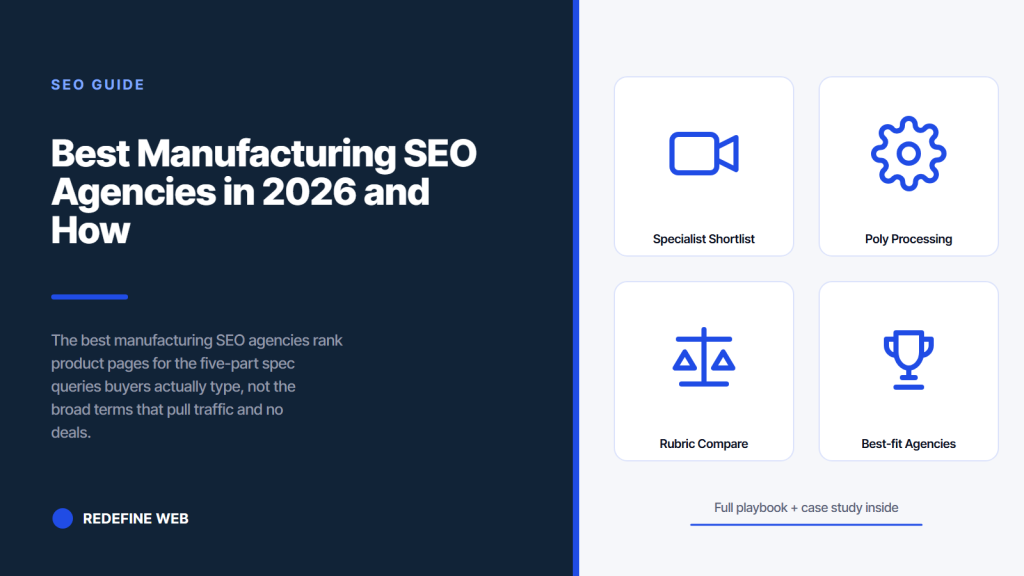
- Specialists know your industry. Generalists learn on your dime.
- Retainers run $2,500 to $12,000 monthly based on catalog size.
- Weight technical fluency test 2x when comparing finalists.
- Avoid 24-month lock-ins. Six-month initial term is standard.
- Ask seven questions on every sales call before signing anything.
- The specialist shortlist and how to build your own
- Poly Processing on picking best seo companies for manufacturers
- Rubric to compare finalists side by side
- Best-fit agencies by manufacturing subsector
- Agency versus in-house for compare seo agencies specializing in manufacturing industries
- Decision checklist for best manufacturing seo agencies before you sign anything
- Where to start this week
The best manufacturing seo agencies do one thing very differently than a generalist agency. They rank your product pages for the five-part spec queries a real buyer types at 9 PM on a Tuesday. Not “industrial valves”. “stainless steel 316 sanitary tri-clamp 2 inch food grade”. The difference between those two searches is the difference between a lead your sales team can quote by Friday and a lead nobody follows up on because it turned out to be a college student writing a paper. You want the agency that lives in the second search, not the first.
You’ll get the honest shortlist in the next twelve minutes. What separates the specialists from the generalists. The retainer pricing bands and what each tier should include. The seven questions to ask on the sales call. The three red flags that mean you should walk. And a rubric to compare two or three finalists side by side. Read straight through, then pull two names into a call this week.
The specialist shortlist and how to build your own
The best manufacturing seo agencies and best seo companies for manufacturers exist in a small circle. Most don’t rank on the first page for “best seo agency for manufacturers” because they don’t need to. They earn business through referrals from industry association contacts, trade publication features, and repeat clients who scale their retainers over five to ten years. Building your shortlist takes some work but produces a much stronger set of finalists than the SERP.
The four sources to build a real shortlist. Ask your trade association for referrals to marketing agencies their member companies have used successfully. Ask your industry publication’s ad sales rep who their advertisers hire for SEO (they usually know). Ask two or three peer manufacturers in adjacent verticals (not direct competitors) who they work with. And look at the by-line pages on industry publications like IndustryWeek, Design World, Machine Design, and Chemical Processing. Every agency that’s placed technical bylines in those publications for its manufacturing clients is worth a conversation. Skip the aggregator sites (Clutch, GoodFirms, DesignRush) unless you filter aggressively for industrial-vertical specialists.
Aggregator site warnings
Clutch, GoodFirms, and DesignRush aren’t wrong. They just favor agencies that pay for placement or work hard on their aggregator profiles. Neither of those is a strong signal for real industrial SEO capability. If you use these sites, filter for agencies with 5-plus reviews from manufacturing or industrial clients, look at the specific project scopes reviewed, and read the review text for spec-specific work. A five-star Clutch review from a dentist tells you nothing about their ability to rank a stainless fitting page. Use aggregators for supplementary vetting, not primary shortlisting.
Trade association referrals are the strongest signal
The best manufacturing SEO agencies show up in trade association member conversations. Society of Manufacturing Engineers members often refer inside their local chapter meetings. NAM member companies share vendor lists at conferences. Precision Machined Products Association members swap notes on which agencies actually understand their world. This isn’t scientific but it’s how most real industrial vendor relationships form. If you have three peer companies in your association willing to name their SEO agency, you have a stronger shortlist than any Google search will give you.
Poly Processing on picking best seo companies for manufacturers
Poly Processing shows why the best manufacturing seo agencies win in industrial verticals. They came to us as an industrial manufacturer of polyethylene chemical storage tanks. Their previous marketing was trade shows and cold outreach. Their cost per lead was expensive. Their online authority was minimal. They needed an SEO partner who could speak the language of chemical processing engineers, understand the certification requirements for chemical containment, and build product content that a real specifier would take seriously.
The engagement ran across 2022 through 2024, producing 10x return on marketing spend, cost per lead down 90 percent, and hundreds of qualified monthly leads from inbound automation. Digital marketing became their most profitable acquisition channel. The story matters for your agency selection because it maps exactly to the specialist-versus-generalist question. A generalist would have written blog posts about “the benefits of polyethylene” and left the money on the table. The specialist built product configurators, industry-application pages, and technical guides that ranked for the specific spec queries chemical engineers actually type when they’re specifying storage systems.
Specialist advantage in action
The Poly Processing team’s SEO agency understood the difference between “industrial storage tank” (broad, low-intent) and “5000 gallon vertical polyethylene chemical storage tank for sulfuric acid” (narrow, purchase-intent). That distinction drives content strategy, page structure, and internal linking. Your agency should be able to draw the same distinction for your product category in the first 15 minutes of a sales call. If they can, they’re likely the right pick. If they can’t, keep interviewing.
Selection lessons transferable to your process
The transferable lessons from that selection process. Test technical fluency on the first call. Ask for a spec-query rewrite exercise as part of the pitch. Demand named writers with sample bylines. Request a sample monthly report from a real client (redacted). And insist on 90-day check-in milestones so you can course-correct or exit if the model isn’t fitting. Every one of these steps protects you from the generic “we can help” pitch that ends in an eighteen-month contract producing no measurable business outcomes.
Every manufacturing agency sales deck has the same slide. “We’ve helped businesses in over 50 industries.” The slide is proudly displayed on slide 3, right after the “About Us” slide. What the deck doesn’t mention is that half those industries are dentists, gyms, and personal injury law firms, and the other half is one client per industry that renewed once and left. Your CNC machining shop doesn’t need an agency that’s helped a dentist. It needs an agency that’s helped fifteen CNC machining shops and knows the difference between a live tool and a driven tool.
Rubric to compare finalists side by side
Once you have two or three finalists, compare them on a rubric. Not on gut feeling. Not on which sales rep was friendliest. On measurable criteria that predict who will produce for you over 12 to 24 months. Use the same rubric for every finalist. This forces an apples-to-apples comparison and surfaces the real differences.
The rubric to compare best manufacturing seo agencies covers seven factors. Industry vertical depth (percentage of book of business in manufacturing or B2B industrial). Technical fluency test result (from your sales call). Named writer portfolio strength. Retainer transparency (do they show scope and hours breakdown). Reporting quality (from the sample). Reference call strength (from calls with two of their clients). And contract structure fairness (initial term, cancellation, IP ownership). Score each finalist 1 to 5 on each factor. Total scores of 25 or more indicate a real specialist. Below 20 usually means keep looking.
Weight technical fluency the heaviest
The technical fluency factor deserves double weight in your total. A specialist with weak reporting can be pushed to improve reports. A generalist with strong reporting will still fail at ranking your spec queries because the writers don’t understand your industry. Weight the fluency test 2x in your total. Any finalist who can’t discuss your industry’s certification requirements, buyer personas, or spec vocabulary at a fluent level drops out of contention regardless of how strong they look on other factors.
Reference call approach
Reference calls are the highest-value step in the shortlist process. Ask each finalist for two client references from the manufacturing sector. Ideally, one currently active client and one who has been with them for at least 18 months. Call both. Ask five questions: how long the engagement has run, what results they’ve seen, how the agency handles scope disputes, would they renew if the contract came up today, and would they refer the agency to a peer without hesitation. The last question is the litmus test. Anyone who says “yes, definitely” without pause is a real reference. Anyone who hesitates is telling you something you need to hear.
Ask any agency what 304 vs 316 stainless means, or what PPAP stands for. Blank stare? They can't rank your product pages either. Move on.
Best-fit agencies by manufacturing subsector
Manufacturing isn’t monolithic. A discrete parts manufacturer’s SEO problem differs from a process equipment maker’s, which differs from a custom fabrication shop’s. The best manufacturing seo agencies specialize by subsector, not just by industry.
The best manufacturing seo agencies fall into four common specialization patterns. Discrete parts and machining specialists (CNC, sheet metal, fasteners, precision machining). These agencies live in ITAR compliance, quality certifications, and the language of drawings and tolerances. Process equipment specialists (valves, pumps, heat exchangers, storage tanks). These agencies live in application engineering, certification bodies, and industry-specific standards. Custom fabrication specialists (structural steel, custom welding, prototyping). These agencies live in project-based sales cycles, portfolio storytelling, and geographic-targeted content. And electronic component or PCB specialists (contract manufacturing, semiconductors). These agencies live in datasheet-driven searches, industry directories, and specification-download workflows. Match your finalist to your subsector, not just to “manufacturing”.
Discrete parts and machining fits
Discrete parts specialists know that a CNC machining prospect starts with a spec drawing, not a category browse. They build content around materials, tolerances, and secondary operations rather than category pages. They target buyers with existing SolidWorks or STEP files. Their content stack includes drawing upload workflows, material selection guides, and industry-specific case studies (aerospace, medical device, automotive). If you’re in this subsector, look for agencies that show real experience with prototyping-to-production transitions and ITAR-registered client work.
Process equipment fits
Process equipment specialists know that valves, pumps, and heat exchangers get specified by application engineers using very specific selection criteria. Content strategy targets those criteria: fluid type, pressure rating, temperature range, material compatibility, connection type. Their portfolio should include ASME-code equipment manufacturers, API-certified suppliers, or sanitary-code product lines. Ask for a walkthrough of how they handle the selection criteria matrix for a mid-complexity product line. Specialists have this pattern memorized. Generalists will improvise.
Agency versus in-house for compare seo agencies specializing in manufacturing industries
Some manufacturers ask whether they should build in-house instead of hiring an agency when comparing seo agencies specializing in manufacturing industries. The answer depends on your revenue and complexity. Below $10M annual revenue, the agency is 3 to 5 times cheaper for equivalent output. Between $10M and $75M, run a hybrid model. Above $75M, in-house makes sense if you can attract senior SEO talent (harder than it sounds in industrial verticals).
The math on hiring in-house. A senior technical SEO with industrial experience costs $95,000 to $145,000 in salary plus 20 percent benefits, tools stack of $8,000 to $15,000 per year, and management overhead. Total loaded cost: $130,000 to $200,000 annually. That’s the equivalent of $10,000 to $16,000 per month in agency retainer. If you’re spending less than that with an agency, the agency wins on math alone. If you’re spending more, in-house starts to make sense assuming you can hire and retain the right person. Turnover in that role at 12 to 18 months makes the math worse than it looks on paper.
Hybrid model advantages
The hybrid model works well between $10M and $75M revenue. One internal marketer owns content coordination, brand voice, and integration with your sales team. The agency owns technical SEO, link acquisition, keyword strategy, and content production coordination. The internal marketer briefs the agency writers with product SME time. The agency delivers the production. The internal marketer reviews before publish. This split scales up to about $75M in revenue before it makes sense to bring more of the specialist work in-house.
Retention risk of in-house SEO hires
In-house SEO turnover in industrial companies runs 18 to 24 months average. Most SEO specialists want tech, ecommerce, or agency environments where the work is fast-paced and varied. A manufacturer with 500 SKUs and a 5-year content roadmap can feel slow to a senior specialist. Plan for the departure by keeping documentation, standard operating procedures, and vendor relationships all in shared systems. The worst outcome is a solo in-house hire who leaves in month 15 with all the institutional knowledge in their head. That’s why the hybrid model often produces better long-term results than pure in-house.
Decision checklist for best manufacturing seo agencies before you sign anything
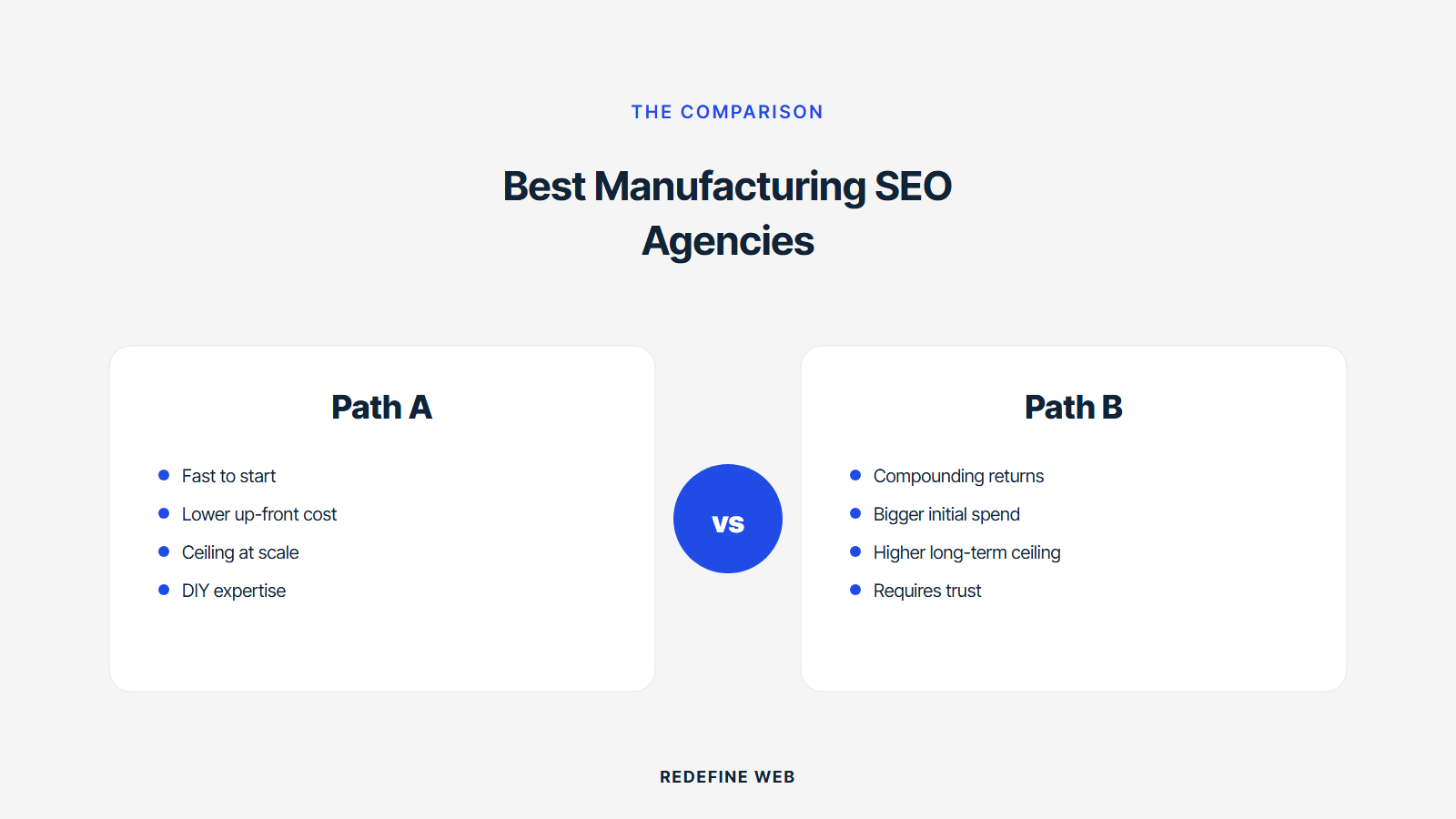
You’re about to commit six figures over two years. Slow down. Run one more checklist before you sign. This last pass catches the two or three details that get missed in the excitement of picking a finalist.
The final checklist. Do you have their scope in writing with clear definitions of deliverables. Have you called both references and confirmed the results in the case studies. Is the initial term six months or shorter with a rolling monthly thereafter. Does the contract specify data ownership (all your keyword research, content, and tracking accounts belong to you). Are the reporting cadence and metrics locked in the contract. Is the cancellation notice 30 days or fewer after the initial term. Do you have direct contact information for the account lead, not just the sales rep. And has the agency answered every question you had, or are there items still “we’ll get back to you” three weeks in.
Data ownership clause
Data ownership is the clause manufacturers most often miss. Your keyword research, content assets, backlink work, Google Search Console access, Google Analytics access, and tracking configurations all need to belong to you. Some agencies hold these hostage during a switch. The contract should specify that all data and assets belong to the client from day one, that the agency will transition full control at end of engagement with no additional fees, and that the client retains rights to reuse content produced during the engagement in any future work. Reference the Google Search Central blog for background on Search Console access and analytics ownership.
Kickoff plan for the first 90 days
Ask the agency to walk you through the first 90 days before you sign. What do the first 30 days look like (usually audit and strategy). What ships in days 31 to 60 (usually first content pieces and technical fixes). What ships in days 61 to 90 (usually first ranking movement and link acquisition results). If they can’t answer this clearly, they haven’t planned real work yet. If they can, use that plan as a milestone check-in at day 90. Either they hit their own plan or they don’t. Both answers tell you what to do next.
Where to start this week
Pick two agencies this week. Not five. Two. From the shortlist sources above. Book 45-minute sales calls with both. Run the seven questions on each call. Run the technical fluency test. Ask for a case study walkthrough. Ask for references and a sample report. Take notes so you can compare directly the next day. Two calls in one week produces a strong preliminary read.
Then request scope proposals from the finalist and one backup. Compare them on the rubric. Call the references. Read the sample reports. Make the decision. Sign. Get started with a clear 90-day plan and quarterly review cadence. The best manufacturing seo agencies work well when the client is engaged, decisive, and treats them as a real partner. Bring that energy and the engagement will produce. Our Manufacturing Marketing Agency Built for Industrial RFQs team runs this exact playbook. See our Manufacturing SEO Built for Real Buyer Searches page for the specific SEO service scope. For the strategy layer, the Search Engine Optimization Services retainer covers the technical, content, and link work. And if you’re weighing SEO against PPC for the same budget, the PPC for Manufacturers That Lowers Cost Per RFQ page walks the paid option. Reference the Moz beginners guide to SEO for third-party fundamentals to level-set with any finalist.
Frequently asked questions
What makes the best manufacturing seo agencies different from generalist agencies
Best manufacturing seo agencies specialize in industrial verticals with a majority of their book of business in manufacturing or B2B industrial. They can walk through ASTM standards, name three certifications your product needs, and rewrite a five-part spec query without prompting. Generalist agencies learn your industry on your dime, which means eighteen months of ramp before real results. Specialists deliver 3 to 5 times the qualified RFQs at the same retainer cost because their writers know the vocabulary, their link acquisition targets the right publications, and their content briefs speak the buyer's language from day one.
How much do top seo agencies for manufacturing companies charge
Top seo agencies for manufacturing companies charge $2,500 to $12,000 per month depending on your site size, product complexity, and target market breadth. Below $2,500 you get keyword research and a monthly report, not real content work. Above $12,000 you're paying for enterprise custom work like international expansion, multi-site consolidation, or ERP-to-PIM integration. Most manufacturers land in the $3,500 to $7,500 sweet spot. What each band buys differs by content volume, link acquisition depth, dedicated writer time, and account management structure. Ask for a scope breakdown with hours per deliverable so you can compare apples to apples.
How do I find the best seo agency for manufacturing for my specific subsector
Start with four sources for referrals. Ask your trade association who their member companies have used successfully. Ask your industry publication's ad sales rep who their advertisers hire for SEO. Ask two or three peer manufacturers in adjacent verticals (not direct competitors) who they work with. And look at the byline pages on industry publications like IndustryWeek, Design World, Machine Design, and Chemical Processing for agencies that have placed technical bylines for their manufacturing clients. Skip aggregator sites for primary shortlisting. Use them only for supplementary vetting once you have a shortlist of specialists.
What questions should I ask on a manufacturing SEO agency sales call
Ask these seven questions. Walk me through a case study for a client in a subsector similar to mine. What's your retainer structure and what happens if we add or remove scope. Who on your team will write the technical content and can I see their bylines. What does your link acquisition look like for an industrial manufacturer. How do you handle Product schema on a 500-SKU catalog. What's your reporting cadence and can I see a sample report. And how do you measure success (traffic, rankings, or RFQs and revenue). The last question tells you almost everything about who they'll be as a partner.
What red flags should I watch for when comparing top seo agency for manufacturing options
The red flags to watch. Guaranteed rankings in specific timeframes (nobody can honestly guarantee this). Traffic promises without any discussion of intent or conversion. Content plans that ignore your product taxonomy. Link building via undisclosed "our network of high-authority sites" (usually PBNs). No writer names or bylines provided. Reporting focused on impressions and visibility instead of RFQs. Contract terms that lock you in for 24 months minimum. Refusal to name their tools stack. And any agency pitching "AI-powered SEO" without being able to explain what that means technically. Two of these together and the agency isn't worth a second call.
Should I hire an SEO agency or build in-house SEO for manufacturing
Below $10M annual revenue, the agency is 3 to 5 times cheaper for equivalent output. Between $10M and $75M, run a hybrid model with one internal marketer plus an agency retainer. Above $75M, in-house makes sense if you can attract senior SEO talent. The math on hiring in-house: a senior technical SEO with industrial experience costs $130,000 to $200,000 loaded annually, equivalent to $10,000 to $16,000 per month in agency retainer. If you're spending less with an agency, agency wins. If more, in-house starts to make sense assuming you can hire and retain the right person. Turnover at 12 to 18 months makes the math worse than paper suggests.
Book your free 30-minute strategy call.
No spam, no sales rep. We use your email to schedule your call with a senior strategist. That is it.
More from the blog
View all articles → SEO
SEO Organic Search Engine Optimization Services That Grow Real Traffic
Read article SEO
SEO SEO for Pet Groomers That Fills the Appointment Book Weekly
Read article SEO
SEO