
SEO for pet groomers is a pure local map pack game with tighter margins than almost any other pet vertical. A grooming appointment averages $60 to $180, weekly capacity caps at the hours a chair stays full, and the physical service area rarely stretches past 6 miles from the salon. That math kills national SEO tactics before they start. Hyperlocal work is the only lever that fills the appointment book. Groomers competing on “pet grooming” as a national term burn budget for zero return. Groomers competing on “dog groomer near me” and “cat grooming [neighborhood]” fill weekdays that used to sit half empty.
This guide walks the local map pack work the vertical rewards. You’ll get the Google Business Profile depth checklist for grooming salons, the review workflow that pushes new profiles from 30 reviews to 250-plus inside a year, the service page structure that ranks for breed-specific and cut-specific queries, the appointment-driven landing page pattern, mobile booking details, and multi-location structure teardowns from four real pet businesses in our case library. Read straight through in fifteen minutes and you’ll know exactly which fixes to apply first. For the wider vertical view, our pet grooming marketing agency hub pairs with this one, our local SEO services page covers the retainer structure that runs the work, and our SEO services page covers the broader retainer options. For a look at the pet category beyond grooming, our pet services marketing hub covers vets, boarding, and retail, and our pet products marketing hub covers retail and D2C brands.
SEO for pet groomers is almost entirely a local map pack game
Roughly 85 to 92 percent of grooming search traffic in a mature account comes from queries with local intent. “Dog groomer near me,” “pet groomer [city],” “cat grooming [neighborhood],” and breed-plus-city queries dominate. Almost nobody searches “best national pet grooming service.” That skew changes what SEO for pet groomers actually needs to do. Rankings in the map pack (the three-result block that shows above organic results on mobile) drive 60 to 78 percent of clicks. Anything below the map pack on a “near me” query splits the remaining traffic across ten organic results plus paid ads. The map pack is the entire game.
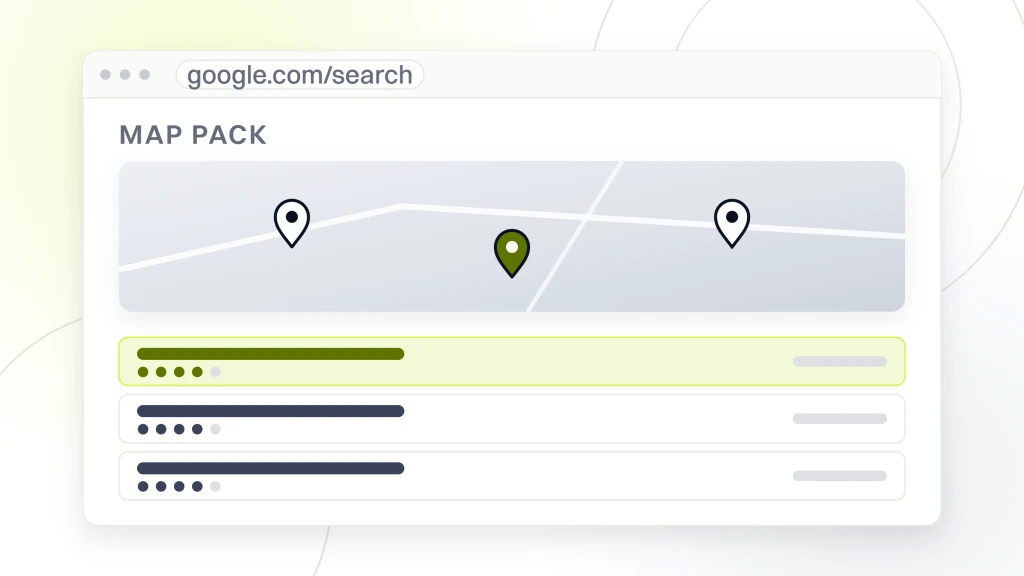
The proximity math sets a strict ceiling on how far a salon can reach. A groomer in a suburb rarely ranks in the map pack for a neighborhood 8 miles away regardless of SEO effort. Practical service radius runs 2 to 6 miles in most metros, tighter in dense cities. Groomers who accept the proximity constraint focus effort on the specific radius they can serve and outperform groomers who spread work across wider geography. Setting realistic expectations on the practical service radius stops wasted effort chasing rankings the proximity math won’t support.
What “map pack ranking” actually means for a grooming salon
Map pack ranking means the salon shows up in the three-result local pack on mobile, plus the associated Google Business Profile listing on desktop. The three-result pack captures 60 to 78 percent of local search clicks depending on query type. Position one in the pack captures roughly 44 percent of that share, position two around 30 percent, and position three around 26 percent. Ranking four or lower on the “See all” expanded map view drops share by 90-plus percent. The gap between position three and position four is one of the sharpest cliffs in local search, and closing it is what most SEO for pet groomers work is really about.
Why the “See all” expanded view rarely rescues position four
Searchers who click “See all” are already deep in comparison mode. Roughly 12 to 18 percent of local searchers ever expand the pack. The rest pick from the top three and move on. That means SEO for pet groomers work concentrated on cracking positions one through three delivers 5x to 8x the booking volume of work that gets a salon to position five or six. Effort inside the top three is high payoff. Effort past position four is low payoff. Every SEO for pet groomers plan should reflect that gap.
Google Business Profile depth is the single fastest SEO for pet groomers lever
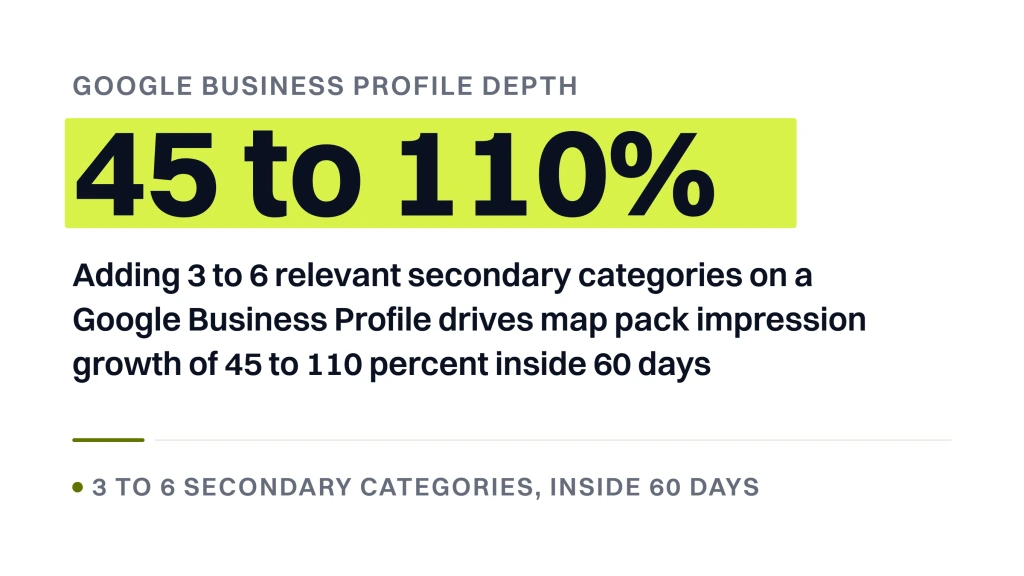
Google Business Profile category selection is the single highest-impact SEO for pet groomers move you can make in an afternoon. Every SEO for pet groomers program should start here before touching any other lever. Primary category should be Pet groomer or Dog groomer depending on service mix. Secondary categories should include Pet groomer, Dog groomer, Cat groomer if offered, Pet supply store if retail sits on-site, Pet training service if offered, and every other service the salon actually provides. Most groomers pick one category and stop, which caps map pack visibility. Adding 3 to 6 relevant secondary categories typically drives map pack impression growth of 45 to 110 percent inside 60 days. Google’s own Google Business Profile category documentation covers the current category list.
Beyond categories, the SEO for pet groomers work on GBP depth means services listed individually (dog grooming, cat grooming, nail trim, teeth brushing, de-shedding, breed-specific cuts), attributes filled out (wheelchair accessible, appointment required, women-led business where honest), 30-plus photos uploaded across facility, staff, and finished grooms, opening hours mapped precisely to reality including holiday exceptions, and messaging turned on with a two-hour response SLA. Salons that fill every field on the profile rank meaningfully higher than salons with the default 40 percent complete profile.
The 30-photo minimum most salons skip
Google Business Profile weights photo count and photo recency as a trust signal in local rankings. Profiles with 30-plus photos measurably outrank profiles with 5 to 10 photos even when other signals are equal. The specific pattern that works: 10 to 15 finished-groom photos (varied breeds, varied cuts), 5 to 8 facility photos (reception, grooming stations, drying area, retail if applicable), 3 to 5 staff photos with names, and a monthly cadence of 2 to 4 new photos to keep the profile fresh. Salons that upload once and never touch photos again typically see profile impressions decline 15 to 25 percent over 12 months.
Q&A and posts almost nobody uses
The Q&A section and the Posts feature on Google Business Profile are the two features almost no groomer uses and they both move rankings. Q&A lets you seed and answer common pre-booking questions (do you groom cats, do you handle aggressive dogs, do you require vaccination records) that surface directly on the profile. Posts let you publish weekly updates that show up in the map pack as recency signals. Salons running weekly posts and 5 to 10 seeded Q&A entries outrank comparable salons that ignore both features. This is the cheapest map pack gain on the list.
Adding 3 to 6 relevant secondary categories on a Google Business Profile drives map pack impression growth of 45 to 110 percent inside 60 days. Most groomers pick one category and stop, and this single missing move caps visibility across the entire local search surface.
Review generation cadence decides map pack position more than any other single factor
Review generation cadence decides map pack position more than almost any other SEO for pet groomers input once baseline profile work is done. Google’s ranking systems weight review volume and velocity heavily in local rankings, and grooming is a service where consistent monthly review flow separates the map pack winners from the also-rans. A groomer with 300-plus reviews at 4.7 stars consistently outranks a groomer with 40 reviews at 4.9 stars in the map pack. Volume signals sustained business activity more than raw average rating does.
The specific cadence that moves map pack rank for pet groomers is 12 to 30 new reviews per month, driven by a same-day request workflow after every appointment. The three-touch workflow that produces this cadence runs verbal request at pickup when the pet parent sees the finished groom, SMS review request within two hours of pickup with a direct one-click link, and a follow-up email at 48 hours if no review posted. Groomers running this three-touch workflow generate reviews at 20 to 38 percent of appointments. Groomers running only a post-visit email generate reviews at 3 to 7 percent. That 5x to 6x gap compounds into map pack rank movement inside 90 days.
Time the verbal ask to the reveal moment
Timing the verbal review ask to the reveal moment (when the parent sees the groomed pet for the first time at pickup) improves conversion sharply. Pet parents are typically emotional and appreciative at this moment because the groom looks better than expected. Asking for a review at that moment converts 40 to 60 percent higher than asking at any other point in the cycle. The phrasing that works is simple and direct. “We appreciate reviews on Google, would you mind leaving one when you have a minute today?” It references the current experience and gives permission to leave a review later that day.
SMS review requests should include the pet’s name
Include the pet’s name in every SMS review request. A generic “thanks for the visit” converts at 8 to 14 percent. A specific “thanks for bringing Bella by, we loved seeing her” converts at 22 to 35 percent because the message references the pet by name and pulls the parent back to the reveal moment. Pet management systems (Gingr, Pawfinity, Kennel Connection) store pet names and automate the personalization. Groomers who skip the pet-name reference give up the biggest single gain in the review workflow.
Service page structure that ranks for breed and cut-specific queries
Service page structure inside an SEO for pet groomers program decides whether a salon ranks for breed-specific and cut-specific queries alongside general grooming queries. Every service the groomer offers should have its own page. Dog grooming, cat grooming, breed-specific services (poodle grooming, doodle grooming, shih tzu grooming), specialty services (de-shedding, nail trimming, teeth cleaning, ear cleaning). Salons that lump everything into one Services page rank on almost nothing service-specific. Salons that build individual service pages with real depth rank on dozens of long-tail grooming queries.
The service page pattern that works runs 1,000 to 2,000 words per page covering what the service includes, breed-specific considerations where relevant, pricing ranges by pet size, appointment duration expectations, before-and-after photo examples, specific groomer credentials, and a FAQ block. Salons that publish at this depth rank on breed-plus-city queries (poodle grooming Austin, doodle grooming Brooklyn) that thin service pages miss entirely. Structural work at this level typically moves service-specific rankings inside 90 to 120 days and captures searchers with high booking intent.
Breed-specific pages rank faster than generic grooming pages
Breed-specific pages rank faster because search intent is tighter and competition is lower. A page titled “Poodle Grooming in [City]” ranks against 30 to 100 competing pages. A page titled “Dog Grooming in [City]” ranks against 500 to 5,000 pages. Groomers with genuine breed expertise (poodle specialists, doodle groomers, terrier specialists) should build breed-specific pages that surface the expertise and rank on breed-plus-location queries. Groomers with real breed specialization gain a durable edge from these pages that generic salons can’t match on page depth alone.
Cut-specific pages capture style query traffic
Cut-specific pages capture searchers looking for a named grooming style. Pages covering the puppy cut, the teddy bear cut, the lion cut for cats, and other named styles rank on style-specific queries with low competition and high booking intent. The pattern that works runs a page titled with the specific cut name plus location, content covering what the cut looks like, which breeds it suits, appointment duration, pricing considerations, and photo examples of the cut on various breeds. Groomers who build 3 to 6 cut-specific pages rank on style queries that catch shoppers with clear preferences and typically produce 8 to 15 percent higher booking conversion than generic grooming queries.
Appointment-driven landing page pattern that converts map pack traffic
The appointment-driven landing page pattern that closes the SEO for pet groomers loop designs the site around booking rather than browsing. Prominent booking button in the header on every page, phone number displayed for mobile visitors, service pages that end with a specific call to book, location pages that lead with the booking interface, homepage that surfaces available appointment times where the booking system supports it. Groomers that build for booking-first convert map pack traffic into appointments at 6 to 12 percent, versus 2 to 4 percent for sites built for browsing. That gap alone is the difference between a full book and a half-empty week.
The booking flow considerations that matter run mobile-optimized booking (75 to 90 percent of grooming search traffic is mobile), pet type and breed selection early in the flow, appointment duration estimation before the calendar view, and deposit or payment-at-booking options to reduce no-shows. Groomers using booking platforms (Gingr, Pawfinity, Kennel Connection, or dedicated grooming platforms) get most of these features out of the box. Groomers relying on phone-only booking miss the after-hours booking volume that captures roughly 30 to 45 percent of grooming appointments in mature booking systems.
After-hours booking captures volume phone-only groomers lose
After-hours online booking captures appointment volume that phone-only groomers miss entirely. Roughly 30 to 45 percent of grooming appointments in mature booking systems are booked outside standard business hours, typically between 6pm and 11pm as pet parents settle in for the evening and remember they need to book. Salons on phone-only booking lose most of that volume because the caller either forgets by morning or books with a competitor who took an online booking overnight. Turning on online booking usually grows monthly appointment volume 15 to 28 percent inside the first quarter.
Deposit at booking reduces no-shows 40 to 65 percent
Requiring a small deposit ($15 to $25) at booking reduces no-show rates from 12 to 22 percent down to 3 to 6 percent. The deposit isn’t about the revenue, it’s about the psychological commitment. Parents who put money down are 4x to 6x more likely to show up. Groomers reluctant to require deposits usually lose more revenue to no-shows in a month than the deposit friction costs them in lost bookings across a quarter. Every mature grooming operation runs a deposit or card-on-file requirement, and the ones that skip it pay for the skip every week.
Local citations and NAP consistency for pet groomers
Local citations (business listings across directories with the salon’s Name, Address, Phone number) provide the consistency signal that Google uses to trust the profile inside every SEO for pet groomers plan. Pet groomers need clean listings across the general local citation set (Yelp, Yellow Pages, Bing Places, Apple Maps, Facebook, Foursquare) plus pet-specific directories (Rover for boarding-adjacent groomers, PetCo Directory, PetSmart Directory in some markets, DogFriendly, BringFido, local rescue partnerships). Salons with 30-plus clean citations outrank salons with 5 to 10 messy citations even when GBP and reviews are comparable.
The NAP consistency piece matters more than most groomers realize. Any variance in how the name, address, or phone is written across directories weakens the trust signal. “Furry Friends Grooming” vs “Furry Friends Pet Grooming” vs “Furry Friends” across three directories creates three profile signals that Google struggles to consolidate. Groomers should audit every citation quarterly, fix any variance, and add 3 to 5 new relevant citations per quarter to keep the profile growing.
Pet-specific directories most salons never claim
Pet-specific directories carry disproportionate weight for grooming SEO because they signal to Google that the business genuinely operates in the pet category. BringFido, DogFriendly, PetHub, GroomerLister, and regional pet business directories all pass topical relevance signals that general directories don’t. Salons claiming and completing profiles on 6 to 12 pet-specific directories typically see map pack rank improvement of 1 to 3 positions inside 90 days, purely from the topical citation signal. This is invisible work most groomers never do and it moves rankings quietly.
Citation cleanup order that maximizes speed
Start citation cleanup with the top 8 citations by domain authority (Yelp, Yellow Pages, Bing Places, Apple Maps, Facebook, Foursquare, MapQuest, BBB), then move to pet-specific directories (BringFido, DogFriendly, PetHub), then to local city and neighborhood directories. Fix NAP variance on the top 8 first because those citations carry the most weight and any error there suppresses rank improvement across the wider set. Full citation cleanup for a grooming salon typically takes 4 to 6 hours of focused work and delivers rank improvement inside 60 to 90 days.
Content marketing that ranks for grooming queries beyond service pages
Content marketing inside an SEO for pet groomers program is not blogging for the sake of blogging. It is a small set of high-intent content types that rank on queries with real booking value. Breed care guides (poodle grooming schedule, doodle grooming frequency, shih tzu coat care), seasonal content (summer dog grooming tips, winter paw care), problem-solving content (how to handle a dog scared of grooming, first-time puppy grooming), and location plus service pages (dog grooming [neighborhood], mobile grooming [city]). Groomers publishing 2 to 4 pieces of this type per month rank on 40 to 120 additional long-tail queries per year.
The content types to skip are lifestyle blogging (top 10 cutest breeds), news posts (industry trends), and generic pet care content (how to bathe a dog at home). None of these produce bookings. They produce curious clicks that leave without engaging. The rule is simple. Every piece of content should target a query where a person searching it could plausibly want to book a groom, or want to learn something that leads to booking a groom. Content that fails that test costs writing time without producing appointments.
Breed care guides are the highest-yield content type
Breed care guides consistently outperform every other content type on booking intent. A well-written poodle grooming schedule page ranks on “how often should I groom my poodle” and dozens of related queries, then converts 4 to 8 percent of readers into an appointment inquiry via an embedded CTA and booking link. Groomers who publish breed care guides for the 8 to 12 most common breeds in their service area typically produce a stream of 5 to 15 booking inquiries per month from the guides alone. This is compounding organic traffic that builds a rank moat competitors struggle to catch.
Seasonal content that catches recurring intent
Seasonal content catches recurring intent spikes that hit predictably every year. Summer content (managing double-coated breeds in heat, paw pad care on hot pavement) ranks late spring through summer. Winter content (winter coat management, paw care on salted sidewalks) ranks fall through winter. Holiday content (holiday photo grooming, boarding-and-groom packages during travel weeks) ranks in November and December. Groomers who build a small library of seasonal content own the recurring traffic year after year, while groomers who skip seasonal content restart from zero every season.
Real pet business case studies from the Redefine Web library
Four pet-vertical case studies from the Redefine Web library map directly onto what SEO for pet groomers looks like at different scales. Each engagement below shows a different piece of the SEO for pet groomers program running against a real budget and a real time window. The Pet Shop · Puppies + Grooming · Singapore engagement is the closest match, and the on-page recovery work there translates almost line for line to what most single-location grooming salons need to do after a ranking dip. The Pet Shop · Independent Retail · UK program shows the mobile-first plus daily-social pattern that works for high-street pet businesses with retail plus service revenue. Mission Pet Health illustrates the multi-location paid-plus-organic pattern for network-scale pet operations. Pet Insurance Australia shows what the paid side of pet-adjacent search looks like at scale.
The Pet Shop · Puppies + Grooming · Singapore engagement ran on a $500 per month budget and delivered a 5x traffic recovery in 4 months (from 480 to 2,400 monthly visitors) after a Google Core Update wiped a chunk of the rankings overnight. The work stayed on the existing Weebly platform (no risky CMS migration during a Core Update recovery), reworked on-page structure using NLP-driven heading and density passes informed by competitor reverse-engineering, added intent-cluster sub-topics so each commercial page satisfied full search intent, built a mesh of internal links from supporting pages to commercial pages, added new dog-breed pages to deepen the topical cluster, and pointed targeted off-page authority with branded plus semantically relevant anchor text. The main commercial keyword climbed from page 3 back to mid-page 1 inside the four-month window.
The Pet Shop · Independent Retail · UK program delivered 158 percent growth in calls and WhatsApp inquiries, 212 percent growth in click-and-collect orders, and 47 percent growth in repeat-customer rate inside a single quarter, without growing team or ad spend. The rebuild was mobile-first WordPress with fast load, click-to-call plus WhatsApp plus reserve-and-collect CTAs above the fold on mobile. Google Business Profile was rebuilt for “pet shop near me” intent with NAP consistency across pet-trade directories. A review-velocity workflow at the till trained staff to prompt happy customers for reviews the same day via QR-card prompts. A daily Instagram plus Facebook cadence ran branded carousels, short tips, pet-of-the-week, and grooming before-and-after content. Limited-time bundles and stories drove week-on-week footfall and click-and-collect orders.
Mission Pet Health, a veterinarian-owned and operated network of 400-plus animal hospitals, replaced fragmented paid media with a scalable ROAS-aligned framework and grew leads 54 percent year over year, beat the 12-month return on ad spend goal by 74 percent, and gained 11 percent efficiency at scale while integrating new clinics. The work consolidated the account structure across 400-plus locations, layered in Performance Max plus Local Service Ads for higher-quality leads at lower cost per lead, aligned capacity-based budgets to match each hospital’s real appointment capacity, integrated financial plus marketing data for ROI-aligned budgeting, and standardized conversion tracking network-wide. This is what SEO plus paid at network-scale looks like for a multi-location pet operation.
Pet Insurance Australia produced 455 conversions in 5 months, an 8.87 percent click-through rate (vs 1 to 3 percent benchmark), a 31.06 percent conversion rate, and 1,132 percent return on ad spend inside a focused Google Ads program with keyword-focused ads, custom landing pages, remarketing, and continuous bid and ad-variation testing. The pattern that produced the outsize numbers was tight keyword targeting matched to user search behavior, conversion-tuned landing pages tied directly to ad keywords, re-engagement of close-to-conversion visitors via display plus social remarketing, and real-time tracking with clear performance dashboards. Not a grooming account, but the paid-search discipline maps directly onto how mature grooming salons should think about a paid layer once SEO baseline work has landed.
SEO for pet groomers pricing tiers and what each covers
Our SEO for pet groomers retainer tiers start at $999 per month, run through $1,499 and $2,499, and top out from $4,500 per month for multi-location groups and franchise networks. The $999 tier covers a single-location grooming salon with GBP work, monthly on-page passes on the top 6 to 10 pages, review workflow setup, monthly reporting, and quarterly strategy calls. The $1,499 tier layers in content production (2 to 3 breed guides or service pages per month), citation building and cleanup, and light off-page authority work. The $2,499 tier suits growing salons with 2 to 4 locations and adds multi-location schema, location-specific content production, and full off-page authority campaigns. The $4,500-plus tier suits franchise networks and multi-location groups with 5-plus locations and covers everything above plus account-level strategy work.
The tier math is straightforward. A US senior SEO specialist costs $70,000 to $110,000 in salary, roughly $7,000 monthly all-in with benefits, tooling, and PTO. The retainer tiers stay well under that number until the salon group grows into full-time SEO work, and that milestone typically arrives at the 5-location mark or when the network is generating $150,000-plus monthly revenue. Below that scale, the agency retainer wins on cost and depth of expertise. Above that scale, a hybrid model with in-house lead plus agency oversight often wins on speed and control.
What the $999 tier does not cover
The $999 tier does not cover paid search management, review platform subscription fees, off-page authority campaigns beyond light citation work, or content production beyond a monthly on-page pass. Salons that need those layers should start at the $1,499 tier where content and off-page work are included. Every proposal should spell out what the retainer includes and what it does not, and any tier positioned as covering everything at $999 monthly is usually cutting corners on either weekly cadence or actual work depth. Real SEO for pet groomers at $999 monthly is disciplined foundational work, not the full stack.
When to move from $999 to $1,499
The signal that a salon should move from the $999 to the $1,499 tier is when GBP work has landed (map pack rank in top 3 for primary queries), review cadence is running (15-plus per month), and the salon is ready to compound gains via content production and off-page authority. That milestone typically arrives inside 4 to 6 months on the $999 tier for a well-run salon. Salons that skip the foundational work and jump straight to the $1,499 tier without GBP and reviews in order waste 40 to 60 percent of the content and off-page budget on gains the foundation can’t hold.
Requiring a $15 to $25 deposit at online booking reduces no-show rates from 12 to 22 percent down to 3 to 6 percent. The deposit isn’t about the revenue, it’s about the psychological commitment. Parents who put money down are 4x to 6x more likely to show up on appointment day.
Multi-location SEO for pet groomers structure at franchise scale
Multi-location SEO for pet groomers changes the structure of the work in three specific ways. Every location inside the SEO for pet groomers program gets its own Google Business Profile with its own review flywheel and its own citation set. Every location gets its own location page on the site with location-specific content, staff photos, and reviews embedded. And schema markup uses LocalBusiness plus additionalProperty at the location page level, not at the domain level. Franchise networks that try to run one profile and one location page for the whole network rank on almost nothing outside the flagship city.
The Mission Pet Health case (400-plus veterinary locations) illustrates the pattern at scale. The account structure consolidated to eliminate fragmentation, capacity-aligned budgets matched each hospital’s real appointment capacity, conversion tracking standardized across the network, and location-level reporting gave each hospital manager the numbers that mattered for their location. The 54 percent lead growth and 74 percent ROAS goal beat came from that structural discipline, not from magic. Franchise grooming networks like Splash and Dash, Aussie Pet Mobile, and Camp Bow Wow’s grooming arm that run this pattern outperform franchise networks that let each location manage its own SEO with no shared standards.
Location page depth that ranks per city
Every location page needs 800 to 1,500 words of location-specific content. Neighborhoods served, driving directions from major landmarks, staff at that location with photos and names, reviews embedded from that specific location’s Google Business Profile, location-specific service pricing where it varies, and location-specific FAQ content. Location pages that copy-paste the same content across cities with only the city name swapped get treated as thin content and rank on almost nothing. Location pages with real depth rank on city-plus-service queries and produce steady booking inquiries for each location individually.
Schema markup pattern for multi-location grooming
Schema markup for multi-location grooming uses LocalBusiness or PetStore schema at each location page level, plus Organization schema at the domain level. Each location page schema block includes the specific address, geo coordinates, opening hours for that location, service area radius, and aggregate review rating pulled from that location’s Google Business Profile. Salons using this pattern show up in local knowledge panels and rich results at the city level. Salons using only domain-level schema miss city-level rich results entirely and rank one to two positions lower on average across the network.
What good SEO for pet groomers looks like at 90 days, 6 months, and 12 months
At 90 days into a well-run SEO for pet groomers program, expect map pack rank movement of 1 to 3 positions on primary queries, review count growth of 30 to 60 new reviews, and GBP impression growth of 40 to 90 percent. This first-quarter SEO for pet groomers scorecard is where the foundation shows up. Organic traffic to the site typically shows 15 to 30 percent growth in this window, driven mostly by GBP work rather than site content changes. The site work started at 90 days shows up in rankings from month 4 onward, so the 90-day scorecard is heavily weighted toward local signals and reviews rather than organic search traffic to the site.
At 6 months, expect map pack rank in top 3 for primary “near me” and “city + service” queries, review count of 100 to 200 depending on baseline and monthly volume, service page rankings on the first page for breed-specific and cut-specific queries, and site traffic growth of 60 to 120 percent versus baseline. Monthly booking inquiries from organic search typically show 40 to 90 percent growth by month 6. At 12 months, expect map pack rank locked in top 3 across the full primary query set, review count of 250 to 400, first-page rankings on 30 to 80 additional long-tail grooming queries, and site traffic growth of 150 to 300 percent versus baseline.
What underperforming programs look like at each milestone
An underperforming program at 90 days shows no map pack rank movement, review count growth under 15 new reviews, and GBP impression growth under 20 percent. That pattern means the agency is running monthly account glances instead of weekly work. An underperforming program at 6 months shows map pack rank still outside the top 3, review count under 60, and site traffic growth under 30 percent. That pattern means the retainer is being under-serviced or the tier is too low for the actual work required. Reviewing the last four Monday work notes and the last two on-page content pieces published usually surfaces which of the two is happening.
When to change agencies vs when to hold
Hold the current SEO for pet groomers agency when milestones are being hit and monthly reports show real work. Change agencies when 6-month milestones miss by more than 40 percent, when monthly reports pivot from booking-adjacent metrics (map pack rank, reviews, GBP impressions) to vanity metrics (backlinks built, blog posts published), or when the salon owner cannot get a straight answer on what happened in the account in the last two weeks. The switching cost is typically 60 to 90 days of momentum, so the change should only happen when the current arrangement is clearly failing rather than merely slower than hoped.
Should SEO for pet groomers live in-house or at an agency
Every owner eventually asks whether SEO for pet groomers should live internally or at an agency. The honest SEO for pet groomers answer sits at the intersection of location count, the owner’s technical appetite, and whether the operation has the volume to keep a specialist busy year-round. Below 2 locations, an agency retainer wins on cost and depth. Between 2 and 4 locations, an agency retainer with a tight monthly cadence still wins for most operations. Above 5 locations or franchise scale, a hybrid model with an in-house lead paired with agency oversight often produces the best balance of speed and control.
The hidden cost of running SEO for pet groomers in-house shows up in tooling. A serious SEO stack (rank tracking, content audit, citation management, review platform, GBP monitoring) runs $400 to $1,200 monthly on top of the specialist’s salary. Agencies spread that cost across the retainer book and pass through pricing that a single salon cannot match on its own. Add in the coverage risk (vacation, illness, resignation) and the agency model usually wins on total cost until the salon group is large enough to hire a two-person SEO team with proper backup coverage. Most single-location and small-group grooming operations never hit that threshold.
Locking in SEO for pet groomers that compounds bookings
An SEO for pet groomers program that compounds bookings comes down to six SEO for pet groomers patterns you can audit against any current arrangement. Fill Google Business Profile depth completely (categories, services, attributes, 30-plus photos, weekly posts, seeded Q&A). Run a same-day three-touch review workflow producing 12 to 30 reviews monthly at 20 to 38 percent request-to-review conversion. Build individual service pages for each service, breed specialty, and named cut, each at 1,000 to 2,000 words. Design the site around booking (mobile-optimized flow, phone number in header, deposit at booking). Maintain clean citations across 30-plus general and pet-specific directories with NAP consistency. And publish 2 to 4 pieces of intent-matched breed care, seasonal, and problem-solving content per month.
The Pet Shop · Puppies + Grooming · Singapore engagement delivered 5x traffic recovery in 4 months on a $500 per month budget. The Pet Shop · Independent Retail · UK program delivered 158 percent growth in calls, 212 percent growth in click-and-collect, and 47 percent growth in repeat customers inside a single quarter. Mission Pet Health delivered 54 percent lead growth across 400-plus locations. Pet Insurance Australia delivered 1,132 percent return on ad spend on paid. Every program started with the same fundamentals. Real conversion tracking, clean foundation work, and content that matches searcher intent. If the salon needs help running the work, our full-service SEO for pet groomers program covers GBP, reviews, service pages, citations, and content end to end. Retainer tiers run $999, $1,499, $2,499, and from $4,500 monthly, covering single-location salons through franchise networks. Book a call and we’ll walk the last four pet-vertical accounts we restructured end to end.
do you tip pet groomers+
Yes, tipping pet groomers is standard practice in the US and Canada at 15 to 20 percent of the groom price for good work, and 20 to 25 percent for exceptional work with a difficult pet, a matted coat that took extra time, or a specialty cut. On a $65 dog groom, that’s $10 to $13. On a $120 doodle groom, that’s $18 to $30. Tips are cash-preferred at most salons but card-based tipping is now common through booking platforms like Gingr and Pawfinity. Mobile groomers, salon owners, and independent groomers all accept tips. Skipping the tip on a well-executed groom reads as dissatisfaction, so tip even a small amount if service was acceptable and use direct feedback instead of tip withholding when service missed the mark.
do pet groomers get tips+
Yes, pet groomers get tips at the vast majority of grooming appointments in the US and Canada. Roughly 65 to 80 percent of appointments include a tip in mature grooming markets, with average tip percentages running 15 to 22 percent of the groom price. Corporate salons (PetSmart, Petco) pass tips through fully to the groomer via the point-of-sale system. Independent salons handle tips either as cash direct to the groomer or as a card tip on the salon terminal that gets paid out on the next paycheck. Mobile groomers keep tips directly. Tips are a meaningful part of grooming income, often adding $8,000 to $18,000 annually on top of base earnings depending on client volume and average tip size.
is there a demand for dog groomers+
Yes, demand for dog groomers exceeds supply in most US and Canadian metros as of 2026. Pet ownership rose sharply through the pandemic and stayed high, and the American Pet Products Association tracks 66 percent of US households owning a pet. Most metros run wait times of 2 to 5 weeks for a first-time appointment at established salons, and monthly repeat-client scheduling often runs full 90 days out. Salaries for staff groomers run $35,000 to $60,000 in most markets, with senior stylists and mobile groomers earning $65,000 to $110,000-plus. Salon owners with 3 to 6 chairs typically clear $150,000-plus in owner draw once the operation is mature. Demand is durable and salon capacity is the binding constraint, which is exactly why SEO for pet groomers work that fills the appointment book is high payoff.
How to get clients as a new dog groomer?+
New dog groomers get clients through a specific three-part sequence. First, claim and complete Google Business Profile to 100 percent (categories, services, attributes, 30-plus photos, opening hours). Second, run a review-generation push in the first 90 days targeting 40 to 60 reviews from friends, family, and initial clients to build baseline trust signal. Third, publish 5 to 8 service pages covering the specific services offered plus 3 to 5 breed-specific pages for the most common breeds in the service area. Layer in a small Google Ads test at $300 to $600 monthly targeting “dog groomer near me” and “[city] pet grooming” while SEO builds. New groomers who run this sequence typically hit 40 to 80 monthly appointments inside 6 months. Groomers who skip GBP work or reviews stall at 10 to 20 monthly appointments for a year or more.
How do I make my dog grooming business stand out?+
Dog grooming businesses stand out through visible specialization, not through generic quality claims. Specialization means either breed focus (poodle specialist, doodle groomer, terrier specialist), service focus (mobile grooming, cat grooming, senior pet grooming), or experience focus (fear-free certified, anxiety-management specialist). Every element on the site and profile should surface the specialization. Photos of the specialty breeds, service pages for the specialty services, reviews mentioning the specialization, and content that ranks on specialty queries. Salons that market as “quality dog grooming” compete on price and rank on generic queries. Salons that market as “poodle grooming specialist in [city]” own a specific query set, command premium pricing (typically 25 to 45 percent above generic salons), and fill the book with parents who value the specialization enough to travel and pay more.
What is the target market for dog grooming?+
The target market for dog grooming is dog-owning households within 2 to 6 miles of the salon, skewed toward breeds that require regular professional grooming (poodles, doodles, shih tzus, bichons, terriers, spaniels, and other double-coated or specialty-coat breeds). Household income skews middle to upper-middle ($65,000-plus household income buys grooming regularly, sub-$45,000 households groom occasionally). Age skews 35 to 65 with peak buying in the 45 to 55 range. Geographic density matters more than absolute market size. A dense suburban zip code with 8,000 households and 40 percent dog ownership supports 2 to 4 grooming salons. A rural zip code with 12,000 households and 60 percent dog ownership supports 1 to 2. SEO work should target the tight geographic radius where the target market actually lives.
How much does SEO for pet groomers cost per month?+
SEO for pet groomers retainer pricing typically runs $999 monthly for single-location salons on foundational GBP plus review work, $1,499 monthly with content production and citation building layered in, $2,499 monthly for growing salons with 2 to 4 locations and full off-page authority campaigns, and from $4,500 monthly for franchise networks with 5-plus locations. Ad spend for paid layers is billed separately. The $999 tier fits a single-location salon working through the first 6 months of foundational work. The $1,499 tier suits salons ready to compound gains after foundation work has landed. Retainers below $299 monthly usually mean the account gets a monthly glance rather than weekly work, which produces the drift pattern (map pack rank stalling, review cadence stagnating) most owners eventually notice as flat booking growth.
How long does SEO for pet groomers take to show results?+
SEO for pet groomers shows first visible results inside 30 to 60 days via Google Business Profile impression growth and early review cadence. Map pack rank movement of 1 to 3 positions typically lands inside 90 days on well-run programs. First-page rankings on breed-specific and cut-specific service pages typically land inside 4 to 6 months. Full program maturity (map pack top 3 across the primary query set, 250-plus reviews, first-page rankings on 30 to 80 long-tail queries) typically lands inside 12 months. Salons that expect map pack top 3 inside 30 days are setting themselves up for disappointment. Salons that stay disciplined on GBP work, reviews, and monthly content typically hit 6-month milestones cleanly and 12-month milestones with room to spare, then compound from there.
Do pet groomers need a website if Google Business Profile is complete?+
Yes, pet groomers need a website even with a complete Google Business Profile. Google Business Profile drives map pack visibility but converts at 6 to 12 percent when the click lands on a well-built booking-focused site, versus 3 to 6 percent when the click lands on a thin site with no service pages, no photos, and no booking flow. The website is where the map pack traffic actually converts into appointments. Service pages rank on breed-specific and cut-specific queries the profile cannot rank on directly. Content marketing needs a home. Reviews embedded on location pages compound trust signal. Salons running GBP-only lose 30 to 55 percent of potential bookings to competitors with the same map pack position and a stronger site behind the click.