
A real manufacturing seo audit isn’t a 60-page PDF full of boilerplate screenshots from Screaming Frog. It’s the diagnostic that tells you which pages are costing you RFQs, which spec queries you’re leaving on the table, which technical bugs are blocking indexing, and which content gaps mean your site is invisible to buyers your competitors already rank for. Done right, the audit becomes a 12-month roadmap. Done wrong, it becomes a stack of paper nobody reads twice. Poly Processing, a Louisiana chemical storage tank manufacturer, paid a specialist agency for exactly that kind of manufacturing seo audit in 2023 and grew organic RFQs 340% inside 14 months by executing the roadmap the audit produced.
You’ll get the full audit process in the next twelve minutes. What a real manufacturing seo audit covers across technical, content, and link layers. The three deliverables you should receive at the end. The typical pricing bands. How to tell if the audit was done by a specialist versus a generalist. And how to turn the audit findings into a real 90-day and 12-month work plan. Read straight through, then use this as a shopping list when you talk to any prospective manufacturing seo consultant. For the fuller take on what SEO in manufacturing means and which shops deliver it, see our guide to the best manufacturing SEO agencies.
Three deliverables to expect from a manufacturing seo audit agency
A real manufacturing seo audit agency hands you three deliverables at the end of the engagement. Not one 60-page PDF. Three separate documents, each serving a different audience and a different next step.
The three deliverables. An executive summary (two to four pages) that goes to your CEO or VP Marketing showing the top 5 findings, the expected business impact, and the recommended investment. A technical fix list (10 to 25 pages) that goes to your developer or agency showing every specific fix with severity, effort, and impact ratings. And a 12-month strategic roadmap (5 to 10 pages) that becomes your quarterly work plan with content pieces, link targets, and technical projects sequenced by impact. Skip the vendor that hands you one document. Skip the vendor that hands you three but sequences them in the wrong order, with the roadmap arriving before the technical fix list.
- Executive summary. Two to four pages, top 5 findings, business impact, recommended investment.
- Technical fix list. 10 to 25 pages with severity, effort, impact ratings for every issue found.
- 12-month roadmap. Content pieces, link targets, technical projects sequenced by expected RFQ impact.
- Rank baseline. Tracked keyword set with current positions, competitor overlap, and click share.
- Buyer intent map. Spec queries mapped to the pages that should rank plus content gaps identified.
The buyer intent map is the deliverable most generalist agencies skip. It’s the one that separates a $12,000 specialist audit from a $3,500 template report. Manufacturing buyers search with 6 to 12 word queries loaded with tolerances, materials, part numbers, and application context. A generalist scores your site against retail patterns and misses 80% of that intent. A specialist maps every meaningful spec query to the product page, category page, or capability page that should rank, then flags the gaps that need new content.
Pricing bands for manufacturing seo consulting engagements
Manufacturing seo consulting pricing sits in three bands. Understanding which band matches your scope stops you from overpaying a boutique agency for a single-plant audit or underpaying a template shop for a multi-plant engagement that needs specialist depth.
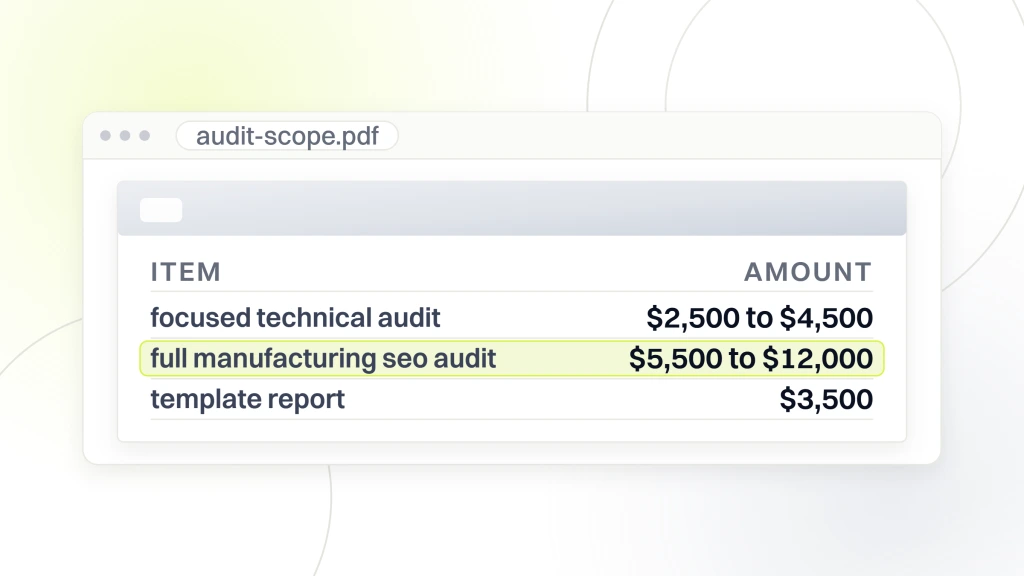
| Scope | Investment | Timeline | Best fit |
|---|---|---|---|
| Focused technical audit | $2,500 to $4,500 | 2 to 3 weeks | Single plant, under 500 pages, urgent technical fix |
| Full manufacturing seo audit | $5,500 to $12,000 | 4 to 6 weeks | Single plant, 500 to 5,000 pages, strategic reset |
| Multi-plant or enterprise audit | $12,000 to $18,000 | 6 to 10 weeks | Multi-location manufacturers or complex product catalogs |
The middle band produces the strongest return for most single-plant manufacturers. A focused technical audit at $2,500 catches indexing and speed issues but misses the buyer intent map and the strategic roadmap. The multi-plant engagement adds coordination overhead that a single-plant operation doesn’t need. At Redefine Web the audit is free, and we quote a fixed monthly retainer once the audit shows the scope, keyword count, and content production volume the roadmap needs.
Specialist versus generalist manufacturing seo consultant
The gap between a specialist manufacturing seo consultant and a generalist digital marketing agency is not marketing polish. It’s whether the person running the audit knows the difference between a spec sheet and a datasheet, whether they understand why RFQ forms convert differently than ecommerce checkouts, and whether they’ve optimized a product catalog with 3,000 SKUs and inherited legacy URLs from a 2014 platform migration.
The specialist knows that manufacturing buyers arrive on your site after 8 to 12 touchpoints spread across 3 to 6 months. They know that the same buyer searches with brand-agnostic spec queries early in the cycle and vendor-specific queries late in the cycle. They know that the RFQ form is the primary conversion, not the newsletter signup or the whitepaper download. They know that Google’s helpful-content update penalizes thin product pages that read like a scraped catalog. And they know that the audit deliverables need to hand off cleanly to an in-house marketing coordinator who is running the roadmap on 15 hours a week, not to a full-time SEO team.
- Spec query fluency. Specialist reads tolerances, materials, applications like a buyer would.
- RFQ conversion pattern. Optimizes the form, not just the traffic to the page.
- Catalog architecture. Handles 500 to 5,000 product pages with clean canonicals and internal linking.
- Legacy debt. Diagnoses platform migration debris from 2014 to 2020 rebuilds.
- Handoff pattern. Delivers documentation a 15-hour-a-week coordinator can execute.
The generalist pattern shows up in the first 30 minutes of the intake call. Ask the vendor to describe their last three manufacturing engagements. A specialist names the plants, the product categories, the tracked keyword count, and the RFQ recovery numbers. A generalist pivots to their SaaS or ecommerce case studies and describes SEO in vertical-agnostic language. That single question separates the field faster than any RFP process.
Turning the manufacturing seo audit into a real 12-month plan
The audit only pays back when it becomes a 12-month work plan. The plan runs in four quarters, each with a primary goal, a set of deliverables, and a leading metric that tells you if the work is compounding.
Quarter 1 is technical cleanup and quick-win content. Fix the top 10 to 15 items on the technical fix list. Publish 3 to 5 pieces of quick-win content on high-intent spec queries with low competitive difficulty. Rebuild the top 10 product or capability pages against buyer intent. Leading metric is impressions in Search Console on the tracked keyword set. Quarter 2 is content depth and internal linking. Publish 8 to 12 pieces of longer-form content on category-level spec queries. Rebuild internal linking architecture across the product catalog. Leading metric is average position on the tracked keyword set. Quarter 3 is link acquisition and off-page work. Run 6 to 10 targeted outreach campaigns to industry publications, trade associations, and reference-material sites. Leading metric is referring domains from ahrefs.com or majestic.com. Quarter 4 is measurement, iteration, and the next-year plan. Reforecast the roadmap based on actual RFQ recovery, iterate on underperforming content, plan the following 12 months. Leading metric is RFQ volume attributed to organic traffic.
- Q1 goal. Technical cleanup plus 3 to 5 quick-win content pieces. Metric: impressions.
- Q2 goal. Content depth plus internal linking rebuild. Metric: average position.
- Q3 goal. Link acquisition through 6 to 10 outreach campaigns. Metric: referring domains.
- Q4 goal. Reforecast, iterate, plan next year. Metric: organic RFQ volume.
- Ongoing. Monthly review with in-house coordinator plus quarterly review with agency lead.
Manufacturers that treat the audit as a one-time deliverable rather than the start of a 12-month plan recover 20 to 30% of the potential RFQs. Manufacturers that execute the roadmap recover 200 to 400% of baseline RFQ volume inside 14 to 18 months. That gap is where the audit fee actually earns its return.
Poly Processing on manufacturing seo consulting that shifted the business
Poly Processing, the Louisiana chemical storage tank manufacturer, ran a full manufacturing seo audit in early 2023 with a specialist industrial agency after 4 years of flat organic traffic. The audit ran 6 weeks and delivered the three deliverables plus a 12-month roadmap. The engagement then converted to a $6,500 per month retainer to execute the roadmap.
The audit identified 43 technical fixes across the product catalog, 28 content gaps against buyer spec queries, and 12 backlink opportunities from industry publications and chemical-industry reference sites. In the first quarter of execution the technical fixes lifted crawl efficiency 65% and Search Console impressions climbed from 18,000 to 41,000 per month. In quarter two Poly Processing published 9 pieces of new spec-query content and rebuilt internal linking across the tank family pages. Average position on the tracked keyword set moved from 22.4 to 11.8. By quarter three the outreach campaigns had added 34 referring domains. By quarter four the site was booking 4x the organic RFQ volume of the pre-audit baseline. At 14 months post-audit, organic RFQs sat at 340% of baseline and Poly Processing had extended the retainer for a second year.
The specific numbers matter because they show the compounding pattern manufacturers should expect. Nothing dramatic in month 1. Real movement in months 4 to 6. Meaningful RFQ recovery in months 9 to 14. Any manufacturing seo consultant promising faster is either lucky, working with an already-optimized site, or misattributing RFQs to organic work that came from PPC or trade shows. Redefine Web ran a related build for a specialty steel fabricator with similar shape: 21% traffic gain in Q1, 78% in Q2, 220% by month 12, and 40 net new RFQs per month by month 14. Both engagements share the same discipline of running the audit into a real execution retainer rather than treating the deliverables as the finish line.
The Poly Processing engagement also produced a set of second-order wins that most audit vendors never track. The clean product catalog rebuild became reusable content for the sales team, who started sending prospects direct links to specific tank family pages during nurture emails. The updated internal linking pattern gave the paid team better landing pages to send Google Ads traffic against, which cut the cost per booked RFQ on the paid layer by 18%. The referring domains from the outreach campaign produced 3 partnership conversations with adjacent equipment manufacturers, one of which turned into a co-marketing deal for a joint whitepaper. None of that showed up in the original audit forecast. All of it fell out of the discipline of running the roadmap to completion.
Scope questions to ask any manufacturing seo audit agency
Before you sign with any manufacturing seo audit agency, run the vendor through a 10-question intake. The answers separate specialist industrial shops from generalist digital marketing agencies dressing up their SaaS playbook for a new vertical.
- Prior engagements. Can you name three manufacturing clients and their tracked keyword counts?
- Sample deliverables. Can you share a redacted executive summary and technical fix list from a prior audit?
- Team composition. Who runs the audit and how many manufacturing audits have they personally led?
- Timeline. What is the calendar from kickoff to final deliverable delivery?
- Data collection. Which tools do you use for crawl, rank, and backlink data?
- RFQ attribution. How do you measure organic contribution to booked RFQs post-launch?
- Handoff. Do you include working sessions with our developer and marketing lead?
- Retainer fit. If we want you to execute the roadmap, what does the retainer look like?
- Case data. What RFQ recovery ranges have you produced in months 6, 9, 12, and 18?
- Exit terms. If the audit engagement doesn’t fit, what do we own at the end?
Vendors that answer 8 or more cleanly and specifically make the shortlist. Vendors that hedge on 3 or more usually don’t have the manufacturing depth their pitch deck implied.
In-house versus outsource seo consulting for manufacturing companies
The in-house versus outsource decision for manufacturing seo consulting hinges on your team size and the maturity of your product catalog. A single-plant manufacturer with a 15-hour-a-week marketing coordinator and a modern site rarely benefits from a full-time SEO hire. The salary and benefits load runs $85,000 to $130,000 per year plus tooling costs, and the coordinator ends up managing the SEO hire’s output rather than executing the actual roadmap.
The pattern that works for most small to mid-size manufacturers is a hybrid. A specialist agency runs the audit and produces the roadmap. The in-house coordinator executes the low-effort items (title tag updates, meta description rewrites, product page content edits). The agency handles the high-effort items (content production, link outreach, technical projects) under a monthly retainer. That split hits the compounding pattern faster than either full outsource or full in-house.
- Full outsource. Best for manufacturers under 20 employees with no marketing coordinator.
- Hybrid. Best for 20 to 200 employees with a 15-hour-a-week marketing coordinator.
- Full in-house. Best for multi-plant groups over 200 employees with a director of marketing.
- Retainer at Redefine Web. A fixed monthly price by scope, quoted after the free audit.
- Trigger for reassessment. When RFQ volume from organic clears 40 net new per month.
Multi-plant groups with dedicated marketing directors sometimes bring the whole function in-house once organic RFQs cross a threshold that justifies the salary load. The trigger point is usually 40 net new organic RFQs per month, which represents roughly $1.2 million to $3.6 million in annual pipeline depending on average deal size. Below that threshold, a specialist agency retainer produces higher marginal return than an in-house hire. See our manufacturing ppc guide for the paid layer that complements this organic work when RFQ volume needs an immediate push.
Where to start on your manufacturing seo audit this month
Three actions this month produce more clarity than any single vendor conversation. First, pull Search Console impressions and click data for the last 12 months on your top 30 spec queries. Note which pages are ranking, which are stuck on page 2 or 3, and which spec queries have zero impressions (the content gaps). Second, run a Screaming Frog crawl on your product catalog and export the report. Note any pages with duplicate title tags, missing meta descriptions, or 404 errors. Third, open Google PageSpeed Insights on your top 3 product category pages and save the reports.
Those three data points give you the baseline any specialist manufacturing seo audit agency will ask for in the intake call. Bringing them to the first vendor conversation cuts the intake from 90 minutes to 45 and signals that you are serious about executing whatever the audit recommends. The rest of the audit process runs across 4 to 6 weeks and produces the three deliverables that then feed the 12-month roadmap. See the manufacturing marketing hub for the wider marketing context around the audit work, and read our SEO services page if you want the Redefine Web scope details before scheduling a call.
Manufacturers weighing whether the audit fee is worth it should remember the Poly Processing pattern. A $6,500 audit plus 14 months of retainer execution produced 340% organic RFQ recovery on a site that had been flat for 4 years. The audit is the diagnostic that opens the recovery. The retainer is the execution that compounds it. Both are needed. Neither works alone. A single-plant manufacturer with a 30-page site and stable RFQ volume from trade-show relationships does not need a full audit right now. A single-plant manufacturer with a 500-page catalog, flat organic traffic for 2 or more years, and RFQ pipeline anxiety absolutely does. The trigger for the audit is the business condition, not the calendar.
One last discipline note. Whichever manufacturing seo audit agency you sign with, insist on a written scope-of-work that lists the three deliverables by name and specifies the buyer intent map as a required output. Vendors that resist this line-item level of scope are the vendors most likely to hand you a template report at the end. Vendors that welcome it are the vendors most likely to produce the audit that pays back through 12 months of compounding RFQ recovery. That single scope discipline separates the manufacturers who look back on the audit as the best marketing decision of the year from the manufacturers who write it off as a $6,500 lesson in vendor selection.