
Best Marketing Channels for Med Spa Advertising Ranked by ROI
- Google Search Ads wins on cost per booked med spa consult.
- Google Business Profile produces free bookings from near-me searches.
- Email marketing lifts patient LTV by $2,800 to $6,400 across retention cycles.
- Referral programs deliver patients at $25 to $85 per new booking.
- Beauté Aesthetics New York compounded 166% lead growth on four channels.
- Meta advertising among the best marketing channels for med spa advertising
- Beauté Aesthetics New York across best marketing channels for med spa advertising
- Referral programs among the best marketing channels for med spa advertising
- TikTok among best marketing channels for med spa advertising
- Influencer partnerships close the best marketing channels for med spa advertising
- Sequencing the best marketing channels for med spa advertising by month
- Mistakes across best marketing channels for med spa advertising
- Budget mix across best marketing channels for med spa advertising
- Wrapping up the best marketing channels for med spa advertising guide
Best marketing channels for med spa advertising split into seven working plays that produce measurable booked treatments and repeat visits. Google Search Ads pulls patients already researching Botox, filler, laser hair removal, and body contouring. Google Business Profile plus local SEO catches map-pack searches at the exact moment somebody types med spa near me. Meta ads (Instagram plus Facebook) run before-and-after campaigns on treatments that photograph well. TikTok reaches younger patients booking their first tox or lip filler consult. Email marketing keeps existing patients booking retreatments on the twelve-week Botox cadence and quarterly filler touchups. Referral programs turn one paying patient into two or three across 90 days. Influencer partnerships open new patient pools through local trust rather than paid reach.
You’ll see the seven channels ranked by cost per booked consult and LTV per channel, monthly costs, which channels launch first versus layer in month six, plus how Beauté Aesthetics New York rebuilt a compounding booking engine on this stack. Read the sections before signing your next med spa marketing plan or renewing a channel that has never hit target on cost per booked patient.
The twelve-week Botox cadence email sequence
Working Botox retention email sequences run three touches across the twelve-week retreatment window. Touch one at week 8 post-treatment shares a wear-and-tear reminder plus a booking link with the patient’s usual injector. Touch two at week 10 offers a specific reminder that Botox typically starts fading around week twelve to fourteen. Touch three at week 12 sends a same-week booking incentive if the patient has not yet rebooked. Working accounts hit 55 to 72 percent retreatment book-rate on this cadence versus 28 to 40 percent on accounts that send zero retention emails between visits.
Segmentation across five patient categories
Med spa email marketing works best with five patient segments. Active regulars on twelve-week Botox cycles. Filler patients on quarterly touchup schedule. Laser and body contouring package holders mid-plan. Newsletter-only leads who have never booked. Lapsed patients who stopped booking after two or more visits. Each segment gets its own working sequence tied back to the practice site through the med spa web design foundation. Blast the same monthly newsletter to all five segments and expect roughly 35 percent of the possible response rate you could have earned on a working segmented cadence across a twelve-month cycle.
Meta advertising among the best marketing channels for med spa advertising
Meta advertising sits mid-pack among the best marketing channels for med spa advertising because it works well on new-patient acquisition for photogenic treatments and works poorly on high-consideration treatments like coolsculpting or body contouring packages. Instagram plus Facebook ads produce $95 to $260 per booked consult on lip filler, Botox, hydrafacial, and laser hair removal. Meta produces $210 to $520 per consult on higher-consideration treatments. The delta comes from creative fit. Photogenic treatments show well in feed. Multi-session body contouring packages need copy explanation that scroll-past behavior kills before the value lands.
Instagram Reels versus feed ads on cost per consult
Instagram Reels ads for med spas produce 2x to 3x the click-through rate of static feed ads and 40 to 60 percent lower cost per booked consult. The math holds across treatments that photograph or video well: injector technique reels, coolsculpting timelapse videos, laser treatment day-of footage, and before-and-after transitions. Static feed ads still work as a retargeting layer for site visitors who did not book on first visit. Reels for cold acquisition, static for warm retargeting. Working accounts split 65 percent of Meta budget to reels and 35 percent to static retargeting across the working 90-day launch window.
HIPAA-safe creative for Meta ads
HIPAA-safe creative for med spa Meta ads means every patient shown on camera has signed a release covering the specific platform, the specific creative use, and the specific treatment area shown. Working release forms cover Instagram, Facebook, TikTok, YouTube, and med spa website reuse. Anything less exposes the practice to a HIPAA complaint that shuts the ad account down and triggers state cosmetology board review. According to HHS HIPAA privacy guidance, patient identity in marketing content requires explicit written authorization. Skip the paperwork and the entire channel becomes a legal liability.
Beauté Aesthetics New York across best marketing channels for med spa advertising
Beauté Aesthetics New York runs a Manhattan luxury beauty and aesthetics clinic covering advanced cosmetic treatments for men and women. The engagement with Redefine Web ran across four of the seven best marketing channels for med spa advertising: Google Search Ads on treatment-plus-neighborhood queries, Google Business Profile plus local SEO for near-me traffic, email marketing to the existing patient database, and treatment-specific landing pages for the paid search layer. Results across the twelve-month partnership window included 166 percent lead growth, 88 percent new user growth, and a 27 percent conversion rate gain. The four-channel discipline compounded because each channel fed the others rather than competing for attention.
Which channels Beauté Aesthetics prioritized and why
Beauté Aesthetics prioritized Google Ads plus GBP plus email plus site landing pages because the account’s SEO foundation was weak on launch. Important treatment keywords were missing. Landing pages lacked structure. Metadata was incorrectly configured. The gender-neutral luxury rebuild with treatment-specific landing pages fixed the foundation across ninety days. Schema markup and structured data got added. Analytics and behavior tracking got wired to actual patient outcomes. The four-channel discipline let the internal team execute consistently rather than scatter attention across TikTok and influencer plays that would not have compounded until the site foundation carried the weight.
Compounding results across the twelve-month window
Beauté Aesthetics compounded across the twelve-month window because each channel amplified the others. Google Ads pulled new patients to freshly-built treatment landing pages. Landing pages converted at 27 percent higher rate than the pre-rebuild baseline. New patients moved into the email retention cadence and drove the retreatment cycle. Google Business Profile picked up the near-me searches from patients who saw the practice on Instagram or heard about it from a friend. New user growth hit 88 percent because the site foundation now supported organic ranking across treatment-plus-neighborhood queries. Lead growth hit 166 percent because every channel finally had somewhere qualified to send traffic.
Referral programs among the best marketing channels for med spa advertising
Referral programs sit near the top of best marketing channels for med spa advertising on absolute cost per new patient. Working referral programs land at $25 to $85 per acquired patient (versus $65 to $185 on Google Ads and $95 to $260 on Meta). Med spa referrals convert at higher rates than cold traffic because the trust layer is pre-built. If your best friend swears her injector is the reason her cheekbones look this good, you’re already 60 percent of the way to booking a consult before you land on the site. The math only works when the program is structured with real incentive weight, not a generic $20 credit that nobody remembers to redeem.
Referral incentive structures that actually produce
Working med spa referral programs pay $75 to $150 credit to the referring patient per new-booking referral, plus $50 to $100 credit to the referred patient on first visit. Both sides need meaningful incentive weight. Sub-$50 incentive on either side kills the program before it produces. Working programs also cap referral credits at 3 to 5 per patient annually to prevent gaming. The reason $20 credit programs die is simple. Nobody talks about their injector to earn $20. They talk about their injector to earn $150 and give their best friend a $75 head start on filler.
Automated referral tracking and attribution
Working referral tracking runs on unique referral codes tied to each patient’s profile in the practice management system, automated email and SMS delivery of the codes after first successful treatment, dashboard visibility on referral activity per patient, and automatic credit application when the referred patient books. Manual tracking on a spreadsheet dies inside 60 days because the front desk cannot remember to log every referral in the middle of a busy Saturday. Automate the tracking through a working med spa marketing retainer from $599/mo or skip the referral program entirely. The middle ground of half-tracked referrals produces roughly 25 percent of the working referral volume.
Acquisition channels get the headlines. Email keeps the calendar full on the 12-week retreatment window. If your Botox reminder isn't segmented by last date, that's the lever.
TikTok among best marketing channels for med spa advertising
TikTok sits fifth or sixth among the best marketing channels for med spa advertising for most locations but rises to top three for practices targeting patients under 35 or launching preventive Botox positioning. TikTok organic plus paid produces $140 to $340 per booked consult on locations that consistently push out 4 to 8 pieces of content weekly. TikTok fails on locations posting once a month or running paid ads without organic presence. The algorithm rewards consistency, not budget. Skip the consistent posting rhythm and the paid layer produces roughly 20 percent of the working ROI it should produce.
TikTok content types that book consults
Working TikTok content for med spas runs across four types. Injector-perspective videos showing technique in slow motion (huge on engagement). Day-of-treatment vlogs from real patients (with signed releases). Educational explainer content on treatment differences (Botox versus Dysport, Restylane versus Juvederm). Trend-jack videos on current sound trends that relate back to a treatment or before-and-after moment. Working accounts split posting 40 percent injector technique, 25 percent patient vlogs, 20 percent educational, and 15 percent trend content across a monthly rhythm of 16 to 32 posts total.
When TikTok fails on cost per consult
TikTok fails on med spa advertising ROI in three common cases. Practice targets a patient base skewing above 45 years old (TikTok reaches under 35 more directly). Practice cannot commit to producing consistent content weekly (the algorithm punishes gaps). Practice sits in a market where local competitors are already three years into a TikTok presence with 40,000+ followers each. Outside those three cases TikTok belongs in the working stack. Inside those three cases the med spa marketing budget produces better ROI on Meta ads or Google Ads instead.
Influencer partnerships close the best marketing channels for med spa advertising
Micro-local influencer partnerships close the ranking on best marketing channels for med spa advertising. Working partnerships land at $180 to $520 per booked consult on influencers with 5,000 to 40,000 local followers inside a five-mile trade area of the med spa. Bigger influencers (100k+ followers) rarely work because the audience isn’t geographically concentrated. Smaller ones (under 3,000 followers) don’t move enough volume to justify the coordination overhead. Micro-local influencers with a hyper-local audience that overlaps with the med spa trade area produce the working numbers when the deal structure includes both cash payment and treatment credit.
Deal structure that actually converts
Working influencer deal structures pay $200 to $800 cash plus $400 to $1,500 in treatment credit for a package of 3 to 6 posts across Instagram and TikTok over 60 days. Both cash and treatment credit matter. Cash-only deals produce content the influencer treats as generic sponcon. Credit-only deals produce content that reads as authentic patient experience because the influencer actually received and used the treatment. Working accounts run 3 to 6 micro-local influencer partnerships quarterly, rotating through injectors and treatment categories to build fresh content angles across the year.
Attribution on influencer bookings
Attribution on influencer-driven med spa bookings runs on unique promo codes per influencer, dedicated landing pages per campaign, and intake form questions asking every new consult how they heard about the practice. Skip the promo codes and 60 to 75 percent of influencer-driven traffic looks like organic or direct traffic in the analytics stack. Skip the intake question and you lose the qualitative signal on which content angle actually drove the booking. Working accounts nail both attribution pieces before spending a dollar on the first influencer partnership. Otherwise the whole channel becomes impossible to evaluate.
Sequencing the best marketing channels for med spa advertising by month
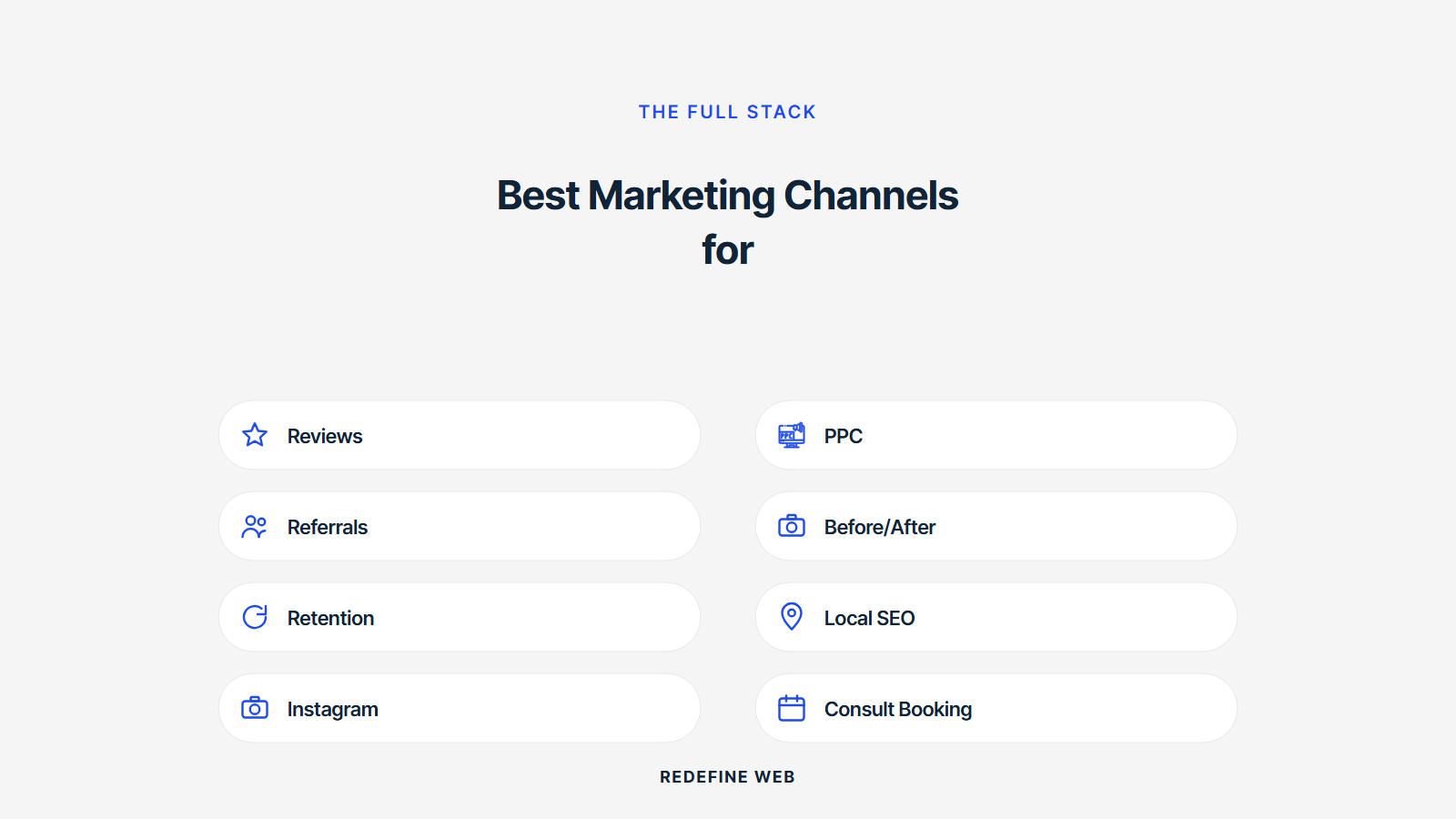
Sequence the best marketing channels for med spa advertising by month against team capacity and patient volume. Month one launches Google Search Ads plus Google Business Profile plus email marketing on existing patients. Month two adds Meta ads on treatment-photogenic campaigns. Month three layers referral program launch and content marketing. Month six adds TikTok if the demographic fits. Month nine adds micro-local influencer partnerships once the site foundation and paid layers are producing predictable numbers on cost per booked consult.
Month one launch checklist for med spa channels
Month one launches on three channels that produce inside week 1 to 4. Google Search Ads on treatment-plus-neighborhood queries (first consults land inside week 1 to 2). Google Business Profile fully optimized with treatment categories and review-ask automation running from day 1. Email marketing on the existing patient list with a Botox retention cadence live inside week 2. All three channels need conversion tracking wired to the practice management system before launch. All three need the front desk trained on tracking booking source in the intake form. Skip either wiring step and the account cannot measure which channel produced which patient across the next six months.
Month three referral and content layer
Month three layers referral program launch and content marketing on top of the working paid plus GBP plus email foundation. Referral program produces first meaningful new-patient volume at month 4 to 6 once the incentive structure has cycled through 60+ existing patients. Content marketing on treatment-specific blog posts and neighborhood landing pages ties into a working med spa SEO services layer and produces first ranking gains at month 4 to 8 and first meaningful organic consults at month 6 to 10. Both layers compound across 12 to 24 months. Skip the layer at month three and the practice stays dependent on paid traffic forever without ever building the compounding organic pipeline.
Mistakes across best marketing channels for med spa advertising
Every med spa marketing plan we audit shows the same five mistakes across the working channel mix. Skip these mistakes and the same channel spend produces 2x to 3x the booked consult volume and 40 to 60 percent higher patient LTV across the fiscal year. Fix any three of the five and the working plan pulls ahead of 65 percent of the local competitive vertical inside 12 months of running the corrected mix.
- Launching Meta plus TikTok plus influencer plays before the site foundation and GBP produce baseline conversion. Every channel then feeds broken landing pages.
- Running Google Ads without treatment-specific landing pages. Conversion stays at 3 to 5 percent when it should hit 8 to 14 percent, tripling cost per consult.
- Blasting the same monthly newsletter to all five patient segments. Retreatment cadence book-rate drops from 55 to 72 percent down to 28 to 40 percent.
- Skipping the review-ask automation on Google Business Profile. Review volume drops to 1 to 2 monthly and map-pack rank slides out of the top three inside 90 days.
- No conversion tracking wired to the practice management system. Every budget decision runs on vibes instead of cost per booked consult by channel.
The med spa that launches all seven channels in month one produces a marketing plan document that looks stunning on the wall. Then you find out the Google Ads account is bidding on the generic med spa term with no landing pages, the Meta account is running a static text ad from 2019 that got approved for another 90 days somehow, the TikTok account has three posts from January and the last one is a New Year sale nobody redeemed, and the front desk is manually logging referrals on a Post-it that fell behind the printer sometime around March. Congratulations on your marketing plan. Please do not attempt to measure the outcome this quarter.
How to audit the current med spa channel mix
Audit the current med spa channel mix with four checks. Check one asks whether cost per booked consult exists as a working metric per channel. Check two asks whether practice management attribution ties each booked patient back to the originating channel. Check three asks whether each channel has a defined monthly budget cap and monthly review cadence. Check four asks whether internal team capacity actually covers execution across every channel currently in the plan. Fail on two of four and cut the channel count from seven back to four before the next quarter kicks off with a fresh budget commitment.
Budget mix across best marketing channels for med spa advertising
Budget mix across the best marketing channels for med spa advertising depends on practice size and current patient volume. Single-location med spas doing $600k to $2 million annual revenue typically run a total marketing budget of $48,000 to $180,000 annually. Split that budget roughly 30 percent on Google Search Ads, 20 percent on Meta ads, 15 percent on local SEO plus GBP management, 15 percent on email marketing infrastructure and content, 10 percent on referral program incentives and tracking, 6 percent on TikTok content production, and 4 percent on micro-local influencer partnerships. Adjust seasonally on treatment cycles like summer coolsculpting or wedding season Botox.
When to shift budget away from Google Ads
Shift budget away from Google Ads when the local SEO layer starts producing organic map-pack rank at month 8 to 14 and the treatment landing pages start ranking for treatment-plus-neighborhood queries. Working accounts shift 15 to 30 percent of Google Ads budget into content marketing and local SEO expansion across months 12 to 24. The paid search budget through med spa PPC management stays higher on new treatment category launches (adding coolsculpting to a Botox-only practice, launching PRP hair restoration). Overall the med spa marketing plan gradually shifts from paid-heavy in year one to organic-plus-referral-heavy by year three across most urban locations we have measured.
When to invest more in TikTok and influencer
Invest more in TikTok plus micro-local influencer when the patient base skews under 35, when the injector team has bandwidth to appear on camera weekly for content production, and when the treatment mix leans photogenic (Botox, filler, laser). Skip more TikTok and influencer investment when any of those three prerequisites fail. Per Hootsuite research on TikTok marketing effectiveness, working accounts double TikTok budget in year two once the injector team, content rhythm, and treatment fit all sit inside the working operational rhythm.
Wrapping up the best marketing channels for med spa advertising guide
Best marketing channels for med spa advertising come down to seven working plays, a sequenced launch across months one through nine, a budget mix that shifts across years one to three, and five mistakes that quietly destroy booked consult pipeline. Google Search Ads wins on cost per new consult. Google Business Profile wins on free intent-based bookings. Email marketing wins on retention LTV growth. Meta ads win on photogenic treatment acquisition. Referral programs win on absolute cost per patient. TikTok wins on under-35 reach. Micro-local influencer wins on trust-based conversion. Beauté Aesthetics New York compounded 166 percent lead growth on the four-channel discipline of Google Ads plus GBP plus email plus site landing pages across the twelve-month partnership window.
The three pieces every med spa channel mix needs on paper are practice management attribution wired to every channel, a monthly review cadence that ties channel spend to cost per booked consult, and a written twelve-month sequencing plan. Every mix needs a defined budget cap per channel. Nail those and the channel mix produces working booked consult pipeline every quarter of every year. Miss any and the mix produces a marketing plan document that looks impressive without producing measurable patient bookings or LTV growth across the treatment mix.
Redefine Web runs four-channel and seven-channel med spa engagements through the med spa marketing agency program. Book a call to walk through your current channel mix against the seven-channel math above, or read the site foundation guide for the technology stack that carries every channel across the working plan.
Frequently asked questions
What are the best marketing channels for med spa advertising?
The seven best marketing channels for med spa advertising ranked by working ROI are Google Search Ads, Google Business Profile plus local SEO, email marketing to existing patients, Meta ads on Instagram plus Facebook, referral programs, TikTok organic plus paid, and micro-local influencer partnerships. Google Ads wins on cost per new consult at $65 to $185. Email wins on retention LTV lift. Referral programs win on absolute cost per patient at $25 to $85.
How much do the best marketing channels for med spa advertising cost?
Single-location med spas doing $600k to $2 million annual revenue typically run marketing budgets of $48,000 to $180,000 annually. Working split runs 30 percent Google Ads, 20 percent Meta, 15 percent local SEO plus GBP, 15 percent email plus content, 10 percent referral incentives, 6 percent TikTok, and 4 percent influencer. Cost per booked consult ranges from $8 on email rebookings to $520 on higher-end influencer partnerships across the working channel mix.
Does TikTok work as a med spa advertising channel?
TikTok works as a med spa advertising channel for practices targeting patients under 35 or launching preventive Botox positioning. TikTok organic plus paid produces $140 to $340 per booked consult when the practice pushes 4 to 8 posts weekly across injector-perspective videos, patient vlogs, educational explainers, and trend-jack content. TikTok fails on practices posting monthly or targeting a patient base skewing above 45 years old across most metro markets we have measured this year.
When should med spas start referral programs?
Med spas should launch referral programs at month three of the working channel launch sequence, after Google Ads plus GBP plus email have produced 60+ new patients through the door. Working programs pay $75 to $150 credit to the referring patient plus $50 to $100 to the referred patient. Automated tracking through unique referral codes tied to practice management profiles matters. Manual spreadsheet tracking dies inside 60 days at any busy front desk.
How do I choose which marketing channels for my med spa?
Choose channels by sequencing them across a nine-month plan against team capacity. Month one launches Google Ads plus GBP plus email (all produce inside week 1 to 4). Month two adds Meta ads on photogenic treatments. Month three layers referral program plus content marketing. Month six adds TikTok if the demographic fits. Month nine adds micro-local influencer partnerships once site conversion is running at target on cost per booked consult across the paid layer.
What are the biggest mistakes med spas make on channel mix?
Five mistakes repeat across the vertical. Launching Meta and TikTok before the site foundation converts. Running Google Ads without treatment-specific landing pages (conversion drops from 8 to 14 percent to 3 to 5 percent). Blasting the same newsletter to all patient segments (retreatment book-rate drops 40 percent). Skipping GBP review-ask automation (map-pack rank slides out of top three). No conversion tracking wired to practice management. Fix any three and channel spend produces 2x to 3x the booked consult volume.
Book your free 30-minute strategy call.
No spam, no sales rep. We use your email to schedule your call with a senior strategist. That is it.
More from the blog
View all articles → Digital Marketing
 Dental Marketing Tips That Compound Into New Patients
Read article Digital Marketing
 Ecommerce Marketing Strategies That Drive Real DTC Revenue
Read article Digital Marketing