
Chiropractor PPC That Books Exams at Real Cost
- Four campaigns cover 90 percent of intent. Back pain, sciatica, auto injury, branded.
- Cost per booked exam ceiling sits at 25 percent of case value.
- Weekly negative keyword pass is the highest-value 20-minute task.
- Branded search is the cheapest booked patient in the account.
- Call tracking on every campaign or the numbers lie.
- What chiropractor PPC actually is
- The chiropractor PPC account structure that produces booked exams
- The chiropractor PPC cost per exam math
- The weekly negative keyword pass that keeps CAC honest
- Landing pages that book exams instead of clicks
- Conversion tracking that keeps the account honest
- The chiropractor PPC budget and bidding rules
- The chiropractor PPC mistakes that drain the account
- A real chiropractor PPC case study
- The way Redefine Web runs chiropractor PPC
Chiropractor PPC is the fastest way to book new patients when the schedule needs volume this week. Google Ads produces the first booked exam inside 48 hours of launch when the account is targeted correctly, sits at a stable cost per booked exam by week four, and stays there for months once the negatives, tracking, and landing pages are dialed in. That is the promise. Most chiropractor PPC accounts do not deliver it because they run broad match on generic terms with no negatives and no call tracking, and the front desk stops answering the phone for tire-kickers.
This guide walks through the exact chiropractor PPC account we build for independent practices. Four campaigns. A weekly negative keyword pass. Call tracking on every campaign. Landing pages that book exams instead of collecting bounces. Real numbers from real practices. Read it as a playbook the marketing lead can pick up on Monday and run against Friday’s search terms report, not as a survey of what other agencies talk about.

What chiropractor PPC actually is
Chiropractor PPC is paid search advertising that puts a practice at the top of Google results for high-intent queries. Not display ads. Not YouTube pre-roll. Not Facebook boosts. Google Ads on search queries where someone is already deciding to book care. That distinction matters because the CAC math only works on real search intent.
The account structure covers four campaign types, and the four handle 90 percent of the volume that produces booked exams. Search on condition queries (back pain, sciatica, auto injury). Search on branded queries (the practice name and common misspellings). Search on competitor queries (only in metros where the CPA math justifies it). Retargeting on prior site visitors who did not book. Everything else layers on when the base is producing.
Where chiropractor PPC fits the marketing plan
Chiropractor PPC gets 40 to 50 percent of the paid marketing budget in month one and drops to 25 to 30 percent by month six as local SEO and reactivation start producing at lower cost. In a typical digital marketing for chiropractors plan, paid search bridges the first 90 days while owned channels build. That sequence keeps the schedule full while the compounding channels mature.
What chiropractor PPC is not good at
Compounding. The month the budget stops, the leads stop. Paid search is a switch, not a system. Any practice hoping to build durable new patient flow needs local SEO, reactivation, and referrals running alongside chiropractor PPC. Practices that rely on paid search alone spend more every year to book the same number of exams. The math gets worse, not better, as auction competition rises.
The chiropractor PPC account structure that produces booked exams
Four campaigns. Not fifteen. Four. Back pain. Sciatica. Auto injury. Branded search. Each campaign has one exact-match ad group and one phrase-match ad group. Negatives run 60 to 100 deep and get refreshed weekly. Conversion tracking fires on the booking form submit and on any phone call over 90 seconds through Google Ads call tracking.
The temptation to build 15 campaigns targeting every condition the practice treats is the single biggest structural mistake in chiropractor PPC. Fifteen campaigns split budget so thin that no single campaign produces enough clicks per week to optimize. Four campaigns with real budget beat fifteen campaigns with token budget every quarter of every year. Keep the account narrow. Let the search terms report widen it as data lands.
- Campaign 1,Back pain: exact match on back pain relief, lower back pain, upper back pain, chronic back pain. Phrase match on longer variants that include the city or town name.
- Campaign 2,Sciatica: exact match on sciatica pain, sciatica relief, sciatica specialist. Phrase match on longer variants.
- Campaign 3,Auto injury: exact match on auto accident chiropractor, car accident chiropractor, whiplash treatment. Phrase match on personal injury and workers comp adjacent terms.
- Campaign 4,Branded search: exact match on the practice name and every common misspelling. This is the cheapest booked patient in the account.
- Optional,Competitor search: only in metros where CPA math works. Exact match on top three competitor names, always with a comparison landing page ready.
Why branded search matters more than owners think
Someone who Googles the practice name is 4 to 7 times likelier to book than a cold searcher. Branded ads intercept them before a competitor buys the same keyword. Owners hate paying for a click on their own name. Then a competitor spends $2.40 for that same click and steals the exam. Buy the branded traffic. It is the cheapest booked patient in the chiropractor PPC account, hands down, and cutting it saves $150 a month while costing $2,400 in booked exams.
The condition page alignment rule
Each campaign points to its own condition landing page. Back pain campaign sends traffic to the back pain page. Sciatica campaign sends traffic to the sciatica page. Not the homepage. Not a generic services page. The condition page. Landing page relevance is a ranking signal in Google Ads and moves quality score by two to three points. A quality score jump from six to nine cuts cost per click by 30 percent overnight. That single alignment often pays for the entire management fee.
The chiropractor PPC cost per exam math
Cost per booked exam is the only chiropractor PPC metric that matters. Cost per click is a diagnostic, not a goal. Practices chasing low CPC end up with cheap clicks from the wrong search terms and no exams on the schedule. The account gets built to concentrate spend on searches the front desk can convert, not searches with a low bid.
Set the CPA ceiling before turning the account on. Divide average patient case value by four. That is the ceiling. A practice with a $1,600 case value can spend up to $400 to acquire a new patient across paid channels combined. In chiropractor PPC specifically, the working CPA target sits at $50 to $150 in mid-size markets, $80 to $200 in metros, and $30 to $80 in rural markets. Anything below those ranges is unusual and worth investigating.
| Market type | Typical CPC | Landing page conversion | Cost per booked exam |
|---|---|---|---|
| Rural / small town | $2.50 to $5.00 | 10% to 15% | $30 to $80 |
| Mid-size metro | $5.00 to $10.00 | 7% to 12% | $50 to $150 |
| Major metro core | $8.00 to $18.00 | 5% to 9% | $100 to $250 |
| Ultra-competitive (Manhattan, LA core) | $15.00 to $30.00 | 4% to 7% | $200 to $450 |
| Branded search (any market) | $1.50 to $4.00 | 25% to 45% | $6 to $18 |
Why CPA drifts up when nobody is watching
Auction competition rises. Google widens keyword matching quietly. Search intent shifts seasonally (back pain spikes in December, auto injury spikes in July). New negatives never get added. Landing page speed slips. Each of these adds five to ten percent to CPA. Four of them stacked over three months doubles the number without anyone doing anything wrong. The weekly review is the only thing that catches the drift before it eats the quarter.
What a good chiropractor PPC week looks like
Clicks steady at target. CTR above 8 percent on branded, above 5 percent on condition campaigns. Conversion rate on landing pages above 8 percent. Cost per booked exam within 15 percent of target. Search terms report producing 15 to 30 new negatives to add. Three to five new booked exams from the account. That is the pattern that holds for months when the account is dialed in.
Chiro PPC dashboards love form fills. Reconcile against actual first-visit paid patients monthly. The gap is usually the receptionist, not the ad.
The weekly negative keyword pass that keeps CAC honest
Every Friday, the marketing lead reviews the search terms report and adds 15 to 30 new negatives. Job seekers. School searches. Insurance-only queries. Free consult tire kickers. Massage-only queries. Physical therapy queries when the practice does not offer PT. This is the single most valuable 20-minute task in the chiropractor PPC account. Skip it for four weeks and cost per exam drifts up by 30 to 50 percent, and nobody notices until the monthly report lands.
The negative keyword list grows to 200 to 500 entries over the first six months and then holds steady with 5 to 10 additions per week forever after. Common categories: employment terms (jobs, careers, hiring), education terms (school, program, degree), competitor terms with the wrong intent, and geographic terms outside the practice’s service area. Read the WordStream negative keyword guide for the structural playbook.
The search terms report workflow
Pull the search terms report for the last seven days. Filter by ad group. Sort by cost descending. Scan every term that spent over $10 with no conversion. Add each junk term to the shared negative list. Add each good term that is not already an active keyword to the ad group as an exact match keyword. That is the whole pass. It takes 20 minutes with the right dashboard.
The shared negative list trick
Build one shared negative list applied to every campaign in the account, not per-campaign negative lists. Practices with per-campaign lists end up adding the same junk term (jobs, careers, free) to four separate lists and forgetting one, which quietly wastes budget in that one campaign for months. Shared lists take five minutes to set up and save hours per year in maintenance.
Somewhere around week seven, the account manager checks the search terms report and finds that the practice has been paying $4.20 per click to appear on queries for “chiropractor school in Ohio” for two months. The practice is not a school. The practice is not in Ohio. The DC is going to have Feelings about this in the Friday call. This is fine. Fixing it is a 30-second add to the negative list, and next week’s report shows the click count drop to zero.
Landing pages that book exams instead of clicks
The landing page is where 60 to 70 percent of chiropractor PPC performance lives. A great ad account with a terrible landing page produces expensive clicks and no booked exams. A mediocre ad account with a great landing page still books exams. The math is unforgiving. Every landing page fix outperforms every ad copy tweak by a factor of three or four.
The condition-specific landing page has one job: turn the paid click into a booked exam or a phone call in 45 seconds. Headline that names the condition and the outcome. Photo of the DC treating that condition (not a stock image). Booking button above the fold with the price transparent. Three trust signals (years in practice, review count, board certification). One-paragraph explanation of what the first exam covers. Phone number in the header, tap-to-call on mobile. Read chiropractor PPC services for the template we use.
The mobile speed floor
Mobile Largest Contentful Paint under 2.5 seconds. Cumulative Layout Shift under 0.1. If those are red on web.dev’s LCP guide, paid ad clicks reaching the site get wasted. Compress every hero image to WebP. Defer non-critical JavaScript. Pull the third-party review widgets that add a full second to load. A slow landing page quietly cuts booked exams by 20 to 30 percent, and no ad budget covers that hole.
The form versus call question
Offer both. Booking form for people who prefer online. Phone number tap-to-call for people who prefer voice. The mix runs 55 to 45 in favor of calls in most independent practices and 65 to 35 in favor of calls in metros where auto injury drives volume. Do not force one channel. Do not hide either. Both get tracked as conversions in the account.
Conversion tracking that keeps the account honest
Chiropractor PPC without proper conversion tracking is a hobby. The account looks like it is working, the CPC looks reasonable, and the monthly bill arrives with no way to know if the money produced booked exams. Real conversion tracking closes that gap in week one and keeps closing it for years.
Three tracking events at minimum. Form conversion on booking submit. Phone call conversion on any call over 90 seconds through Google Ads call tracking or a third-party like CallRail. Offline conversion import when the front desk marks the new patient as showed. The offline import closes the loop that Google Ads needs to optimize bidding toward showed patients instead of just form submits.
Call tracking setup that works
Use a dynamic number insertion tool that shows a tracked number only to visitors from paid search. The main practice number stays visible to every other visitor for local SEO purposes. Call length threshold at 90 seconds. Anything under that is a wrong number or hangup, not a booked exam attempt. Record the calls for training if the state allows it. Score five random calls per week for tracking quality.
Offline conversion imports that close the loop
Every week, export the new patient list from the EMR filtered by “paid search” source. Match to the Google Click ID stored at booking. Upload the matched list to Google Ads as offline conversions. The account starts bidding toward booked-and-showed patients instead of form submits alone, and the CPA on booked exams drops 15 to 25 percent inside six weeks. This is the single highest-return technical setup task in chiropractor PPC.
The chiropractor PPC budget and bidding rules
Budget sits at $1,500 minimum per month once management is counted. Below that, the account cannot produce enough weekly clicks to optimize meaningfully, and CPA stays high because the algorithm does not have enough conversion data to bid toward booked exams. Above $6,000 per month, most independent practices hit diminishing returns unless they run in a major metro.
Bidding runs on Target CPA once the account has 30 or more conversions per month. Below that threshold, manual CPC or Maximize Conversions performs better because Google’s algorithm needs a training set. Set the Target CPA at 20 percent above the ceiling initially, then tighten it 10 percent a month as data lands. Tightening too fast starves the account of clicks. Not tightening at all leaves 15 to 25 percent CPA improvement on the table.
The monthly budget decision
Every month, three questions. Did the account hit the booked exam target. Was CPA at or below ceiling. Did the account underspend. Two yeses and one no means hold budget. Three yeses means add 20 percent. One yes or fewer means fix the offer, the landing page, or the campaign structure before adding more budget. This decision runs in the last week of every month.
Seasonal adjustments that keep the account calibrated
Back pain queries spike in December and January (holiday travel, cold weather, heavy holiday shopping). Auto injury queries spike in July and August (summer travel, teen drivers on the road). Sciatica queries stay flat year-round. Increase budget on the seasonal campaign 30 to 50 percent for the spike months. Cut it 20 percent for the trough months. This one adjustment keeps CPA within 10 percent of ceiling across the year.
The chiropractor PPC mistakes that drain the account
Every account loses money the same way. Broad match on generic terms. No negative keywords. No landing page relevance. No call tracking. Bidding on the homepage instead of condition pages. Running the account with no weekly review. Trusting Performance Max without a search campaign underneath. These seven show up in almost every audit and cost independent practices thousands a month.
The pattern behind all seven is the same: activity without measurement. Chiropractor PPC only earns when the account gets built with a target, measured against it weekly, and tightened when the number drifts. The alternative is spending five figures a quarter and feeling productive without booking exams. Practices that skip the weekly review end up in the alternative every time.
- Broad match on generic terms: Google widens matching aggressively. Broad match on “chiropractor” produces clicks from job seekers, students, and Ohio residents when the practice is in Nevada.
- No negative keyword list: the fastest way to lose 30 to 50 percent of budget with no exams to show for it.
- Homepage as landing page: quality score suffers, conversion rate drops by half, CPA doubles.
- No call tracking: the account looks like it converts on form submits only, and the front desk phone rings twice as often with no attribution.
- Performance Max as the whole account: Google spends where it wants, which is rarely where the practice wants.
- Ignoring quality score: a quality score of six versus nine on the same keyword doubles the cost per click.
- Running the account with no weekly review: the drift catches nobody in month one and buries CPA by month three.
When to pause a chiropractor PPC campaign
Two consecutive weeks with CPA above ceiling and no obvious fix in the search terms report. Or clicks flowing but conversion rate below 3 percent on the landing page with no fix planned. Or the campaign consuming more than 30 percent of budget while producing less than 20 percent of booked exams. Any one of these is a fair signal to pause and diagnose instead of feeding the campaign more budget hoping it recovers.
When to hire outside help
When chiropractor PPC has been running for four months and CPA has never sat below the ceiling. When the account has 20-plus campaigns and none of them have obvious owners. When Performance Max is spending 60 percent of budget and nobody can explain the placements. Any one of these is a fair signal for outside help. A good chiropractor PPC services partner should show the numbers on day one, not month three.
A real chiropractor PPC case study
Pain Cure Clinic, a chiropractic practice with a whole-person care model, came into the engagement with a manual booking system, sparse Google reviews, and a Google Ads account that had been spending $2,400 a month for eight months at a CPA above $260. Standard cold start for an independent practice that had been sold “Google Ads management” by a generalist agency and never got the account audit or the landing page work.
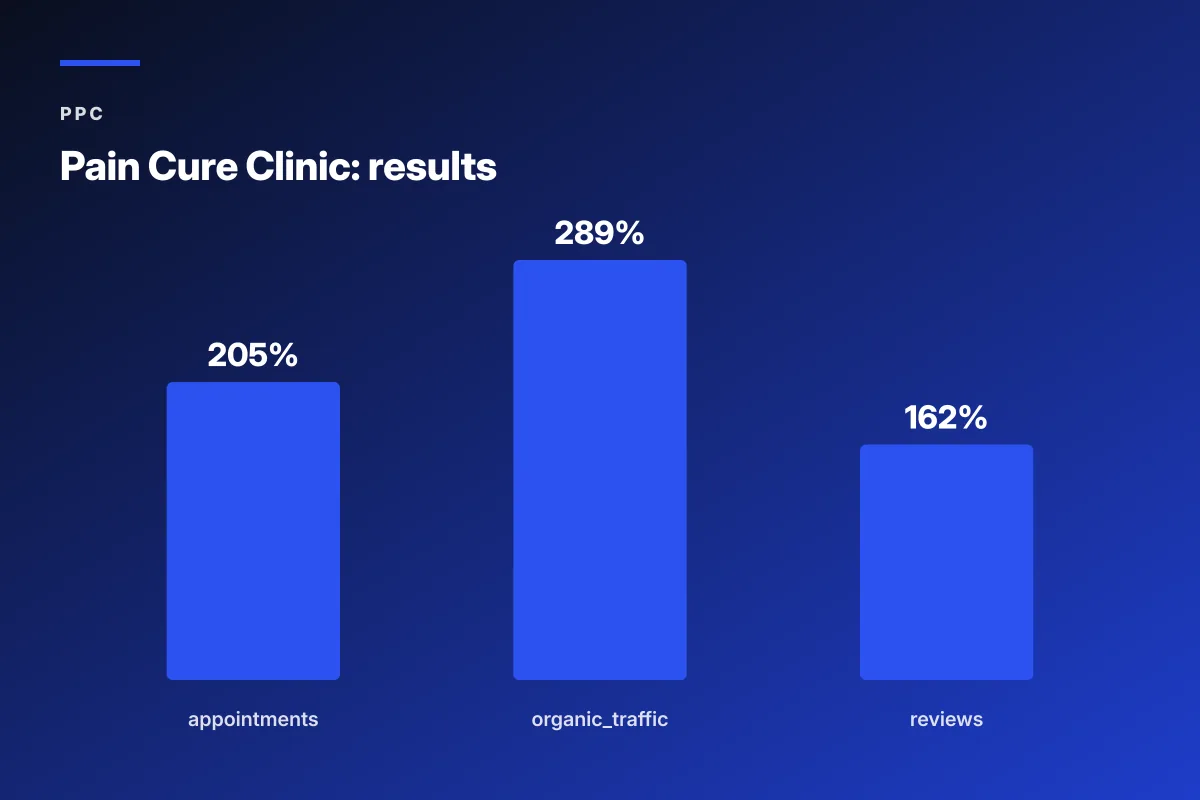
The rebuild ran in three phases. Phase one restructured the account into four campaigns and added a shared negative list of 240 terms in week one. Phase two rebuilt the back pain and sciatica landing pages with the DC’s real photos and a booking button above the fold in weeks two and three. Phase three set up call tracking and offline conversion imports in weeks three and four. Twelve months later the practice had 205 percent more new appointments (from 40 a month to 122), a CPA around $84 on chiropractor PPC, and reviews up 162 percent to a 4.9-star Google rating. The paid search account did not cost more. It just started producing.
What carried the growth
The landing page rebuild produced the largest single gain. Conversion rate on the back pain page went from 3.2 percent to 9.8 percent inside three weeks. That alone cut CPA by roughly 60 percent. The account restructure and negative keyword work produced the durable base. The offline conversion imports let the algorithm bid toward booked-and-showed patients instead of form submits, which held the gains through auction competition rises in months six through twelve.
What would not have worked
A budget increase without the landing page rebuild. More campaigns without the negative keyword work. Performance Max without the search foundation. Each of those has been sold to independent practices as the answer, and each fails the same way: adding activity without fixing the underlying pressure points in the account. The gains at Pain Cure Clinic came from fixing what the previous plan skipped, not from spending more.
The way Redefine Web runs chiropractor PPC
Redefine Web runs chiropractor PPC as a monthly retainer that covers the account structure, the weekly negative keyword pass, the landing page work, the conversion tracking, and the monthly reshape meeting. Practices sign up when they want CPA to move instead of sitting on a spreadsheet. Contracts are typically six months because the account takes that long to fully mature.
The engagement starts with a two-hour kickoff and an account audit. A written 90-day plan lands in the practice’s inbox by day three. The account restructure ships in week one. Landing page rebuilds run in weeks two through four. Call tracking goes live before week two. Weekly Friday calls for the first eight weeks, biweekly after that. The base retainer starts at $599 per month for management and scales with ad spend from there.
What a typical engagement covers
Google Ads account audit and restructure. Weekly negative keyword pass and search terms review. Landing page rebuild on the four condition pages. Call tracking setup and monthly quality scoring. Offline conversion import setup and weekly upload. Monthly reshape meeting with a written decision. Read chiropractor marketing services for the full service list.
When chiropractor PPC does not fit the practice
Practices under $150,000 annual revenue often need a leaner plan built around local SEO and reactivation instead of paid search. Practices in ultra-competitive metros where CPA sits above 25 percent of case value sometimes need to focus on SEO for chiropractors until the organic base can carry the plan. In both cases we say so at the kickoff and structure the engagement to fit, instead of taking the retainer and pretending chiropractor PPC will match every practice in every market.
If a practice is ready to run chiropractor PPC or ready to talk through whether it fits, book a call through the chiropractor marketing services page. Chiropractor PPC earns because the account structure holds, the negative keyword pass runs every Friday, and the offline conversion import teaches the algorithm what actually books an exam. Start there.
Frequently asked questions
What is chiropractor PPC?
Chiropractor PPC is paid search advertising that puts a practice at the top of Google results for high-intent queries like back pain relief, sciatica specialist, and chiropractor near me. It runs through Google Ads and, sometimes, Microsoft Ads. The account gets built to concentrate spend on search terms the front desk can convert into booked exams. Done right, chiropractor PPC produces new patients within 48 hours of launch and sits at a stable cost per booked exam within four weeks. Done wrong, it burns budget on unqualified clicks with no exams to show for it.
How much does chiropractor PPC cost per month?
Most independent chiropractic practices spend $1,500 to $6,000 per month on chiropractor PPC once ad spend and management are counted. Solo practices in mid-size markets sit at $1,500 to $3,000. Two-DC practices in metros run $3,000 to $6,000. Multi-location groups scale from there. Management fees usually run $500 to $1,500 per month on top of ad spend. Below $1,500 total, the account cannot produce enough signal to optimize monthly, and CPA stays high. The right budget comes from the new patient target, not from a percentage of revenue rule.
What is a good cost per booked exam for chiropractor PPC?
A working cost per booked exam sits at 25 percent of average patient case value or lower. A practice with a $1,600 case value can spend up to $400 to acquire a new patient and still make the math work over a 12-month care plan. In mid-size markets, chiropractor PPC typically produces booked exams at $50 to $150. Competitive metros push higher, up to $200. Rural markets sit lower, around $30 to $80. The CPA ceiling matters more than the CPA average because the CAC math has to hold across bad months, not just good ones.
Which Google Ads keywords work for chiropractors?
Four keyword clusters cover 90 percent of the intent. Back pain (back pain relief, lower back pain, upper back pain, chronic back pain). Sciatica (sciatica pain, sciatica relief, sciatica specialist). Auto injury (auto accident chiropractor, car accident injury, whiplash treatment). Branded search (the practice name plus common misspellings). Everything else is testing budget. Broad match on these terms burns money. Exact match and phrase match with a heavy negative keyword list produce the booked exams. Keep the account narrow and let the search terms report widen it as data lands.
Should chiropractors run Facebook ads or Google Ads?
Google Ads first, every time. People searching back pain, sciatica, or a chiropractor near a specific town are already deciding to book. Facebook and Instagram ads run into people who might one day need care, which is a longer sales cycle and a higher cost per booked exam. The practical plan starts paid budget in Google Search, then layers Facebook and Instagram Reels once the base is producing predictable booked exams from paid search. Reversing the order tends to produce activity and no exams for three to four months.
How long does chiropractor PPC take to work?
Google Ads books new patients in week one. The first booked exam usually lands inside 48 hours of launch if the account is targeted correctly. Cost per booked exam stabilizes across weeks two through four as the search terms report fills in and negatives get added. Full account maturity (steady CPA, high conversion rate, low waste) hits around month three. Practices should expect noisy numbers for the first two weeks and start judging performance after week four. Judging performance on week one data leads to bad reallocation decisions.
Can chiropractors run PPC without an agency?
Solo practices with a technical marketing lead can run a basic chiropractor PPC account with three campaigns and a weekly negative keyword pass. The work that gets skipped in-house is the weekly search terms report review, the conversion tracking maintenance, and the landing page conversion rate work. Practices that stay disciplined on those three can do meaningful DIY chiropractor PPC. Practices that want the account stacked and measured usually save money by hiring a specialist because the CPA gains typically outweigh the management fee inside two months.
Book your free 30-minute strategy call.
No spam, no sales rep. We use your email to schedule your call with a senior strategist. That is it.
More from the blog
View all articles → PPC
PPC Healthcare PPC Advertising Channels Compliance and Targeting
Read article PPC
PPC Dental Facebook Ads Guide for Practices That Book Patients
Read article PPC
PPC