
Classify Dental Practices Independent vs DSO Chain in Minutes
- Signage and phone greetings give the fastest read but acquired-but-not-rebranded DSOs often hide behind them.
- Tech stack (Dentrix Eaglesoft Open Dental versus Denticon or Curve) is the strongest single indicator.
- Billing address on EOBs and tax ID on NPI registry provide definitive classification.
- Smile Design Dentistry shows every classification signal at 50-plus location DSO scale.
- Use the 7-point checklist for 85 percent confidence in ten minutes.
- Why you’d want to classify dental practices independent vs dso chain in the first place
- Quick comparison table to classify dental practices independent vs dso chain
- Signage signals that classify dental practices independent vs dso chain
- Phone signals when you call to classify dental practices independent vs dso chain
- Staffing signals that separate independent from DSO
- Tech stack signals that classify dental practices independent vs dso chain
- Billing patterns that give the game away
- Marketing signals visible in ads, website, and search
- Case study on how Smile Design Dentistry looks under the microscope
- Records and public data to classify dental practices independent vs dso chain remotely
- Edge cases that trip up first-time classifiers
- Vendor perspective on the classification
- Patient perspective on why the classification matters
- Investor perspective on the classification for due diligence
- Quick checklist to classify dental practices independent vs dso chain in ten minutes
- How to use the classification once you have it
You want to classify dental practices independent vs dso chain because it changes what you’re walking into. A patient wants to know if the person on the treatment plan owns the chair or reads a script from a corporate playbook. A vendor wants to know if the buyer is the owner-dentist or a regional director sitting in Nashville. An investor wants to know if the practice on the spreadsheet is a rollup target or already a rollup line item. The label on the door won’t tell you. Half of DSO practices still trade under the founder’s name because retention scores go up when patients think their dentist owns the place.
This guide walks the physical signals, the staffing signals, the tech stack signals, and the billing patterns that let you classify dental practices independent vs dso chain inside a 30-minute visit or a 10-minute records pull. You’ll see what the signage looks like, what the front desk answers when you call, which practice management systems point which direction, and how EOB codes give the game away. Skip to the section you need. The comparison table near the top is the quick-look.

Why you’d want to classify dental practices independent vs dso chain in the first place
You classify dental practices independent vs dso chain because ownership changes the negotiation, the continuity of care, the pricing authority, and the acquisition target math. Patients want to know who sets the fee. Vendors want to know who signs the purchase order. Investors want to know if the practice is available or already inside somebody else’s platform.
The reason you’d classify dental practices independent vs dso chain depends on which hat you’re wearing that day. A patient booking a crown wants to know if the dentist has room to negotiate on price or if the fee schedule is locked at the regional office. A supply rep working on a $40,000 sterilization deal wants to know if the decision maker is in the operatory or in a group purchasing agreement three states away. A private-equity analyst underwriting a rollup wants to know how many of the 87 practices on the target list are already inside a DSO structure and don’t count as fresh acquisition inventory. Same question. Three very different reasons.
The trick is that DSO ownership is rarely disclosed on the practice website. Most DSOs operate on a captive PC model where the dentist of record legally owns the professional corporation and the DSO owns the management company that runs everything else. On paper, the practice is dentist-owned. In reality, marketing, hiring, purchasing, scheduling, and billing all run through the parent. That corporate practice of medicine loophole is why the front-of-house looks independent even when the back-of-house is anything but. According to the ADA Health Policy Institute, roughly 13 percent of US dentists were affiliated with a DSO as of 2023, up from 8.5 percent in 2017, and the curve keeps climbing.
You need a repeatable method because the surface signals lie. The rest of this guide is that method. Fifteen minutes of observation and three phone calls will tell you the answer with 90 percent confidence. A record pull and an EOB review get you to 98 percent. You rarely need the last two percent unless you’re closing a deal.
Quick comparison table to classify dental practices independent vs dso chain
Before the deep dive, the quick reference. Every signal below carries weight but none is a single-point diagnosis. You want three or four consistent signals pointing the same direction before you classify dental practices independent vs dso chain with confidence. A solo dentist who bought a Weave phone system and outsourced billing to a national vendor can look DSO-adjacent on two signals and still be genuinely independent. Read the pattern, not the pixel.
| Signal category | Independent practice | DSO chain practice |
|---|---|---|
| Exterior signage | Dentist name in prominent type | Brand name first, dentist name small or absent |
| Phone greeting | Practice name only | Brand plus location, scripted |
| Front desk staffing | 1 to 3 stable faces for years | Rotating staff, badges with region codes |
| Practice management system | Dentrix, Eaglesoft, Open Dental | Denticon, Curve, custom multi-tenant |
| Website footer | Solo copyright, local address | Corporate legal entity, multi-location links |
| Billing address on EOB | Practice street address | Regional office in different city |
| Insurance participation | 5 to 10 PPO plans | 15 to 25 plans via central contracts |
| Marketing budget | $1,500 to $4,000 per month | Central spend, no local budget line |
| Recall system | Manual or Weave, dentist-set cadence | Corporate recall software, fixed cadence |
The table is a starting point. Any two rows can flip on a savvy independent or a stealth DSO. The next sections walk each signal so you can weigh them properly on the ground. If you’re doing the walk for a multi-location acquisition, our DSO dental marketing page covers the operator side of what a rollup actually installs.
Signage signals that classify dental practices independent vs dso chain
Signage is the fastest signal because you can read it from the parking lot. An independent practice puts the dentist’s name in the biggest type on the building. Dr. Sarah Chen, DDS. Riverside Family Dental. Owner-dentists paid for that sign out of pocket and they want their name on it. A DSO chain practice puts the brand name in the biggest type and either buries the dentist’s name at the bottom of the sign or leaves it off entirely. Aspen Dental. Heartland. Pacific Dental Services. The dentist rotates through the location. The brand stays.
Watch the typography. DSO signage is professionally kerned, brand-guideline compliant, and identical across every location within the chain. Same font, same color, same lockup. Independent signage is idiosyncratic. Handmade choices. A slightly-off gradient. A logo that looks like the dentist’s spouse mocked it up in 2011 and never touched again. That inconsistency is a positive signal for independence because DSOs kill inconsistency in the first 90 days of ownership. The whole point of a chain is that the storefront looks the same in Tampa as in Toledo.
The exception that trips up the naive observer is the acquired-but-not-yet-rebranded location. A DSO buys an independent practice, keeps the founder’s name on the sign for two to five years to protect patient retention, then slowly rebrands. During that window, the sign still says Chen Family Dentistry but everything behind the sign runs on the DSO’s playbook. That’s when you need the other signals. The sign lies for the transition period. The tech stack and the billing address never do.
The parking lot tell
Look at the trash bins and the landscaping. An independent practice picks the vendor. Local landscaper on a first-name basis with the dentist. Trash service billed to the practice LLC. Snow removal handled by whoever the office manager called last winter. A DSO chain practice uses regional vendor contracts. National waste hauler. Standardized landscaping package. Salt company on a corporate PO. The bins have the same brand of liner across every location, and if the practice sits inside a chain of 20+ offices, the parking-lot maintenance schedule is on a fleet contract.
Signage lies. Pull an EOB from any recent visit. If payer ID routes to a Nashville or Boca clearinghouse, you're in a group. Front-desk answers won't matter.
Phone signals when you call to classify dental practices independent vs dso chain
Call the practice at 9:15 on a Tuesday morning. Listen to how the phone gets answered. An independent front desk answers with the practice name and often the receptionist’s own name. Riverside Family Dental, this is Karen, how can I help you. A DSO chain answers with a scripted brand-plus-location greeting. Thanks for calling Aspen Dental, Riverside location, this is Jessica, how can I direct your call. The script tells you the phone is either at a central call center or the local team is trained on a corporate cadence.
Test three questions when you call. First, ask if you can schedule with the specific dentist named on the website. An independent will confirm on the first try or explain that the dentist is out today. A DSO will often reroute you to whichever dentist is next available at that location, because chair-utilization software fills the schedule, not by patient-dentist relationships. Second, ask what the cash price is for a specific procedure. An independent gives a number in under 30 seconds. A DSO puts you on hold to look up the fee schedule or has to route you to a treatment coordinator. Third, ask if they take a specific PPO plan you know is regionally rare. If they say yes to a rare plan without hesitation, they’re on a central contract that participates in dozens of networks.
The hold music is another tell. Independent practices use whatever came with the phone system. Weave, RingCentral, or 8×8 default hold audio. DSOs cut custom hold-music tracks with brand messaging that mentions the chain name and cross-sells services. If the hold music tells you about the DSO’s implant financing options during a 90-second hold, you have your answer. See our dental marketing agency page for how independent practices structure their intake calls to compete with corporate scripts without losing the personal touch.
Central call center detection
Some DSOs route inbound calls through a regional or national call center that books appointments and only transfers clinical questions to the practice. The tells are subtle. Slight audio delay when the receptionist repeats your name back. Background noise that doesn’t match a small office (too many voices, too much room reverb). Inability to answer any question about the specific location’s parking, entry, or nearby landmarks. A call center rep booking for a Cincinnati office who has never been to Cincinnati is the tell. Ask about parking or the nearest coffee shop and listen for the fumble.
Staffing signals that separate independent from DSO
Walk into the lobby and read the badges. Independent staff wear practice-specific badges with just a name and role. Front desk badges say Karen and Practice Manager. Hygienist badges say Dana, RDH. DSO staff badges include a location code, an employee ID, and sometimes a regional identifier. The badge itself looks like corporate ID because it is. HR paperwork sits at the parent company. Employment is with the management entity, not with the professional corporation on the front door.
Ask the hygienist during your cleaning how long she’s been at the practice. Independent practices retain hygienists for 5 to 12 years because the owner-dentist has a personal relationship with the clinical team. DSO practices see hygienist turnover every 18 to 36 months because compensation is set by corporate, benefits change with acquisitions, and hygienists know they can jump to another chain location or an independent for similar pay without the corporate policies. If your hygienist has been there four months and the last hygienist you saw a year ago has been there two months, you’re in a DSO with high turnover.
The dentist rotation is the loudest staffing tell. Independent practices have one to three dentists who own the practice or are partners. Same dentists year after year. DSO practices rotate associate dentists on 12 to 24 month cycles. The dentist you saw for your last crown may not be there this year, and the new dentist has no context on your last treatment plan. Check the state dental board website for the current dentist roster at the practice address. If the roster has changed three or more times in the past 24 months, you’re looking at a DSO. Independent practices show 0 to 1 roster changes in the same window unless the owner sold or brought on a partner.
The office manager role
An independent office manager runs everything. Hiring, firing, insurance verification, treatment plan follow-up, marketing decisions, vendor selection. She reports to the owner-dentist and has been in the role for 4 to 15 years. A DSO office manager reports to a regional director who oversees 4 to 12 locations. Her authority is limited to daily operations. Hiring goes through corporate. Marketing is decided at the regional level. Vendor selection is on a central contract. If you ask the office manager who chooses the software or the supply vendor and she says corporate, you have your answer without ambiguity.
Tech stack signals that classify dental practices independent vs dso chain
The practice management system is the single strongest tech signal you can use to classify dental practices independent vs dso chain. Independent practices run Dentrix, Eaglesoft, or Open Dental. Each is a single-tenant desktop or on-prem cloud install that a solo owner can afford at $500 to $1,200 per operatory in setup and $200 to $500 monthly in support. Ask the front desk what system they use for records. Independent receptionists know the answer instantly and will show you the interface on their monitor if you ask.
DSO chains run Denticon, Curve Dental, or a proprietary multi-tenant system built for aggregating data across dozens or hundreds of locations. Denticon in particular is the giveaway. It’s engineered for multi-location groups and rarely deployed at a single-site independent because the pricing and complexity don’t pencil out below 5 locations. Curve Dental is more common in mid-size DSOs. If the receptionist doesn’t know what the system is called or has to check with corporate to answer, you’re in a DSO. Independents own their tech decisions and their front desk knows the stack.
Imaging tech is a secondary tell. Independent practices buy imaging equipment from a preferred local supplier and the units are older, unified with the practice for years. A DSO practice runs newer, standardized imaging fleets because purchasing is centralized. If every operatory has an identical model of intraoral camera and the panoramic X-ray is the same model that shows up in the DSO’s marketing photos of other locations, you’re inside a chain. According to Becker’s Dental Review, the top 20 DSOs have moved toward standardized digital imaging fleets over the last five years to control per-location cost and reporting.
Patient communication tools
Independents use Weave, Solutionreach, or NexHealth for patient reminders, texts, and reviews. The office manager chose the vendor. DSOs use RevenueWell, LocalMed, or an internal patient communication tool that plugs into the multi-tenant PMS. The texts you receive from an independent are usually personalized with the dentist’s or hygienist’s name. Texts from a DSO practice are generic, brand-signed, and identical in format to texts from other locations of the same chain. Save two appointment reminder texts, one from a suspected independent and one from a suspected DSO. Compare the sender ID, the format, and the personalization. The pattern is unmistakable.
Billing patterns that give the game away
The billing address on an explanation of benefits is where the truth lives. Ask for a copy of your last EOB or look at your own if you’re a patient at the practice. Independent practices bill from the same street address the treatment happened at. The check from your insurance goes to Riverside Family Dental at the practice address. DSO chain practices bill from a central billing office, often in a different city or state. The EOB shows Aspen Dental Management Inc. at a corporate address, even though your appointment was 40 miles from that office. That mismatch is definitive.
The tax ID on the EOB is the second definitive tell. Independent practices bill under the professional corporation’s EIN, which is registered in the state the practice sits in. DSO practices bill under either the local PC’s EIN (which is legally the dentist of record’s PC, per the corporate practice of medicine rules) or the management company’s EIN. If you look up the tax ID and find it registered to a management company in a different state, or if the same EIN appears on EOBs from multiple practice locations in your area, you have a DSO. A single-location independent EIN will only ever appear on one practice address.
The insurance participation pattern is the third billing tell. Independent practices participate in 5 to 10 PPO networks, chosen by the owner based on local patient demographics. DSO practices participate in 15 to 25 networks, negotiated centrally by corporate. If you call the practice and ask which insurance plans they accept and the answer is a long, memorized list that includes obscure plans you wouldn’t expect a single dentist to bother contracting with, you’re calling a DSO location on a central contract portfolio. For context on how billing tech shapes practice finances, our dental ppc management post covers how paid channels tie to booked patients across single and multi-location groups.
Payment collection process
Independent practices collect payment at the front desk on the day of service. Terminal on the counter, receipt printed, done. DSO practices increasingly use a centralized payment portal that emails you a link, texts you a QR code, or asks you to pay through the DSO’s patient app. If you’re offered payment options that don’t involve a card reader at the desk, you’re inside a DSO. The reason is corporate reconciliation. Centralized payment tech means all revenue flows through one clearing account regardless of which location produced it, and revenue-cycle management can be outsourced or centralized without disrupting the local office.
Marketing signals visible in ads, website, and search
Search the practice name in Google. Read the top three organic results. An independent shows a website with a local phone number, an address in the domain footer, and a Google Business Profile with 40 to 200 reviews. The reviews mention the dentist by name repeatedly. Great work Dr. Chen. Dr. Chen fixed my crown. A DSO chain shows a website with a local landing page under a national domain like aspendental.com/riverside or a locations subdirectory. Reviews mention the location and staff more than any specific dentist because the dentists rotate.
The domain structure is the fastest online tell. Independent practices own a domain that matches the practice name. riversidefamilydental.com. drchendental.com. DSO chains use a subdomain or subdirectory of the parent brand. locations.aspendental.com/riverside or heartland.com/tampa. If the practice URL is a subdirectory of a national brand, you’re done. Classification confirmed with one search. The exception is the acquired-but-not-yet-migrated location that still runs on the original independent domain during a two to five year rebrand window. Check the WHOIS record for domain registration date and registrant. A domain registered to a management company address instead of the owner-dentist is a DSO.
Ad spend is a slower but reliable tell. Independent practices run local Google Ads campaigns with a $1,500 to $4,000 monthly budget managed by the office manager or a local agency. The ads are geo-targeted tight (usually a 5 to 10 mile radius) and feature a local phone number. DSO chains run national or regional campaigns with location-specific ad extensions but a shared account structure. The ads are visually identical across markets because creative is produced centrally. Use SEMrush, Ahrefs, or the free Google Ads Transparency Center to pull a practice’s ad history. A single-location practice with 3 to 8 active ads is independent. A practice tied to an ad account running 200 to 2,000 concurrent ads across multiple locations is a DSO.
Review velocity and pattern
Look at the Google review timeline. Independent practices grow reviews organically at 2 to 8 per month with irregular spacing. Reviews come in clusters after positive appointments and drop off during slow months. DSO practices show unnaturally consistent review velocity because they use automated review-request software with fixed post-appointment triggers. 8 to 20 reviews per month, evenly spaced across weekdays, sent within 24 hours of every completed appointment. That pattern is the software signature of a DSO recall stack. Independents rarely run that discipline unless they hired an agency to install it.
Case study on how Smile Design Dentistry looks under the microscope
Smile Design Dentistry gives you a live example of how a DSO chain shows up when you apply the framework to classify dental practices independent vs dso chain in a real market. Founded in 2004 with the first office in Dade City, Florida, Smile Design has grown to more than 50 locations across Central Florida and Tampa Bay. From the outside, individual Smile Design locations use consistent brand signage, a shared domain (smiledesigndentistry.com with location subpages), and standardized office layouts that photograph identically across the network. Those three signals alone classify the group as a multi-location DSO with high confidence.
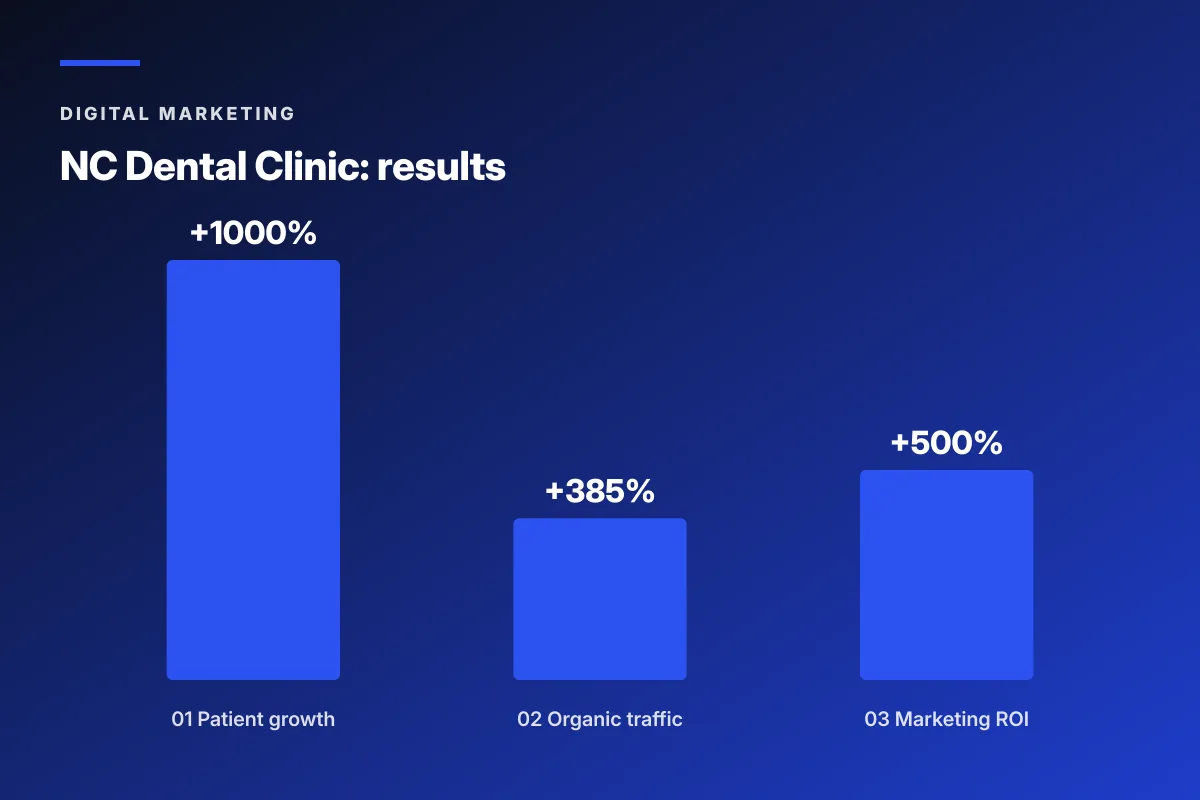
The tech stack signals confirm it. Smile Design Dentistry runs centralized digital marketing across all 50-plus locations. Redefine Web restructured their PPC campaigns by funnel stage and geography, added full-funnel paid social, and built location-specific landing pages tied to a shared brand system. The result was a 20 percent gain in PPC conversion rate and a 30 percent cut in cost per call across the network. That kind of coordinated marketing infrastructure only exists at DSO scale. An independent solo practice can’t underwrite the analytics or landing-page tooling required to run per-location bid logic at that granularity.
The billing and reporting layer is the third confirmation. Smile Design uses CallRail for centralized call tracking and analytics-driven optimization, which routes patient-quality scoring back to a headquarters team. Independent practices rarely deploy that infrastructure because the cost only pays off when you’re spreading it across 20 or more offices. The pattern of centralized paid channels plus location-specific landing pages plus network-wide call analytics is a textbook DSO fingerprint. If you walked into any Smile Design Dentistry location cold and applied the signage, phone, staffing, tech, and billing tests, all five would point the same direction inside 20 minutes.
What the signals reveal about scale
The Smile Design case is instructive because the group is what a mature regional DSO looks like operationally, not just legally. 50-plus locations under unified brand, unified tech, and unified marketing infrastructure. A patient walking in doesn’t necessarily know they’re inside a DSO because the front-of-house experience is friendly and local-feeling. But every one of the classification signals in this guide would fire at a Smile Design location. That’s the useful thing about the framework. It works whether the DSO is trying to look independent or not.
The best proof I ever got that a practice was a DSO came from a receptionist who put me on hold and forgot to press the hold button. For 40 seconds I listened to her ask her co-worker whether the corporate email about the new implant financing terms had been approved, because a caller was asking about it. The co-worker said the regional manager would send the approved script by Friday and until then to just quote the old numbers. She came back on the line and cheerfully quoted the old numbers. I hung up, wrote DSO in my notes, and moved on. Never underestimate a hold button.
Records and public data to classify dental practices independent vs dso chain remotely
You can classify dental practices independent vs dso chain remotely without ever setting foot in the office. Three public data sources give you 80 percent of the answer in 20 minutes. State dental board records show the dentists of record at the practice address and any changes over time. State corporation registries show the professional corporation and any linked management entity. Domain WHOIS records show the registrant of the practice website. Run all three for the target practice and cross-reference. The pattern that emerges is definitive.
Start with the state dental board. Every state publishes a public roster of licensed dentists with their practice addresses. Search for the practice address and pull the list of dentists currently affiliated. Then pull the same list from an archived version of the same page 12, 24, and 36 months ago using the Wayback Machine. If the list has been stable for three years with the same one to three dentists, you’re looking at an independent. If the list has cycled through 6 or 10 different dentists in that window, you’re looking at a DSO. The turnover pattern is the tell. Solo owners don’t leave their own practice. Associate dentists at DSOs rotate constantly.
State corporation registries (Sunbiz in Florida, the Secretary of State portal in every other state) show the professional corporation entity that owns the practice. Search the practice name and look at the registered agent, the officers, and any related entities. An independent shows a single PC with the dentist as officer and often registered from the practice or the dentist’s home address. A DSO shows a PC owned by a dentist of record, plus a management LLC registered from a completely different city or state, with officers who don’t match the dentist. The paper trail is public and it doesn’t lie. Cross-reference against your dental marketing due diligence and you have your remote classification.
NPI and CMS records
The National Provider Identifier registry is a free federal database that every billing dentist must be listed in. Search the practice address and pull the NPI records. Type 1 NPIs belong to individual dentists. Type 2 NPIs belong to organizations. An independent practice has one Type 2 NPI (the PC) and one to three Type 1 NPIs (the dentists). A DSO practice location has one Type 2 NPI locally but the parent management entity has its own Type 2 NPI that shows up on the group billing records. If the Type 2 NPI at the practice address is linked to a parent organization NPI, you have a DSO.
Edge cases that trip up first-time classifiers
Three edge cases confuse people trying to classify dental practices independent vs dso chain for the first time. The first is the group practice that isn’t a DSO. Two or three dentists partnered up, sharing overhead, running as an LLC together. That’s a group practice, not a DSO. The tell is that all partners are actively practicing dentists at the location, not silent management-company owners. Ask who owns the practice. If the answer names dentists who work there, it’s independent group. If the answer names a management company or a private equity firm, it’s DSO.
The second is the recently acquired independent. A solo dentist sold to a DSO 18 months ago. The sign still has her name. The website still uses her domain. The front desk still has the same three faces. But the tech stack migrated to Denticon 6 months ago, the billing address moved to the corporate office, and the marketing budget disappeared. Those three back-office changes reveal the acquisition even when the front-of-house was preserved for retention. Always check the back-office signals when the front-of-house feels independent. Acquisitions hide in the tech and billing, never in the signage.
The third is the invisible DSO. Some smaller regional DSOs (5 to 15 locations) run under a shell brand that looks like an independent group practice. Same name across all locations. Real dentists on the website with real bios. But behind the shell, a private equity holding company or a family office owns the management entity. The tell is that the same three faces on the website appear across three or four different practice websites in the same region. Reverse-image search the dentist headshots. If Dr. Chen’s photo appears on three different practice websites at three different addresses, she’s a stock photo or a rotating associate at a shell DSO. Either way, you’re not looking at an independent.
The franchise model
A handful of dental brands operate on a franchise model rather than a corporate ownership model. The individual location is dentist-owned but pays a franchise fee, follows a brand playbook, and uses centralized systems. This is a hybrid that trips the classification because the paperwork looks like independent ownership but the operations look like DSO. The right classification is dentist-owned franchise, which behaves differently from both independent and DSO on questions like negotiation authority, hiring, and marketing spend. Ask if the practice pays a royalty to a parent brand. If yes, it’s a franchise. The dentist owns the practice but doesn’t control the playbook.
Vendor perspective on the classification
If you sell to dentists, the classification changes your sales motion completely. An independent practice buys through the office manager or the owner-dentist directly. Decision cycles are 2 to 6 weeks. Deal sizes are $2,000 to $80,000. The owner cares about ROI, chairside efficiency, and patient experience. You sell benefit-driven, price-flexible, relationship-based. A DSO practice buys through a regional director or a central procurement team. Decision cycles are 6 to 18 months. Deal sizes are $50,000 to $5 million across the network. The buyer cares about standardization, integration with the multi-tenant PMS, and per-location cost. You sell contract-based, volume-priced, integration-heavy.
Selling the wrong motion to the wrong buyer costs you the deal. Show up at an independent with a 47-slide corporate deck and a legal-review-required master service agreement and the owner-dentist will walk away in the first meeting. Show up at a DSO with a handshake proposal and a same-day close pitch and the regional director will laugh you out of the office. The classification tells you which motion to run. Vendors who misclassify their pipeline waste 40 to 60 percent of sales cycles pushing the wrong pitch. Vendors who classify correctly on day one close 2 to 3 times the deals per rep-hour.
Group purchasing organization membership is a fast vendor tell. Independent practices rarely belong to a GPO. DSOs use GPOs (Darby Dental, Henry Schein Dental group programs, and DSO-specific consortiums) to lock in supply pricing across the network. If your prospect brings up their GPO discount in the first pricing conversation, they’re inside a DSO or a large group. Independents talk about local vendor relationships and hand-negotiated pricing. Read our dental SEO services guide for how the classification changes local search competition too.
Contract cadence versus relationship cadence
Independent practices renegotiate vendor pricing on an ad hoc basis, usually when the office manager notices a competitor undercutting. DSOs renegotiate on fixed contract cycles, usually annually or biennially, and won’t touch a deal outside the cycle without escalation to procurement. If your prospect asks when your fiscal quarter ends because they want to time the deal to your discount cycle, they’re procurement-trained and inside a DSO. Independents don’t care about your fiscal quarter. They care about whether the price works this month.
Patient perspective on why the classification matters
As a patient, you might not care whether your dentist is independent or DSO if the clinical care is good and the billing is fair. Fair enough. But the classification does change three practical things you should know about before you commit to a practice for years of care. Continuity of provider is different. Treatment plan aggressiveness is different. And your ability to negotiate a cash price or an atypical payment plan is different. Knowing which practice you’re at helps you set expectations correctly.
Continuity is the biggest one. Independent practices see the same dentist and hygienist for decades. Your records stay in one system. The dentist remembers your history without checking the chart. DSO practices rotate associates, so the dentist who diagnosed your last cavity may not be the one restoring it next year. The DSO tries to compensate with better records systems, but patient-provider familiarity is different from documentation. If long-term continuity matters to you, weigh the independent option carefully.
Treatment plan aggressiveness varies too. Studies from the Journal of the American Dental Association and independent consumer investigations have documented that some DSOs incentivize higher-revenue treatment recommendations through associate-dentist production bonuses. Not all DSOs, and not all associate compensation structures, but enough of a pattern that patients should ask. When a dentist recommends 4 crowns and 2 root canals in your first exam, ask if the practice compensates dentists on production. An independent owner-dentist will say no because the owner captures the revenue anyway. A DSO associate will either confirm or dodge the question. Either answer tells you something.
Cash pricing and payment flexibility
Independent dentists set their own fees and can flex on cash pricing for patients without insurance. Ask for a 15 percent cash discount and the owner-dentist has authority to say yes on the spot. DSO practices have fee schedules set at corporate. The associate dentist and the office manager both lack authority to discount without regional approval, which takes 24 to 72 hours minimum. If cash-pay flexibility matters (self-employed, high-deductible plan, uninsured), an independent typically gives you more room to negotiate. That’s not a knock on DSO care quality. It’s a structural difference in who has pricing authority.
Investor perspective on the classification for due diligence
Private equity and family office buyers running dental rollups need to classify dental practices independent vs dso chain across their target list before they underwrite a deal. Independents are acquisition targets. DSO chain locations are already inside someone else’s platform and are not primary acquisition targets unless you’re doing a DSO-of-DSOs consolidation play. Getting the classification wrong at the targeting stage means your BD team spends months chasing practices that were already sold two years ago. That’s expensive and it kills the LOI conversion rate.
The investor use of the framework in this guide is to run it against a target list of 300 to 2,000 practices in a metro or region. The signage, tech stack, and public records signals scale as spreadsheet columns you can research remotely at $8 to $22 per practice using a combination of desk research and a phone-verify vendor. A classified target list of 1,500 practices where you know which 900 are independent, which 400 are DSO-owned, and which 200 are group-practice or franchise, is worth 6 to 10 times what an unclassified list is worth. That classification is the difference between a targeted BD campaign and a mass-mail spray.
Deal sourcing math changes with the classification too. Independents convert at 2 to 6 percent on a well-run outreach sequence. DSO locations convert at 0.1 to 0.4 percent because the parent has to be the buyer of your platform, not the individual dentist. Franchises convert at 1 to 3 percent depending on whether the franchisee is willing to unwind the brand relationship. Working from an unclassified list, your BD team runs the same sequence against all three and gets a blended 1 to 2 percent conversion. Working from a classified list, you segment sequences by type and hit 4 to 8 percent on the independent segment while parking the DSO segment for platform-level conversations. That’s a 4x productivity swing on the same headcount.
Platform versus tuck-in classification
Within the independent segment, subclassify by whether the target is a platform or a tuck-in. A platform is a 3 to 15 location group with existing management infrastructure and an owner willing to stay on and continue running the group under private equity ownership. A tuck-in is a 1 to 3 location practice that gets absorbed into an existing platform. Platforms trade at 8 to 12x EBITDA multiples. Tuck-ins trade at 4 to 7x. The classification informs the deal type, the valuation framework, and the integration plan. Getting it right at the sourcing stage means the LOI reflects the right structure and the closing multiple lands where you underwrote it.
Quick checklist to classify dental practices independent vs dso chain in ten minutes
You have ten minutes and one target practice. Here’s the fast checklist that gets you to 85 percent confidence. Skip anything that requires an in-person visit and lean on the public data first. The order below is the fastest cheapest sequence I’ve found across a few hundred practice classifications. If the first three signals all point one direction, you can stop there for casual purposes. Only push through the full list when you’re closing a deal or spending real money.
- Search the practice name in Google and look at the domain. Subdirectory of a national brand equals DSO. Owned local domain equals likely independent
- Pull the state dental board roster at the practice address across three time snapshots. Stable roster equals independent. Rotating roster equals DSO
- Check the state corporation registry for the PC and any linked management LLC. Solo PC equals independent. PC plus management LLC equals DSO
- Look at the Google Business Profile review pattern. Organic 2 to 8 per month equals independent. Automated 8 to 20 per month equals DSO
- Call the practice and listen to the greeting, then ask a cash pricing question. Scripted greeting plus hold-to-look-up-fee equals DSO
- Ask what practice management system they use. Dentrix or Eaglesoft or Open Dental equals independent. Denticon or Curve equals DSO
- Check the WHOIS on the domain for registrant. Owner-dentist name or personal address equals independent. Management company or PO Box equals DSO
The checklist above catches 80 to 90 percent of practices correctly. The remaining 10 to 20 percent are edge cases (recently acquired, invisible DSO, franchise) that need the deeper signals from the full framework. For patient and vendor use cases, 85 percent is enough. For investor use cases, run all seven signals plus the NPI check and the EOB tax ID pull to get to 98 percent.
When the checklist gets it wrong
The checklist misfires on two known scenarios. First, an independent that hired a marketing agency running review-request automation looks DSO-like on the review pattern. Cross-check with domain registration and PMS to correct. Second, a DSO location acquired in the last 12 months that still runs on the original owner’s tech stack and domain looks independent on those signals. Cross-check with the state dental board turnover and the state corp registry for management LLC filings. Two corrections usually clear the false positive. When you can’t clear it remotely, the phone call and site visit resolve it in a single trip.
How to use the classification once you have it
Use the classification to route decisions. Patients pick the practice model that matches their priorities. Vendors route leads to the right sales motion. Investors tier acquisition outreach by conversion probability. The classification only pays off when it changes what you do the next hour, not when it sits in a spreadsheet.
Classification is only useful if it changes what you do next. Patients use the classification to decide whether continuity of provider or breadth of service matters more, and to set expectations on cash pricing negotiability. If you value a decades-long relationship with one dentist, prefer independent. If you value evening and weekend hours, extensive insurance participation, and standardized workflows, DSO is often the better fit. Neither is universally better. They’re different products for different patient priorities.
Vendors use the classification to route leads to the right sales motion and shorten the cycle. Independent leads go to a rep trained on relationship selling, price flexibility, and same-week closes. DSO leads go to an enterprise rep trained on procurement, contract terms, and multi-month cycles. The routing decision at the top of the funnel prevents you from wasting an enterprise rep’s month on a $6,000 solo deal or an SMB rep’s month on a $600,000 chain contract they can’t credibly close. Simple triage. High payoff. See our dental marketing retainer page for how the pricing bands split between single-practice and multi-location engagements.
Investors use the classification to build a tiered outreach map. Tier 1 is independent 3 to 15 location groups with owner-dentist continuity and clean financials. Tier 2 is single or dual-location independents that fit as tuck-ins to an existing portfolio. Tier 3 is DSO chain locations parked for future platform-level conversations. Tier 4 is franchises requiring unwind analysis. Each tier gets a different outreach sequence, a different valuation framework, and a different closing playbook. Working the tiers in parallel with dedicated resource allocation is how the top-quartile dental PE shops out-execute the bottom quartile. Classification is table stakes. Everything else compounds from there.
Keeping the classified list current
Classification is not a one-time exercise because the market is moving. Roughly 500 to 900 independents sell to DSOs each year in the US, and 40 to 60 new DSO platforms launch annually. That means a classified list built 18 months ago has 8 to 15 percent drift by the time you use it. Rerun the state dental board roster check and the NPI registry pull annually on your target list to catch acquisitions and rebranding. Vendors and investors who refresh quarterly on their top-200 targets and annually on the long tail keep their pipeline honest. The ones who never refresh work off a snapshot that gets less accurate every month.
Frequently asked questions
How do I classify dental practices independent vs dso chain in under ten minutes?
Search the practice name in Google and check the domain structure. A subdirectory of a national brand like aspendental.com is a DSO tell. Then pull the state dental board roster for the practice address across three time snapshots. Stable roster of one to three dentists across three years means independent. Rotating roster of six or more dentists in the same window means DSO. Those two signals alone get you to about 80 percent confidence. Add a phone call to hear the greeting and you're at 85 percent inside ten minutes.
What practice management system tells me it's a DSO?
Denticon and Curve Dental are the strongest DSO tells because both are engineered for multi-location groups and rarely deployed at single-site independents. Independent practices run Dentrix, Eaglesoft, or Open Dental. Ask the receptionist what system they use for records. An independent front desk answers instantly and often shows you the interface. A DSO receptionist may need to check with corporate. If the answer is Denticon, you have your classification. If it's Dentrix or Open Dental at a single-location practice, it's almost certainly independent.
Can a DSO practice still look independent from the outside?
Yes and that's the whole design of the captive PC model most DSOs use. The professional corporation is legally owned by the dentist of record, and the DSO owns a separate management company that runs marketing, purchasing, staffing, and billing. On paper the practice is dentist-owned. In reality corporate runs the back-office. Acquired independents often keep the original name, signage, and domain for two to five years to protect patient retention. When the front-of-house feels independent, always check the back-office signals like billing address, PMS, and marketing spend.
How does the billing address on an EOB reveal a DSO?
Independent practices bill from the same street address where treatment happened. Your insurance check goes to the practice at the practice address. DSO chain practices bill from a central billing office, often in a different city or state entirely. The EOB shows a management company name like Aspen Dental Management Inc. at a corporate address, even though your appointment was 40 miles away. That address mismatch is a definitive signal that classifies the practice as DSO without ambiguity, and it's visible on any EOB you receive as a patient.
Why should investors care about the classification before outreach?
Independents convert at 2 to 6 percent on a well-run acquisition outreach sequence. DSO chain locations convert at 0.1 to 0.4 percent because the parent has to become the buyer of your platform, not the individual location. Franchises convert at 1 to 3 percent. Working from an unclassified list, you get a blended 1 to 2 percent conversion. Working from a properly classified list, you segment sequences by type and hit 4 to 8 percent on the independent segment. That's a 4x productivity swing on the same BD headcount and it changes the economics of the platform.
Do patients get better care at independents or DSOs?
Neither is universally better. Independents offer continuity of provider (same dentist and hygienist for years or decades), pricing flexibility, and a personal relationship with the owner-dentist. DSOs offer extended hours, broader insurance participation, standardized workflows, and often newer imaging tech. Some DSOs incentivize higher-revenue treatment recommendations through associate compensation structures, so patients at DSO practices should ask about production bonuses. If continuity matters most, choose independent. If convenience and network breadth matter most, DSO often fits better.
Book your free 30-minute strategy call.
No spam, no sales rep. We use your email to schedule your call with a senior strategist. That is it.
More from the blog
View all articles → Digital Marketing
 Dental Marketing Tips That Compound Into New Patients
Read article Digital Marketing
 Ecommerce Marketing Strategies That Drive Real DTC Revenue
Read article Digital Marketing