
Commercial Real Estate SEO Services That Fill Vacancy Pages
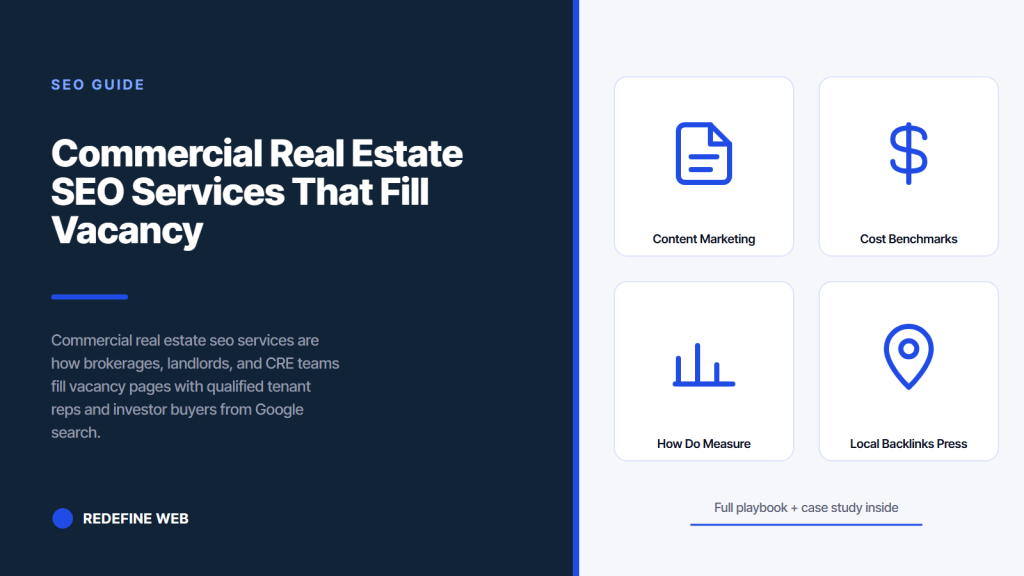
- CRE search rankings move in 8 to 12 weeks with consistent work.
- Organic delivers 30 to 45 percent of introductions by month 12.
- Retainers run $1,500 to $6,000 depending on firm size and coverage.
- Vacancy pages plus submarket content do the real work every month.
- CRE category on GBP is the fastest 30-day ranking move.
- Content marketing feeds the commercial real estate seo funnel long-term
- How long does seo for commercial real estate take to produce leads
- Cost benchmarks for commercial real estate seo services by firm size
- How do you measure roi from commercial real estate seo services
- Local backlinks and press mentions build CRE map-pack authority
- What separates a great commercial real estate seo agency from a bad one
- The launch checklist for seo commercial real estate at rebrand or new office
- What to do this week for commercial real estate seo
Commercial real estate seo services are what turn a CRE brokerage website from a static tombstone of past deals into a working pipeline of tenant reps and investor buyers. You spend a fixed monthly retainer, the site starts ranking for "office space for lease [city]," "industrial warehouse for sale [metro]," and 200 other high-intent CRE queries, and by month 12 the phone rings with brokers representing tenants ready to sign leases. That is the compounding math a CRE firm cannot get from CoStar subscriptions alone.
This guide is the honest breakdown of commercial real estate seo services from a firm that runs the 12-month plan across office, industrial, retail, and multifamily verticals. You get the intent map that separates tenant reps from investor buyers, the vacancy-page structure that ranks and converts, the local pack signals that move CRE map rankings, the cost benchmarks by firm size, and the reporting cadence that ties organic traffic back to signed leases and closings. Bring your last quarter's lead source data and your CoStar spend numbers.
Content marketing feeds the commercial real estate seo funnel long-term
Every high-intent transactional CRE search has 30 to 50 informational searches around it. "What is triple net." "How to negotiate a lease renewal." "What class A vs class B means." Google Ads on those queries wastes budget. Blog content ranks on the same queries at zero variable cost and pulls the reader back when they're ready to lease.
The editorial calendar for a commercial real estate seo agency covering office, industrial, and retail looks like this: month one covers tenant rep questions (four posts on lease negotiation, market rates, tenant improvements, renewal strategy), month two covers investor buyer questions (four posts on cap rates, due diligence, financing, 1031 exchanges), month three covers submarket-specific market posts (four posts per metro area you serve), month four cycles back with deeper topics. Twelve months of that cadence produces 48 blog posts, all indexed, all pulling their share by month 15.
Every submarket post links to your vacancy pages for that area, one adjacent submarket post, and one tenant or investor guide. Six months of submarket posts across 10 areas produces a working local content graph that outranks CoStar's auto-generated submarket pages for local intent queries. That is how seo for commercial real estate compounds through year one.
Answer the whole question in the post. AI Overviews and ChatGPT extract from posts that structure information for extraction. Lead every blog post with a 40 to 60 word direct answer, then deepen the explanation, then close with a broker introduction CTA. Read the details in HubSpot's content marketing guide for the extraction pattern top-performing sites use.
How long does seo for commercial real estate take to produce leads
Search rankings for commercial submarket queries move in 8 to 12 weeks for a new CRE firm domain and 4 to 6 weeks for an established brokerage site. First tenant rep or investor inquiries from organic land in month 3 or 4. Mature yield lands at month 12 to 18.
The 12-week horizon is the honest number to plan against for CRE. Commercial real estate seo companies promising page-one rankings inside 30 days are either using tactics Google penalizes within 90 days or lying about attribution. CRE search queries have lower monthly volume than residential but much higher commercial value per lead. A single ranking for "industrial warehouse for lease [city]" can be worth six-figure commissions per year.
Quick wins do exist. A Google Business Profile that was 40 percent complete jumps to 90 percent complete in one afternoon can pick up map visibility inside two weeks for the "commercial real estate broker [city]" query. A homepage title tag rewrite can move rankings for the flagship submarket term inside three weeks. These are patches, not compounding wins. Real compounding takes 12 months of consistent execution.
The compounding curve for CRE looks flat for the first two months, moves visibly through month 4, and bends upward through month 6. CRE firms that quit at month 4 because "seo isn't working" miss the exact moment the curve starts to compound. Firms that hold through month 12 see the mature yield.
Cost benchmarks for commercial real estate seo services by firm size
Commercial real estate seo services run $1,500 to $6,000 per month on retainer depending on firm size, submarket coverage, and vertical (office, industrial, retail, multifamily). Solo CRE brokers in mid-size markets sit at $1,500 to $2,500. Mid-size brokerages with 5 to 15 agents run $2,800 to $4,500. National firms with 30+ agents and multi-metro coverage pay $4,500 to $7,000 for coverage across submarkets.
Anything under $1,500 usually means no content and no vacancy-page work, just monthly Google Business Profile edits worth about $200 a month of actual value to your CRE firm. Anything over $7,000 for a mid-size brokerage typically includes services you're not ready to use yet. The middle of the range produces the honest yield curve every commercial real estate seo agency delivers when the work stays consistent.
A named CRE-adjacent example: McCarthy Court, a UK property development we ran a launch site for, hit 100 percent occupancy within 3 months of completion and generated 60 qualified buyer leads through the website plus 10,000 targeted campaign visits. The math holds when a CRE brokerage runs the same playbook on submarket vacancy pages with a matching content and citation investment. Another named client, Abels Residential in London, generated 20+ qualified rental leads per month from organic search and ranked on 300+ first-page keywords through consistent citation and content work.
| Firm profile | Monthly retainer | What is included | Time to compounding |
|---|---|---|---|
| Solo CRE broker, one submarket | $1,500 to $2,200 | GBP + citations + 2 posts/mo + on-page | 10 to 14 weeks |
| Mid-size brokerage 5-15 agents | $2,800 to $4,000 | Above + 4 posts/mo + 10 vacancy pages | 10 to 14 weeks |
| National firm 30+ agents | $4,500 to $6,000 | Above + 30 submarket pages + schema audit | 12 to 16 weeks |
| Institutional CRE 100+ agents | $6,000 to $10,000 | Full stack + quarterly audit + link outreach | 12 to 20 weeks |
A fair commercial real estate seo retainer covers the following every month:
- Weekly Google Business Profile posts with fresh vacancies and closings
- Monthly citation audit and correction across the top 30 CRE-specific directories
- Two vacancy or submarket page rewrites per month at 1,200 to 1,800 words each
- Two blog posts per month covering tenant rep, investor buyer, or market questions
- Case-study production every 6 to 8 weeks with named client and real commission numbers
- Local backlink outreach with one to three new links per month from CRE journals, chambers, and adjacent professionals
- Monthly reporting tied to booked broker introductions and submarket ranking
Zillow owns city-level commercial searches. Rank pages for suite size, floor plate, and neighborhood grade instead. Portals cannot rank those variants.
How do you measure roi from commercial real estate seo services
Track three numbers every month: search ranking for the flagship submarket plus property-type query, booked broker introductions attributed to organic search via call tracking and form source tagging, and closed commission revenue tied back to those introductions. Everything else is diagnostic. Impressions, sessions, and bounce rate are input signals, not decisions.
Every seo commercial real estate engagement needs a dedicated call-tracking number placed only on organic landing pages. That number rings the same broker line but logs the source as organic. Set up matching numbers for CoStar leads, LoopNet leads, and email campaigns. Without that setup, the CRE firm has no honest way to know whether the last 15 broker introductions came from organic, from CoStar, or from referrals.
The monthly review meeting runs 60 minutes. Managing broker, marketing lead, and seo contact review the three summary numbers plus one page from Search Console showing top-ranking queries and top-clicked vacancy pages. Decisions come out of the meeting: publish next month's submarket topic, adjust the review-request script for tenants, correct one citation, add one submarket page. Small consistent decisions compound over 12 months.
The final number to watch at year one is the source mix on new broker introductions. A healthy mid-size CRE brokerage with 12 months of seo under it sees 30 to 45 percent from organic search, 20 to 30 percent from CoStar plus LoopNet, 15 to 20 percent from referrals, and the rest from direct or other. If the mix is still 70 percent CoStar at month 12, the seo plan is not compounding and someone needs to ask why.
Local backlinks and press mentions build CRE map-pack authority
General backlinks help every domain rank on the web. Local backlinks are what separate the top-three map pack from position six in every metro. A CRE broker who sponsors the metro CRE journal, speaks at the annual submarket forecast breakfast, joins the ULI local chapter, and contributes quarterly market reports to the regional business journal has four local backlinks a competitor doesn't.
Citations pull in the second lane. Get the CRE firm listed on every directory a search crawler indexes: CoStar broker profiles, LoopNet, CREXi, RealMassive, Better Business Bureau, chamber of commerce, ULI local chapter, and 20+ metro-specific business directories. Every citation carries the same name, address, and phone. Consistent NAP across every citation is a ranking input.
Cross-referral relationships produce backlinks and commission at the same time. Commercial mortgage brokers, tenant improvement contractors, environmental consultants, and CRE attorneys all have websites with local authority. Pick five practitioners whose clients would benefit from your service, meet each one for coffee, and set up a two-way link exchange plus referral tracker.
Press mentions compound. Every time a broker gets quoted in the regional business journal about market conditions, appears on a CRE podcast, sponsors an ICSC event, or writes a guest column for the ULI newsletter, the firm earns a backlink and a mention. Track these in a spreadsheet. Aim for one new local backlink per month across 12 months. The Urban Land Institute chapter directory is a good starting point for finding local CRE events worth speaking at or sponsoring.
What separates a great commercial real estate seo agency from a bad one
A great commercial real estate seo agency quotes 90-day ranking movement, 6-month traffic compounding, and 12-month mature commission attribution. A bad one promises page-one rankings in 30 days. A great agency reports commission revenue tied to organic search. A bad one reports impressions without tying them to closed deals.
Ask three questions before hiring. First: name a specific submarket query your last CRE client ranks first for and how much commission revenue that ranking books each quarter. Second: what tools do you use for CRE-specific rank tracking, citation monitoring, and reporting (BrightLocal, Semrush, Ahrefs, Whitespark)? Third: what does a sample monthly report look like? If it's 40 pages of impression charts with no decisions, the retainer is billing for reporting, not for work.
The best commercial real estate seo companies share three habits. They call you the first week of every month to walk through the report, not email a PDF and disappear. They audit competitor submarket positions monthly and flag when a competitor moves ahead. They flag content topics based on the queries you're already ranking on page two for.
Every managing broker has hired an seo agency that guaranteed page-one rankings for the flagship submarket in 30 days, delivered on it by ranking for "[firm name] commercial real estate brokers LLC office space 2018" (three people searched that phrase all year), and cashed six checks before getting fired. The right response the second time around is asking every agency candidate to name the specific query their last CRE client ranks first for and how much commission that ranking books each quarter. Real answers separate real work from theatre.
The launch checklist for seo commercial real estate at rebrand or new office
Site launches are the moment CRE seo is easiest to get right or hardest to fix later. A launch that went live without a working sitemap, without RealEstateListing schema, and with duplicate title tags across vacancy pages spends the next 6 months undoing the damage. A launch that went live with the whole checklist in place hits the compounding curve inside quarter two.
Every page on launch day has: unique title tag under 60 chars leading with focus keyword; unique meta description under 160 chars; one H1 matching the primary search query; canonical tag pointing to itself; RealEstateListing or LocalBusiness schema block; XML sitemap generated and submitted to Google Search Console; robots.txt open to Googlebot; HTTPS across every URL; call tracking installed on every vacancy page; and CoStar or LoopNet embed loading current inventory live.
The internal-link graph goes live on day one. Homepage links to the top three submarket pages. Each submarket page links to two adjacent submarkets and one tenant or investor guide. Every blog post links to at least one vacancy page and two sibling posts. Every case study links back to the property type it demonstrates.
CRE firms that skip the launch checklist and try to retrofit commercial real estate seo services in month 4 spend two months just fixing schema errors and title-tag conflicts before any content or link work can start. Build the boring foundation once, then spend the next 12 months adding the content that compounds on top.
What to do this week for commercial real estate seo
Pick three actions and finish them by Friday. Compounding rewards operators who move on Tuesday, not planners who research through Q3. Fix the Google Business Profile primary category to Commercial Real Estate Agency (not Real Estate Agency), install a call tracker on every vacancy page, and audit the top five CRE citations.
Those three alone usually move ranking one to two positions inside 30 days on solo profiles and small brokerages. Every week of delay pushes the ranking start date another week down the road, and the competitor already ranking first books the tenant reps.
- Change Google Business Profile primary category to Commercial Real Estate Agency
- Install call tracking on every vacancy page with a dedicated organic-only number
- Audit the top five CRE citations (CoStar, LoopNet, CREXi, Google, BBB) and correct any NAP mismatches
- Rewrite the homepage title tag to lead with primary property type plus city plus one benefit word
- Publish one blog post on the top question a tenant rep or investor asks in the first meeting
- Add RealEstateListing schema to every current vacancy page with correct property data
- Set the first-Tuesday monthly seo review meeting on the managing broker calendar for 12 months
The real estate seo service at Redefine Web covers the wider retainer plan for CRE firms that want the execution off their plate. A 30-minute audit call reviews your current site, submarket rankings, and Search Console dashboard, then hands back a specific 90-day plan.
Commercial real estate seo services are not one clever tactic. They are 12 months of consistent execution across a boring checklist that produces a compounding asset the CRE firm owns for years. The real estate marketing retainer at Redefine Web covers the ongoing execution for firms that want a fixed monthly cost. Adjacent verticals see our professional services seo playbook for the same 12-month plan applied to law firms and CPAs. See the wider real estate marketing agency for full context. Next Friday is when the work starts.
Frequently asked questions
How long do commercial real estate seo services take to book broker introductions?
Search rankings for commercial submarket queries move in 8 to 12 weeks for a new CRE firm domain and 4 to 6 weeks for an established brokerage site. First tenant rep or investor inquiries from organic land in month 3 or 4. Mature yield of 30 to 45 percent of qualified broker introductions from organic search lands at month 12 to 18 with consistent execution across content, citations, reviews, and technical seo. CRE firms that hold through month 12 see the compounding payoff.
How much do commercial real estate seo services cost per month?
Commercial real estate seo services run $1,500 to $6,000 per month on retainer depending on firm size, submarket coverage, and vertical. Solo CRE brokers in mid-size markets sit at $1,500 to $2,500. Mid-size brokerages with 5 to 15 agents run $2,800 to $4,500. National firms with 30+ agents pay $4,500 to $7,000. Anything under $1,500 usually means no content and no vacancy-page work, just monthly Google Business Profile edits worth about $200 a month of actual value to your CRE firm.
Is Google Business Profile part of commercial real estate seo services?
Yes, Google Business Profile is a top-impact input for CRE local rankings because it drives about a third of the qualified broker introductions a CRE firm receives in any given month for local-intent queries. The profile ranks in the map pack for "commercial real estate broker [city]" and appears in Google Maps. A fully populated profile with weekly posts, 20+ recent reviews from tenants and past clients, correct primary category, and accurate hours out-earns most $4,000 CoStar subscription lines at zero direct variable cost per lead.
What pages should a commercial real estate website have for seo?
Every submarket the firm actively brokers deserves a dedicated submarket page targeting the property type plus submarket plus city. At minimum a mid-size CRE brokerage covers 15 to 25 submarket pages across office, industrial, and retail, one page per active broker, one tenant rep guide, one investor buyer guide, one market outlook page updated quarterly, and case study pages per completed deal. Each submarket page runs 1,000 to 1,600 words with RealEstateListing schema, a live inventory embed, and a lead-capture form.
Can a commercial real estate firm do seo in-house without an agency?
Yes, when the firm dedicates one detail-oriented marketing lead for 15 to 20 hours a week to a consistent weekly checklist covering Google Business Profile posts, citation cleanup, vacancy page publishing, review generation from past clients, and local backlink outreach across CRE journals and adjacent professionals. In-house CRE seo matches agency results at about 40 percent of the cost through month 12 to 18. The transition to hiring a commercial real estate seo agency usually pays back when the firm opens a second office or expands into a second metro.
What is the biggest seo mistake commercial real estate firms make?
Setting the Google Business Profile primary category to Real Estate Agency (residential) instead of Commercial Real Estate Agency is the single most common and costly seo mistake for CRE firms. That one setting costs 30 to 60 percent of the profile map-pack visibility because Google ranks profiles largely by category match to the search query. Every "commercial real estate broker [city]" search filters out profiles categorized as residential. The fix takes 45 seconds inside Google Business Profile and produces visible ranking gains within 2 to 4 weeks of the change.
Book your free 30-minute strategy call.
No spam, no sales rep. We use your email to schedule your call with a senior strategist. That is it.
More from the blog
View all articles → SEO
SEO Organic Search Engine Optimization Services That Grow Real Traffic
Read article SEO
SEO SEO for Pet Groomers That Fills the Appointment Book Weekly
Read article SEO
SEO