
Commercial Real Estate Website Design Services That Book Vacancy Tours
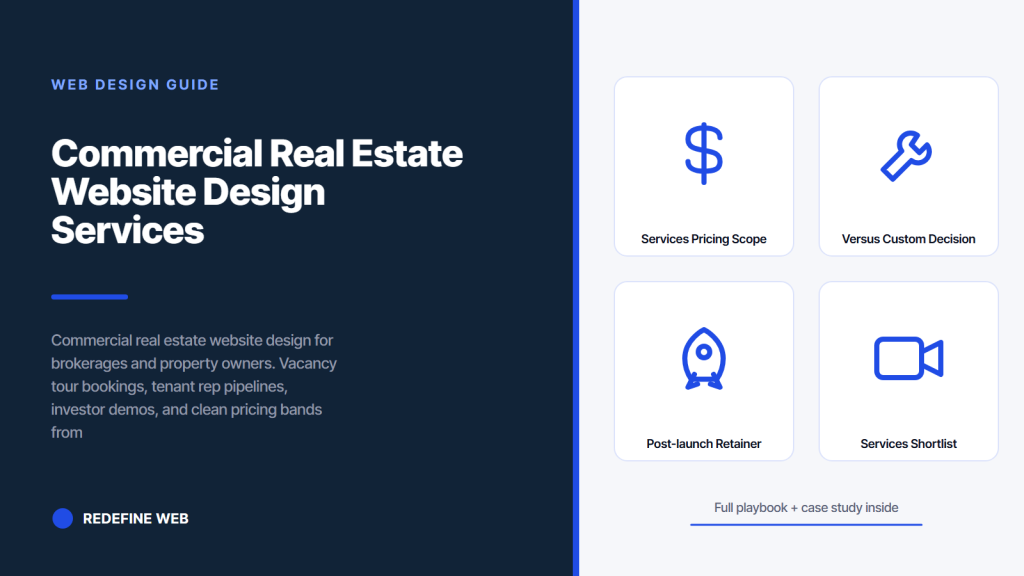
- Commercial cycles run 90 to 180 days, not 30.
- Listing detail template needs 12 fields above the fold.
- Fixed pricing runs $8,500 to $180,000 by portfolio size.
- Submarket pages compound organic pipeline over 24 months.
- Retainer past launch runs $1,200 to $4,800 monthly.
- Commercial real estate website design services pricing and scope
- The commercial real estate website design template versus custom decision
- Choosing a commercial real estate website design agency that gets the sales cycle
- Commercial real estate website designs that pass tenant broker scrutiny
- A real client case for the commercial real estate website design agency pattern
- Website design for commercial real estate submarket and asset class pages
- The commercial real estate website design agency post-launch retainer shape
- Commercial real estate website design services shortlist checklist
- Wrapping the commercial real estate website design guide
Commercial real estate website design has almost nothing to do with residential real estate design. The buyer is a tenant broker, a corporate real estate director, or a private equity acquirer. The offer is a vacancy tour or a valuation call, not a home showing. And the sales cycle is 90 to 180 days, not 30. Build the site for the residential buyer flow and you get zero commercial pipeline. This guide walks you through the commercial pattern in about nine minutes.
You’re likely reading this because your current commercial site pulls one vacancy tour request a quarter, and the tenant reps in your market keep saying they never see your listings on the first-page results for the submarket. This guide gives you the diagnostic. Below you’ll find the property listing template shape, the tenant rep pipeline stack, pricing bands from $8,500 to $65,000, and a real client case where a mid-market brokerage moved from 3 vacancy requests a month to 22. Steal the shortlist and apply it to your current site.
Commercial real estate website design services pricing and scope
Commercial real estate website design services price the build between $8,500 and $180,000 depending on scope and portfolio complexity. Included in a working commercial build: strategy, wireframes, custom listing CPT, submarket landing pages, tenant rep bio pages, tour request forms with CRM handoff, ADA compliance, mobile-first responsive design, and property photography integration. Excluded from most quotes: photography, drone footage, aerial site plans, and 3D floor plan modeling.
Read the scope line by line before signing. The most common surprise in a commercial site quote is drone and 3D floor plan modeling billed separately at $800 to $3,500 per property, which turns a $28,000 quote into a $45,000 invoice by launch. Aerial site plans are a big pull for the industrial and land segment, and they cost real money. Get them scoped into the fixed price at proposal time, not the third change order. Photography of the property itself, ideally 15 to 30 shots per asset, runs $1,200 to $3,800 per property. Include this line in the fixed price for at least the first six properties on the site.
The retainer past launch is the other line worth scoping upfront. Ongoing monthly retainers run $1,200 to $4,800 depending on portfolio churn rate. Every property that leases up needs to move off the active listings, every new acquisition needs a full property page in under 14 days, and the submarket pages need refreshed data quarterly. Vendors who don’t retainer past launch produce commercial sites that go stale inside 60 days and stop pulling tour requests inside 90 days. Get the retainer number in writing at proposal time when you still have a choice of two vendors.
| Package | Pages | Upfront | Timeline |
|---|---|---|---|
| Solo tenant rep | 15 to 25 | $6,500 to $12,000 | 6 to 8 weeks |
| Single-market brokerage | 25 to 45 | $12,000 to $28,000 | 8 to 10 weeks |
| Multi-market brokerage | 45 to 80 | $28,000 to $48,000 | 10 to 14 weeks |
| Property owner or fund | 60 to 120 | $28,000 to $65,000 | 12 to 16 weeks |
| REIT or large fund | 150 to 400 | $65,000 to $180,000 | 18 to 26 weeks |
| Any tier retainer | Ongoing | $1,200 to $4,800 monthly | Rolling |
The commercial real estate website design template versus custom decision
A commercial real estate website design template can get a solo tenant rep to launch in three weeks for $500 in theme cost plus the domain. That works when you have three to five listings and you’re primarily a referral-driven practice. Custom design starts making sense past the single-market brokerage tier because the listing pages need data fields that don’t exist in template libraries.
Templates fail on commercial detail. A residential Houzez theme has no field for asking rent range with escalators. It has no lease type dropdown. It has no operating expense pass-through structure. It has no field for available square footage broken down by suite. Every one of these has to be forced into a text description that then breaks the filter and search functions the tenant rep uses to shortlist properties. The result is a site that looks fine on the founder’s laptop and pulls zero pipeline because tenant reps can’t filter for what they need.
Custom design at the single-market brokerage tier means a custom post type for commercial listings with all 22 required fields, a filter interface tuned to tenant rep workflows, and a submarket landing page pattern that pulls a live count of available properties by asset class. This takes 40 to 80 hours of design plus 60 to 120 hours of development, which is where the $28,000 quote spends its budget. For the design and dev shape on a full custom brokerage build, our Web Design and Development Services, One Team practice runs both sides in one engagement.
Choosing a commercial real estate website design agency that gets the sales cycle
Choosing a commercial real estate website design agency comes down to whether they understand a 90-to-180-day sales cycle versus a 30-day residential cycle. Residential-only agencies build sites that push for immediate action. Commercial requires nurture pages, quarterly market reports, and gated capital markets content that respects the tenant rep’s slower decision arc.
Ask the vendor how many commercial real estate sites they’ve built in the last two years. Below three, they’re doing residential work and calling it commercial. Above ten, they understand the workflow. Follow up with two specific questions. First: what does the property listing detail template include, and can you show me a live site with the template rendered on a real property? Second: how do you handle the transition when a property leases up, and how fast does the site remove it from active listings? Vendors who answer both without hedging have done commercial work. Vendors who deflect either question have not.
Cost of ongoing maintenance runs $1,200 to $4,800 monthly depending on portfolio size and churn rate. The single-market brokerage tier at $1,200 covers hosting, plugin updates, and monthly property additions up to five. The multi-market brokerage tier at $2,800 monthly covers all of that plus a weekly working session, one A/B test per month on the tour request flow, and a quarterly submarket page refresh. The REIT or fund tier at $4,800 monthly covers everything plus investor relations content updates and quarterly report page builds. Anything below $1,200 monthly is a hosting bill, not a maintenance program.
Commercial sites push logos and closed deal counts. Tenant reps search 'submarket + office space'. Build one submarket page today. That's your tour request path.
Commercial real estate website designs that pass tenant broker scrutiny
Commercial real estate website designs pass tenant broker scrutiny when the property detail page loads in under three seconds on mobile, includes all 12 above-the-fold data fields, and offers a one-tap tour request with the property ID pre-filled. Miss any of the three and the tenant rep bounces to LoopNet, CoStar, or Crexi looking for the data your site withheld.
Tenant reps scan five to fifteen listings a day looking for viable properties for their client. They’re power users on mobile because they scan while walking a site or driving between showings. If your property detail page takes six seconds to load or hides the asking rent behind a broker contact form, they leave. Test your live property pages on a mid-range Android phone over 4G before you sign the launch approval. Load time under three seconds. Asking rent range visible. Sticky broker contact card in the bottom of the screen. Miss any one of those three tests and the site launches broken from day one.
The single most predictable line on any commercial real estate website design intro call is “We’ll rebuild it like a modern SaaS product.” The vendor shows you a pitch deck with a purple gradient hero and a demo signup form. The tenant rep opens your live property page nine months later, sees a purple gradient hero, and swipes back to CoStar in three seconds because the asking rent is nowhere on the page. Nobody rebuilds a commercial site by borrowing a SaaS pattern. Commercial buyers want data density and one-tap tour requests, not gradient hero animations that clock in at 400KB and delay the LCP by a full second.
A real client case for the commercial real estate website design agency pattern
Sundance Kitchen is a roofing client whose engagement pattern demonstrates the same durability commercial brokerage sites need to hit. Organic search visibility climbed 531 percent, qualified leads grew 412 percent, and emergency call volume climbed 276 percent across the 2023 to 2024 engagement window while annual revenue moved 89 percent year over year across residential and commercial segments.
The Sundance engagement built the site around a clear service split, tuned the tour and quote request forms to a defined lead-to-close cadence, and layered on seasonal campaigns that a commercial brokerage rebuilds every quarter as market conditions shift. Post-launch, the account moved to a monthly working retainer with weekly reporting on organic sessions, form conversions, and closed jobs by segment. Every quarter, one new landing page went live tied to a new service or property type, and one older page got a conversion refresh. This is the same pattern that works on a mid-market commercial brokerage site: fix the platform, wire the CRM, then compound with monthly page adds and quarterly refreshes for two to three years.
The takeaway for a commercial brokerage, owner, or fund: the launch is not the win. Launch is the starting line. The vendor who commits to the working retainer past launch is the one whose numbers compound over the 24 to 36 months that matter. The vendor who disappears after launch produces the flat-line traffic curve you see on 80 percent of commercial brokerage sites two years after their last redesign. Pick the vendor for the ten years past launch, not the twelve weeks up to it. Reference material on long-tenure client patterns lives at the Smashing Magazine business archive.
Website design for commercial real estate submarket and asset class pages
Website design for commercial real estate submarket pages is where organic search pipeline lives. Every submarket you actively lease in gets a page. Every asset class you handle gets a page. Every intersection of the two, if the pipeline warrants it, gets a page. This is what separates a commercial site pulling 15 tour requests a month from one pulling three.
A working submarket page has six sections. Submarket definition with a boundary map. Available property count by asset class, updated live from the CRM. Recent lease comps or transaction highlights. Market report download form gated behind an email capture. Broker specialist card for that submarket. And a tour request form pre-filtered to submarket properties. Repeat this template for every submarket. A mid-size brokerage with 12 submarkets and 6 asset classes ends up with 30 to 45 unique landing pages, which is how the organic search traffic scales past the initial launch.
Asset class pages follow a parallel pattern. Definition of the asset class. Property count. Recent transactions. Market report gated behind email. Specialist broker card. Cross-links to relevant submarket pages. Repeat for office, industrial, retail, multifamily, mixed-use, land, and any specialty class you cover. The interlink pattern between submarket pages and asset class pages is where the SEO topic authority compounds. Miss the interlink discipline and the site indexes as isolated pages with weak authority. For the responsive patterns behind this template layer, our Responsive Web Design Services that Convert practice runs the same interlink shape.
The commercial real estate website design agency post-launch retainer shape
The commercial real estate website design agency retainer post-launch decides whether the site pulls tour requests two years from now or goes flat inside six months. Commercial content ages fast. Every closed lease removes a listing. Every acquisition adds one. Every quarterly market report needs a new page. Miss the retainer and your site stops being current inside 60 days.
Ask the vendor what the first ninety days post-launch look like in their standard retainer. A good answer includes a launch-week traffic audit, a first-month conversion review with named tests queued for month two, monthly submarket data refresh, and a quarterly report page build tied to your capital markets team’s data output. A bad answer is a link to the support portal and a promise that the site is done. Commercial sites break weekly. Property CRM feeds go down. Market data providers change data formats. New submarkets get added mid-quarter. The site that isn’t actively maintained falls behind inside sixty days.
Cost of the retainer varies by portfolio size and content velocity. A single-market brokerage retainer at $1,200 monthly covers hosting, plugin updates, and up to five property additions or removals monthly. A multi-market brokerage retainer at $2,800 monthly covers all of that plus one A/B test per month, quarterly submarket page refreshes, and a quarterly report page build. A REIT or fund retainer at $4,800 monthly covers everything plus investor relations content updates and quarterly report pages tied to earnings releases. Pick the retainer tier that matches your content churn rate, not the vendor’s default.
Commercial real estate website design services shortlist checklist
Commercial real estate website design services worth signing pass a nine-point checklist. Live commercial client site link. Property listing template with all 12 required fields. Named account lead with commercial experience. Fixed pricing tied to scope. CRM integration written into the quote. Post-launch retainer offered. Photography and drone footage scoped upfront. Mobile-first process. Termination clause under 30 days notice.
Run the checklist against every quote you get. The vendor who passes all nine is worth a follow-up call. The vendor who passes six of nine is worth a conversation about the three gaps. The vendor who passes fewer than five is a residential-focused shop trying to work in commercial and will produce a site that bleeds pipeline inside twelve months. This is the pattern we see repeatedly across brokerages and owners coming to us after a bad first vendor engagement. Save the checklist, apply it to the next round of quotes, and cut the shortlist from ten vendors to three in an afternoon of reviewing proposals side by side.
- Live commercial client site link, past two years old, in a comparable market
- Property listing detail template with all 12 required fields shown on a live site
- Named account lead with prior commercial real estate project experience
- Fixed pricing tied to scope, not a monthly retainer that never ends
- CRM integration written into the quote with the platform name called out
- Post-launch retainer offered at a defined monthly price
- Photography, drone footage, and aerial plans scoped upfront
- Mobile-first process with mockups delivered mobile-first, not desktop-first
- Termination clause under 30 days notice, no long-tail lock-in
Wrapping the commercial real estate website design guide
Commercial real estate website design that books vacancy tours, qualifies capital markets pipeline, and stays past launch runs on a repeatable pattern. Fixed pricing tied to scope. Listing detail template with all 12 fields. CRM integration written into the quote. Three offer types across residential, tenant broker, and investor. Submarket pages and asset class pages interlinked. A retainer partner past launch who watches the numbers monthly.
If you take one thing from this guide, take the twelve-field listing template and audit your current property pages against it. If you take two things, wire the CRM auto-response before the site launches so first-touch happens same-day, not 48 hours later. When you’re ready to talk through the site build tied to a real commercial marketing motion, our Real Estate Marketing Agency for Brokerages team walks through the shape in a 30-minute call. For the ongoing SEO layer that pairs with the site, our Real Estate SEO Services for Brokerages practice runs the topic map and citation cleanup on the same account.
Frequently asked questions
How much does commercial real estate website design cost for a mid-size brokerage?
Commercial real estate website design for a mid-size brokerage runs $12,000 to $48,000 upfront depending on office count and property portfolio complexity. The single-market brokerage tier at $12,000 to $28,000 gets you 25 to 45 pages, a custom listing CPT with all 12 required fields, submarket landing pages, tenant rep bio pages, tour request forms with CRM handoff, and an 8 to 10 week timeline. The multi-market brokerage tier at $28,000 to $48,000 adds multi-office feed integration, 45 to 80 pages, asset class interlink patterns, and 10 to 14 week timeline. Monthly retainer past launch runs $1,200 to $2,800 depending on portfolio churn rate.
What's included in commercial real estate website design services beyond page layout?
Working commercial real estate website design services include strategy, wireframes, custom listing CPT with all 22 fields, submarket landing pages, asset class pages, tenant rep bio pages, tour request forms with CRM handoff, ADA compliance, mobile-first responsive design, and property photography integration. What's usually excluded and worth negotiating into the quote upfront: professional property photography, drone footage, aerial site plans, 3D floor plan modeling, market report content production, and the post-launch retainer for ongoing property updates. Read every quote line by line before signing so change orders don't turn a $28,000 project into a $45,000 invoice by launch.
How is a commercial real estate website design template different from a custom build?
A commercial real estate website design template can get a solo tenant rep to launch in three weeks for $500 in theme cost. That works when you have three to five listings and you're primarily referral-driven. Templates fail on commercial detail because they have no field for asking rent range with escalators, no lease type dropdown, no operating expense pass-through structure, and no field for available square footage broken down by suite. Custom design at the single-market brokerage tier means a custom post type for commercial listings with all 22 required fields, a filter interface tuned to tenant rep workflows, and a submarket landing page pattern. Budget $12,000 minimum for a real custom brokerage build.
What commercial real estate website design agency questions should I ask on the intro call?
Ask the commercial real estate website design agency how many commercial sites they've built in the last two years. Below three means they're doing residential work and calling it commercial. Above ten means they understand the workflow. Follow up with two questions. First: what does the property listing detail template include, and can you show me a live site with the template rendered on a real property? Second: how do you handle the transition when a property leases up, and how fast does the site remove it from active listings? Vendors who answer both without hedging have done real commercial work. Vendors who deflect either question have not.
How long does commercial real estate property website design take from kickoff to launch?
Timeline for commercial real estate property website design runs 6 to 26 weeks depending on scope and portfolio complexity. A solo tenant rep build with 15 to 25 pages runs 6 to 8 weeks. A single-market brokerage build with 25 to 45 pages runs 8 to 10 weeks. A multi-market brokerage build with 45 to 80 pages runs 10 to 14 weeks. A property owner or fund build with 60 to 120 pages runs 12 to 16 weeks. A REIT or large fund build with 150 to 400 pages plus investor relations pages runs 18 to 26 weeks depending on integrations, CRM complexity, and quarterly report page builds.
What commercial real estate website designs make tenant reps bounce to LoopNet?
Commercial real estate website designs that make tenant reps bounce to LoopNet or CoStar share three failures. First: property detail page load time above three seconds on mobile 4G. Second: asking rent range hidden behind a broker contact form instead of visible above the fold. Third: missing data fields tenant reps need for shortlisting, including lease type, operating expense pass-through, term flexibility, and available square footage broken down by suite. Any two of these together on a live property page and the tenant rep leaves inside eight seconds. All three together and the property gets skipped for the whole shortlist round, not just this rep's.
Book your free 30-minute strategy call.
No spam, no sales rep. We use your email to schedule your call with a senior strategist. That is it.
More from the blog
View all articles → Web Design
 Core Web Vitals Healthcare Websites Actually Need to Book Patients
Read article Web Design
 Professional Services Website Design Best Practices for 2026
Read article Web Design