
Content Marketing for Fashion Brands Pillars and Formats
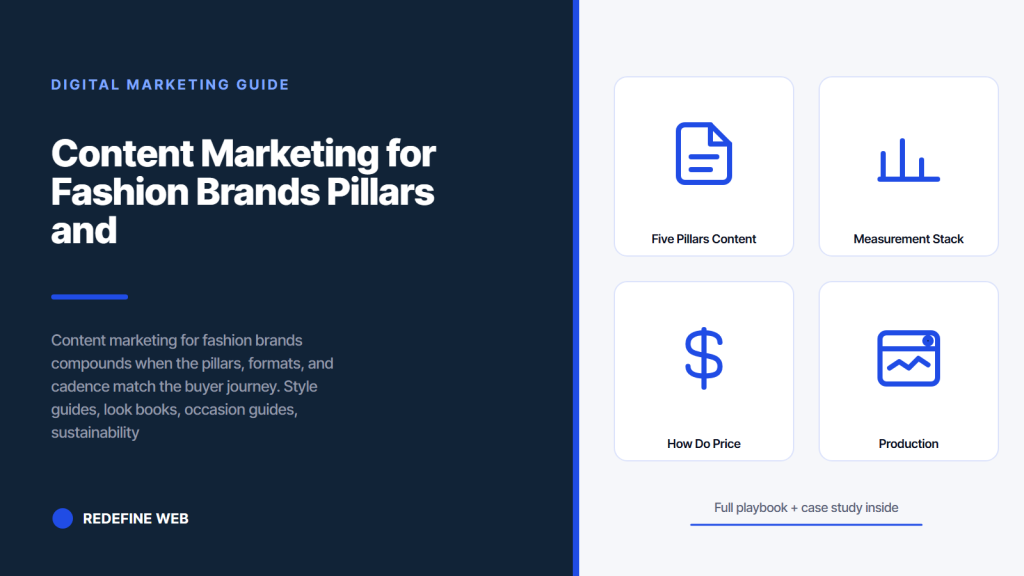
- Pillars are style, occasion, sustainability, brand editorial, drops.
- Every pillar ships across blog, video, email, and short form.
- Repurpose one long piece into 8 to 12 downstream assets.
- Cadence beats volume on apparel content programs.
- Content only compounds when linked to product pages.
- What content marketing for fashion brands really means
- The five pillars of content marketing for fashion brands
- Format matrix inside content marketing for fashion brands
- Cadence table for content marketing for fashion brands
- The repurposing math that makes content marketing for fashion brands scale
- Internal linking inside content marketing for fashion brands
- Paid and earned amplification of content marketing for fashion brands
- Measurement stack for content marketing for fashion brands
- How do you price content marketing for fashion brands honestly
- Content marketing for fashion brands in production
- The weekly review that keeps content marketing for fashion brands honest
- Where content marketing for fashion brands fits the wider stack
A DTC apparel founder we onboarded last winter opened the first meeting with a Notion board full of blog drafts, a pinboard full of screenshots, and an ad account bleeding $86 blended cost per acquisition. She asked which piece of content to write next. The right answer was none of them until the plan named the pillars first. Content marketing for fashion brands only compounds when style guides, look books, occasion guides, sustainability stories, and brand editorial roll up to one topic map with one publishing cadence and one weekly review meeting that stays honest about what worked and what fell flat.
This guide covers the working version of content marketing for fashion brands our team runs for DTC apparel and accessories labels between $80,000 and $2 million monthly. You will see the five pillars, the format matrix, the cadence table by revenue band, the repurposing math that turns one long piece into eight downstream assets, the measurement stack that reads honestly at week four, and the case study behind a Swedish resale program that grew organic revenue 174 percent in twelve months. Everything below runs on real programs our apparel and fashion marketing hub supports every quarter.
What content marketing for fashion brands really means
Content marketing for fashion brands is an editorial engine that publishes style, occasion, sustainability, and brand story across blog, video, email, and short form on a fixed weekly cadence tied to product drops, seasonal peaks, and search intent buyers actually type at each moment.
Most apparel programs under $600,000 monthly run content as a side desk staffed by one social manager who posts Reels and a freelance blogger who ships one post a month. The two operations never talk, never link to each other, and never roll up to a single growth number. That fractured setup is why 68 percent of DTC apparel founders we audit report content as busy but not measurable, and it is the first thing our pod fixes on any new engagement. A working editorial engine names the five pillars, assigns an owner to each, ships across four to six formats per pillar, and reads the assisted revenue number every Monday morning.
Content as growth infrastructure
The founder decision the plan protects is treating content as growth infrastructure, not marketing collateral. Growth infrastructure earns its own line on the P&L, gets a named owner, holds a fixed publishing cadence, and reports assisted revenue against a documented target. Marketing collateral gets written when the social manager has time, ships when a paid campaign needs a landing story, and never rolls up to a revenue number. Programs that treat content as infrastructure grow brand search 40 to 90 percent inside twelve months. Programs that treat it as collateral plateau their organic revenue quarter after quarter while the ad budget carries the whole load. That single reframe is worth 15 to 25 percent revenue gain in the following year with no new channel spend.
The five pillars of content marketing for fashion brands
Every apparel brand builds its editorial engine on five pillars. Style guides. Look books. Occasion guides. Sustainability stories. Brand editorial. Each pillar targets a distinct buyer intent, ranks for a distinct keyword cluster, and ships across a distinct format mix. Programs that pick fewer than three pillars produce thin editorial engines that never build the topical authority Google’s helpful content system rewards.
For editorial writers wiring category structure, image SEO, and seasonal republishing into a single blog operating plan, our seo tips for fashion blogging writeup covers the site graph fixes that produce compounding organic traffic without adding a post to the archive.
Style guides and look books
Style guides answer the how to wear questions buyers type into search. How to style a wrap dress. How to wear cowboy boots in fall. How to layer a linen shirt for summer. Each guide ranks for a two to four thousand monthly search volume keyword and drives eight to fifteen percent of first order revenue on a healthy fashion year. Look books show the collection as a visual story with model, mood, location, and price point. Both pillars pair with a working fashion SEO services program that maps the keyword clusters to the pillar plan before a single piece gets written.
Founders scoping the higher-end tier of the roster should also read our guide to luxury fashion marketing for the scarcity, VIC retention, and brand versus performance ratios that separate luxury programs from mass market DTC apparel.
Occasion guides and sustainability stories
Occasion guides target buyer intent tied to a life event. Wedding guest dresses under $200. Work trip capsule wardrobe. Holiday party outfits for over 40 audiences. Each ranks for a high intent commercial query and converts at 4 to 7 percent when linked correctly to product pages. Sustainability stories cover materials, factory choices, water usage, and end of life. Fashion buyers who read one sustainability page spend 22 percent more per order and repeat 30 percent faster than buyers who never touch the sustainability content, based on Klaviyo cohort data across the twelve DTC apparel accounts we ran through the same test last year.
Format matrix inside content marketing for fashion brands
Each pillar ships across six formats. Blog post. YouTube video. Instagram Reel. TikTok. Email newsletter. Pinterest board. The format matrix turns one editorial idea into eight to twelve downstream assets, which is the multiplier that makes the retainer math work at a mid market apparel scale.
Long form as the anchor
The blog post is the anchor asset every other format repurposes from. A 1,800 word style guide gets cut into a 90 second Reel, a 60 second TikTok, a 4 minute YouTube explainer, a 400 word email newsletter, and a Pinterest board with 12 pins. One writer plus one video editor produce the whole set in nine to fourteen hours per pillar week when the workflow is documented and the templates stay locked. Programs that skip the anchor and ship straight to short form miss the search traffic entirely and burn creative hours on assets that rarely rank beyond the first 48 hour spike.
Short form as the discovery layer
Short form video handles the discovery layer where new buyers meet the brand. Instagram Reels and TikToks pull cold audiences into the top of the funnel at 8 to 22 cent cost per view when paired with a strong hook and a specific product story. The math holds only when the short form clip drives to a blog anchor or product page that converts. Programs that treat short form as a standalone channel earn views without earning revenue. Programs that treat short form as the top of a funnel that ends on a product page convert 3 to 7 percent of the paid clicks into first orders. The social media marketing for fashion brands playbook covers the platform math in more depth.
Blogger ships monthly, social posts daily, neither links. Kill silos this week. Pick one topic map, one growth number. 68% of DTC apparel content never measures back.
Cadence table for content marketing for fashion brands
Cadence is the second decision after the pillar plan. Too fast burns the writer and the video editor inside two quarters. Too slow lets competitors outpublish the brand on cluster keywords and stalls the topical authority build. The right cadence depends on the brand’s revenue band, and it holds constant once picked rather than shifting week to week based on the founder’s mood.
| Revenue band | Blog posts | YouTube videos | Reels per week | TikToks per week | Email sends | Pinterest boards |
|---|---|---|---|---|---|---|
| Under $80K monthly | 2 per month | 1 per month | 2 | 3 | 1 per week | 1 per month |
| $80K to $250K monthly | 4 per month | 2 per month | 3 | 4 | 1 per week | 2 per month |
| $250K to $600K monthly | 6 per month | 2 per month | 4 | 5 | 2 per week | 4 per month |
| $600K to $1.5M monthly | 8 per month | 4 per month | 5 | 6 | 2 per week | 4 per month |
| Above $1.5M monthly | 10 per month | 4 per month | 6 | 8 | 3 per week | 6 per month |
The cadence table assumes the pod has a writer, a video editor, and an email manager either in house or on retainer. Brands publishing under 2 blog posts per month rarely earn compounding traffic gains from content because the cluster never reaches the 8 to 10 page depth Google’s topical authority signal rewards. Brands publishing over 12 blog posts per month without a strong editorial process usually publish thin pages that dilute the site’s ranking momentum rather than build it. Cadence is a strategic choice, not a productivity target. Locking a single cadence for 90 days and holding it produces the compounding measurable gains an apparel program needs across a full editorial year without burning the team into quarterly turnover cycles that reset the whole engine.
The repurposing math that makes content marketing for fashion brands scale
Repurposing is the second lever that decides whether the editorial engine scales or grinds. One 1,800 word blog post produces eight to twelve downstream assets when the workflow is documented. Two Reels. Two TikToks. One YouTube edit. One email newsletter. One Pinterest board. One podcast clip if the brand has a podcast. One creator kit brief. The multiplier is the reason retainer math works at $599 per month starting scope.
The nine hour production week
A working production week runs nine to fourteen hours for one pillar week of output. Two hours to research and outline the anchor blog. Three hours to write it. Two hours to shoot short form assets against the outline. Two hours for the video editor to cut Reel, TikTok, and YouTube. One hour for the email manager to write the newsletter. One hour to build the Pinterest board. The workflow assumes documented templates and a shot list handed to the model or creator before the shoot day. Programs without documented templates spend 22 to 35 hours per pillar week producing the same volume, which is why in house teams burn out inside two quarters.
Assets that never touch the blog
Some short form clips originate outside the pillar plan. Creator seeded content. Behind the scenes clips from a shoot day. Founder answers to community questions posted on Substack. These assets live outside the pillar cadence and follow their own rhythm at 2 to 4 pieces per week. Programs that force every asset through the pillar template lose the freshness that short form audiences reward. Programs that never document the pillar template produce inconsistent output and blame the creators. The right split runs 70 percent pillar aligned output and 30 percent creator or founder driven content across a healthy quarter.
Internal linking inside content marketing for fashion brands
Internal linking is the third artifact of a working editorial engine. It is also the artifact most apparel brands skip because it feels invisible while the shoot day and the Reel drop feel visible. The invisible layer is where topical authority actually compounds inside a fashion site.
Pillar to cluster reciprocity
Every cluster page links to its pillar page at least once in natural body prose. Every pillar page links back to its top three cluster pages inline and links to every cluster page in a related reading block at the end. Style guide clusters link back to the collection page they support. Look book pages link to the product pages featured in the shoot. Occasion guides link to the collection filter that matches the intent. Sustainability stories link to the materials page. The pattern is boring but the ranking gains from getting the linking right run 40 to 90 percent on the linked to pages inside 8 to 12 weeks, which is why every retainer starts with a linking audit.
Anchor discipline that works
Anchors that read learn more or shop the look pass no ranking signal. Anchors that read complete guide to styling a wrap dress or wedding guest dresses under two hundred pass strong ranking signal. Apparel brands that fix nothing else about their internal linking except anchor discipline see ranking gains on the linked to pages within eight to twelve weeks. That is one of the cheapest wins available inside the retainer and the first fix our pod ships on week two of every engagement. The fashion marketing agency guide covers the wider linking audit workflow.
Paid and earned amplification of content marketing for fashion brands
Amplification is what turns a published pillar into revenue. Publishing without amplification produces a page that ranks slowly and a Reel that dies inside 48 hours. Fashion programs that budget for amplification at the plan stage capture the compounding gain in month two. Programs that leave amplification for after publishing catch the gain twelve months late.
Paid amplification math
Paid amplification runs at 15 to 25 percent of the content production cost as a budget line. A pod producing $12,000 monthly in editorial output allocates $1,800 to $3,000 to paid amplification across Meta boost, Pinterest promoted pins, and TikTok Spark Ads. The math holds when the paid clicks drive to a blog anchor page that converts at 2 to 4 percent to email capture and at 0.8 to 1.8 percent to first order. Programs that boost every post equally lose money on the flat performers. Programs that boost only the top quartile winners return 4 to 7 times on the paid dollar. Meta’s creative best practices reference covers the paid social discipline every apparel content team should read before scoping quarterly boost budget.
Earned amplification through creators
Earned amplification runs through creator seeding, PR outreach, and the pinboard. A working creator program seeds 15 to 30 creators per quarter with the collection plus a shot list tied to the pillar plan. Fifteen to twenty percent produce organic content that gets picked up outside the paid roster, which grows brand search 12 to 22 percent inside two quarters. The seeding cost sits at $8,000 to $22,000 per quarter depending on creator tier and gifting rules. The fashion influencer marketing guide covers the tier math in more depth.
Measurement stack for content marketing for fashion brands
Measurement closes the loop on the plan. Content that never gets measured never gets improved, and the pod ends up publishing the same style guide template every quarter without checking whether the original one ever paid its cost per hour. The right measurement stack reads six numbers on one dashboard every Monday morning before the review meeting kicks off.
The six KPIs that matter
- Organic sessions per pillar cluster from Google Search Console at week 4 and week 12.
- Assisted conversion revenue per blog cluster from Google Analytics 4 attribution model.
- Email revenue attributed to editorial sends from Klaviyo campaign reporting.
- Short form saves and shares per Reel or TikTok from platform native analytics.
- Repeat purchase rate on buyers who read the pillar page before first order via Klaviyo cohort.
- Brand search growth on Google Trends quarter over quarter for the label name plus category.
Programs that read only pageviews on the blog dashboard miss the assisted revenue that drives 60 to 80 percent of the compounding gain over a full year. Founders who read all six numbers weekly catch the drift inside 30 days and adjust the plan before the quarter closes. Founders who read only Meta return on ad spend catch the drift 90 days late. Google’s attribution model documentation is the source every founder should read before arguing about which number is correct on the weekly review call.
How do you price content marketing for fashion brands honestly
Honest pricing for content marketing for fashion brands runs on three variables. Pillar count active in the plan. Format count per pillar. Production cadence per format each week. The retainer starts at $599 monthly on a 6 month contract at the two pillar tier and scales from there based on the pod math.
A launch year brand under $80,000 monthly runs a lean plan with two pillars, four formats, and a single writer plus part time video editor at $2,400 to $4,800 monthly production plus $599 to $1,400 retainer for planning and review. A brand at $250,000 to $600,000 monthly runs four pillars, six formats, and a full pod of writer, editor, and video producer at $8,000 to $18,000 production plus $2,400 to $5,000 retainer. Brands above $1.5 million monthly run all five pillars, seven formats, and a dedicated content pod at $20,000 to $60,000 production plus $5,000 to $12,000 retainer with monthly measurement audit and quarterly editorial refresh built into the scope.
Founders scoping the wider agency side should also read our what is fashion marketing primer for the broader channel context that decides which pillars deserve budget in a given quarter. Content pricing that ignores the channel context produces plans that ship editorial into a growth stack that never routes buyers to the pillar pages in the first place, which is the single most common budget waste we audit at the mid market stage.
Content marketing for fashion brands in production
RAFZ Cirkulära Interiörer came to our team with a Swedish resale program built on Shopify running the same content problem most sustainable apparel brands run at the $180,000 monthly stage. Blog posts existed but ranked nowhere past position 20. The Reels feed had 4,200 followers and a 0.6 percent engagement rate. Email was sending one weekly campaign at a 12 percent open rate. Pinterest was empty. The sustainability story was the strongest asset the brand owned and nobody had written it down.
Our team rebuilt the plan around the five pillars. Wrote 18 sustainability story anchors in the first quarter covering material sourcing, factory tours, water usage, and end of life reuse math. Repurposed each anchor into 2 Reels, 2 TikToks, 1 YouTube edit, 1 email newsletter, and 1 Pinterest board. Fixed the internal linking so every pillar page routed to the collection filter that matched the intent. Locked cadence at 6 blog posts per month, 4 Reels weekly, and 2 email sends weekly. Assigned ownership to the brand’s marketing coordinator with our pod supporting on writing, editing, and video production.
Twelve months in, organic sessions grew 174 percent, brand search on Google Trends grew 88 percent quarter over quarter, and blended cost per acquisition on the paid social side dropped from $64 to $29 as the pillar content qualified buyers before the ad. Email revenue climbed to 32 percent of total revenue on the Klaviyo attributed number. Repeat purchase rate at day 90 grew from 18 percent to 34 percent. The content plan did not drive all the gain alone. It made the brand into a program where every published piece routed buyers toward the same pillar map that compounded over the twelve months.
The weekly review that keeps content marketing for fashion brands honest
The Monday review meeting is where a content plan earns the right to keep spending. 45 minutes, three agenda items, one decision. Read the reconciled dashboard. Review the top and bottom three pieces by assisted revenue and organic session growth. Decide whether the current pillar continues into next week, gets a format pivot, or gets retired. The founder is invited and expected to make the retire decision when the numbers warrant it.
Every apparel Monday review meeting eventually reaches the moment where somebody points at a blog post from 2022 titled 5 Ways to Wear a Trench and asks why the retainer is billing to update it. Nobody remembers commissioning it. Nobody has read it since the shoot week. Its all time traffic is 89 sessions and its assisted revenue is $12. The polite thing is to retire it. The founder will insist on keeping it. Somewhere in the archive of every fashion brand’s Shopify blog, a 2022 post on trench styling is quietly generating more Monday meetings about itself than actual orders about anything.
The retire rule is simple and it holds across every pillar. Zero organic sessions in the last 90 days plus zero assisted revenue in the last 180 days plus zero internal links from live content triggers a retire decision. The URL either gets 301 redirected to the closest live pillar page or gets rewritten from scratch as part of the next quarter’s editorial refresh. Programs that keep dead posts alive out of nostalgia produce sitemaps bloated with 200 to 400 pages that never rank, which caps the topical authority of the pillars that do earn their rank. Retiring 30 to 60 dead posts per year is the boring hygiene that keeps the compounding gain intact.
Where content marketing for fashion brands fits the wider stack
Content marketing for fashion brands sits under the wider marketing plan and above the tactical channel work inside the growth stack. Every SEO, paid social, email, and creator investment either compounds through the pillar plan or fights against it. Programs that budget for tactics without a pillar plan produce busy months with soft brand search. Programs that build the pillar plan first produce quarters where every published post, Reel, and email adds up to a single growth arc the founder can defend on the quarterly board deck.
The retainer that runs the pillar plan starts at $599 monthly on a 6 month contract and scales with revenue band, pillar count, and format volume. The retainer covers pillar plan, editorial calendar, weekly review meeting, production coordination, and quarterly measurement audit. Founders scoping the wider agency side should read our digital marketing for fashion brands guide for the broader deliverable list, the retainer tier math, and how the pillar plan slots into the wider paid, brand, and retention stack the pod runs against every quarter.
Two outside reads worth an hour before the first pillar cycle kicks off. The Content Marketing Institute strategy guide covers the wider industry framing on pillar planning across sectors. Meta’s creative best practices reference above covers paid amplification. Both are free and both are worth reading before the founder signs the retainer scope. A pillar plan built without the outside context tends to copy competitor cadences without checking whether the competitor’s revenue math actually works, which is why so many apparel content plans publish 30 pieces a month and grow brand search by 4 percent instead of the 40 percent the founder was promised at kickoff.
Frequently asked questions
What does content marketing for fashion brands include?
Content marketing for fashion brands includes five pillars working together as one editorial engine. Style guides teach buyers how to wear the product across seasons. Look books show the collection as a story with model, mood, and place. Occasion guides target buyer intents like wedding guest, holiday party, or work trip. Sustainability stories cover materials, factory choices, and end of life. Brand editorial covers the founder story, factory tour, and creator collabs. Each pillar ships across blog post, YouTube video, Instagram Reel, TikTok, email newsletter, and pinboard. The output rolls up to one growth number the pod defends together every Monday.
How often should a fashion brand publish content?
A fashion brand between eighty thousand and six hundred thousand dollars monthly publishes one long blog post per week, two YouTube videos per month, three Reels per week, four TikToks per week, one weekly email, and one weekly Pinterest board. Brands under eighty thousand halve the cadence and lean harder on short form. Brands above six hundred thousand add a second weekly blog and monthly livestream shopping. The cadence holds constant once picked. Programs that flex the cadence week to week produce inconsistent output that confuses the writer and dilutes the compounding gains.
How does content marketing for fashion brands drive revenue?
Content marketing for fashion brands drives revenue in three ways. Organic search brings new buyers through pillar pages ranking on high intent queries like wedding guest dresses under two hundred. Owned channels like email and pinboards drive repeat purchase revenue at thirty to forty percent share of the retention P&L line. Brand editorial qualifies buyers before they see a paid social ad, which drops cost per acquisition twenty to thirty five percent inside two quarters. Programs that only publish the blog and never repurpose across email and short form leave sixty percent of the revenue on the shelf.
Which content pillars work best for DTC apparel brands?
The five pillars that work for DTC apparel are style guides, look books, occasion guides, sustainability stories, and brand editorial. Style guides answer how to wear questions and rank for high volume search terms. Look books show the collection with narrative and get the pinboard and creator amplification. Occasion guides target buyer intent like holiday party or work trip. Sustainability stories move brand trust for the twenty percent of buyers who value the story. Brand editorial covers the founder, factory, and campaign context that qualifies buyers before they arrive at the product page. Programs that pick fewer than three pillars produce thin editorial engines.
How do you measure content marketing for fashion brands?
Content marketing for fashion brands measures against a KPI stack that reads honestly at week four and week twelve. Organic sessions per pillar. Assisted conversion revenue per blog cluster. Email revenue attributed to editorial send flows. Short form saves and shares per Reel or TikTok. Repeat purchase rate on buyers who read the pillar page before the first order. Brand search growth on Google Trends quarter over quarter. Six numbers, one dashboard, one weekly review. Programs that read only pageviews on the blog dashboard miss the assisted revenue that drives eighty percent of the compounding gain over a full year.
Book your free 30-minute strategy call.
No spam, no sales rep. We use your email to schedule your call with a senior strategist. That is it.
More from the blog
View all articles → Digital Marketing
 Dental Marketing Tips That Compound Into New Patients
Read article Digital Marketing
 Ecommerce Marketing Strategies That Drive Real DTC Revenue
Read article Digital Marketing