
Digital Marketing for Fashion Brands That Grows DTC
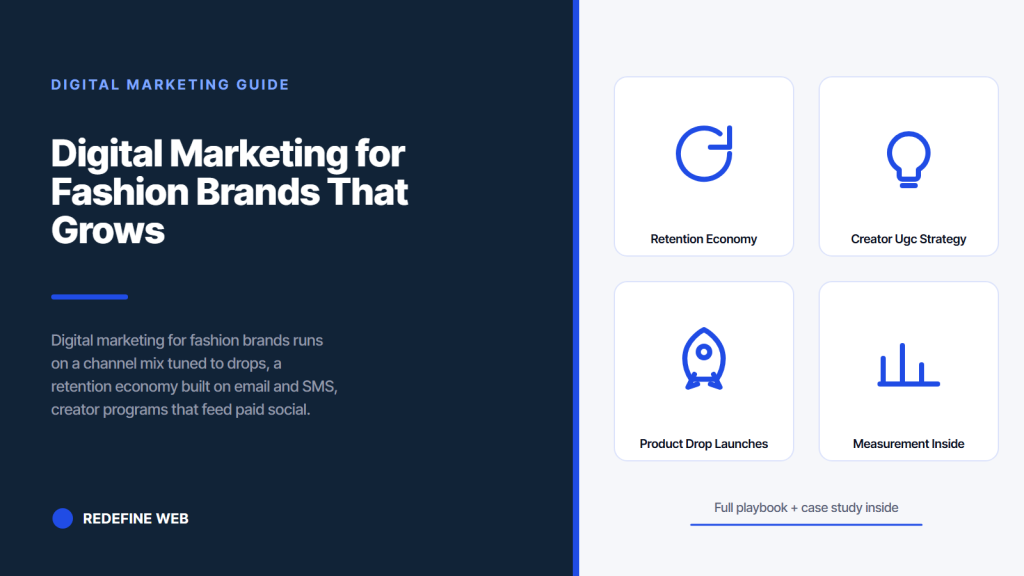
- Six channels carry the working apparel stack.
- Drop cycles change every calendar decision inside the plan.
- Retainer starts at 599 dollars a month on 6 months.
- Retention flows tied to drops earn back paid acquisition.
- Micro creators beat macro creators for licensed assets.
- Measurement runs at drop pace not quarterly review pace.
- What digital marketing for fashion brands covers
- The channel mix in digital marketing for fashion brands
- How much does digital marketing for fashion brands cost
- The retention economy inside digital marketing for fashion brands
- Creator and UGC strategy in digital marketing for fashion brands
- Product drop launches in digital marketing for fashion brands
- Measurement inside digital marketing for fashion brands
- Budget allocation across digital marketing for fashion brands
- Who runs digital marketing for fashion brands
- A real example inside digital marketing for fashion brands
- Where digital marketing for fashion brands fits the wider stack
Most apparel founders open a new quarter with the same complaint. The ads work for six weeks, then the click through rate collapses, the email list stops opening, and the last drop’s leftover inventory quietly starts eating margin in a warehouse the brand pays 3,400 dollars a month to keep. Digital marketing for fashion brands is the fix, not because it adds a channel, but because it changes the way the whole stack runs against the drop calendar instead of running against the wall clock. You get a plan the paid social ad account, the email flows, the creator briefs, and the site all pull from together.
This guide covers digital marketing for fashion brands across the six channels that matter, the retention economy that pays the acquisition budget back, the creator programs that feed paid social a wider creative pool, and the product drop launch playbook we run for apparel labels on 6 to 12 week release cycles. Every number below comes from apparel accounts our team has priced, planned, or watched from the pitch side of the table.

What digital marketing for fashion brands covers
Digital marketing for fashion brands is the working set of channels, calendar rules, and creative disciplines an apparel label runs so browsers turn into first orders and first orders turn into second and third orders inside a season. What is left is a tight stack that respects aesthetics as a revenue driver.
Two jobs the stack has to do at once
Every apparel plan does two jobs at the same time. The plan carries the brand identity so an aspirational browser trusts the label enough to buy in the third or fourth season she sees it. The plan also carries the direct response weight so the shopper ready to check out today finds the size, the price, and the shipping window without fighting the site. Brands that lean fully into brand end up with a beautiful lookbook and no revenue. Brands that lean fully into performance train the algorithm to serve discount hunters who churn out at the second full price drop. The stack works when both jobs run in parallel every week of the season.
Why generic DTC playbooks miss the mark
A generic DTC playbook assumes a stable catalog, an 8 to 12 percent return rate, and search intent driven discovery. Apparel breaks all three assumptions. The catalog turns over on 6 to 12 week drops. Return rate on apparel runs 25 to 40 percent. Discovery leans on trend signal and visual identity rather than problem solving keywords. Any playbook borrowed from a supplements brand or a home goods brand will misprice the ad account, undersize the creative production line, and miss the retention window that pays the paid social budget back. Digital marketing for fashion brands accepts those three realities up front and builds the plan around them.
The channel mix in digital marketing for fashion brands
Six channels earn a slot in the working stack for an apparel label. Each one carries a specific job across the shopping journey. Drop a channel that fits, force a channel that does not, and the drop numbers drift by 15 to 25 percent inside a single quarter.
For the pillar plan and format matrix that sits above these tactics, see our guide to content marketing for fashion brands across style, occasion, sustainability, and brand editorial.
Organic social as the front window
Instagram and TikTok carry the visual identity that a fashion label lives on. A brand with 6,000 real engaged followers and a coherent grid converts at 2 to 4 times the rate of a brand with 60,000 bought followers and a scattered feed. The grid is the storefront window shoppers check before they trust the site. Our ecommerce social media marketing playbook covers the platform mix at a broader ecommerce level. Fashion labels tune it further by treating the grid as a rolling lookbook a stylist would approve, and by planning organic posts against the drop calendar rather than posting daily on autopilot.
Paid social and paid search that fit the drop
Meta and TikTok ads carry the direct response weight for most apparel brands under 20 million in revenue. Paid search plays a smaller role than most agencies pitch because trend driven discovery does not read as high volume search queries the way home services or B2B software does. Google Ads for fashion labels works best on branded terms, retargeting via Performance Max, and shopping feeds tied to the current drop. A brand doing 2 million in revenue usually spends 65 to 75 percent of the paid budget on Meta and TikTok, 15 to 20 percent on Google, and holds 10 to 15 percent for testing a third platform per quarter.
How much does digital marketing for fashion brands cost
Digital marketing for fashion brands runs 4,000 to 60,000 dollars per month in blended retainer plus ad spend for labels under 30 million in revenue. Solo founders sit at the low end. Brands scaling past 10 million run 30,000 to 60,000 dollars monthly across paid social, email, and creator programs.
Retainer bands by revenue tier
Apparel labels under 500k in revenue usually run a 599 to 2,400 dollar monthly retainer with a freelance ad buyer and a photographer on rolling brief. Brands between 500k and 2 million run 2,400 to 6,000 dollars for agency support on paid social and email. Brands between 2 million and 10 million sit at 6,000 to 15,000 dollars for agency partnership on brand plus performance. Above 10 million the retainer sits at 15,000 to 40,000 dollars for full stack support with an in house marketing lead. Our work as a fashion marketing agency starts at 599 dollars a month on a 6 month contract and scales up the stack as the brand hits new revenue tiers.
Ad spend versus retainer split
The retainer covers people and process. The ad spend covers media. A brand doing 3 million in revenue usually runs 4,000 to 6,000 dollars of retainer against 20,000 to 30,000 dollars of monthly ad spend. Founders who cut the retainer to save money and increase the ad budget end up burning media against sloppy creative rotations and untested audience targets. The math works when the retainer buys tight creative production and the ad budget scales what already works. Trying to reverse that order is where most apparel labels waste the first 18 months of ad spend across two agency swaps.
Fashion channels break when they run on wall-clock weekly cadence. Line every campaign push to your drop calendar. If you don't have one, that's the real first fix.
The retention economy inside digital marketing for fashion brands
Retention is where digital marketing for fashion brands quietly earns back the acquisition budget. A brand that converts a first order buyer into a second order buyer within 90 days runs at roughly 2 times the lifetime value of a brand that stops the conversation at delivery. Email, SMS, and a light loyalty layer carry that work when the flows are wired to the drop calendar rather than set up once and left alone.
Email flows the drop calendar reads
The core flows every apparel brand runs are welcome, browse abandon, cart abandon, post purchase, back in stock, and win back. Layered on top for fashion sit a drop announce flow, a pre order confirmation flow, a size and fit reminder flow, and a season closing flow. Ten flows total. Brands that skip the fashion specific four usually leave 18 to 28 percent of drop revenue on the floor across the year. Klaviyo or Attentive handle the setup in roughly 30 to 45 hours of platform work per season, and a monthly audit against open rate, click rate, and revenue per recipient keeps the flows honest as the list ages.
SMS and a loyalty program that fits
SMS carries drop day launches better than email for most fashion labels because the open rate hits 90 percent within an hour and the click rate on well written SMS runs 3 to 6 times higher than email on the same list. Send SMS only on drop day, restock day, and the final 24 hours of a sale to hold unsubscribe rate under 1 percent per send. A light loyalty program on Yotpo or Smile that rewards second and third orders inside a season, not lifetime spend, moves repeat purchase rate 4 to 9 percentage points across a full year. Founders who over engineer loyalty with 8 tier structures usually confuse buyers and the program dies inside two seasons.
Creator and UGC strategy in digital marketing for fashion brands
Creator content covers what studio content cannot. Real bodies, real lighting, real styling context. Every apparel label past 500k in revenue runs a creator program alongside studio production, because paid social burns through a single creative pool inside 21 to 28 days and needs a wider library to hold click rate stable across a full drop cycle.
Micro creators over macro creators
A tier of 15 to 25 micro creators with 8,000 to 40,000 followers each usually beats a single macro creator with 500,000 followers for two reasons. The micro tier delivers 15 to 25 licensed asset packs per season for paid social, which is what the ad account actually needs. Macro creators deliver one flashy post and a bill that hurts. Cost per licensed asset across the micro tier runs 40 to 120 dollars per asset when the brief is tight. Macro creators usually price at 4,000 to 12,000 dollars per post with a single asset that expires in 30 days. The math almost always favors the micro tier for a scaling label.
Licensing and briefs that pay back
License creator content up front with paid usage rights on the contract, or the creative pool dies the moment paid social wants to test a variation. The brief covers three things. Pose direction so product shows correctly. Copy angle so the caption aligns with the current drop’s story. Deliverables list so the licensed pack fits both organic and paid social specs. Our influencer marketing programs covers the wider ecommerce version, and fashion labels layer a drop specific brief on top of it. A tight brief cuts revision rounds from three to one on average, which is where the real cost sits inside a creator program.
Product drop launches in digital marketing for fashion brands
The product drop is the anchor event of a fashion calendar. A drop that lands cleanly on the marketing plan can carry 25 to 45 percent of the season’s revenue in the first two weeks. A drop that misses on creative timing, email cadence, or inventory sync usually salvages 40 to 60 percent of the target and eats into the next drop’s warmup budget.
The four week drop launch runway
Week 4 before launch covers teaser posts, list growth via giveaways or waitlist forms, and creator brief kickoff. Week 3 covers first look creator content going live and the paid social account starting to warm up the retargeting pixel with product view retargeting. Week 2 covers a full lookbook release on organic social, an email preview, and paid social scaling on cold audiences. Week 1 covers the pre order flow, SMS list warm up, and final creative rotations pushed to the ad account. Drop day carries the SMS push, the paid social peak, and a single email that goes to every segment with clear size guidance and stock levels visible.
Post drop measurement and restock decisions
The 72 hour post drop review decides restock and markdown. Read sell through by SKU, return rate by size, and blended cost of acquisition against the drop’s revenue. Sell through above 55 percent at 72 hours usually signals a restock candidate. Sell through below 25 percent at 72 hours usually signals a markdown candidate at week 6. Return rate above 32 percent on a specific SKU usually signals a size chart or fit issue rather than a demand problem. Founders who read all three signals early hold gross margin roughly 6 to 11 percentage points higher across a season than founders who read revenue alone and react at week 4.
Measurement inside digital marketing for fashion brands
Measurement in fashion runs on a shorter feedback loop than measurement in other ecommerce categories because the drop cycle is short. A metric that takes 90 days to read is a metric that reads its first result after the drop has ended. The dashboard has to move at the pace of the calendar, and the reporting cadence has to match the launch rhythm rather than the standard monthly cycle.
The six numbers that matter every drop
Sell through rate at week 2, week 4, and week 8. Return rate by SKU. Blended cost of acquisition per new customer. Repeat purchase rate at 30, 60, and 90 days. Contribution margin per SKU after returns and shipping. Creative fatigue signal per ad set. Brands that watch all six make faster decisions on what to cut, restock, and mark down. Brands that watch only revenue and return on ad spend end up with a full warehouse of unsold sizes at the end of the season and a founder who cannot explain to the board why the P and L looks tight.
The working measurement stack
The working stack for most apparel brands under 30 million pairs GA4 with enhanced ecommerce, an attribution tool like Northbeam or Triple Whale, Klaviyo reporting, and a monthly Looker Studio dashboard tied to Shopify. Adding a returns platform like Loop plugs return data straight into the same board. Total tooling cost for a brand doing 3 to 5 million in revenue runs roughly 800 to 1,300 dollars a month. That is one of the last budget lines the plan should squeeze, because the whole point of digital marketing for fashion brands is faster decisions on shorter cycles, and the tooling is the wire that feeds the dashboard.
Budget allocation across digital marketing for fashion brands
Budget allocation is where the plan on a slide deck turns into a real quarterly commitment. The right split between brand and content, paid, retention, and creator or PR shifts as the brand grows through revenue tiers. Copying a bigger label’s split at a smaller label’s revenue is the fastest way to run out of runway.
| Revenue tier | Brand and content | Paid social and search | Email and SMS retention | Creator and PR |
|---|---|---|---|---|
| Under 500k | 35 percent | 50 percent | 10 percent | 5 percent |
| 500k to 2M | 25 percent | 50 percent | 15 percent | 10 percent |
| 2M to 10M | 20 percent | 45 percent | 20 percent | 15 percent |
| 10M to 30M | 15 percent | 40 percent | 25 percent | 20 percent |
| Above 30M | 15 percent | 35 percent | 25 percent | 25 percent |
The table above is a starting point, not a rule. A label with a strong founder story and a limited product range often over invests in brand at every tier and wins for it. A label with heavy inventory turns often over invests in paid performance and holds retention lower until it scales. The split works when the founder can defend why each slice exists and what it earns back inside the season. Reviewing the split every 90 days keeps it honest as channel returns move and new platforms enter the mix. A founder who audits the split at the end of every drop, not just at the end of a quarter, catches the underperforming line item roughly six weeks earlier than a founder on a standard quarterly review. Six weeks of trimmed budget on a bad channel is usually 30,000 to 80,000 dollars saved for a scaling label, which is enough to fund the next capsule shoot without touching working capital.
Who runs digital marketing for fashion brands
Every apparel label past 500k in revenue faces the same question. Who owns marketing on the inside, and who runs on the outside. Getting the split wrong drops drop sell through by 10 to 15 percent because the creative reviews, ad approvals, and inventory calls sit in the wrong hands and decisions stall.
- Under 500k: founder owns strategy and creative direction, a freelance ad buyer runs the paid account, a photographer on retainer covers studio.
- 500k to 2M: founder plus a marketing coordinator, agency runs paid social and email, photographer plus a small creator crew on rolling brief.
- 2M to 10M: marketing lead in house, agency runs the ad account, retention platform managed by an in house email lead.
- 10M to 30M: VP of marketing in house, brand and performance split into two teams, agency partners on paid social scale or moves in house depending on ad spend.
- Above 30M: full in house team, agency partners on measurement, creator production, and occasional launches.
- All stages: photographer relationship stays under the founder or brand lead, never fully outsourced to a paid social agency.
The split above holds across most apparel accounts our team has watched over a full season. Founders who protect the photographer relationship and hand paid social to an outside team keep the visual identity intact while getting scale on the ad account. Founders who reverse that split end up with a beautiful ad account and a scattered brand, and usually swap agencies inside 9 months trying to fix a problem the plan created.
A real example inside digital marketing for fashion brands
Passion Built came to us as an adjacent vertical rather than a straight apparel account, and the drop cycle logic and channel discipline travel across categories. The brand was running catalog product against always on ads with no seasonal calendar, and the creative refresh cycle sat at 90 days when the ad account needed a 30 day refresh cycle to hold click rate stable. Our team rebuilt the plan around the drop launch rhythm, tied the paid social creative refresh to the calendar, and layered email plus SMS retention on top of the paid work.
Every apparel review meeting eventually reaches the moment where the founder points at a knit sweater from two winters ago that is still sitting in a distribution warehouse and asks why the ad account is not selling it. Nobody has taken a new photo of it in fourteen months. The creator who last wore it now runs a candle brand and a book club. The polite thing is to mark it down. The founder will insist on one more push. Somewhere in the archive of every clothing label, a leftover sweater is generating more meetings about itself than actual orders about anything.
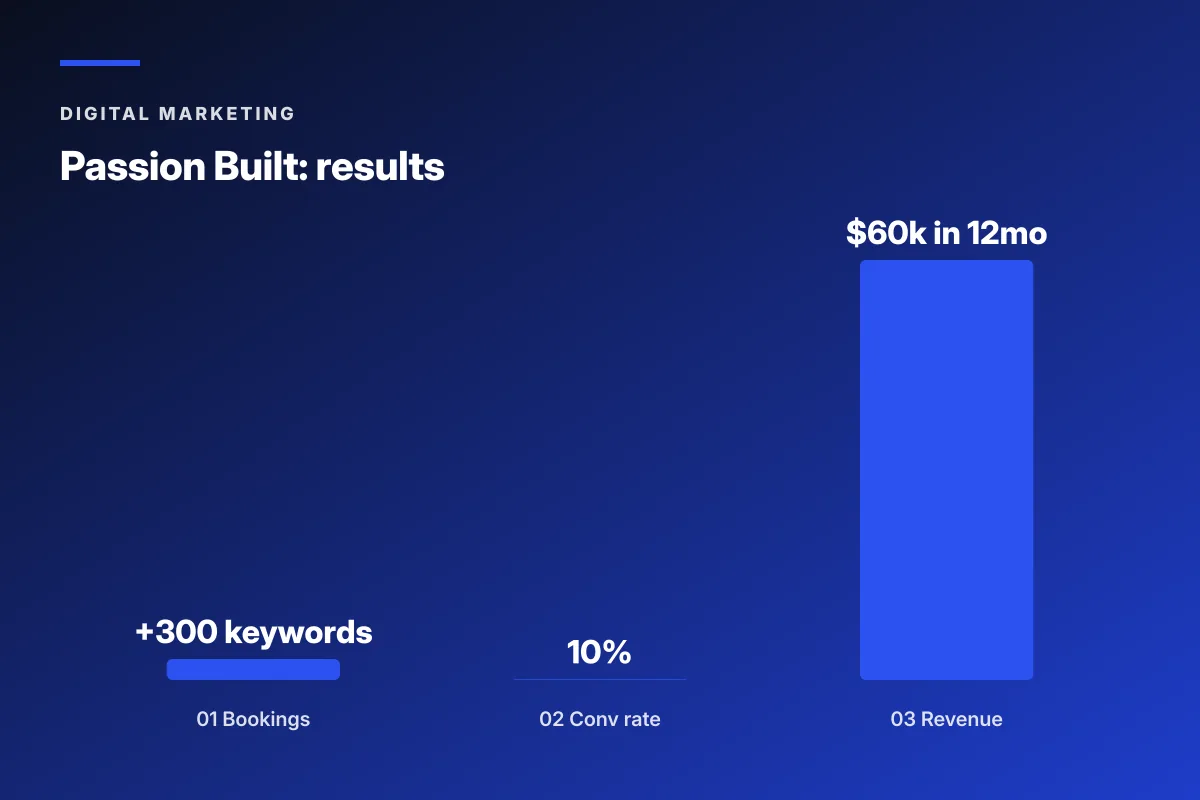
Over the next two seasons, Passion Built secured 300 plus keyword rankings, saw 10 percent of new visitors convert to inquiries, and generated 60,000 dollars in bookings inside 12 months on a lean retainer. The plan did not do all the work by itself. It made every other decision cheaper. Our apparel fashion marketing hub covers the wider stack we run for apparel labels, and the paid work sits alongside our broader retail playbooks. The HubSpot piece on fashion marketing basics is a useful outside read for founders who want a wider view.
A disciplined fashion market research loop feeding the drop calendar is what turns generic digital marketing for fashion brands into a compounding system, because every paid, email, and organic decision then runs against verified customer signal instead of guesses.
Where digital marketing for fashion brands fits the wider stack
Digital marketing for fashion brands at the highest level is a stack that respects the drop calendar, the return rate, and the aesthetic in equal weight. A plan that ignores any one of the three drifts into looking like every other DTC label and loses the identity a fashion buyer bought into originally. The rest of the marketing stack sits under that constraint, from paid social creative production to the size chart on the product page.
Retainer wise our fashion work starts at 599 dollars a month on a 6 month contract, and every apparel brand gets a channel plan, a drop calendar, and a returns strategy inside the first 30 days. Founders reading this piece usually walk in with a clearer view of what the retainer scope covers and how the paid, retention, and creator sides connect. The Shopify guide to fashion marketing and the Business of Fashion piece on planning fashion marketing are the outside voices we point apparel founders at during scoping.
For the platform specific breakdown across Instagram, TikTok, Pinterest, and YouTube, our social media marketing for fashion brands playbook covers the cadence, shoppable setup, and paid overlay.
Frequently asked questions
What does digital marketing for fashion brands actually include?
Digital marketing for fashion brands includes six channels tuned to the drop calendar. Organic social carries brand identity across Instagram and TikTok. Paid social carries direct response on Meta and TikTok ads. Paid search handles branded terms and shopping feeds. Email and SMS retention flows earn the second and third order per customer. Creator and UGC programs feed paid social a wider asset pool. A launch playbook wraps around drops so paid, email, and SMS all fire on the right week. The whole stack runs against a 90 day feedback loop that matches the drop cycle rather than a standard monthly reporting rhythm.
How much does digital marketing for fashion brands cost per month?
Digital marketing for fashion brands runs 4,000 to 60,000 dollars per month in blended retainer plus ad spend for labels under 30 million in revenue. Solo founders on a first drop sit at the low end with a freelance stack. Brands between 500k and 2 million usually spend 2,400 to 6,000 dollars on the retainer with agency support on paid social and email, plus 5,000 to 20,000 dollars monthly on ad spend. Brands scaling past 10 million run 30,000 to 60,000 dollars monthly across paid social, email, creator programs, and a rotating agency partner. Ad spend usually outpaces the retainer by 3 to 6 times at scale.
How is digital marketing for fashion brands different from general DTC marketing?
Digital marketing for fashion brands differs from general DTC in three ways. Product catalogs turn over on 6 to 12 week drops instead of steady replenishment, so email cadence, ad creative refresh, and inventory forecasting all move on a shorter clock. Return rates run 25 to 40 percent on apparel versus 8 to 12 percent on category leaders, so sizing and fit expectations get set in the creative brief before ad spend goes live. Category discovery leans on trend signal and visual identity rather than problem solving keywords, so paid search plays a smaller role than social. A generic DTC playbook fails on all three points inside the first quarter.
What retention flows should a fashion brand run alongside paid ads?
A fashion brand runs six core flows plus four fashion specific ones. The core flows are welcome, browse abandon, cart abandon, post purchase, back in stock, and win back. Layered on top for fashion sit a drop announce flow, a pre order confirmation flow, a size and fit reminder flow, and a season closing flow. Ten flows total. Klaviyo or Attentive handle the setup in 30 to 45 hours of platform work per season. Brands that skip the fashion specific four usually leave 18 to 28 percent of drop revenue on the floor across the year. A monthly flow audit against open, click, and revenue per recipient keeps the flows honest.
How should a fashion brand plan a product drop launch across channels?
A fashion brand plans a product drop launch across a four week runway. Week 4 covers teaser posts, list growth via giveaways or waitlist forms, and creator brief kickoff. Week 3 starts first look creator content and paid social product view retargeting warm up. Week 2 releases a full lookbook on organic social, an email preview, and paid social scale on cold audiences. Week 1 opens the pre order flow, warms the SMS list, and rotates final creative to the ad account. Drop day carries the SMS push, the paid social peak, and one email to every segment with clear size guidance and stock levels visible. A 72 hour post drop review decides restock and markdown.
Should fashion brands work with micro creators or macro creators?
Fashion brands should work with a tier of 15 to 25 micro creators over a single macro creator in almost every scaling scenario. Micro creators with 8,000 to 40,000 followers each deliver 15 to 25 licensed asset packs per season for paid social, which is what the ad account actually needs to hold click rate stable across a drop cycle. Cost per licensed asset across the micro tier runs 40 to 120 dollars per asset when the brief is tight. Macro creators usually price at 4,000 to 12,000 dollars per single post that expires in 30 days. The math favors micro creators for scaling labels under 30 million in revenue, and macro creators only earn a slot for one off launch buzz on select flagship campaigns.
Book your free 30-minute strategy call.
No spam, no sales rep. We use your email to schedule your call with a senior strategist. That is it.
More from the blog
View all articles → Digital Marketing
 Dental Marketing Tips That Compound Into New Patients
Read article Digital Marketing
 Ecommerce Marketing Strategies That Drive Real DTC Revenue
Read article Digital Marketing