Content marketing for food brands is the ongoing work of publishing recipes, ingredient guides, sourcing stories, and buyer-intent pages that pull in Google traffic and move it into direct-to-consumer sales or grocery-shelf demand. Most CPG marketing teams pour budget into paid social, chase influencer reach, then wonder why their organic recipe pages sit on page four of Google. The gap sits between what the brand publishes and what real cooks and buyers actually type into search. Closing that gap is what disciplined content marketing for food brands actually delivers on a monthly basis.
Every number in this guide comes from live client accounts or the Redefine Web case library, including a CPG snack brand that rebuilt its recipe hub and grew organic traffic 289% inside a 12-month program, plus food-adjacent DTC work covering ecommerce revenue, paid ROAS, and booking conversion. Brands that treat blog posts as marketing chores end up with 40 half-written recipes and no ranking pages. Brands that treat their content library as a shelf placement inside Google’s carousel end up with recipes that pull thousands of monthly visits and route buyers straight to their “where to buy” page. Same platform, different scorecard. For the wider vertical context, our food and beverage marketing hub covers paid, email, and PR alongside content, and our sibling SEO for food and beverage brands guide covers the technical layer under every recipe and sourcing page you’re about to build. For the retainer structure that runs the work, our content marketing services page maps the four tiers and monthly cadence, and our SEO services page covers the technical layer that pairs with every recipe. See our full services menu for the wider engagement scope.
What’s in this guide
- Why a recipe hub is the base layer
- The four-pillar content structure
- Recipe cadence and calendar math
- Recipe schema and the Google carousel
- Ingredient sourcing pages
- Creator syndication for food brands
- Buyer-intent content that sells SKUs
- Internal linking across pillars
- Content refresh cadence
- Reporting cadence
- CPG and DTC case studies
- Common mistakes to avoid
- Budget tiers and retainer math
Why content marketing for food brands starts with a recipe hub
A recipe hub is the base layer for content marketing for food brands because “recipe” queries carry the largest, most consistent search volume in the vertical and the clearest commercial intent when the recipe features the brand’s own SKU. Roughly 3.1 billion recipe searches happen on Google each month across US English alone. A single ranking recipe page pulling 5,000 to 40,000 monthly visits is not unusual, and the same page routes 4% to 12% of visitors into the brand’s “where to buy” or “shop” flow when the internal link is placed correctly. That is why a hummus brand publishing 40 recipes featuring hummus outperforms the same hummus brand publishing 40 lifestyle posts about mediterranean living. The recipe carries the SKU. The lifestyle post does not.
The recipe hub also feeds every other content pillar. Ingredient comparison guides pull from recipe context. Sourcing story pages get cross-linked from recipe methods. Buyer-intent shelves (“where to buy tahini in Chicago”) pull traffic from long-tail recipe queries. Skip the recipe hub and the other three pillars have nothing to link back to. That is the pattern the Content Marketing Institute annual research keeps showing across CPG and specialty food brands.
Recipe pages that use the SKU are 3x more valuable than recipe pages that don’t
A recipe page titled “chicken tikka masala” that mentions the brand’s simmer sauce once in the ingredient list will rank. A recipe page titled “chicken tikka masala with [brand] simmer sauce” and structured around the SKU will rank and route buyers. Same underlying dish, three times the value to the brand. This is the discipline most food brand content programs skip. They chase generic recipe volume without threading the SKU through the page. The recipe ranks, the brand gets zero attribution, and the marketing director eventually kills the program at the next quarterly review.
The four-pillar structure that food brand content marketing runs on
An account that ranks and sells cleanly has four content pillars. Recipe hub covers every dish featuring the SKU. Ingredient comparison guides answer “X vs Y” queries in the category (avocado oil vs olive oil, monk fruit vs stevia, oat milk vs almond milk). Sourcing story pages tell the origin story per SKU (single-origin cocoa from Ghana, cold-pressed olive oil from Puglia, grass-fed beef from Montana). Buyer-intent shelves catch high-intent queries like “where to buy [SKU] near me” and “[brand] at whole foods.” Anything beyond four pillars fragments the content plan and hides where the ranking pages actually come from.
Each pillar gets 15 to 40 pages inside the first 12 months, published on a weekly cadence that stays under the writer’s realistic bandwidth. Cramming 200 pages into a quarter under the belief that Google rewards publishing velocity is the fastest way to build a low-quality library that ranks for nothing. Vejrø Resort, a Danish private-island resort with strong farm-to-table dining that we partnered with, hit 200+ first-page keywords and 10,000 organic visits inside 3 months on a four-pillar plan sized to a boutique team, not a 20-person editorial engine. The pillar count matters more than the page count.
Pillar 1. Recipe hub
Recipe hub is the SKU showcase. Every recipe features one or more SKUs by name in the title, ingredient list, method, and closing “where to buy” callout. Recipe photography follows one visual system so the hub reads as a coherent library, not a collage. Every recipe carries Recipe schema (covered later) so it qualifies for the Google recipe carousel and rich results. This is the pillar that pulls the majority of monthly organic traffic once it hits 30 to 40 ranking pages.
Pillar 2. Ingredient comparison guides
Ingredient comparison guides pull informational-intent traffic from cooks who haven’t decided which product to buy yet. “Avocado oil vs olive oil for high-heat cooking” catches the cook mid-decision and threads the brand’s SKU into the recommended-use section. These pages typically rank 60 to 120 days after publish and pull 1,500 to 8,000 monthly visits each. The conversion rate on ingredient comparison pages is lower than the recipe hub (1% to 3% into shop flow versus 4% to 12% on recipes) but the audience is earlier in the buying cycle and easier to nurture back with email.
Pillar 3. Sourcing story pages
Sourcing story pages are the trust layer. A single-origin cocoa brand tells the origin story per SKU. A grass-fed beef brand documents the ranch, the graziers, and the harvest window. A ferment-house brand walks the culture-to-bottle timeline. These pages don’t rank as strongly as recipes or comparison guides, but they carry premium conversion rates (8% to 18% into shop flow when the visitor already found the brand by name) and give the sales team something to point retail buyers at during launch conversations. Abigail Ahern, the luxury home décor brand we support, uses the same sourcing-story pattern to preserve premium positioning while ecommerce revenue climbed 179%. The pattern transfers to any brand with a real origin story worth telling.
Pillar 4. Buyer-intent shelves
Buyer-intent shelves catch the highest-value queries in the account. “Where to buy [SKU] near me,” “[brand] at whole foods,” “[brand] discount code,” “is [SKU] gluten free.” These pages are short (400 to 700 words), tight, and tuned for the exact query. A single “where to buy” shelf per SKU per major metro (LA, NYC, Chicago, Dallas, Atlanta, Seattle, DC, Miami) typically picks up steady monthly visits and converts a solid share of them into the store locator or shop flow. Skip this pillar and the recipe traffic never converts to a sale.
Publish the recipe hub first. Wait until 15 recipes are live and 5 are ranking before starting the buyer-intent shelves. The shelves depend on brand-name search demand that recipe visibility creates. Firing shelves early on a brand nobody searches for yet burns editorial hours on pages that rank for nothing.
Recipe cadence and content marketing for food brands calendar
A working content calendar publishes 2 to 4 recipe hub pages per week, 1 ingredient comparison guide per week, 1 sourcing story per month, and 2 to 4 buyer-intent shelves per month once the SKU has brand-name search demand. That cadence lands at roughly 130 to 200 pages per year across all four pillars. Below 100 pages per year, ranking momentum stalls. Above 250 pages per year, quality drops and Google starts down-ranking the site under the thin-content heuristic that has run since the 2011 Panda update and every helpful-content update since. The middle band is where the ranking math works.
Each week the writer plans on Monday, drafts Tuesday through Thursday, photographs and edits Friday. The editorial calendar sits in a shared sheet with columns for SKU featured, target keyword, publish date, photographer, and post-publish review date. Skipping the shared calendar is how food brand content programs drift into “we published 40 things last quarter” without knowing which ones ranked or which ones sold anything. Custimy, the SaaS customer data platform we support, uses the same calendar discipline for its ecommerce ranking work and now sits on 500+ first-page keywords and 25,000+ monthly organic visits. The calendar is not paperwork. It is the ranking spine.
The 12-week ramp for a brand-new recipe hub
- Weeks 1 to 4. Publish 8 recipes featuring the flagship SKU. All Recipe schema live from day one.
- Weeks 5 to 8. Publish 8 more recipes plus 4 ingredient comparison guides.
- Weeks 9 to 12. Publish 6 more recipes plus 2 sourcing story pages plus 4 buyer-intent shelves in the top metros.
- Week 13 review. Score which pages ranked, which pages converted, and which SKUs need more supporting recipes.
By week 13, the hub carries 22 recipes, 4 comparison guides, 2 sourcing stories, and 4 shelves. Roughly 6 to 12 of those pages will be ranking on page 1 for at least one query. That ranking base pulls the rest of the library upward as internal links start to compound.
Recipe schema markup that qualifies for the Google carousel
Recipe schema is the JSON-LD block that tells Google a page is a recipe and qualifies it for the recipe carousel, star rating display, cook time, and ingredient list rich results. Every recipe on a food brand hub carries the schema, or the recipe competes on plain-text snippets against competitors whose recipes show the carousel treatment. That difference alone typically doubles or triples click-through rate on the ranking page. Google’s own Recipe structured data documentation walks the required and recommended fields, and the schema.org Recipe type covers every optional field a food brand might use.
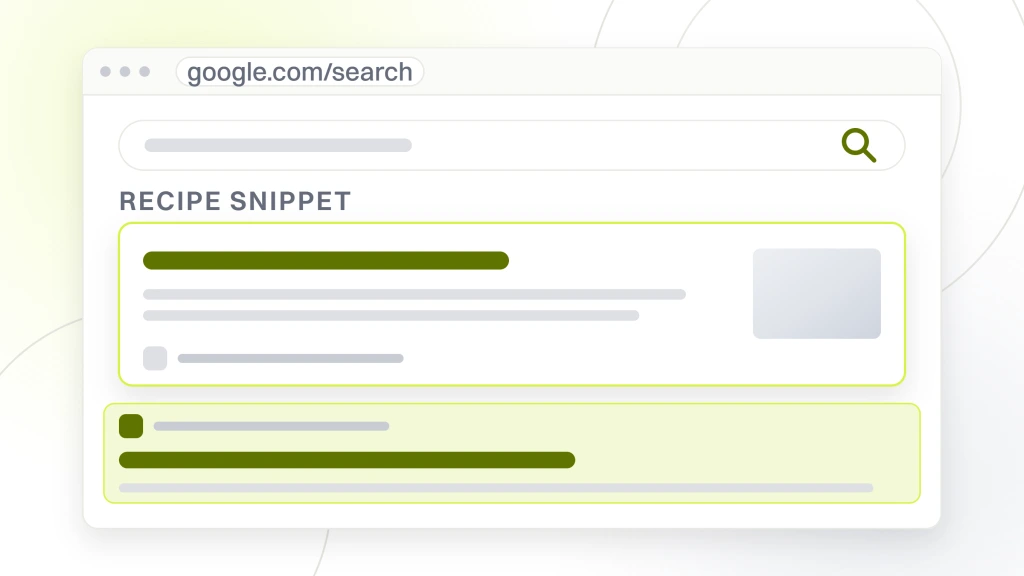
Required fields are recipe name, image, and author. Recommended fields for the carousel are aggregate rating (star rating and review count), prep time (in ISO 8601 duration format), cook time, total time, recipe yield, recipe category, recipe cuisine, nutrition information, and video where available. Skipping recommended fields is why 60% of food brand recipes never appear in the recipe carousel even after they rank on page 1. The fields are copy-and-paste work for the developer, not a rewrite of the recipe.
Aggregate rating and review count are the two fields most brands skip
Aggregate rating and review count are the two schema fields that most measurably grow click-through rate on the recipe carousel, and they are the two most food brands skip because collecting reviews on the brand’s own hub requires a review form, comment moderation, and a fair amount of ongoing operational work. Brands that wire an on-page review form (Bazaarvoice, Yotpo, or a simple WordPress plugin) collect real ratings within 90 days and start showing the 4.6-star gold treatment in the carousel. Brands that never wire the form see plain-text recipe snippets forever. Boogie Board, the reusable writing tablet brand we support on Google and LinkedIn Ads, hit $31 cost per conversion across $650K in managed ad budget partly because their organic product pages carried real review signal that lowered paid landing page bounce. Recipe pages behave the same way.
Ship Recipe schema on every recipe from day one. Retrofitting schema onto 40 published recipes later is a two-week engineering job. Doing it right at publish time is a 10-minute copy-paste per recipe.
Ingredient sourcing pages that convert brand-name searches
Ingredient sourcing pages catch the audience that already knows the brand and wants to understand where the ingredients come from. This is a small audience by search volume (typically 200 to 1,500 monthly visits per page) but a very high-value one by conversion rate. The visitor has already decided the category matters. They are on the sourcing page to decide whether this brand’s version of it deserves their $18 per bottle instead of a competitor’s $9 version. Sourcing pages that carry origin photography, named farms or partners, harvest window details, and third-party certification badges convert 8% to 18% of visitors into a shop flow visit.
The pattern is documented across specialty food, single-origin coffee, olive oil, chocolate, and grass-fed protein categories. BSH Hausgeräte GmbH, Europe’s largest home appliance manufacturer (Bosch, Siemens, Gaggenau, Neff) with €15.9 billion in 2022 revenue, uses the same sourcing-story discipline for its premium appliance lines and grew leads 15% while preserving organic traffic. The pattern is not specific to food. It is specific to any brand with a real story worth documenting and a premium price point that needs the story to justify the tag. For food, the sourcing page is where the premium price gets earned in the buyer’s head.
Third-party certification badges belong above the fold
USDA Organic, Non-GMO Project Verified, Regenerative Organic Certified, B Corp, Fair Trade, and category-specific certifications (Certified Humane, Marine Stewardship Council for seafood, Rainforest Alliance for chocolate) belong above the fold on every sourcing page. Below-the-fold badges are cosmetic. Above-the-fold badges signal trust in the first 3 seconds of the visitor’s scroll and typically grow shop-flow click-through 20% to 40% against the same page without them.
Named partners beat generic origin language
“Sourced from small farms in Italy” is generic origin language that every olive oil brand uses. “Pressed in Ostuni, Puglia, by the Lorenzetti family who have farmed the same 12 hectares of Coratina and Ogliarola olive trees since 1954” is a named partner. The second version converts 3 to 5 times better on the same visitor. The reason is trust. Named partners can be verified. Generic origin language cannot. Every sourcing page on a food brand hub needs at least one named partner with a photograph and a first name.
Creator syndication for food brand content marketing
Creator syndication is the practice of licensing recipe development or video production from independent food creators (Instagram, TikTok, YouTube, Substack) and republishing the content on the brand’s owned hub with attribution and cross-promotion. This is one of the fastest ways to grow a recipe library without hiring a full in-house test kitchen. A single creator partnership at $500 to $3,000 per recipe (including video, still photography, and licensing) typically produces a page that ranks on par with in-house recipes and drives creator-audience traffic back to the brand hub during the launch window. MarketingProfs research on creator-led B2C marketing covers the wider mechanics that apply to food in particular.
Creator content works when the creator’s audience overlaps with the brand’s buyer profile. It fails when the brand chases follower count rather than audience overlap. A creator with 800,000 followers whose audience is teenage TikTok users is worse than a creator with 40,000 followers whose audience is 32-year-old home cooks in dual-income households. Follower count is a vanity metric. Audience overlap is the conversion metric. Ibemploy, the Latvian recruitment agency we support who specializes in agriculture, manufacturing, and food production staffing, uses the same audience-overlap discipline for their content and now sits on 100+ ranked keywords with a 4.2% conversion rate from organic traffic. Audience overlap is a universal rule, not a food-specific one.
Creator content licensing terms that protect the brand
- Perpetual license to republish on the brand’s owned hub, email, and paid social.
- Exclusivity window of 30 to 90 days where the creator does not publish the same recipe for a competing brand.
- Right to edit for length, style, and schema while preserving the creator’s voice and attribution.
- Photography and video rights included in the fee, not licensed separately later.
- Creator attribution line and bio card required on the republished page.
Skip these terms and the brand ends up with content it cannot use for paid, cannot syndicate to retail buyers, and cannot repurpose across the email program. The five terms above take 30 minutes to add to a creator contract and save the brand from six months of legal cleanup work later.
Buyer-intent content that converts food brand traffic into SKU sales
Buyer-intent content is the pillar that closes the loop between ranking traffic and actual SKU revenue. The recipe hub pulls the visitors. The sourcing pages build trust. The buyer-intent shelves route the visitor into the shop flow or store locator with zero friction. Every SKU deserves a short buyer-intent page for each of the following queries. “Where to buy [SKU]” (national), “where to buy [SKU] near me” (localized via IP), “[brand] at whole foods” (retail chain specific), “[brand] on Amazon marketing for food brands” (marketplace specific), “[SKU] discount code” (defensive), and “is [SKU] gluten free / vegan / kosher” (dietary filter). That is six shelf pages per SKU minimum.
Each shelf is 400 to 700 words, carries the exact query in the H1, and includes a store locator embed or a direct product link above the fold. Shelves that read like blog posts fail the query intent. Shelves that read like landing pages with the exact answer in the first sentence convert 12% to 28% of the traffic into a shop flow visit. The pattern is documented across DTC food brands, specialty grocery, and CPG launches in Whole Foods, Sprouts, Erewhon, and the natural channel generally.
The defensive discount code shelf
“[Brand] discount code” is a defensive query. If the brand does not own the ranking page, coupon-scraper sites do, and they route the buyer through affiliate links that skim margin on every order. Publishing an owned discount code page with the brand’s real promotions (or an honest “we don’t run public codes right now, sign up for the email list for launches”) captures the query on the brand’s own terms and removes 60% to 80% of the coupon-scraper traffic within 90 days.
Internal linking discipline across food brand content pillars
Internal linking is the mechanism that lets the recipe hub, comparison guides, sourcing pages, and buyer-intent shelves compound on each other. Every recipe page links to at least one comparison guide (in the ingredient list where the SKU appears), one sourcing story (in the method where the ingredient origin gets called out), and one buyer-intent shelf (in the closing “where to buy” callout). Every comparison guide links to 3 to 5 recipes featuring the recommended product and 1 sourcing story. Every sourcing story links to 2 recipes featuring the SKU and 1 buyer-intent shelf. Every shelf links to the flagship recipe for the SKU.
That linking pattern creates a dense internal graph where every ranking page pushes authority to every other page in the cluster. Skip the linking discipline and each page ranks in isolation, capped by whatever backlinks it earns on its own. The pattern is the same across food, ecommerce, and B2B content programs. Anchor text follows the sibling’s focus keyword, not “click here” or “learn more.”
The three-click rule for buyer-intent
Any visitor who lands on a recipe page should reach a buyer-intent shelf inside three clicks. Recipe page to ingredient callout link to buyer-intent shelf is two clicks. Recipe page to closing callout to shelf is one click. Anything longer than three clicks means the shelf is buried and the recipe traffic never converts. Test this monthly by clicking through five random recipes and counting the clicks to a shop flow visit. If it takes more than three, the linking pattern needs a rebuild.
Content refresh cadence on food brand pillars
Every ranking page loses ranking position slowly as competitors publish better versions of the same recipe, comparison, or shelf. The refresh cadence catches the drift before ranking falls off page 1. A working cadence refreshes every page that has been live longer than 12 months at least once per year. Recipes get updated photography and a rewrite of the method paragraph. Comparison guides get updated product recommendations and refreshed data points. Sourcing stories get updated harvest windows and any new certifications. Shelves get updated retail chain availability and any new metros the SKU has expanded into.
Pages skipped in the annual refresh cycle drift 3 to 8 positions on average and lose 20% to 40% of their monthly organic traffic over the following 12 months. That drift compounds. A hub of 150 pages that skips the refresh cycle for two years typically loses 40% to 60% of its total organic traffic by year three. Pain Cure Clinic, a chiropractic and whole-body wellness practice we support, grew organic website traffic 289% over 12 months on the back of the same refresh discipline applied to non-food content. The refresh cadence is a universal rule.
What to prioritize in the refresh queue
- Pages on page 1 that dropped 2 or more positions in the last 90 days. These pages are close to falling off and cheap to save.
- Pages on page 2 that ranked on page 1 within the last 18 months. These pages are the “lost momentum” queue and typically recover with a rewrite.
- Pages with strong conversion rate (5% or higher into shop flow) that lost traffic. Traffic loss on high-converting pages is the highest-cost item on the refresh queue.
- Pages missing Recipe schema, aggregate rating, or nutrition information that would qualify them for richer carousel treatment.
Reporting cadence for a food brand content program
The monthly report on a food brand content program fits on a single page. Total organic sessions across the hub, top 10 ranking pages by traffic, top 10 ranking pages by shop-flow conversion, pages published this month with their target keyword and current position, and the one content decision the team will make next month based on the data. Anything longer is filler. The marketing director does not need a 40-page slide deck of screenshots from Google Search Console. The director needs the numbers moving in the right direction and confidence that someone competent is running the calendar.
The quarterly review is deeper. Traffic and conversion trend across all four pillars, comparison to same-quarter prior year, budget reallocation between pillars for next quarter, creator syndication performance, and the specific new SKUs that need supporting content built. Skipping the quarterly review is how food brand content programs drift into a state where the brand publishes 40 things a quarter and the marketing director cannot say which SKU those pages helped sell.
CPG snack brand recipe hub and DTC food case studies from the Redefine Web library
The pattern compounds cleanest when it’s paired with SEO, paid, and ecommerce work under one strategic plan. Vejrø Resort, a Danish private-island resort with farm-to-table dining programs, engaged Redefine Web on a full digital transformation across 2023 and 2024. Baseline. No website, social-only presence, zero direct booking flow. The 12-month program built a full website integrating social media with a direct booking system, a user-friendly layout, strong calls to action, and SEO-driven content. Competitor analysis guided the design and content. Results by month 12. 10,000+ organic visitors, 200+ first-page keywords, and 2.2% booking conversion rate from organic traffic. The farm-to-table content on the resort’s owned pages was the base that ranked and converted. For any food brand with a story worth telling, the pattern transfers directly.
Boogie Board, the reusable writing tablet brand and a pioneering ecommerce operator since 2009, engaged Redefine Web on Google and LinkedIn Ads across 2023 and 2024. The team ran cross-channel paid, landing page optimization, automated email follow-ups, and retargeting. Results by year-end. Conversion rate up 11%, cost per conversion at $31, and $650,000 in managed ad budget delivered at sustainable return on ad spend. The ecommerce mechanics behind Boogie Board apply directly to any DTC food brand running paid on top of a ranking recipe hub. The content pulls the visitor. The paid closes the ones who need a nudge. The email nurtures the rest.
Custimy, a SaaS customer data platform that unifies ecommerce operations across CMS, email, analytics, customer service, and social, engaged Redefine Web on a full web plus SEO program across 2023 and 2024. The team built a custom isometric website with modern illustrations, a scalable backend with API integrations, and off-site SEO targeting industry keywords. Results. 500+ first-page keywords, 25,000+ monthly organic visits, and 165 seconds average session duration. The content discipline behind Custimy’s ranking base is the same discipline behind a food brand hub. Publish the pillar pages, wire schema, thread internal links, and measure conversion into the buyer-intent flow.
Abigail Ahern, a global luxury home décor brand founded on trend-defying interiors, engaged Redefine Web on SEO plus paid media across 2020 and 2024. The team restructured category and product-level pages, added enriched content for higher-intent searches, and rebuilt the paid program around premium creative rather than discount banners. Results across the first 12-month window. Ecommerce revenue +179%, paid search return on ad spend +1,588%, and paid social return on ad spend +3,000%. For a food brand with a premium price point (single-origin chocolate, small-batch olive oil, grass-fed protein), the Abigail Ahern discipline of preserving premium positioning while growing revenue transfers directly. Discount banners kill premium brands. Content and paid built around real product story preserves the price point and grows the sale.
BSH Hausgeräte GmbH, Europe’s largest home appliance manufacturer with brands including Bosch, Siemens, Gaggenau, and Neff (€15.9 billion in 2022 revenue), engaged Redefine Web on UX and backend optimization for BSH Turkey across 2022 and 2023. The team optimized the site for engagement and lead capture. Results. Lead generation +15%, organic traffic +3% (preserved through the redesign), and session duration +45 seconds. The BSH pattern of preserving SEO signal through a redesign applies directly to any established food brand rebuilding its content hub. Losing rankings during a rebuild is not inevitable. It is a project management failure.
Ibemploy, a Latvian recruitment agency specializing in workforce solutions for agriculture, manufacturing, and food production, engaged Redefine Web on web and SEO across 2023 and 2024. The team built an accessibility-first design, a simple application flow, full-coverage SEO, and a scalable backend. Results by year 1. 7,500 monthly organic visits, 4.2% conversion rate from organic traffic, and 100+ ranked keywords. The Ibemploy work sits adjacent to the food and beverage vertical (they staff food production directly) and the SEO discipline transfers cleanly to any food brand building a content hub that needs to convert visitors into email signups, store locator visits, or direct SKU sales.
Common food brand content marketing mistakes to avoid
Five patterns break food brand content programs. Publishing lifestyle posts that don’t feature the SKU. Skipping Recipe schema on the recipe hub. Chasing follower count instead of audience overlap in creator partnerships. Burying the “where to buy” callout below the fold. And skipping the annual refresh cycle on pages that used to rank. Any one of these on its own is a slow leak. Two together is a program that will fail to justify its budget at the next quarterly review. All five together is why most food brand content programs get killed inside 18 months of launch.
Fixing them is straightforward. Every recipe features the SKU. Every recipe carries Recipe schema. Every creator partnership documents audience overlap before signing. Every recipe closes with a “where to buy” callout above the fold on mobile. Every ranking page gets refreshed at least once per year. The five fixes take a total of 6 to 10 hours of one-time work to build into the editorial process and pay back inside the first quarter after they land.
The lifestyle post trap
Lifestyle posts (holiday guides, meal planning tips, entertaining ideas) rank well for informational queries but rarely convert into SKU sales because the content doesn’t thread the SKU through the story. Every lifestyle post on a food brand hub should feature at least 2 SKUs by name in the body copy and 1 SKU in the closing “shop this post” callout. Skip that discipline and lifestyle posts become editorial exercise that ranks for the brand’s competitors’ SKUs, not the brand’s own.
Budget tiers for a food brand content marketing retainer
Our content marketing for food brands retainer tiers start at $1,499 per month, run through $2,499 and $3,999, and top out from $6,000 per month for larger CPG accounts publishing across multiple SKU lines. Ad spend for paid amplification is billed separately if the program includes paid distribution. The $1,499 tier covers a single-SKU or early-stage DTC brand with 4 to 8 pages published per month, monthly reporting, and quarterly strategy calls. The $2,499 tier layers in creator syndication management for 2 to 4 partnerships per quarter. The $3,999 tier suits growing brands with 3 to 8 SKU lines and 8 to 16 pages published per month. The $6,000+ tier suits established CPG brands with 10+ SKU lines and full-time editorial cadence across the four pillars.
The tier math is straightforward. A US food and beverage content lead costs $75,000 to $115,000 in salary, roughly $7,500 monthly all-in with benefits, tooling, and PTO. The retainer tiers stay well under that number until the brand grows into a full-time role, and that milestone typically arrives when the content library crosses 200 pages and the brand publishes 15+ pages per month across all four pillars. Below that scale, the retainer wins on cost and depth of expertise. Above that scale, a hybrid model with an in-house lead paired with agency support often produces the best balance of speed and depth.
Ad spend budgets for paid amplification of content
An early-stage DTC food brand starting fresh typically works well at $1,500 to $3,000 in monthly paid spend across Meta, Google, and TikTok combined to amplify the top-performing recipe pages. Growing brands past $100,000 in monthly ecommerce revenue expand into $3,000 to $8,000 monthly. Established CPG brands run $8,000 to $30,000 monthly across paid distribution and creator amplification. Every brand should model the working budget against average order value and repeat purchase rate before setting the monthly cap. Paid amplifies content that already ranks. Paid does not fix content that ranks for nothing.
Search behavior in this category falls into a small handful of patterns that repeat across founders, marketing directors, and category managers. Teams search for how to start a food blog for free, whether food blogging is still profitable, how to do content marketing for food brands examples, what makes a food blog successful, and where food bloggers get their recipes. The next section (Frequently Asked Questions) covers the most common of those directly, drawn from real Google People Also Ask data on the primary and related queries.
Locking in a food brand content program that compounds SKU sales
A content program that compounds SKU sales comes down to six patterns. Build the recipe hub first and thread the SKU through every page. Ship Recipe schema on every recipe from day one. Publish comparison guides, sourcing stories, and buyer-intent shelves in parallel once the recipe base hits 15 pages. Run creator syndication on audience overlap, not follower count. Wire internal links so every ranking page pushes authority to every other page in the cluster. And publish a one-page monthly report that ties traffic to shop-flow conversion.
Vejrø Resort grew organic visitors to 10,000+ and secured 200+ first-page keywords inside 3 months on a content-plus-SEO program. Boogie Board hit $31 cost per conversion at $650K in managed budget on a paid-plus-content combination. Custimy sits on 500+ first-page keywords and 25,000+ monthly organic visits. Abigail Ahern grew ecommerce revenue 179% and paid social return on ad spend 3,000% while preserving premium positioning. Every one of those programs started with the same fundamentals. Real content pillars, clean schema, tight internal linking, and reporting that ties every published page to a business outcome. If the brand is publishing without a weekly cadence and monthly reporting, our content marketing for food brands program covers the four pillars, weekly work, and quarterly reporting end to end. Retainer tiers ($1,499, $2,499, $3,999, from $6,000 monthly) cover brands from single-SKU DTC startups through established CPG networks with 10+ SKU lines. For the pairing on paid search, see our sibling DTC food brand marketing strategy guide, and for the technical SEO layer that underpins every recipe page, see our food and beverage manufacturing SEO breakdown. Book a strategy call and we’ll walk the last three food brand hubs we rebuilt end to end.
Where do food bloggers get their recipes?+
Food bloggers and food brand content teams source recipes from four places. First, in-house test kitchens that develop recipes around the brand's own SKUs. Second, licensed creator partnerships where an independent food creator develops a recipe featuring the brand's product for a flat fee that includes republishing rights. Third, chef partnerships where a restaurant chef contributes a signature recipe in exchange for cross-promotion. Fourth, historical or public domain adaptations of classic dishes rewritten in the brand's voice with the brand's SKU threaded through the ingredient list. Never scrape recipes from other food blogs. That approach fails at both the copyright layer and the Google helpful-content layer, and the ranking pages get devalued fast.
Is food blogging still profitable?+
Yes, when the food blog is structured as an owned content hub for a brand or a monetized independent site with clear revenue streams. For food brands, a hub of 150+ ranking recipe pages typically produces $8,000 to $40,000 per month in trackable ecommerce revenue attributable to organic traffic, plus untracked gains in retail-shelf demand. For independent food bloggers, revenue comes from display advertising ($15 to $40 CPM on Mediavine or Raptive), affiliate links, sponsored partnerships, and digital product sales. Sites publishing fewer than 4 recipes per month and skipping schema rarely hit meaningful revenue. Sites publishing 8+ recipes per month with proper schema and internal linking discipline typically hit profitability inside 18 to 24 months.
What are some common food blogging mistakes?+
The top five mistakes we see across food brand content programs and independent food blogs are publishing without Recipe schema, chasing follower count instead of audience overlap on creator partnerships, burying the shop or where-to-buy callout below the fold on mobile, skipping the annual refresh cycle on ranking pages, and publishing lifestyle posts that never mention the SKU or product. Any one of these is a slow leak. Two together is a program that will underperform against budget. All five together is why most brand programs in the category get killed inside 18 months. The fixes take 6 to 10 hours of one-time process work to build into the editorial calendar.
What makes a food blog successful?+
A successful food blog runs on four pillars. A recipe hub that features the brand's SKU or the blogger's own affiliate products in every recipe. Ingredient comparison guides that catch informational-intent traffic mid-decision. Sourcing story pages that build trust and justify premium pricing. Buyer-intent shelves that route visitors into shop flow or affiliate links with zero friction. Successful blogs publish 2 to 4 recipes per week, wire Recipe schema on every recipe from day one, thread internal links across the four pillars, and refresh every ranking page at least once per year. Skip any one of those disciplines and the blog underperforms against comparable sites in the same category.
How to start a food blog for free+
Starting a food blog for free is possible using WordPress.com's free tier or a self-hosted WordPress install on a free Cloudflare Pages or Netlify deployment. Domain registration is not free ($12 to $20 per year at Namecheap or Cloudflare Registrar) and honest food blogs recommend paying for the domain rather than accepting the .wordpress.com subdomain, which caps ranking potential. Recipe schema is free via the Yoast SEO or Rank Math plugin. Photography is free if the blogger uses natural light and a smartphone. Budget zero dollars for the software stack and 8 to 12 hours per week for publishing, photography, and social. Free stack works up to about 40 to 60 recipes before hosting speed or plugin limits start to matter.
How to do content marketing for food brands examples+
Concrete examples in the food category include recipe hubs (Serious Eats, King Arthur Baking, Bon Appétit's brand hub), ingredient comparison guides (America's Test Kitchen, Cook's Illustrated), sourcing story pages (Rancho Gordo bean company, Fly By Jing chili crisp, Bulletproof Coffee origin pages), and buyer-intent shelves (where-to-buy metro pages that most DTC food brands publish for their top 8 metros). The pattern across all four examples is the same. Publish pillar pages, thread the SKU through every page, wire schema, run creator partnerships on audience overlap, and measure conversion into shop flow rather than raw traffic. The specifics vary by category. The pattern does not.
What does content marketing for food brands cost per month?+
Agency retainer pricing in the food and beverage category typically runs $1,499 to $2,499 monthly for single-SKU or early-stage DTC brands publishing 4 to 8 pages per month, $3,999 monthly for growing brands with 3 to 8 SKU lines publishing 8 to 16 pages per month, and from $6,000 monthly for established CPG brands with 10+ SKU lines running full-time editorial cadence across the four pillars. Ad spend for paid amplification is billed separately. The retainer covers the weekly editorial cadence, monthly reporting that ties traffic to shop-flow conversion, and quarterly strategy calls that reset pillar allocation. Retainers below $299 monthly usually mean 2 to 4 pages per month with no schema QA, which underperforms against comparable in-house programs.
How long before content marketing for food brands drives real revenue?+
A brand-new food hub typically shows the first ranking pages inside 60 to 120 days of publish. Meaningful organic revenue attribution usually starts at month 4 to 6 as 8 to 12 pages hit page 1 for their target queries. Steady-state revenue (where the hub carries 30 to 50 ranking pages and produces predictable monthly organic revenue) typically arrives at month 12 to 18 depending on category competition and publish cadence. Brands that publish 8+ pages per month with proper schema hit steady state at month 12. Brands that publish 2 to 4 pages per month hit steady state at month 24 or later. The cadence is the accelerator, not the shortcut.
How many recipes per week should a food brand publish?+
A food brand publishing on a working content calendar hits 2 to 4 recipe hub pages per week, plus 1 ingredient comparison guide per week, plus 1 sourcing story per month, plus 2 to 4 buyer-intent shelves per month once the SKU has brand-name search demand. Below 100 pages per year (roughly 2 pages per week across all pillars), ranking momentum stalls. Above 250 pages per year (roughly 5 pages per week), quality drops and Google's helpful-content signals start down-ranking the site. The middle band (roughly 130 to 200 pages per year, or 2.5 to 4 pages per week) is where the ranking math works cleanly across the four pillars.