
A content marketing strategy for chiropractors decides whether your blog stays a dusty archive or turns into the top source of new patient bookings. Most practice sites post twice a year, chase random topics, and wonder why the organic column on the Google Analytics report stays flat. You already know a blog can rank. What most practices lack is the pillar map, the publish rhythm, and the monthly reporting loop that turn a chiropractor blog into a steady booking engine. For the wider playbook, our chiropractor marketing strategies guide covers the paid and referral layers that pair with content.
This guide walks through the full content marketing strategy for chiropractors we hand practice clients on day one. You get the three-pillar topic model, the twice-monthly publish cadence that survives a busy quarter, the SEO hook every post has to carry (our chiropractor website SEO playbook covers the on-page hooks that pair with content), the case study math from a chiropractic clinic we grew 205% on patient appointments, and the monthly reporting cycle that shows which posts book patients. Ten minutes to read. One weekend to set up. Twelve months to compound.
Why a content marketing strategy for chiropractors beats random posting
Random posting fails on Google since the ranking system now rewards topical depth over topical variety. A content marketing strategy for chiropractors picks 3 or 4 pillars, maps every future post into a cluster under one of them, and publishes on a rhythm the search index can predict. Depth on a small set of pillar topics beats breadth across two dozen scattered ones, and the gap widens every quarter.
The math is simple. A practice publishing 24 planned posts across 3 pillars over 12 months ranks for 4 to 8 times more keywords than a practice publishing 24 random posts. Same effort. Very different result. A working content marketing strategy for chiropractors is that plan. You don’t need to write more. You need to write on a plan. That plan is what turns your site into an asset instead of a Sunday-night chore.
Topical depth is the ranking signal now
Google’s helpful content system rewards sites that cover a topic in depth. That change hit hard in 2023, and every update since has doubled down. A chiropractor site with 12 posts on lower back pain, all interlinked, will outrank a site with 40 random posts almost every time. Depth beats breadth. Your content marketing strategy for chiropractors should pick pillars that match your best treatment revenue and go deep on each one.
Every post has to match patient intent
Someone typing “chiropractor near me for sciatica” is ready to book. Someone typing “what causes lower back pain” is researching. Your content mix needs both. A serious content marketing strategy for chiropractors covers both intents on every pillar. Research posts build trust and rank for informational keywords. Near-me and treatment posts capture booking intent. Skip either side, and you either rank without booking or book from paid alone with no organic support. Both problems get expensive fast.
The three-pillar model behind every working chiropractor content marketing plan
Every content marketing services for chiropractors engagement we run kicks off with the same three-pillar map. Pillar one is Conditions, covering the top complaints that fill your intake board. Pillar two is Treatments, covering the techniques your table sees every day. Pillar three is Local Trust, covering city pages, insurance coverage, first-visit walkthroughs, and the operational answers patients look up before they pick up the phone. 3 pillars. Every future post fits under one of them.
Under each pillar, you plan a pillar page, 6 to 8 cluster posts, and a set of internal links that tie the cluster back to the pillar. A pillar page targets the broad head term like “chiropractor for lower back pain in Denver.” Cluster posts target the long-tail questions inside that head term. Together, they build the topical depth a content marketing strategy for chiropractors needs to rank a healthcare site above a directory result.
| Pillar | Head term example | Cluster count | Booking intent |
|---|---|---|---|
| Conditions | Lower back pain treatment | 8 posts | Mid to high |
| Treatments | Spinal adjustment for sciatica | 6 posts | High |
| Local Trust | First visit to a chiropractor | 6 posts | Very high |
Conditions pillar covering your top complaints
Pull the last 6 months of intake notes. Rank the top complaints by patient volume. That list is your conditions pillar. Lower back pain, sciatica, neck pain, headaches, sports injuries, auto accident recovery, and pregnancy-related pain are the 7 that show up on almost every US chiropractor’s list. Write one pillar page per condition, then 6 to 8 cluster posts under each one covering causes, symptoms, treatment options, at-home care, and when to see a chiropractor.
Treatments pillar covering what you perform
Your treatments pillar covers spinal adjustments, decompression therapy, cold laser, dry needling, sports massage, cupping, and any technique your practice specializes in. These posts rank for high-intent searches from patients who already know they need chiropractic care and are shopping providers. Explain what happens, how long it takes, whether it hurts, and what the average recovery timeline looks like. Add a photo of your actual equipment. Patients trust posts that show a real room instead of a stock image.
Local Trust pillar covering the operational answers
Local Trust posts answer the operational questions patients search before booking. Do you take my insurance. What happens on the first visit. How long does an appointment take. Do I need a referral. Do you treat kids. Are you open on Saturday. These posts convert like landing pages since the reader is already deciding whether to call you today. Your Local Trust pillar deserves as much attention as your Conditions pillar even when the search volumes look smaller.
Publishing cadence that holds for 12 months
The most common failure inside a content marketing strategy for chiropractors is the month-three calendar collapse. 4 posts land in January. February drops to 2. March scrapes out 1. April goes silent. By June the blog reads as abandoned, the plan gets shelved, and the practice is back at zero. A humble cadence you can hold every week for 12 months beats a heroic January burst every single time.

The cadence we recommend for a solo or two-provider practice is 2 posts per month, on the first and third Tuesday, at 900 to 1,400 words each. That’s 24 posts a year, enough to cover 3 pillars with real depth. Practices with an in-house marketing coordinator can push to 4 per month. Practices without one should stay at 2, since a broken cadence signals abandonment and hurts rankings on the posts you already have.
- Week 1. Outline and interview the doctor for the next post.
- Week 2. Draft, edit, add images, and schedule for publish.
- Week 3. Draft the following post so the scheduled one goes live on time.
- Week 4. Promote via email newsletter and Google Business Profile.
Who writes the posts on the plan
The doctor should not be the one typing. The doctor should be the one being interviewed. A 20-minute recorded call with the doctor covering the topic outline gives a copywriter everything they need to draft a 1,200-word post that sounds like the practice. Have the doctor review the draft for clinical accuracy, add one personal example, and approve. That workflow costs 40 minutes of doctor time per post and produces content patients trust, since it carries your voice.
What to do when the cadence slips
Every cadence slips. What matters is the recovery. If you miss a Tuesday, don’t double up next week. Publish the missed post as soon as it’s ready and keep the schedule going. Trying to catch up creates a two-week burst followed by another gap. Steady beats bursty for the algorithm and for your team. Build a two-post buffer as soon as you can so a busy month never breaks the content marketing strategy for chiropractors you are running.
The SEO hook every chiropractor blog post needs
Every post inside a working content marketing strategy for chiropractors carries a specific SEO hook. That hook is one exact keyword phrase, one title tag that leads with it, one meta description that repeats it in the first 60 characters, one H1 that mirrors the title, and 2 H2s that answer the biggest sub-questions inside the topic. Miss any one of those five and the post underperforms on search. Get all five aligned, and even a 900-word post lands in the top 5 for local terms.
The keyword itself should carry local intent when possible. “Sciatica treatment in Austin” outperforms “sciatica treatment” for a local practice, since the local modifier tells Google exactly which map pack to trigger. Use the city name in the title, the H1, one H2, and the meta description. Don’t stuff it 12 times in the body. 3 or 4 natural mentions is the sweet spot.
Title tag rules that still work in 2026
Your title tag is the single highest-impact SEO element on any blog post. Keep it under 60 characters. Lead with the focus keyword. Add a benefit in the second half. Skip colons between thought fragments, since Google now flags colon-in-title as an AI writing tell and dampens posts that overuse the pattern. “Sciatica Treatment in Austin That Sticks” outperforms the colon version every time.
Meta descriptions that earn the click
Meta descriptions don’t rank you directly, and they decide whether the searcher clicks your result over the 4 above it. Put the focus keyword in the first 60 characters. Follow with a concrete benefit. Close with a soft call to action. Keep total length between 145 and 160 characters. Rewrite any description that comes out generic. Every post inside a content marketing strategy for chiropractors gets a hand-written meta description, not the auto-generated one. “Learn about sciatica treatment” earns zero clicks. “Sciatica treatment in Austin that gets you back to running. Same-week appointments, five-star reviews, insurance accepted” earns the click.
Internal linking that turns clusters into rankings
Internal linking is where most chiropractor blogs quietly die on SEO. Every new post has to link back to its pillar page and out to at least 2 sibling cluster posts under that same pillar. The pillar page has to link out to every cluster post it owns. That structure sends topical authority back to the head-term page and shows Google the full cluster reads as one connected body of work. A cluster with no internal linking is a pile of orphan posts, not a topic map.
Anchor text matters. Use the target keyword of the destination page as the link text when it reads naturally. Skip “click here” and “read more.” Those phrases waste the ranking signal. If you want the full breakdown on the content topic map for a practice, our content marketing for chiropractors post covers the topic layer under the strategy layer. And for the plan document that sits underneath both, check our marketing plan for chiropractors.
Cleaning up orphan posts you already have
Most chiropractor sites already have 10 to 30 blog posts sitting orphaned with zero internal links pointing at them. Fix that before writing anything new inside your content marketing strategy for chiropractors. Pull the list of every post on the site. Group by topic. Add 3 to 5 internal links from newer content into each orphaned post. Then link the orphan back to a pillar page. That single afternoon of cleanup grows rankings on posts you already own without writing a word.
A quarterly internal link audit
Every quarter, pull a crawl of your site with Screaming Frog or Ahrefs. Filter for any page with fewer than 3 inbound internal links. Fix those first. Then filter for any page that links out fewer than 5 times. Add links where they read naturally. That 90-minute audit keeps the internal link map healthy and prevents new orphans from piling up. Practices that skip this end up with 60 posts and only 15 that rank.
Pain Cure Clinic case study on content marketing that books chiropractic patients
Pain Cure Clinic, a chiropractic and natural-pain-management provider focused on spinal health and full-body wellness, arrived with the same underlying issue most chiropractor practices carry. Blog content sat scattered across the site with no pillar structure. Organic traffic barely moved the needle. New patient searches converted through paid ads only. The organic pipeline was a rounding error on the monthly report. The clinical work was outstanding. The content on the site was not doing the work of showing that to a first-time visitor.
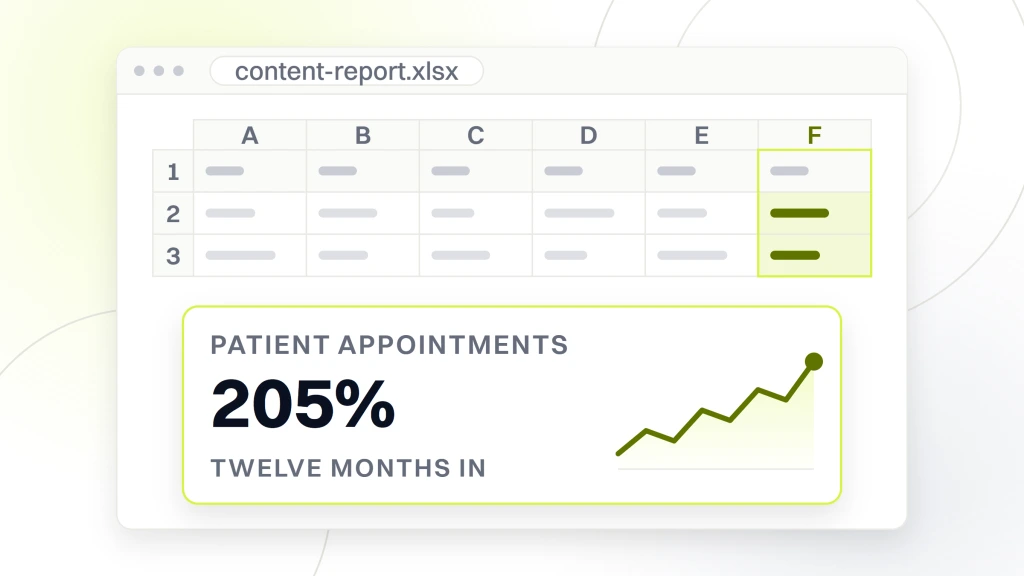
We rebuilt the entire content marketing strategy for chiropractors around 3 pillars matched to their top conditions. Each pillar got a head-term page and 6 to 8 cluster posts. Internal linking got mapped from scratch. Publishing moved to a steady cadence tied to the intake board. 12 months in, patient appointments grew 205%, averaging 122 monthly vs 40 previously. Organic traffic climbed 289%. Google reviews grew 162% and lifted the rating from 4.3 to 4.9 stars. The playbook works the same way for any US chiropractor practice at any scale.
What worked in the rebuild
The three-pillar model gave every new post a home before the copywriter opened a document. Interlinking rules got documented so every post added 3 links to the pillar page and 2 links to sibling cluster posts. The doctor interview workflow kept content sounding like the practice instead of like every other healthcare blog on the internet. And a monthly reporting call showed which posts were driving new patient bookings, which let the team double down on the cluster that worked best. For the multi-location marketing pattern in more depth, our chiropractor marketing services page covers the operational layer.
Lessons that transfer to any chiropractor
3 lessons transfer regardless of practice size. First, pick pillars from your actual patient volume, not from what you wish you treated more. Second, publish on a steady cadence you can hold for 12 months instead of a burst you can’t sustain. Third, measure booked patients from organic, not just traffic itself, since the two often move in opposite directions. Solo practices running this plan see 40 to 80 new organic patients per month within 9 months, which pays for the content program 4 times over.
SEO blog writing services for chiropractors and when to hire out
SEO blog writing services for chiropractors span a huge quality range. Offshore content mills sit at $80 a post. Specialist healthcare writers charge $400 to $700 a post. The cheap end produces posts that sound like every other blog Google has already ranked and buried. The specialist end produces posts that earn top-5 rankings, book patients on a repeatable timeline, and stay on page one for 3 to 5 years. If your budget is $200 per post, keep the work in-house and record a doctor interview. If your budget clears $500 per post, hire a healthcare-specialist writer and hand them the transcript.
When to hire out is the more useful question. Hire out when your cadence has slipped 3 months in a row. Hire out when you have topics on the plan you personally don’t want to write. Hire out when the practice has grown enough that your billable hour rate makes writing your own posts genuinely uneconomic. Don’t hire out just since a sales rep called and pitched you. The wrong provider costs more than doing nothing.
What to ask a writer before hiring
Ask any potential SEO blog writing services for chiropractors provider for 3 sample posts they wrote for a chiropractor or a related healthcare vertical. Not blog posts they generated. Posts they wrote from a doctor interview and that ranked. Ask which URL, which keyword, and which page in Google’s results the post lands on today. If the writer can’t show you a live example that ranks, they are learning on your dime. Ask what their revision policy is and how they handle clinical accuracy checks. A specialist writer answers those questions in one email. A generalist dodges.
In-house coordinator vs. outside agency
A part-time marketing coordinator at $22 an hour, 15 hours a week, can produce 6 to 8 posts a month using a doctor interview workflow inside your content marketing strategy for chiropractors. That’s $1,300 a month all in. A specialist content agency delivers similar output for $2,500 to $4,500 a month. Both models work. The in-house model builds practice knowledge over time. The agency model gets started faster and takes less of your management attention. Pick based on which resource you have more of, cash or bandwidth.
Reporting cycle that shows which posts book patients
Traffic reports are the wrong scoreboard. Booking reports are the right one. Every 30 days, pull a table showing sessions per post, form fills per post, and booked appointments attributed to organic inside your content marketing strategy for chiropractors. The last column is the one that decides where the next month of writing goes. 2 posts with 400 monthly visits each might book 12 patients from one and zero from the other. That gap tells you which pillar deserves more content and which needs a CTA rebuild before another word gets written.
Attribution for booked patients from organic requires either a call tracker like CallRail with dynamic number insertion or a booking system that captures referrer data. Set it up before you spend a dollar on content. Otherwise you spend 12 months writing and then guess which posts helped. Don’t guess. Track it. A content marketing strategy for chiropractors without attribution is a guess with a bill attached. See Google’s helpful content guidance for the ranking side of the same measurement question.
The monthly report the team keeps open
The monthly report the team should look at is one page with 4 rows. Row 1. Total organic traffic this month vs last. Row 2. Top 5 posts by organic traffic. Row 3. Top 5 posts by form fills or booked calls. Row 4. Pillar-level totals so you can see whether Conditions, Treatments, or Local Trust drove the most bookings. That report takes 30 minutes to build and drives every content decision for the next month.
When to cut content that is not working
Posts that get zero traffic 6 months after publishing usually have one of 3 problems. Wrong keyword, thin content, or bad title. Don’t delete them. Rewrite the title tag, add 400 words of depth, and add 3 internal links. Give the rewrite 90 days. If it still gets zero traffic, then delete or 301 to a stronger sibling post. Deleted posts can’t recover. Rewritten posts often do. See Ahrefs on content audits for the full framework, plus Moz on topic clusters for pillar planning.
Budget and timeline for a working chiropractor content marketing plan
A realistic budget for a working content marketing strategy for chiropractors runs $1,500 to $4,000 a month depending on in-house vs agency resources. That covers 8 posts a month, keyword research, internal linking cleanup, quarterly audits, and monthly reporting. Timeline for measurable results is 9 months from the first post. Traffic starts moving at month 4. Rankings hit page one at month 6. Booked patients from organic start showing up around month 8.
Practices trying to move faster usually spend more, get worse content, and see similar results. The pattern doesn’t compress well. If you want quicker booking growth in the first 6 months, run paid alongside the content plan instead of trying to speed content up. Content compounds slowly and then dominates. Paid works fast and stays flat. Both belong in a real chiropractor marketing plan. Neither replaces the other.
- Month 1 to 3. Publish 6 to 8 posts, fix orphan links, launch reporting.
- Month 4 to 6. Hit steady cadence, watch rankings move to page 2 then 1.
- Month 7 to 9. First booked patients from organic, adjust pillars based on data.
- Month 10 to 12. Scale winning pillars, rewrite underperformers, plan year 2.
Solo practice budget breakdown
A solo chiropractor with one location can run a serious content marketing strategy for chiropractors on $1,500 a month. That covers 2 posts a month from a specialist writer, monthly keyword research and reporting, and a quarterly audit. Add $200 a month for a call tracker and $50 for keyword research tools. Total, $1,750 a month, or about $21,000 a year. If that plan brings in 30 new patients a month by month 12 at a $2,400 lifetime value each, the ROI math works even at conservative retention numbers.
Multi-location practice plan
Practices with 3 or more locations should double the budget and add city pages under every pillar of the content marketing strategy for chiropractors. Each location deserves at least one Local Trust post per quarter naming the neighborhood, the office manager, and the specific insurance panels accepted there. Multi-location practices that skip city-level content leave 40% to 60% of local search traffic on the table (and a slow site cuts that further, which our page speed for chiropractor websites guide walks through), since Google shows the closest office to each searcher and needs a page to show for each location.
What to do this week to start a content marketing strategy for chiropractors
Start with 3 decisions this week. Pick your 3 pillars from your top-volume conditions from intake. Pick your cadence, 2 posts a month or 4. Pick who writes, in-house coordinator with doctor interviews, or specialist agency. Those 3 decisions cover 80% of the strategy. Everything else is execution.
Commit to a full 12 months before you judge the content marketing strategy for chiropractors you just launched. Content marketing doesn’t deliver on a three-month sprint. It compounds on year-long cycles since Google needs 4 to 8 months of steady publishing before topical depth turns into first-page rankings. Every chiropractor who stops at month 4 ends up restarting the plan next January. Every chiropractor who holds the cadence through month 12 ends up with a booking pipeline that repays the plan several times over. For the retainer math on how we structure engagements, our chiropractor marketing services page covers what an ongoing content plan costs, and our SEO for chiropractors writeup covers the technical layer that has to sit under any content plan for the strategy to hold.