
Dental Ads Compliance Rules for 2026 Practices and Agencies
- State boards enforce dental ad rules through patient and competitor complaints.
- ADA guidance and HIPAA both apply on top of state rules.
- Every ad landing page needs a disclaimer matching the offer type.
- Meta and Google enforce different rules, so review per platform.
- A two-person pre-publish review catches most compliance violations.
- State dental board rules that drive dental ads compliance
- ADA marketing principles behind dental ads compliance
- HIPAA marketing rules that affect dental ads
- Google Ads policies affecting dental ads compliance
- Meta ad policies for dental practices
- Disclaimer for dental ads that satisfies most rules
- Dental ads compliance review workflow
- Dental ads compliance at scale for a DSO
- Platform-specific dental ad compliance
- Wrapping up dental ads compliance
Dental ads compliance is the boring layer that nobody enjoys reading but every practice ignores at real cost. State board penalties, HIPAA violations, Google Ads suspensions, Meta account bans, and patient complaints all trace back to the same root cause: an ad that ran without a compliance review. This guide translates the rules from state boards, the ADA, HIPAA, Google, and Meta into a practical checklist you can hand to your agency or run over your own campaigns before you launch.
You get the state board patterns, the ADA marketing principles, the HIPAA-on-ads rules, the platform policies, the disclaimers that actually protect you, and the review workflow that catches issues before they publish. Read straight through, then bookmark the checklist and run it on every new ad campaign for the next 12 months. Nobody will thank you until an ad complaint lands in your state board’s inbox and does not stick.

State dental board rules that drive dental ads compliance
Dental ads compliance starts with your state dental board. Every US state licenses dentists and every state board has authority to discipline dentists for advertising violations. The rules vary by state, but the common threads are consistent: no false or misleading claims, no guarantees of results, no disparaging competitor claims, and appropriate disclosure when a testimonial appears. Violating any of these can result in a warning letter, a fine, a license suspension, or a public reprimand.
Most state boards do not review ads proactively. They respond to complaints from patients, competitors, or public advocates. That means a bad ad can run for months without issue until a single complaint lands, and the resulting investigation covers not just that ad but the practice’s entire marketing history. That is why the compliance review at the front end is the cheap option. The investigation at the back end is the expensive one.
State board variations to watch
Texas, Massachusetts, and California have historically had stricter advertising rules than the national average, including specific restrictions on before-and-after photos and testimonials. New York and Florida have moderate rules. States with less specific rulebooks still apply general false-advertising principles under state consumer protection law. If you run ads in multiple states, the rules of the strictest state usually govern the ad because a Texas patient could see an ad targeted to a Florida market. The safe path is to use the strictest state’s rules for national or multi-state campaigns.
Specialty titles and advertised expertise
State boards restrict the use of specialty titles like orthodontist, oral surgeon, endodontist, periodontist, prosthodontist, and pediatric dentist. A general dentist who advertises as a specialist without formal specialty credentials commits a compliance violation. Terms like implant specialist, cosmetic dentistry expert, and Invisalign specialist have all been challenged in various states. The safe language is provider, dentist offering, or dentist experienced in, unless the dentist actually holds the ADA-recognized specialty credential. Our dental marketing tips post covers the language layer.
ADA marketing principles behind dental ads compliance
The American Dental Association publishes a Principles of Ethics and Code of Professional Conduct that includes marketing guidance. State boards frequently reference the ADA code when adjudicating complaints, even in states where the code is not incorporated into law. Following the ADA guidance is a defensive posture against state board challenges and a professional standard that most dental peer reviewers apply.
The ADA marketing principles cover truthfulness, non-disparagement, appropriate use of testimonials, and clear identification of the treating dentist. Ads that promise specific outcomes, disparage other practices, or use edited before-and-after photos without disclosure fall outside the ADA principles. Ads that identify the treating dentist, describe services accurately, and use unedited photos with consent stay inside them. Guidance from ADA News and the HHS HIPAA for Professionals portal covers current enforcement trends.
Testimonials in dental advertising
Patient testimonials in dental ads are allowed in most states but require disclosure. The disclosure should note that individual results vary, that the testimonial reflects the patient’s own experience, and if the patient was compensated, that the compensation was disclosed. Fake testimonials, edited testimonials, and testimonials from non-patients are compliance violations that state boards have penalized. Real testimonials with clear disclosure work. Anything else risks the account and the license.
Before and after photos with consent
Before and after photos in dental ads require patient consent, appropriate disclosure, and no digital manipulation beyond standard lighting or cropping. The consent form should specify use in advertising, publication rights, and revocation terms. Digital manipulation beyond standard adjustments is a compliance issue in almost every state. A whitening ad that shows a photo edited to appear whiter than the actual clinical result is a false advertising violation. Real photos with real results and real consent work. Enhanced photos do not.
HIPAA marketing rules that affect dental ads
HIPAA applies to dental practices as covered entities under the Health Insurance Portability and Accountability Act. The marketing rules in HIPAA restrict how patient information can be used for marketing purposes, and violations can result in civil monetary penalties from the Office for Civil Rights. HIPAA is federal, applies in every state, and adds a layer of compliance on top of state board rules.
The core HIPAA marketing rule is that patient information cannot be used for marketing purposes without patient authorization, with narrow exceptions for face-to-face communications and promotional gifts of nominal value. This means any ad that uses patient information, including a testimonial, a before-and-after photo, or a case study, requires HIPAA-compliant patient authorization. That authorization is different from a state board consent form and needs to meet HIPAA’s specific requirements.
Marketing pixels and HIPAA
HIPAA rules apply to marketing pixels on dental practice websites, including Meta Pixel, Google Ads conversion pixels, and third-party analytics. The rule is that pixels cannot transmit protected health information without patient authorization. Practices that install pixels on booking forms, patient portal pages, or procedure pages without authorization risk HIPAA violations. The Office for Civil Rights has fined healthcare organizations for pixel-related HIPAA breaches. Our HIPAA marketing compliance for dentists post covers pixel setup in depth.
Retargeting and audience building
Retargeting audiences built from patient website behavior can trigger HIPAA concerns if the retargeting reveals patient status. A patient who visited an implant procedure page and then sees an implant ad on Facebook has been identified as a dental patient to Meta, which is a disclosure of protected health information. The safe approach is to retarget based on general site visits without procedure-page specifics, or to use HIPAA-compliant audience building through platforms that offer signed BAAs. Meta does not sign BAAs, which limits how healthcare practices can use its retargeting.
TX, MA and CA police testimonials hardest. Pull your last 5 ads and check if any patient photo lacks written consent on file. That's where the complaints start.
Google Ads policies affecting dental ads compliance
Google Ads applies its healthcare and medicines policy to dental ads. The policy restricts certain claims, requires accurate representation of services, and prohibits misleading offers. Google enforces the policy through automated review, human review of flagged accounts, and account suspension for repeat violations. A dental practice with a suspended Google Ads account loses paid search traffic entirely, and reinstating a suspended account can take 2 to 8 weeks even after policy compliance is restored.
The specific Google policy areas that trip dental practices most often are unrealistic price claims, exaggerated results claims, misleading urgency language, and healthcare privacy policy requirements on landing pages. Ads promising $99 dental implants get flagged. Ads promising instant perfect smiles get flagged. Ads with countdown timers falsely representing scarcity get flagged. Landing pages without a privacy policy get flagged. Guidance from the Google Ads healthcare and medicines policy covers the specific rules.
Price claims and disclosures
Price claims in dental ads need supporting disclosures. An ad offering $199 teeth whitening should disclose what is included, what is excluded, whether the price applies to new patients only, whether insurance is factored, and any expiration date. Google’s policy requires the disclosed details either in the ad copy or on the linked landing page within one click. Ads that promise a low price and then link to a page selling a different offering violate the policy and often violate state consumer protection law simultaneously.
Personalized ads for healthcare
Google restricts personalized ads for healthcare topics. Dental ads cannot use personalized targeting based on medical or health status. Ads targeting people identified as having dental anxiety, tooth loss, or specific health conditions are prohibited under Google’s personalized advertising restrictions. The safe targeting approach uses geographic targeting, demographic targeting outside health status, and interest-based targeting focused on general categories like beauty and wellness rather than clinical conditions.
Meta ad policies for dental practices
Meta enforces its own set of policies on Facebook and Instagram ads. The dental-relevant policies restrict before-and-after photos in ways that differ from Google, prohibit certain body-image messaging, and require compliance with local healthcare law. Meta’s automated review is aggressive and often rejects ads that are technically compliant, which creates operational friction even for well-run dental accounts.
Meta prohibits close-up before-and-after mouth photos in many cases because the algorithm categorizes them as personal health-status disclosures. Meta prohibits body-focused messaging that implies inadequacy, which affects cosmetic dental campaigns positioned as fixing bad smiles. Meta requires that health-related ads not promise unrealistic results. Meta rejects ads that use compliance-required disclaimers in the ad body if they take up too much visual space. Reading the current Meta advertising policies before launching creative is the fastest way to avoid an ad rejection cycle.
Before and after on Meta
Meta’s typical practice is to reject direct before-and-after mouth close-ups. The workaround is to show the patient’s face pre and post with a natural smile rather than a clinical close-up, or to show only the post photo with a testimonial. Some ad accounts get more permissive treatment than others based on account history, but planning for the stricter interpretation avoids rejection loops. Our dental photo consent for marketing covers the consent side of using patient photos.
Body image messaging on Meta
Ads that imply patients are inadequate because of their appearance get rejected under Meta’s ideal body image policy. Cosmetic dental ads that use language like fix your ugly smile or embarrassed by your teeth get flagged. The workaround is to focus on the outcome and confidence rather than the current appearance. Confident smiles work. Fixing embarrassment does not. This applies across cosmetic categories including whitening, veneers, Invisalign, and full-mouth reconstructions.
Disclaimer for dental ads that satisfies most rules
Disclaimer for dental ads is one of the smallest edits with the largest compliance payoff. A well-drafted disclaimer covers the state board disclosure requirements, the ADA testimonial guidance, and the Google price-claim policy in one paragraph. The disclaimer should appear on the linked landing page and be readable at standard viewport sizes. Small print at the bottom of a mobile screen does not count as accessible disclosure.
The disclaimer patterns below cover the most common dental ad scenarios. Copy them, adapt to your state and offer, and put them on every relevant landing page. Skipping the disclaimer to keep the page clean is short-term thinking that trades a small design consideration for real compliance risk. Every serious dental agency puts the disclaimer in the footer of every ad landing page as a standard practice.
Testimonial disclaimer template
Individual results vary. Testimonials reflect the personal experience of the patient shown, are used with written consent, and do not guarantee similar outcomes for other patients. Photos and video are unretouched beyond standard cropping and lighting. If a patient received compensation for the testimonial, that is disclosed alongside the testimonial. This wording satisfies state board disclosure requirements in most jurisdictions and the ADA testimonial guidance in all of them.
Price offer disclaimer template
Offer valid for new patients only, cannot be combined with insurance or other offers, applies to a single-appointment new-patient exam and X-rays only, does not include treatment recommended after the exam, and expires 30 days from initial inquiry. This wording satisfies Google’s price-claim policy and blocks most consumer protection challenges. Adjust the specifics to match the actual offer terms. A price disclaimer that misrepresents the offer is worse than no disclaimer.
Dental ads compliance review workflow
Dental ads compliance review workflow is the process that catches issues before an ad publishes. The workflow that works is a two-person review with a checklist. The workflow that fails is a solo creative signing off on their own work. Compliance review takes 10 to 15 minutes per new ad and typically catches 30 to 50 percent of ads that would otherwise get flagged, rejected, or complained about.
The reviewer is not typically a lawyer. The reviewer is a marketing operations person or an experienced account manager who runs the compliance checklist. Escalate to counsel only for the ambiguous cases. Most compliance issues are pattern violations that a trained reviewer catches on the checklist, and the overwhelming majority of issues get resolved in the review pass with a small copy or image adjustment.
The pre-publish review checklist
- Does the ad make any specific results guarantee
- Does the ad disparage another practice or dentist
- Are testimonials disclosed with individual-results-vary language
- Are before-and-after photos consented, unretouched, and disclosed
- Are price claims backed by a landing-page disclaimer
- Does the landing page have a current privacy policy
- Are HIPAA-covered pixels appropriately configured
- Is the ad targeting compliant with personalized-ads restrictions
- Do specialty titles match actual credentials of the treating dentist
- Is the ad copy compliant with the strictest applicable state’s rules
Documentation and audit trail
Keep the compliance checklist, reviewer sign-off, patient consents, testimonial authorizations, and photo consents in a central archive. State board investigations sometimes require producing this documentation years after the ad ran. A practice that can produce the documentation resolves the investigation quickly. A practice that cannot produce it faces a much longer inquiry. The archive is cheap operational insurance for a serious compliance exposure.
Dental ads compliance at scale for a DSO
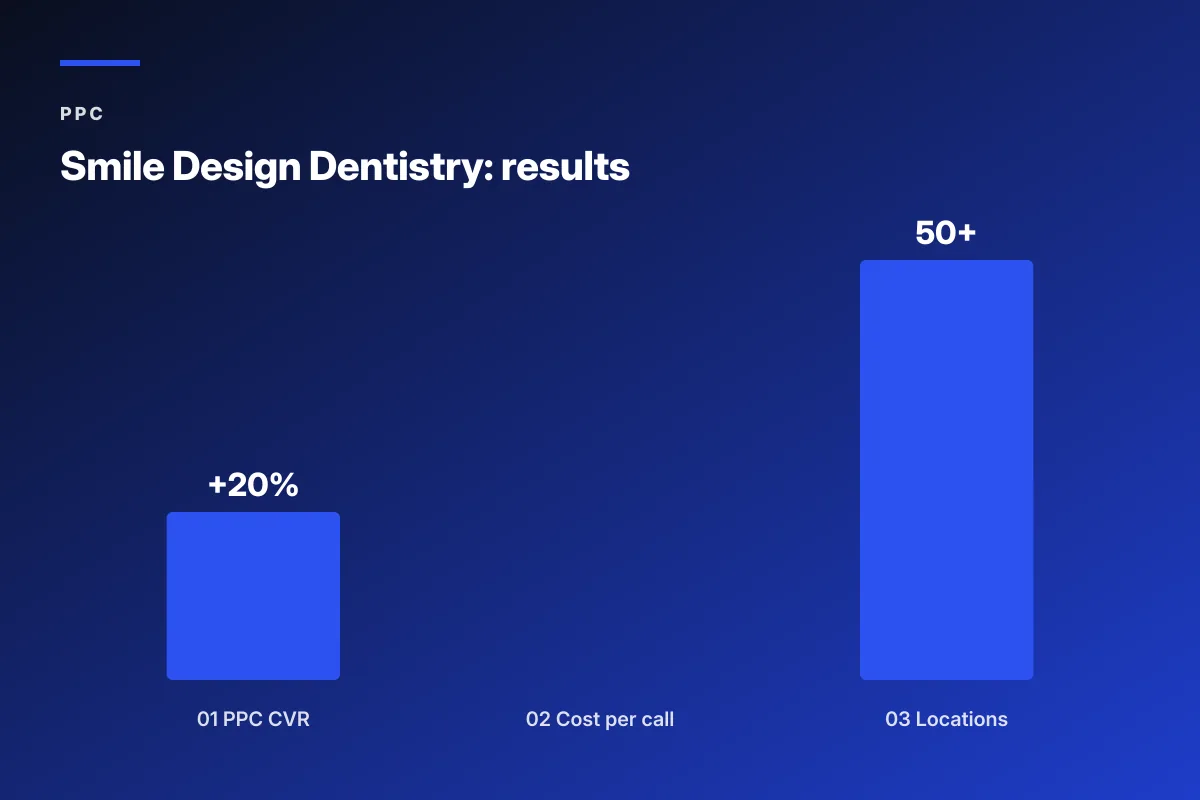
Smile Design Dentistry runs 50-plus offices across the US as a mid-market DSO. Compliance across the group was inconsistent before we engaged. Some offices had strong consent workflows and testimonial documentation. Others had gaps that would have created problems if a state board complaint had ever landed. The variance tracked to office manager tenure and local marketing autonomy.
We standardized the compliance review workflow across the network, unified the consent forms to the strictest state’s requirements, centralized the testimonial and photo archive, and put every new ad through a two-person review. Alongside the compliance work, we restructured the paid accounts, added full-funnel paid social, and built tailored landing pages per location. Cost per call dropped 30 percent. PPC conversion rate climbed 20 percent. Fifty-plus locations went live on unified, compliant systems.
| Compliance area | Pre-engagement | Post-engagement |
|---|---|---|
| Testimonial consent | Inconsistent per office | Standardized to strictest state |
| Photo consent | Mixed documentation | Central archive |
| Ad review process | Solo signoff | Two-person checklist |
| Disclaimer coverage | Missing on some pages | Every landing page |
| HIPAA pixel setup | Legacy pixels active | Reviewed and reconfigured |
Every dental agency we have audited has at least one legacy Meta ad account with a decade-old Facebook Pixel firing from a booking page that nobody remembers configuring. It was set up in 2015 by a marketing intern, works fine, and is a HIPAA time bomb that nobody has ever thought to check. The compliance review always finds it. The office manager is always surprised. The agency always insists it was there when they onboarded. Nobody argues too hard once you offer to help take it out.
Platform-specific dental ad compliance
Different platforms enforce different rules, and the dental ad that works on Google might get rejected on Meta or vice versa. Building creative to the strictest common denominator saves rework cycles. Building creative optimized per platform requires per-platform review. Either approach works. Mixing them without discipline creates chaos, especially in multi-location groups.
The bigger the ad account, the more the platform reviews Get automated. Automated review is faster but less accurate. Ads that a human reviewer would approve sometimes get rejected by the algorithm, and appeals take days. Ads that a human reviewer would reject sometimes slip through automation only to get flagged after a complaint. Both patterns exist, and neither is dependable enough to skip the pre-publish compliance review.
TikTok and emerging platforms
TikTok, YouTube Shorts, Snapchat, and other emerging platforms have less codified dental ad review than Google and Meta but apply broadly similar rules. Some platforms are stricter on before-and-after. Some are looser on price claims. All of them require compliance with state board rules and federal HIPAA. The prudent approach is to run the same compliance review workflow across every platform regardless of whether the platform’s own review is strict or loose.
Video ad specifics
Video dental ads carry additional compliance considerations. Testimonials in video need on-screen disclaimers. Before-and-after transitions need pause frames long enough to read. Voice-over claims count as ad claims. Music with copyrighted lyrics carries a separate rights issue. Video review takes 20 to 30 minutes per creative and requires access to the raw source files to check editing decisions. Our video ads for dental services covers the video layer in depth.
Wrapping up dental ads compliance
Dental ads compliance is a small operational cost that prevents a large exposure. State board investigations, HIPAA penalties, Google Ads account suspensions, and Meta account bans all cost dramatically more than the review workflow that would have prevented them. The checklist in this guide covers 90 percent of the pattern violations most dental practices need to worry about, and the disclaimers cover the remaining paper-trail requirements.
If you want the compliance layer built into a broader dental marketing program by a team that has done it across 50-plus locations, our dental marketing practice covers what compliance looks like as part of a full engagement. If you want to run compliance in-house, work the review checklist on every new ad and archive the documentation. Either way, the practice that avoids the compliance complaint is the practice that treated the review as routine, not as an afterthought.
Frequently asked questions
What are the most common dental ads compliance mistakes?
The most common mistakes are unretouched-photo claims that used editing beyond standard adjustments, testimonials without individual-results-vary disclaimers, price offers without landing-page disclosure of the terms, specialty title claims by general dentists, and Meta Pixel or Google Ads pixel installations that transmit protected health information without patient authorization. Each of these can trigger state board complaints, HIPAA violations, or platform account suspensions. Fixing them takes hours. The consequences of leaving them in place range from license reprimand to five-figure federal penalties. Every practice we audit has at least two of these on active campaigns.
Does the ADA code of conduct legally apply to dental ads?
The ADA Principles of Ethics and Code of Professional Conduct are voluntary at the ADA level, but state dental boards frequently reference the code when adjudicating complaints, and many state statutes incorporate ADA guidance either explicitly or by practical enforcement. Even in states that do not formally adopt the ADA code, board investigators use it as a benchmark for professional conduct. Practices that follow ADA guidance have a defensive posture against board challenges. Practices that ignore it look unprofessional in an investigation. The safe path is to treat the ADA code as enforceable in practice, regardless of the technical statutory status.
How does HIPAA affect dental Google and Meta ads?
HIPAA restricts using patient information for marketing without authorization, and this extends to marketing pixels on dental practice websites. A Meta Pixel on a dental booking page that transmits URL data or form data can transmit protected health information. A Google Ads conversion pixel on a procedure page can quietly disclose a patient's health interest to Google. The Office for Civil Rights has issued guidance and enforcement actions on healthcare pixel use. The safe approaches are to obtain HIPAA-compliant patient authorization, to configure pixels through HIPAA-compliant intermediaries, or to limit pixel firing to pages that do not carry protected health information.
Do I need a lawyer for dental ads compliance review?
Not for routine ad review. Most compliance work is pattern recognition on a checklist that a trained marketing operations person handles at 10 to 15 minutes per ad. You do need a healthcare attorney for the initial workflow setup, the disclaimer templates, the consent forms, and the HIPAA authorization forms. You also need counsel for state board complaints, HIPAA breach responses, and any platform account escalations that go beyond routine appeals. Budget for 4 to 8 hours of healthcare counsel per year on a well-run compliance program, plus incremental spend when a novel situation arises. That is much cheaper than fighting a state board complaint.
What happens if a dental ad triggers a state board complaint?
A complaint typically comes from a patient, a competitor, or a public advocate. The state board opens an investigation, requests documentation, and may schedule an interview with the practice owner. Practices with a well-organized compliance archive resolve the investigation quickly, often with a warning letter or no action. Practices without documentation face longer investigations, potential fines, license probation, and public reprimand. The best defense against a complaint is a documented compliance review workflow that shows the practice acted in good faith and had processes in place. Retroactive compliance work does not carry the same weight as documented prior process.
Are dental ad disclaimers required on every ad?
Disclaimers are required whenever the ad makes a specific claim, offer, or testimonial that could be interpreted as guaranteeing results or misrepresenting the practice's services. Ads with price offers need a disclaimer covering the terms. Ads with testimonials need an individual-results-vary disclaimer. Ads with before-and-after photos need a photo-consent and no-manipulation disclaimer. Ads with specialty titles need language that clarifies the treating dentist's actual credentials. Simple brand ads that identify the practice without making claims do not need a disclaimer. The disclaimer covers claims, not existence, and belongs on the linked landing page where it is accessible in one click.
Book your free 30-minute strategy call.
No spam, no sales rep. We use your email to schedule your call with a senior strategist. That is it.
More from the blog
View all articles → PPC
PPC Healthcare PPC Advertising Channels Compliance and Targeting
Read article PPC
PPC Dental Facebook Ads Guide for Practices That Book Patients
Read article PPC
PPC