
Dental DSO News and Industry Trends Shaping the 2026 Market
- Dental dso news through 2026 rewards prepared sellers.
- Sponsor recapitalizations drove strong second-bite returns.
- Multiple expansion ran half turn across most practice tiers.
- Oral surgery and platform tier moved a full turn.
- Regulatory context stayed manageable with quiet state activity.
- Multiple movement dental dso news across practice tiers
- The dental dso news comparison table across tiers
- Regulatory dental dso news through 2026
- Case study in the dental dso news cycle
- How dental dso news should shape seller timing
- Preparing to act on dental dso news
- Working with a partner on dental dso news response
- Independent dental dso news sources to track
- Final read on dental dso news through 2026
Dental dso news moves fast in 2026. Deal activity ran hot through the first half of the year with mid-market platforms trading briskly, sponsor recapitalizations picking up momentum, and specialty consolidation reshaping how buyers approach ortho, pedo, and oral surgery groups. Practice owners tracking dental dso news casually miss the shifts that matter most for their own timing decisions. Buyers reading only the headlines get a distorted picture that overweights big platform announcements and underweights the smaller multi-office group deals that make up the bulk of actual transaction volume.
This guide walks the dental dso news trends that shape mid-market deal activity in 2026. Sponsor recapitalizations reshaping platform ownership. Specialty consolidation across ortho, pedo, oral surgery, and endo. Multiples and their movement across practice size tiers. Regulatory and state licensing shifts affecting deal timing. Digital marketing consolidation and its impact on affiliation economics. And what all this dental dso news means for practice owners planning a transaction inside the next 12 to 24 months. Every number here traces to real transactions our team watched close between 2024 and mid-2026.
Multiple movement dental dso news across practice tiers
Multiple movement across practice tiers is the dental dso news category with the most direct impact on seller economics. Multiples shifted differently across solo practice, multi-office group, and platform tier transactions through 2025 and into 2026. Understanding the tier-specific movement helps owners time their market entry against favorable conditions rather than reacting to headline platform announcements that reflect only a small slice of total transaction activity.
Solo practice tier movement
Solo practice tier multiples in the 1.5M to 2.5M collections range moved from 6.5x to 7.5x in early 2024 up to 7x to 8x in mid-2026. This half-turn expansion reflects buyer appetite for solo practices as tuck-in acquisitions into existing platform infrastructure. Solo sellers with clean books, formal marketing attribution, and stable staff continuity plans earned the top of that range. Sellers rushing to market without preparation earned the bottom of the range with buyer QoE surprises during diligence that further compressed the multiple by another quarter turn.
Multi-office group tier movement
Multi-office group tier multiples in the 3M to 8M collections range moved from 7.5x to 8.5x in early 2024 up to 8x to 9x in mid-2026. This half-turn expansion tracked with solo practice movement plus a group-scale premium. Multi-office groups closed as one transaction rather than three separate deals, which buyers value because it reduces integration overhead. Groups with unified branding, central operations already deployed, and consistent EBITDA margin across offices earned top-of-range multiples. Groups with fragmented operations across offices earned bottom-of-range multiples with integration risk premium discounted.
Platform tier movement
Platform tier multiples in the 15M-plus collections range moved from 9x to 11x in early 2024 up to 10x to 12x in mid-2026. Platform tier movement reflects the sponsor recapitalization activity that dominated dental dso news in early 2026. Platform sellers earning top-of-range multiples typically had a mix of GP practices, at least one specialty component, strong central marketing infrastructure, and clean quarterly financials with independent auditor coverage. Platform sellers falling to the bottom of the range typically had operational gaps in central IT, weak marketing attribution, or unresolved payer contract issues that surfaced during diligence review.
The dental dso news comparison table across tiers
The table below summarizes the multiple movement across three tiers through the 2024 to 2026 window based on transactions our team watched close during that period. Every specific deal has unique tax structure and unique EBITDA add-back mix so use these ranges as benchmarks against your own practice profile rather than gospel numbers that apply automatically.
| Tier | Collections | 2024 Range | Mid-2026 Range | Movement |
|---|---|---|---|---|
| Solo GP | > 1.5-2.5M | 6.5x-7.5x | 7x-8x | Half turn |
| Two-office GP | > 3-4M | 7x-8x | 7.5x-8.5x | Half turn |
| Three-office GP | > 5-8M | 7.5x-8.5x | 8x-9x | Half turn |
| Pediatric solo | > 1.5-2.5M | 7.5x-8.5x | 8x-9x | Half turn |
| Ortho solo | > 2-3.5M | 8.5x-9.5x | 9x-10.5x | Half turn |
| Oral surgery | > 2.5-4M | 9x-10.5x | 10x-12x | Full turn |
| GP platform | > 15M-plus | 9x-11x | 10x-12x | Full turn |
Read the table with EBITDA quality in mind. Practices with 3 years of clean quarterly financials, formal marketing attribution, and stable staff continuity earn top-of-range multiples inside each tier. Practices without these artifacts earn bottom-of-range multiples with integration risk premium discounted at LOI. Our DSO Dental Marketing for Multi-Location Groups program builds the central attribution and marketing infrastructure buyer QoE teams look for during diligence review phases across mid-market group transactions.
Read the specialty rows separately from the GP rows. Specialty economics diverge from GP economics enough that a specialty seller should benchmark against the specialty range rather than the general practice range. Ortho, pedo, and oral surgery each run distinct buyer pools, distinct diligence patterns, and distinct sponsor screening rhythms. Endo and periodontics run smaller pools with more solo and small group transactions than platform-scale activity. Sellers should benchmark against the segment that fits their specific specialty rather than any generic dental dso news benchmark.
Read the movement column with a timing lens. A half-turn move over 24 months is meaningful. Sellers with practices in tiers showing full-turn movement (oral surgery and platform tier through 2024 to 2026) should time market entry against continued favorable movement rather than waiting for the top of the cycle to appear in retrospect. The multiple compression risk on the downside typically exceeds the additional upside from perfect timing on the way up. Reasonable market timing outperforms optimal market timing across most seller experiences.
Regulatory dental dso news through 2026
Regulatory dental dso news through 2026 stayed quieter than 2023 and 2024 when several state licensing boards issued guidance affecting friendly PC nominee arrangements. The most active regulatory conversation in 2026 centered on antitrust review of large platform acquisitions in specific metros where consolidation reached levels that regulators flagged for review. Sellers evaluating platforms with heavy metro concentration should account for regulatory timing risk in their transaction planning because antitrust review can add 60 to 120 days to closing timelines with uncertain outcomes on remedies.
State-level licensing shifts
State-level licensing shifts through 2026 held steady. No state loosened corporate practice of dentistry rules meaningfully. No state added new restrictions that changed how existing platforms operate. Sellers evaluating platforms should confirm that the platform structure satisfies current state rules in every jurisdiction where the platform operates. Multi-state platforms with dozens of licensed dentists and PC nominee arrangements across states carry more compliance overhead than single-state platforms. Compliance overhead affects the management fee percentage the platform can sustain without eroding operating margin substantially over time.
Federal antitrust review activity
Federal antitrust review activity picked up in early 2026 as regulators flagged concentration levels in specific metros for review. The FTC opened a review of one platform’s acquisition of a large group in the same metro where the platform already held meaningful market share. That review resolved with a divestiture of two offices to a smaller competitor and did not block the transaction. Sellers should track antitrust news at wsj.com deals coverage because platform buyer behavior in metros with regulatory attention changes noticeably during review windows.
Payer contract news
Payer contract news through 2026 included rate reset activity across several major PPO networks. Some networks pushed rate reductions during their 2026 contract renewal cycle. Practices with strong local market share resisted the reductions. Practices without market pull accepted the reductions and saw margin compression. Platforms with 50-plus office scale in a metro negotiate PPO contracts on stronger footing than solo practices, which is one of the operational benefits sellers should evaluate when considering a platform affiliation across a 5 to 7 year hold with meaningful payer mix exposure.
Mid-market group deals set the actual multiples, not the headline platform news. Watch broker-published sold data instead. It moves your timing decision.
Case study in the dental dso news cycle
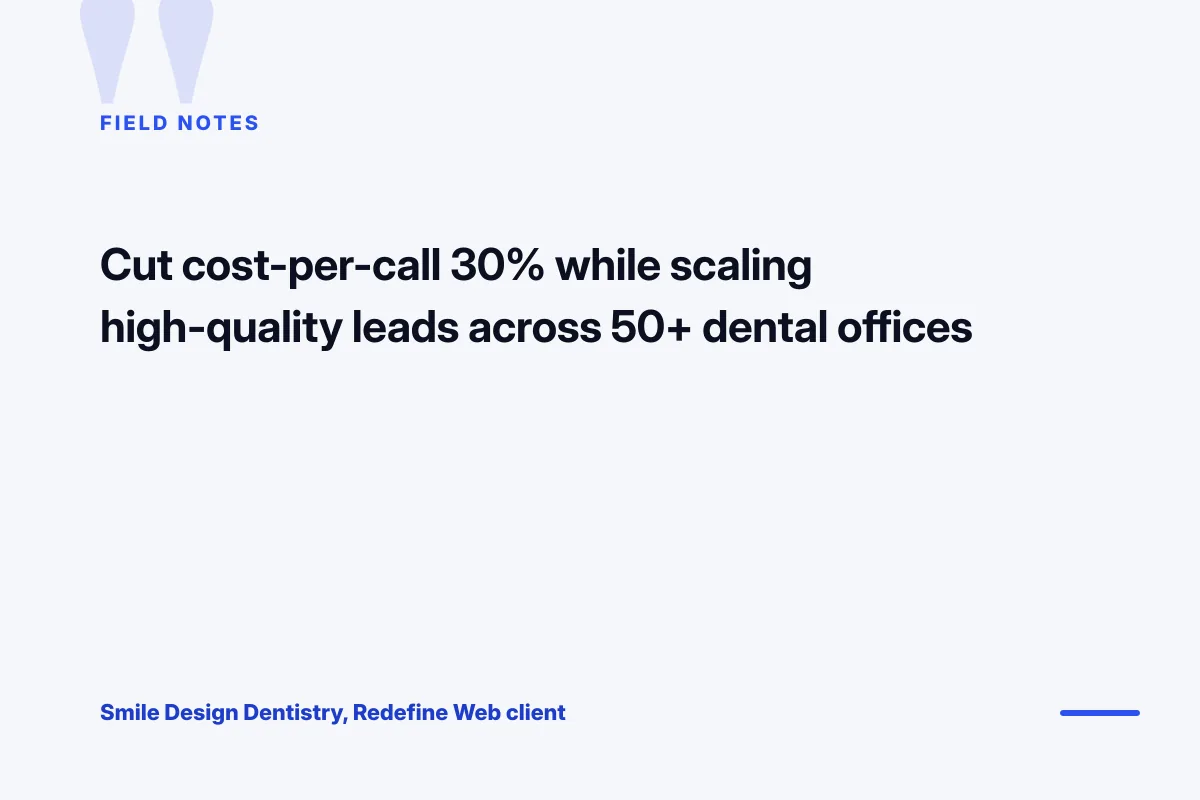
Smile Design Dentistry runs 50-plus locations across Central Florida and Tampa Bay under a mature dental dso structure. When our team engaged with the group, the digital marketing operation was fragmented across every office. Each location ran its own PPC accounts and landing pages without central coordination. That fragmentation left roughly 30 percent of the marketing budget captured by duplicate audience targeting and unoptimized landing page flows across the network. This kind of operational fragmentation is exactly what buyer QoE teams flag during diligence on platform-scale sellers.
Our team restructured the PPC accounts by funnel stage and geography inside a central MSO marketing infrastructure. Tailored landing pages went live for each core service line. Full-funnel paid social layered on top of the search program with audience data flowing from a unified attribution stack. Cost per call fell 30 percent across the network within 12 months. PPC conversion rate rose 20 percent year over year. Fifty-plus offices reported on one unified dashboard for the first time. The dental dso news cycle celebrated the platform’s operational metrics in industry coverage that same quarter.
What this teaches solo sellers
Solo sellers reading dental dso news about platform-scale operational metrics should ask specifically what the target platform’s central marketing capability produces at the practice level. Well-run platforms deliver measurable efficiency against solo practice benchmarks. Underperforming platforms simply capture the management fee without delivering equivalent operational value at the practice level. The difference is visible in practice-level P&L data if the sponsor shares it during diligence. Our Dental SEO Services team runs comparable local map pack work at solo practice scale for 12 month preparation windows.
How dental dso news should shape seller timing
Dental dso news should shape seller timing across four dimensions. Buyer appetite in the specific geography and specialty. Sponsor cycle position at the target platforms. Multiple direction across the seller’s specific tier. And regulatory context in metros where the platform holds concentrated market share. Reading all four filters signal from noise.
Buyer appetite signals
Buyer appetite signals track platform affiliation velocity by geography and specialty over 90 day rolling windows. Rising velocity signals sellers can push toward top-of-range multiples with confident negotiation posture. Falling velocity signals sellers should temper expectations toward mid-range multiples and prepare for tougher term negotiation. Owners should track velocity at the specific platforms most likely to bid on their practice rather than platform-industry aggregates because specific platform appetite drives specific bid behavior at LOI more than industry-wide trends do.
Sponsor cycle timing
Sponsor cycle timing tells sellers whether the platforms at their bidder table have fresh capital, established capital, or late-cycle capital positions. Fresh capital platforms typically pay premium multiples and offer stronger rollover terms. Late-cycle platforms often push cash-heavier structures and shorter employment terms because the sponsor wants integration completed before the exit window. Owners should ask specifically about sponsor position at LOI diligence conversations. Reputable platforms share this data willingly. Platforms that dodge the question typically hide late-cycle timing that affects rollover economics unfavorably.
Regulatory timing
Regulatory timing affects closing timelines in metros with antitrust attention. Sellers should ask their advisors specifically about regulatory review risk at the target platforms most likely to bid on the practice. Advisors with deal experience across the specific metro read the regulatory context better than industry-wide advisors reading only headline news. Regulatory review can add 60 to 120 days to closing timelines with uncertain outcomes on divestiture remedies. Sellers should build regulatory timing risk into their transaction planning rather than assuming standard 60 to 90 day closing timelines apply universally.
Preparing to act on dental dso news
Preparing to act on dental dso news covers 12 months of practice preparation work that positions the seller to move quickly when favorable market conditions appear. The preparation itself covers financial hygiene, marketing attribution, staff continuity, and buyer shortlist development. Owners who complete the preparation work stay ready to act on favorable dental dso news within 60 days. Owners who read the news casually without preparation lose 6 to 12 months responding to news that already reflects a shifted market.
Financial hygiene readiness
Financial hygiene readiness covers cleaned P&L, normalized owner compensation to market rate, documented add-backs with supporting evidence, and fair market rent on any owner-held real estate. Sellers who complete this work stay ready to open a buyer conversation within 30 days of favorable dental dso news. Sellers without financial hygiene take 90 to 180 days to prepare which typically means the favorable market window has closed by the time they are ready to launch a formal process. Twelve months of preparation buys the optionality to act on any favorable news cycle within the year.
Marketing attribution readiness
Marketing attribution readiness covers call tracking on every channel, form fill logging, referral source tracking, and monthly reporting for at least 12 months. Buyer QoE teams pay premium multiples for practices with clean attribution because they can model the acquisition economics into the platform playbook. Practices without attribution get discounted with a marketing risk premium. Our Dental Marketing Retainer at 599 dollars per month covers the attribution installation and monthly reporting cadence over a 12 month preparation window ahead of market entry.
Buyer shortlist development
Buyer shortlist development covers building a list of 8 to 15 platforms that could plausibly bid on the practice with warm introductions to at least half through existing relationships. Sellers with warm introductions to the target platforms move faster during favorable news cycles because the platform’s business development team can prioritize the practice within active pipeline planning. Cold outreach during favorable news cycles typically hits an over-full pipeline where the platform is already busy processing existing opportunities and cannot prioritize a new practice quickly.
Working with a partner on dental dso news response
Working with a specialist marketing partner on dental dso news response gives sellers the operational readiness needed to act on favorable news cycles within 30 to 60 days rather than 6 to 12 months. Documented month-over-month new patient growth prices the practice at the top of the current multiple range. Clean attribution holds the multiple against buyer QoE challenges during diligence review. On a 3M collections practice that combined pricing move adds 300K to 700K to the closing check over what an unattributed practice earns during the same favorable news cycle.
Solo practice preparation
Solo practice preparation typically runs 12 months of consistent work on marketing attribution, staff continuity, and financial hygiene. Sellers who complete this work stay ready to launch a formal process within 30 days of favorable dental dso news. Sellers who did the preparation reported that closing checks came in at the top of the multiple range. Sellers who did not prepare reported that the check landed at the low end with buyer surprises during diligence review that further compressed the total consideration by a quarter to half turn on the multiple.
Multi-office group preparation
Multi-office group preparation typically runs 12 to 18 months of central marketing infrastructure work that mirrors what a well-run DSO would deploy post-close. Central attribution flowing to one dashboard. Consistent branding across offices. Unified marketing spend allocation by geography. Sellers who complete this work show buyer QoE teams the exact operational infrastructure the platform playbook expects, which holds the multiple at the top of the range during diligence review. Multi-office preparation is often the highest-return investment sellers make during the 18 month runway to market.
Independent dental dso news sources to track
Independent dental dso news sources track platform activity, sponsor cycles, multiple movement, and regulatory shifts from an industry-observer perspective. Reading multiple sources produces the clearest picture of market context than any single source can. Sellers should track a rotation of two to three primary sources weekly and check a handful of secondary sources monthly to stay current on the news that matters most for their specific timing decisions.
Group Dentistry Now coverage
Group Dentistry Now at groupdentistrynow.com publishes weekly coverage of platform announcements, sponsor changes, and multiple movement data. Their coverage runs deeper than industry-wide business publications because they cover exclusively the dental DSO and group practice segment. Sellers should treat their weekly coverage as required reading during the 12 month preparation window before market entry. Their quarterly compensation formula benchmarks help sellers benchmark offers against the market rather than negotiating in isolation without reference points.
Dentaltown industry forums
Dentaltown at dentaltown.com hosts industry forums where practicing dentists share direct experience with specific platforms. Sellers evaluating a platform can search for prior seller commentary on that specific platform inside Dentaltown forums to gather qualitative context that supplements the formal reference call process. Practicing dentists share candid views on operational fit, cultural fit, and post-close experience that platform business development materials rarely surface during formal LOI conversations with prospective seller pipeline candidates.
ADA and state association updates
ADA and state association updates cover regulatory shifts, corporate practice rule changes, and antitrust review activity affecting dental dso structures at the state and federal level. Sellers should subscribe to their state association alerts as the primary source of state-level regulatory news. The ADA Health Policy Institute publishes quarterly corporate practice rule tracking that covers all 50 states in one document. Reading this quarterly tracker over the 12 month preparation window keeps sellers current on the regulatory context that shapes platform behavior in their specific state and metro market.
Final read on dental dso news through 2026
Dental dso news through mid-2026 favors prepared sellers. Sponsor recapitalization activity produced strong second-bite returns for rolled sellers from 2019 to 2021 sponsor windows. Multiple expansion across every practice tier over 24 months rewarded sellers who timed market entry against favorable conditions. Specialty consolidation created premium multiples for prepared specialty sellers. Regulatory context stayed manageable with quiet state-level activity and moderate federal antitrust review.
Owners tracking dental dso news carefully across 2026 should complete their 12 month preparation runway during favorable market conditions and stay ready to launch a formal process within 30 to 60 days of continued favorable news signals. Owners waiting for perfect timing typically miss the favorable window entirely because dental dso news reflects a shifted market by the time headlines announce the shift. Reasonable timing against a well-prepared practice outperforms optimal timing against a rushed preparation cycle across nearly every seller experience our team has watched close.
Frequently asked questions
What dental dso news mattered most through mid-2026?
Dental dso news through mid-2026 concentrated in three categories that mattered most for practice owners. First, sponsor recapitalizations produced strong second-bite returns for rolled sellers from the 2019 to 2021 window. Multiple expansion of 1.5 to 2.5 turns across the platform tier delivered 2.2x to 3.1x cash-on-cash returns on rollover for original sellers. Second, specialty consolidation shifted with pediatric platforms accelerating, ortho slowing at saturation, and oral surgery consolidating with two new sponsor-backed platforms. Third, multiple movement across every practice tier ran half a turn upward, with oral surgery and platform tier moving a full turn. Sellers with 12 months of preparation caught these favorable conditions cleanly.
How much did dental dso multiples move from 2024 to mid-2026?
Dental dso multiples moved half a turn upward across most practice tiers from early 2024 to mid-2026. Solo GP practices moved from 6.5x to 7.5x up to 7x to 8x. Two-office GP groups moved from 7x to 8x up to 7.5x to 8.5x. Three-office GP groups moved from 7.5x to 8.5x up to 8x to 9x. Pediatric solo practices moved from 7.5x to 8.5x up to 8x to 9x. Ortho solo practices moved from 8.5x to 9.5x up to 9x to 10.5x. Oral surgery groups moved a full turn from 9x to 10.5x up to 10x to 12x. Platform-tier practices moved a full turn from 9x to 11x up to 10x to 12x. Prepared sellers earned the top of these ranges.
What sponsor recapitalization activity happened in early 2026?
Sponsor recapitalization activity dominated dental dso news in early 2026 as multiple platforms hit the 5 to 7 year sponsor hold window and cycled to new sponsors. Entry multiples in the 8x to 9x range during the 2019 to 2021 sponsor window exited at 10x to 11.5x during the 2024 to 2026 recapitalization window. Rolled sellers who joined during the original sponsor window earned strong second-bite returns from the multiple expansion combined with EBITDA growth of 40 to 60 percent across most platforms during the hold. Rolled sellers still under employment contracts reinvested 30 to 50 percent of proceeds into the new sponsor's equity to maintain economic alignment through the second hold cycle.
Which dental specialties saw the most consolidation activity?
Pediatric and oral surgery segments saw the most consolidation activity through mid-2026. Three major pediatric platforms closed 30-plus affiliations each in the first half of 2026. Commercial payer mix pediatric practices earned top-of-range multiples at 8.5x to 9.5x. Oral surgery consolidation accelerated with two new sponsor-backed platforms entering the market. Multiples for oral surgery groups reached 10x to 12x driven by high case values and strong referral network positions. Ortho platform activity slowed slightly as major platforms hit saturation in top metros with affiliation velocity dropping from 15-20 deals per platform in 2024 to 10-12 deals in early 2026. Endo consolidation stayed quiet with economics favoring solo and small group models.
How should dental dso news shape my transaction timing?
Dental dso news should shape transaction timing across four dimensions. First, buyer appetite signals in your specific geography and specialty tracked over 90 day rolling windows. Rising velocity supports top-of-range multiple negotiation. Second, sponsor cycle position across the platforms most likely to bid on your practice. Fresh capital platforms pay premium multiples. Late-cycle platforms push cash-heavier structures. Third, multiple direction across your specific tier over the trailing 12 months. Half-turn upward movement supports pushing for the top of the current range. Fourth, regulatory context in metros with concentration issues. Antitrust review adds 60 to 120 days to closing timelines. Owners who track all four dimensions time market entry against favorable conditions cleanly.
What sources should I follow to track dental dso news?
Sellers should track a rotation of two to three primary sources weekly and check a handful of secondary sources monthly during the 12 month preparation window. Group Dentistry Now publishes weekly coverage of platform announcements, sponsor changes, and multiple movement data across the entire dental DSO segment. Dentaltown hosts industry forums where practicing dentists share direct experience with specific platforms, which supplements formal reference call diligence. The ADA Health Policy Institute publishes quarterly corporate practice rule tracking across all 50 states. Sellers should also subscribe to their state dental association alerts for state-level regulatory news. WSJ deals coverage tracks federal antitrust review activity affecting large platform acquisitions in concentrated metros.
Book your free 30-minute strategy call.
No spam, no sales rep. We use your email to schedule your call with a senior strategist. That is it.
More from the blog
View all articles → Digital Marketing
 Dental Marketing Tips That Compound Into New Patients
Read article Digital Marketing
 Ecommerce Marketing Strategies That Drive Real DTC Revenue
Read article Digital Marketing