
Dental Google Ads Keywords Worth Bidding On in 2026
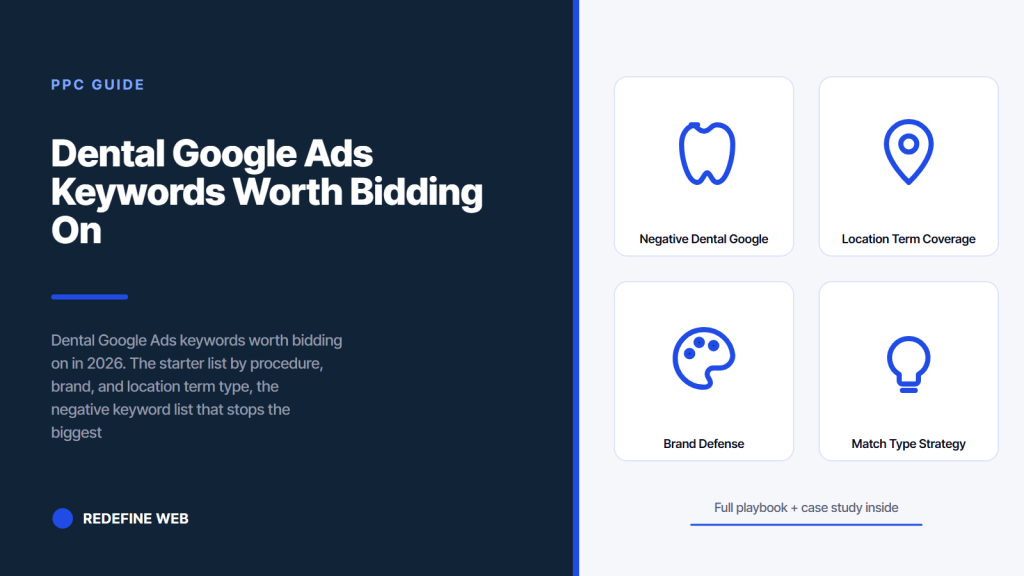
- Four keyword types. Procedure, brand, location, question.
- Negatives block 30 to 50 percent of waste in month one.
- Phrase match default. Broad match only after 90 days.
- One campaign per procedure. Budget by case value.
- Pull search terms weekly for 60 days, then bi-weekly.
- Negative dental Google Ads keywords that stop the biggest waste
- Question terms and long-tail intent
- Location term coverage for dental Google Ads keywords
- Brand defense and competitor terms
- Match type strategy for dental google ads keywords
- Account structure that keeps keywords honest
- Seasonality across dental Google Ads keywords
- Reporting cadence for keyword-level optimization
Dental Google Ads keywords fall into four types. Procedure terms. Brand terms. Location terms. Question terms. Each type does a different job in the account and each type needs a different match type, a different landing page, and a different negative keyword list. Get the mix wrong and 40 to 60 percent of the budget lands on searches that will never book. Get it right and cost per booked patient drops 20 to 40 percent inside the first quarter. This guide is the starter list for each type, plus the negative keyword list that stops the most common waste patterns.
You will finish in eight minutes and know exactly which dental Google Ads keywords to add on day one, which to hold for month two, and which to leave alone. Same framework works for a solo general dentist and a five-location group. Bookmark this page and reference it when the search terms report lands every Friday, because that is the moment the negative list either grows or the account bleeds another week.
Negative dental Google Ads keywords that stop the biggest waste
The negative keyword list is where accounts get healthy. A dental Google Ads account without 200 to 400 mature negatives is bleeding budget on queries that will never book. Adding the right negatives on day one prevents 30 to 50 percent of the wasted spend that new accounts otherwise suffer through in the first 90 days.
Negatives fall into six categories. Free intent terms. DIY terms. Educational terms. Job seeker terms. Geographic exclusions. Competitor brand terms. Add every category to every campaign on day one, then expand as the search terms report reveals fresh waste in weeks two through eight. Google’s documentation on negative keywords covers the mechanics.
| Negative category | Example terms | Waste share saved |
|---|---|---|
| Free intent | free, cheap, coupon, discount, low income | 10 to 18 percent |
| DIY | diy, at home, home remedy, cure, how to | 5 to 12 percent |
| Education | school, hygienist school, dental assistant, program | 4 to 9 percent |
| Job seeker | jobs, salary, employment, career, hiring | 3 to 7 percent |
| Wrong geography | nearby city outside service area | 6 to 15 percent |
| Competitor brand | rival practice names within metro | 2 to 5 percent |
Free intent negatives
Free intent captures searchers looking for free care, low income assistance, or coupon-only offers. These clicks cost the same as high-intent clicks but almost never convert to paid case revenue. Block free, cheap, coupon, discount, low income, medicaid, medicare (unless you take it), no insurance, and no money down on every campaign. Practices that skip this negative bucket typically waste 10 to 18 percent of the monthly budget.
Education and career negatives
Education negatives block searchers looking to become a dentist rather than see one. Dental school. Dental hygienist program. Dental assistant training. Job. Salary. Career. Employment. These queries look adjacent to procedure terms but the intent is completely different. Block them at the campaign level. Never at the ad group level unless the ad group is specifically a hiring campaign.
Question terms and long-tail intent
Question terms capture research intent. How much does an implant cost. Do dental implants hurt. What is the recovery time for a root canal. Is Invisalign covered by insurance. These queries convert at 30 to 60 percent of procedure term conversion rates but cost 40 to 70 percent less per click. On the right landing page, they subsidize the whole account.
Run question terms in a dedicated campaign with a lower budget and a longer conversion window. Route them to a content-first landing page that answers the question in the first paragraph, then offers a consult booking. Track them with a 30-day conversion window in GA4 because the buying journey runs longer than the procedure term journey. Smile Design Dentistry, a 50-plus location DSO we work with, ran a question-term campaign that produced 20 percent PPC conversion rate growth by treating question intent as a distinct funnel with dedicated copy.
Cost and price terms
Cost terms convert well when the landing page shows a real price range. Implants cost. Invisalign cost. Veneers price. Bidding on cost terms without a price range on the page frustrates the searcher and burns the click. Practices that pair cost-term ads with a transparent price band see 25 to 35 percent higher conversion rates than practices that route the same query to a generic consult page.
Do you take my insurance queries
Do you take my insurance queries convert extremely well when the landing page carries a searchable insurance list. Add the top 8 to 12 accepted PPO plans as page copy and as structured data. Practices that answer this query specifically on the landing page book 40 to 55 percent of qualified queries. Practices that push the searcher to call for insurance verification lose 60 percent of them in the transition. WordStream’s small business Google Ads breakdown covers the same principle in retail contexts.
Location term coverage for dental Google Ads keywords
Location terms combine a procedure with a city, neighborhood, or ZIP. Dentist near me. Dentist downtown Cincinnati. Emergency dentist 45242. These queries carry the strongest local intent and the highest conversion rate of any dental Google Ads keyword type. Bid aggressively inside your service radius.
Every service page on the practice website should map to a location plus procedure ad group. Implants + city name. Invisalign + city name. Emergency dentist + city name. Bid at max CPC 30 to 60 percent higher than procedure-only terms because the intent is stronger and the conversion rate justifies it. Layer geo-targeting on the campaign to hit exactly the ZIPs your practice can serve within 20 minutes of drive time. Our local SEO for dentists guide covers the geo overlap between paid and organic.
Near me variants
Near me is the highest-converting location modifier in dental. Bid on dentist near me at phrase match and layer every procedure variant as an ad group. Emergency dentist near me. Cosmetic dentist near me. Kids dentist near me. Every one converts 15 to 30 percent higher than the same term without the near me modifier. Never negative out near me on a location-targeted campaign. That mistake happens more than you would think.
ZIP and neighborhood terms
ZIP terms carry lower volume but higher intent. Dentist 45242 or dentist near Blue Ash. Bid on the top 3 to 6 ZIPs and neighborhoods inside the practice service radius. Match to a neighborhood-specific landing page if the ad group is a real revenue driver. Practices that build 6 or 8 neighborhood landing pages typically outperform practices that route all local intent to the same generic contact page.
A implant click competes with a blog query in the same ad group. Split them by intent bucket. Your cost per booked case drops in the first week.
Brand defense and competitor terms
Brand defense bidding costs pennies on the dollar and prevents competitor traffic hijacking. If your practice is Smile Vista Dental, bid on Smile Vista Dental, smile vista dentist, smilevista, and common misspellings. Competitors bidding on your brand can steal 8 to 22 percent of the branded search traffic and pay only $1 to $3 per click because their Quality Score is low. Your quality score on your own brand runs 9 or 10, so the cost is even lower.
Competitor brand bidding is a different question. Bidding on a rival’s practice name gets clicks that rarely convert because the searcher already picked their destination. The exception is when a rival has bad reviews and your practice has strong reviews with a comparison landing page. That specific play works. Bidding on rival brand terms with a generic homepage as the destination does not.
Brand impression share targeting
Target 90 percent impression share on brand terms. Track it in the auction insights report weekly. Practices that let brand impression share drop under 70 percent typically discover a competitor bidding aggressively on their name and losing 15 to 20 branded clicks per month. The fix is a bid increase inside the brand campaign, which costs an extra $60 to $180 per month and recovers all the lost traffic.
Competitor bidding cautions
Google restricts trademark use in ad text. You can bid on a competitor’s brand as a keyword, but you cannot mention their trademarked name in the ad copy without permission. Read the trademark policy before running competitor conquest. Practices that violate the policy trigger disapprovals fast, and repeated disapprovals hurt Quality Score across the whole account.
The most expensive dental Google Ads keyword we ever inherited on a new account was DENTIST at pure broad match with no negatives, running $12,400 per month for six months on a practice with a $30,000 monthly ceiling. The office manager called it their marketing. We called it a subscription to Google’s stock plan. The rebuild dropped the number to $4,900 per month and doubled call volume. She now audits the account herself every Friday.
Match type strategy for dental google ads keywords
Match type controls how broad your keywords match against real search queries. In 2026 the three match types Google offers are broad, phrase, and exact. Every one behaves differently for dental accounts and every one deserves its own campaign or ad group. Mixing match types within a single ad group makes reporting incomprehensible.
Start every new account on phrase match for procedure and location terms. Use exact match for brand terms. Use broad match only after 90 days of conversion data is trained into Smart Bidding, and only on campaigns with tCPA or tROAS bid strategies. Broad match without Smart Bidding is where budgets go to die in dental accounts. Our dental ppc management post covers the ongoing rhythm.
Phrase match as the default
Phrase match catches queries containing the keyword phrase in the same order, plus common variants. Dental implants near me phrase-matches to affordable dental implants near me but not to dental hygienist near me. That behavior is exactly what dental accounts want because it captures long-tail intent without leaking into unrelated queries. Practices that skip phrase match for exact match usually miss 20 to 40 percent of qualified long-tail traffic.
When broad match works
Broad match works when Smart Bidding has enough conversion data to steer the query mix. That threshold is roughly 90 days of history with 30 or more monthly conversions. Below that, broad match burns budget faster than any other single decision in the account. Above it, broad match with tCPA can outperform phrase match on cost per booked patient by 10 to 20 percent. Test it late, not early. Search Engine Land’s PPC coverage tracks the Smart Bidding thresholds as they shift.
Account structure that keeps keywords honest
Structure your dental Google Ads account around one campaign per procedure. Not one campaign per landing page. Not one campaign per week. One per procedure. Implants campaign. Invisalign campaign. Emergency campaign. Brand campaign. Question campaign. Each campaign has 3 to 8 ad groups, each ad group has 8 to 20 keywords, each keyword resolves cleanly to one landing page.
Budget allocation follows expected case value times conversion rate. Implants at $4,500 case value gets a bigger slice than cleanings at $150. Emergency gets a bigger slice than cosmetic when patient acquisition is the goal, because emergency converts faster. Reassess allocation every 30 days based on what actually paid out. Our dental ppc strategy writeup walks through the reallocation math.
Single keyword ad groups
Single keyword ad groups (SKAGs) still work for the top 5 to 10 revenue keywords. Implants near me gets its own ad group. Invisalign cost gets its own ad group. Emergency dentist near me gets its own ad group. Message match reaches 100 percent because the ad headline can quote the keyword verbatim. SKAGs on tail keywords is overhead you do not need.
Themed ad groups for tail terms
Themed ad groups collect related tail terms with shared ad copy. A veneers ad group might hold porcelain veneers, composite veneers, veneers cost, veneers before after, and snap on veneers. All five deserve the same three landing page and the same three ad variants. Themed groups keep ad copy relevant while consolidating spend into a manageable number of ad groups per campaign.
Seasonality across dental Google Ads keywords
Dental Google Ads keywords carry real seasonality. January and September are peak search months for cleanings and exams because insurance benefits reset in January and school-year checkups drive September. Emergency searches spike Monday mornings and Sunday nights because weekend pain crosses a threshold. Cosmetic terms peak in April through June ahead of wedding season and again in November ahead of holidays. Plan budgets around the shape of the curve.
Bid modifiers by day of week and hour of day cut waste 8 to 15 percent on most dental accounts. Bid up 15 to 25 percent Sunday 6pm through Monday 10am for emergency terms. Bid up 10 to 15 percent Tuesday and Wednesday for cosmetic consults because those are the days people research and book. Bid down 20 to 30 percent late Friday afternoon on non-emergency terms because the search does not convert to a Friday-afternoon booking anyway. Our dental PPC guide covers the seasonality patterns campaign by campaign.
January and September peaks
Increase budget 20 to 40 percent in the first two weeks of January to catch insurance-reset searches. Add another 15 to 25 percent boost in the last two weeks of August and first two of September to catch back-to-school checkup searches. Miss these two windows and the account underdelivers for the year, because a disproportionate share of annual dental search volume lands in these four weeks combined.
End-of-year benefit runoff
Late October through mid-December carries a use-it-or-lose-it dental Google Ads keyword surge on procedure terms because patients want to spend PPO benefits before the year rolls over. Add creative around benefits expiring. Add offer posts on the landing page around remaining benefit usage. Practices that lean into this window book 20 to 40 percent more Q4 procedures than practices that hold flat budgets through the fall.
Reporting cadence for keyword-level optimization
Pull the search terms report weekly for the first 60 days. Add new negatives every Friday. Pull it every two weeks after that once the negative list is mature. Pull it monthly by month six once the account is stable. That cadence catches waste while it is small enough to fix cheaply.
Track cost per booked patient by keyword, not by ad group. Some ad groups mix high and low cost per booked patient inside the same wrapper, which hides the good keywords and the bad ones. Keyword-level tracking exposes the truth. Kill keywords costing $600 per booked patient in an account targeting $200 per booked patient. Scale keywords costing $80 per booked patient by adding phrase match variants and question adjacencies.
Quality Score as a keyword lens
Quality Score sums expected CTR, ad relevance, and landing page experience. A Quality Score of 3 costs 400 percent more than a Quality Score of 8 on the same keyword. Pull the QS column monthly and prioritize fixes on keywords with the highest impressions and lowest QS. Fixing three low-QS high-impression keywords per month usually drops account CPC by 12 to 20 percent inside a quarter.
Conversion lag and attribution
Dental Google Ads keywords have a 3 to 21 day conversion lag depending on procedure type. Emergency queries convert same-day. Implant queries convert 7 to 28 days later. Kill decisions inside the lag window burn keywords that were about to book. Wait until the full lag window closes before pausing anything. Practices that pause too early lose 15 to 25 percent of the campaigns that would have paid out on day 14.
Frequently asked questions
What are the highest-converting dental Google Ads keywords
The highest-converting dental Google Ads keywords are procedure plus location terms with strong intent. Dental implants near me. Emergency dentist near me. Invisalign cost. Same-day dental crowns. These combine commercial intent with geographic specificity and typically convert at 12 to 22 percent lead rate. Brand terms convert at 30 to 45 percent but the volume is lower and the customer already knew the practice. Cost terms and near me variants sit at the top of the paid conversion table for most dental accounts. Skip broad top-of-funnel terms in the first 90 days because the conversion rate is too soft to justify the CPC.
How much should a dental practice spend on Google Ads keywords
A dental practice spends $2,000 to $8,000 per month on Google Ads in most metros, with $4,500 being the median for a solo general dentist. The budget splits across procedure terms (roughly 50 percent), location terms (25 percent), brand defense (10 percent), and question terms (15 percent). Specialty practices offering implants or invisalign in dense metros can spend $10,000 to $25,000 per month because case values justify the CPC. Cheaper stacks under $1,500 per month usually produce 4 to 8 booked patients, which is enough to prove the channel but rarely enough to scale it.
What negative dental Google Ads keywords should I always add
Always add these negative categories on day one. Free intent (free, cheap, coupon, discount, low income). DIY (home remedy, at home, cure, how to). Education (school, program, dental assistant, hygienist school). Job seeker (jobs, salary, career, hiring, employment). Wrong geography (nearby cities outside your service area). Insurance you do not accept (medicaid, medicare if you skip them). This list blocks 30 to 50 percent of the wasted spend most new accounts otherwise suffer. Add more from the search terms report starting week two. A mature negative list runs 200 to 400 terms.
Should dentists bid on competitor brand names in Google Ads
Bidding on competitor brand names in Google Ads has limited value for dental practices. The clicks convert poorly because the searcher already decided on the destination. The exception is a specific play where a rival has poor reviews, your practice has strong reviews, and you route the click to a comparison landing page. That configuration converts at 4 to 8 percent, which pays out on high-value procedures like implants. Bidding on rival brand terms with a generic homepage as the destination wastes budget every time. Also read the trademark policy because you cannot mention the competitor's trademarked name in the ad copy.
What match type should dental Google Ads keywords use
Start dental Google Ads keywords on phrase match for procedure and location terms. Use exact match for brand terms. Use broad match only after 90 days of conversion data has trained Smart Bidding and only on campaigns using tCPA or tROAS bid strategies. Broad match without a trained conversion signal is the fastest budget-burn in dental PPC. Phrase match catches long-tail intent without leaking into unrelated queries. Practices skipping phrase match for exact match on procedure terms typically miss 20 to 40 percent of qualified long-tail conversions from queries that never appear in an exact match audit.
How often should I update dental Google Ads keywords
Pull the search terms report weekly for the first 60 days and add negatives every Friday. Move to bi-weekly by month three and monthly by month six once the negative list is mature. Add new positive keywords when the search terms report shows a repeated query pattern converting well. Pause keywords with a cost per booked patient above 3x the account target. Every 90 days run a full account audit covering match types, ad group structure, and Quality Score. Skipping these cadences is why dental accounts drift from a 3x return in month three to a 1.5x return in month twelve.
Book your free 30-minute strategy call.
No spam, no sales rep. We use your email to schedule your call with a senior strategist. That is it.
More from the blog
View all articles → PPC
PPC Healthcare PPC Advertising Channels Compliance and Targeting
Read article PPC
PPC Dental Facebook Ads Guide for Practices That Book Patients
Read article PPC
PPC