
Dental Local SEO for Dentists (Google Maps Fundamentals)
- Google Business Profile primary category drives 40 percent of pack ranking.
- Recent reviews outweigh 2019 reviews at 3 to 1 in the pack signal.
- NAP consistency across top 15 citations beats 200 sloppy citations.
- Map rank moves in weeks 6 to 12 with disciplined execution.
- Retainer starts at $599 monthly and scales with location count.
- On-Page Signals That Support SEO for Dental Offices
- Backlinks and Authority for Dental Local SEO
- SEO for Dental Offices Cost and Timeline
- Case Study VP Dental and Doubled New Patients via Dental Local SEO
- How to Measure Dental Local SEO Results
- Common Dental Local SEO Mistakes
- Where Dental Local SEO Fits Inside the Marketing Mix
- SEO for Dental Offices Execution Checklist
Dental local seo is what puts your practice in front of the patient who searches “dentist near me” at 7:42 a.m. on a Tuesday. The map pack (those three listings above the organic results) captures 44 percent of clicks on local dental searches. Rank on page two of the map pack and you are invisible to the searchers who become 60 percent of new patients under 40.
This guide is the fundamentals. Google Business Profile setup and optimization, on-page signals the map pack ranking algorithm actually reads, citation cleanup, review velocity, and the internal linking that lets a dental site punch above its domain authority. Read it once and apply the checklist over four weeks. Most practices move from page two into the top three of the pack inside 6 to 12 weeks with disciplined execution. The plan works whether you run it in-house or with an agency partner, at almost any budget.
On-Page Signals That Support SEO for Dental Offices
The on-page layer signals to Google what your practice does and where. Every service page, location page, and blog post reinforces the local relevance signal that pulls the map pack ranking. A practice with 4 thin service pages struggles against a practice with 15 substantive service pages, even when Business Profiles are similar quality.
Service pages that rank
Every core service gets a dedicated page. Cleanings and exams. Whitening. Crowns and bridges. Implants. Invisalign or clear aligners. Root canals. Extractions. Emergency dental care. Each page needs 800 to 1,600 words of substantive content, one clear H1, service-plus-city variations in H2s, an FAQ section, real staff photos, and a booking or call CTA every 400 words. See dental office seo for the template.
Location pages for multi-office practices
A single-location practice needs one “about” page with location details. Multi-location practices need a unique location page per office with directions, parking notes, provider photos, hours, and location-specific reviews embedded. Thin location pages that only differ in address get flagged as duplicate content. The goal is 500+ unique words per location page, each with something a patient in that neighborhood actually needs to know.
Schema markup for dental practices
Schema markup is structured data that tells Google exactly what your page is about. The Dentist schema type (or MedicalBusiness for specialists) with NAP, hours, service list, and aggregate rating produces rich results in some searches and helps disambiguation. See Google’s structured data documentation for LocalBusiness for the exact schema properties. Schema is a signal, not a magic trick.
Backlinks and Authority for Dental Local SEO
Domain authority sits under everything else. A newer practice with a fresh Business Profile and thin backlink profile struggles to displace a 10-year practice with 50+ referring domains. That does not mean brand-new practices cannot rank; it means the plan needs a link-building layer alongside the Business Profile and on-page work.
Local partnerships as link sources
Local chambers of commerce, parent-teacher associations, youth sports leagues, and community charity events are natural link sources for a dental practice. Sponsor a Little League team ($400 to $800), get listed on their sponsor page with a link. Speak at a school career day, get mentioned on the school’s community page. Each link is worth more than 40 paid directory listings because it comes from a real, local, topically relevant source.
Guest content on health sites
Regional health blogs, mommy blogs in your metro, and local news outlets accept guest contributions from professionals. A well-written 800-word post on “When to bring your child for a first dental visit” placed on a regional parenting blog produces a link plus real referral traffic. This is slower than paying for citations, and every link earned this way outweighs 20 paid ones.
What to avoid
Avoid paid link farms, private blog networks, and any “dental SEO service” promising 100 links a month for $299. Google’s spam updates catch these patterns and penalize sites months after the fact. Recovery from a link-based penalty takes 6 to 18 months. Slow, clean links beat fast, dirty ones every time.
SEO for Dental Offices Cost and Timeline
$599 to $2,800 per month for a solo practice in a mid-sized metro. $1,500 to $4,500 monthly for a multi-location group. Rural practices sit at the low end. Metros with 40+ competing dental practices in a 5-mile radius sit at the high end. Below $500 per month usually means monthly Business Profile edits and nothing else, which is not real seo for dental offices.
| Practice type | Monthly retainer | Time to top 3 in pack | Time to first-page organic |
|---|---|---|---|
| Solo GP, mid market | $599 to $1,600 | 4 to 8 weeks | 3 to 6 months |
| Solo GP, competitive metro | $1,600 to $2,800 | 8 to 14 weeks | 5 to 9 months |
| Specialty, mid market | $1,200 to $2,400 | 6 to 10 weeks | 4 to 7 months |
| Two-location group | $1,800 to $3,500 | 10 to 16 weeks | 6 to 10 months |
| Multi-location (5+) | $3,000 to $6,500 | 12 to 20 weeks per location | 6 to 12 months |
What drives cost variation
Three things drive the retainer cost. Number of tracked keywords (10 keywords vs 40 keywords is a 3x work delta). Local competition intensity (3 competitors vs 15 is a 2x work delta). Content backlog on the site (a practice starting with 6 thin pages vs one with 20 solid pages needs a heavier content sprint in month one).
The 90-day payoff window
Most practices see the map pack rank move in weeks 6 to 12. Organic rank improvements come later, typically weeks 12 to 24. Below-median practices see nothing for the first 90 days and then rank gains stack up quickly. Above-median practices see quick early wins on long-tail service-plus-city queries, then the main service keywords move around month four.
One rank number for your city is a lie. Run Local Falcon on a 5-mile grid. Half your neighborhoods probably rank 8th. Fix the weak grid points, not the whole strategy.
Case Study VP Dental and Doubled New Patients via Dental Local SEO
VP Dental is a 20-year practice that hired us with a fragmented setup: two vendors managing different pieces of the website, a weak Google Business Profile presence, and no online booking flow. The rebuild was as much an operations project as an SEO project. We unified the site under one strategy, rebuilt the Business Profile with a full service list, and layered on a review generation workflow.
What the numbers looked like at 12 months
Monthly new patients doubled (a 100 percent increase). Search impressions grew 776 percent as the local relevance signals compounded. The practice added $8,100 a month in recurring revenue directly attributed to new patients coming through the website. That is real local seo for dental doing what it should do inside a defined budget.
The specific changes that produced the gain
Consolidating vendors under one strategic plan produced the biggest single delta. Adding online booking pushed conversion rate on the site up 2.4 percentage points. Rebuilding the Business Profile with an accurate service list moved the pack rank on primary keywords from position 8 to position 3 inside 10 weeks. Everything else compounded from there.
What did not work
Two things underperformed the initial plan. Paid ads on Facebook produced traffic without booking conversion; we cut the budget by month four. And a set of long-tail blog posts targeting informational keywords ranked well but produced few bookings; they now serve as internal link fuel for the money pages rather than standalone traffic sources. Good SEO plans get pruned quarterly.
How to Measure Dental Local SEO Results
Track five numbers monthly. Map pack rank on your top 10 service-plus-city keywords. Organic rank on the same keywords. Business Profile actions (calls, directions, website clicks). New patients attributed via GA4 and call tracking. Total marketing spend. That is the whole checkpoint.
The map pack ranking grid
Ranking varies block by block within your service area. A grid audit of 30 to 60 points across your metro shows where you dominate and where you struggle. Use Local Falcon or the local dashboard in Semrush to run the grid quarterly. The heatmap surfaces the neighborhoods where a service page or Business Profile post can move the pack rank without touching the site-wide strategy.
Business Profile insights that matter
Google Business Profile insights show searches, actions, and photo views. The two numbers that matter: total calls originating from the Business Profile, and website clicks originating from the profile. Those roll into GA4 as the local pack traffic source. Everything else in the Business Profile dashboard is context, not conversion.
Attribution quirks in local SEO
Local pack traffic often lands as direct or organic in GA4 depending on how the searcher tapped through. Direct-to-Business-Profile calls do not always show up in GA4 at all, only in the Business Profile insights. Reconcile monthly across the three surfaces. If Business Profile insights show 40 calls and GA4 shows 12 from the pack, that is a normal split, not a tracking failure.
Common Dental Local SEO Mistakes
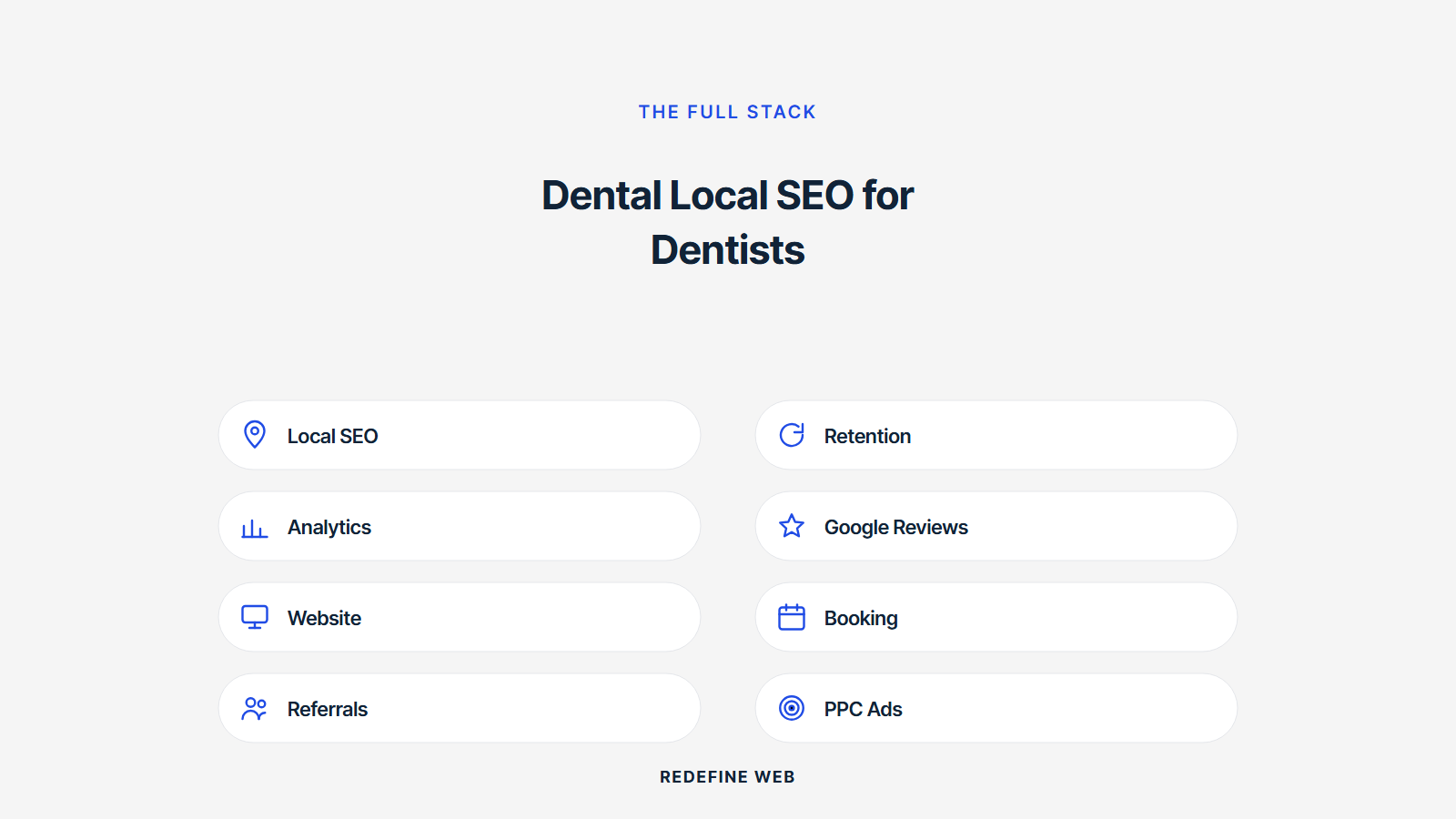
The most common local seo for dental mistakes cluster in three areas. Not verifying and controlling the Business Profile (someone else claimed it, or it duplicates an old listing). NAP inconsistency across citations (5+ variants of address or phone). Set-and-forget mindset (Business Profile untouched for 18 months while competitors post weekly). Each mistake is fixable inside 60 days.
Unclaimed or duplicate Business Profiles
Search your practice name on Google Maps. If you see two listings, one is a duplicate created by a former staff member, an old address, or Google’s auto-generation from public data. Claim both, mark the duplicate as closed, and consolidate reviews. This one fix moves practices 2 to 5 pack positions inside a month because the ranking signal that was split across two profiles now concentrates on one.
Category mis-selection
General practices sometimes choose “Dental Clinic” or “Medical Center” as the primary category, thinking those cast a wider net. They do the opposite. Google reads those as less specific and ranks them for fewer queries. “Dentist” is the correct primary category for 90 percent of dental practices. Get the primary right, layer specifics as secondaries.
Ignoring the mobile experience
75+ percent of local dental searches happen on mobile. A site that loads in 4 seconds on desktop but 11 seconds on mobile loses the map pack ranking signal because Google measures Core Web Vitals on the mobile crawler. Test with PageSpeed Insights monthly. Anything below 70 on mobile needs a fix inside the current quarter.
Where Dental Local SEO Fits Inside the Marketing Mix
Local SEO is the slowest channel to produce ROI and the fastest to compound. Paid ads produce week-one calls. Social ads produce brand awareness. Local SEO takes 6 to 12 weeks to move the pack and then produces steady, cheap patients for years. A balanced marketing mix pairs paid ads for immediate volume with local SEO for long-term efficiency.
The 12-month channel arc
Months 1 to 3: paid ads carry the volume while SEO foundations get built. Months 4 to 6: pack rank moves, SEO leads start to hit. Months 7 to 12: SEO becomes the cheapest channel per new patient and you can trim paid budget by 20 to 40 percent. That arc is the standard trajectory for a practice that runs both channels together from day one.
When to pause SEO
Pause SEO if the practice is at operational capacity and cannot see more patients. Pause it if the practice is planning to sell or relocate inside 6 months. Otherwise, keep the local SEO retainer running. The compounding effect breaks when you pull the plug, and restarting from a paused state takes 3 to 6 months to recover the lost pack rank.
How local SEO pairs with paid
Google Ads plus Local Services Ads produce the fast layer. Local SEO produces the slow, cheap layer. Meta Ads produce the middle-funnel awareness. Our dental marketing plan post walks through the mix decisions and how the retainer scope changes as the site matures.
SEO for Dental Offices Execution Checklist
Every practice starting a local seo program should work through the same checklist in the first 90 days. Skipping steps is what produces “SEO doesn’t work” complaints six months later when the missing foundation collapses under the ad spend. Work the checklist in order.
- Claim and verify the Google Business Profile; check for duplicates
- Select the correct primary category and populate 10 secondary categories
- Fill out the service list with 300-character descriptions and pricing ranges
- Standardize canonical NAP across the site and top 15 citations
- Install call tracking with dynamic number insertion on all landing pages
- Build 5 to 15 substantive service pages tied to real practice offerings
- Add Dentist schema markup across the site with aggregate rating
- Set up a review generation workflow via SMS or email at checkout
- Respond to every review within 48 hours across every platform
- Publish weekly Business Profile posts and refresh photos monthly
- Audit Core Web Vitals monthly; fix anything below 70 on mobile
- Run a monthly grid rank audit across 30 to 60 points in your metro
The first 30 days
Days 1 to 30 concentrate on Business Profile and NAP. Verify the profile, choose categories, populate the service list, standardize NAP across top citations. That is the whole month. Skip on-page work and content until the profile is bulletproof; on-page work amplifies profile signals that need to be right first.
Days 31 to 60
Days 31 to 60 shift to on-page work and reviews. Rebuild or expand the top 5 service pages, install schema, launch the review generation workflow. By day 60, patients are hitting Google review pages via SMS follow-ups and service pages are indexing. The pack rank should start moving on secondary keywords by end of month two.
Days 61 to 90
Days 61 to 90 add authority and content depth. Guest post on a local health blog. Sponsor a community event for the link. Publish 3 to 5 educational posts targeting service-plus-city long-tail terms. For a canonical view on the mobile experience, see web.dev on Core Web Vitals. By day 90, the pack rank has moved on primary keywords, organic rank is trending up, and the plan for months 4 to 12 is clearer than it was on day one.
Dental local seo is boring to execute and powerful once compounded. The practices that treat it as a monthly discipline outrank the ones treating it as a project. Six to twelve weeks of clean work moves the pack. Twelve to twenty-four months of consistent maintenance turns the map pack into a reliable, cheap patient acquisition channel.
Frequently asked questions
How long does dental local seo take to produce results?
Map pack rank movement typically shows in weeks 6 to 12 for a solo practice with disciplined execution. Organic ranking improvements follow in months 4 to 8. Most practices see cost per new patient drop below $100 by month 9 as the pack rank stabilizes in the top three for primary keywords. Newer practices in less competitive markets can move faster; established practices in metros with 40+ competing dental offices in a 5-mile radius take longer. The single biggest determinant is Business Profile quality and NAP consistency at day one, not the total volume of content or backlinks accumulated later.
How much does dental local seo cost per month?
$599 to $2,800 monthly for a solo practice depending on market competitiveness. $1,500 to $4,500 for a two-location group. $3,000 to $6,500 for multi-location groups with 5+ offices. Rural or specialty practices sit at the low end. Metros with dense dental competition sit at the high end. Anything below $500 monthly usually means Business Profile edits and nothing else, which is not real seo for dental offices. Any retainer above $5,000 monthly for a single-location practice needs a defensible justification tied to specific work volume, not just brand or agency premium.
What is the single most important factor in dental local seo?
The Google Business Profile primary category. That one field drives roughly 40 percent of the map pack ranking signal for a dental practice. "Dentist" is the correct primary for 90 percent of general practices. Specialty practices need to pick their specialty as primary and use secondary categories to layer additional services. Once the primary is right, the next most impactful factor is review velocity: a Business Profile that gains 8 to 12 new reviews a month with owner responses within 48 hours outranks profiles with more total reviews but stagnant velocity. Everything else compounds slower.
How many reviews does a dental practice need?
Volume matters less than velocity. A practice with 150 reviews with 10 new each month outranks a practice with 400 reviews from 2019 and 0 new this year in nearly every case. Aim for a review generation workflow that produces 8 to 20 new Google reviews monthly through an automated SMS or email fired 2 hours after checkout. Recent reviews signal current relevance to Google's algorithm. Older reviews signal a stagnant profile the algorithm downweights over time. A steady drip beats a big historical stockpile for pack ranking purposes.
Does schema markup help dental local seo rankings?
Schema markup helps but is not a magic ranking booster. The Dentist schema type with NAP, hours, service list, and aggregate rating helps Google disambiguate your practice and produces rich results in some searches. That improves click-through rate on organic results, which indirectly supports ranking. Schema alone will not move a page from position 15 to position 3. Pair schema with strong on-page content, Business Profile optimization, and citation consistency and it becomes a meaningful signal. Schema is a supporting factor, not a leading one, in the local ranking equation.
What is the difference between local dental seo and traditional seo?
Local dental seo optimizes for map pack rank and service-plus-city queries within a 10 to 15 mile drive time. Traditional seo optimizes for organic rank on informational and commercial queries at any geographic scope. A practice serves patients within a small radius, so local SEO produces higher conversion per session than national organic traffic ever will. That said, the two layers reinforce each other. Strong service pages help both the pack rank and organic rank. A local SEO plan that ignores the traditional organic layer misses 20 to 30 percent of local dental traffic.
Can dental local seo be done in-house?
A trained front-desk staffer can absolutely own Business Profile management and review responses, at 3 to 5 hours a week. The technical SEO (schema, Core Web Vitals, on-page audits), citation cleanup, and link earning require specialist time that most practices cannot justify hiring in-house at less than 25 hours a month. Most practices land on a hybrid model: staff owns the Business Profile posting and review responses, the agency handles the technical work and content sprints. That split matches how the workload actually breaks down inside a real practice.
Book your free 30-minute strategy call.
No spam, no sales rep. We use your email to schedule your call with a senior strategist. That is it.
More from the blog
View all articles → SEO
SEO Organic Search Engine Optimization Services That Grow Real Traffic
Read article SEO
SEO SEO for Pet Groomers That Fills the Appointment Book Weekly
Read article SEO
SEO