
Dental SEO company vs agency is the split every practice owner runs into before signing a 12-month contract. Both models promise more booked patients from Google. Both sales decks look the same. The pricing bands even overlap in the middle. So the real answer sits under the hood in the team size, the scope shape, the monthly hours, and who touches your Google Business Profile every week. This guide gives you the honest side-by-side the sales calls skip, so your next vendor comparison ends in 30 minutes instead of 3 weeks.
You get the working definitions, the price bands we see in the market, the 7 questions that expose which model a vendor really runs, the red flags that end a bad sales call fast, and the budget math for solo suburban practices, two-office groups, and multi-location DSO setups. Read straight through in about ten minutes and you walk into your next vendor call with a shorter list and a clearer filter.
What separates a dental SEO company from a dental SEO agency
A dental SEO company is a small productized shop, 2 to 8 people, running the same $499 to $1,800 playbook on every practice. A dental SEO agency is a larger multi-service team of 15 to 60 people building custom scopes at $1,800 to $6,000 per month. Scale versus depth. That is the split in one line.
Neither model is inherently better. A solo suburban practice with a clean site and a working Google Business Profile often gets more per dollar from a productized company. A multi-office practice with three locations, a broken schema stack, and a stalled paid program usually needs the depth of an agency. The real failure mode is picking the wrong side of the split for your stage, not picking the wrong vendor inside the right side.
Team shape and who touches your account
A dental SEO company hands you one account manager who runs the checklist. That same person runs 30 other dental practices at the same time. The scale keeps prices down and delivery repeatable. An agency assigns a strategist plus an SEO analyst plus a content writer plus a link outreach lead. 4 or 5 people touching one account. Fewer accounts per person, deeper work per account. You feel that gap on the monthly reporting call within 60 days.
Scope shape and the productized versus custom split
Productized companies sell the same 12 deliverables per month. Same GBP posts. Same blog cadence. Same citation cleanup schedule. Custom agencies scope work against your specific audit findings. If your NAP is already clean and your Profile is tuned, a productized package still charges you for those line items every month. An agency skips them and reallocates the hours to link building or technical fixes. Same monthly invoice, very different work delivered.
Reporting cadence and monthly calls
Companies send a monthly PDF with rankings, traffic, and a task list. 20 minutes of your time. Agencies run a 45 to 60 minute video call where the strategist walks the numbers, flags the next quarter priorities, and takes questions on business changes that affect the plan. The call format matters. Practices that just want a monthly check-in prefer the PDF. Practices actively pushing patient growth need the video call.
Pricing math for a dental SEO company vs agency
Dental SEO company pricing sits at $499 to $1,800 per month for a solo practice in a suburban metro. Dental SEO agency pricing runs $1,800 to $6,000 per month for the same practice, with the higher end covering multi-location groups. The gap is not a markup on the same work. The gap reflects the depth of scope, the team size, and the hours actually delivered per month.
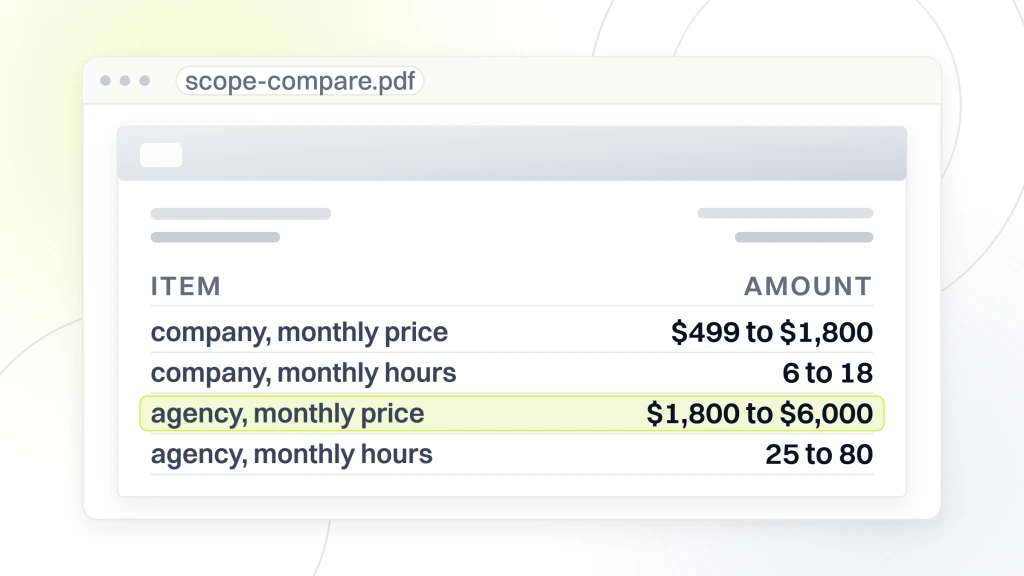
| Line item | SEO company | SEO agency |
|---|---|---|
| Monthly price range | $499 to $1,800 | $1,800 to $6,000 |
| Team size on account | 1 to 2 | 3 to 6 |
| Monthly hours delivered | 6 to 18 | 25 to 80 |
| Content per month | 1 to 2 posts | 4 to 8 posts |
| Link building | Rare, citations only | Included, 2 to 6 links |
| Reporting format | PDF or dashboard | Video call plus dashboard |
| Best for | Solo suburban practice | Multi-location or metro |
Solo practice budget math
A solo practice pulling $80,000 to $120,000 per month in collections should spend $800 to $1,600 per month on SEO. Under $800 the scope collapses to Profile updates and directory pings, which stalls inside 90 days. Over $1,600 the marginal dollar usually goes further into PPC or a website rebuild than into more SEO hours. The math holds for a suburban market with 2 or 3 competing practices inside the three-mile ring.
Multi-location practice budget math
Two-location practice budgets sit at $2,400 to $4,000 per month. Three-location practices at $3,600 to $5,500. DSO or group practices over 5 locations at $6,000 to $18,000 depending on how centralized the marketing operation runs. Each office needs a dedicated Profile plus its own location page and its own review generation workflow. The productized company model breaks down past 2 locations since the checklist multiplies without additional strategic thinking.
Contract length across the split
Companies pitch 3 to 6 month starter agreements. Agencies pitch 6 to 12 month engagements. Both have their reasons. The shorter company term reflects less setup work and a checklist that runs the same regardless of your starting position. The longer agency term reflects the 60 to 90 day ramp before deep technical and content work compounds. If a vendor offers a real 90-day pilot, that is often the fairest test on either side of the split. Ask for it in the first call.
Dental SEO consultant, solo expert, or a full team
A dental SEO consultant is a third path. One person, deep expertise, no delivery team. Consultants charge $150 to $350 per hour or $2,000 to $5,000 per month on retainer. They audit, strategize, and hand you a plan your in-house or freelance team executes. That works when you have a staff coordinator who can drive the checklist. It breaks when the plan lands on a busy practice manager who never opens the doc.
A dental SEO expert who works solo can outperform a productized company at the same price point when your practice has real technical debt. The expert does the surgery. The company sends the same monthly checklist that ignores your specific problem. But the solo expert is a bus factor of one. When they go on vacation or hit a client cap, your account stalls. Teams absorb that risk. Solo work carries it forward on your side of the invoice.
When a dental SEO consultant is the right pick
The consultant fits when you already have an in-house marketing coordinator or a virtual assistant who can execute a written plan. Consultant scopes the audit, delivers the roadmap, and reviews progress monthly. The internal person handles the work. Cost lands 40 to 60 percent lower than a full-service agency, but only when the internal execution actually happens. Practices with no internal capacity should skip this path since the plan quietly gathers dust for 6 months.
When a solo dental SEO expert makes sense
A solo dental SEO expert works well for practices with unique technical problems. A broken schema stack, a rebuild after a Google core update penalty, a duplicate location page mess, or a citation cleanup nightmare across 5 brand names the practice has used over 15 years. These are surgical problems. A solo expert with 10 years in local search fixes them faster than a company running a generic checklist over 6 months.
When a full agency team is worth the premium
A full agency team earns its premium when you need coordinated SEO, PPC, web design, and content running against the same monthly plan. The strategist owns the whole picture. The individual specialists deliver their piece. You get one weekly report instead of 4 vendor calls. Multi-location groups, DSOs, and practices spending $8,000 per month or more across channels usually find the coordination worth the pricing gap. Below that spend threshold, the coordination overhead often exceeds the value.
What a real dental SEO scope should include either way
A real scope covers 7 work streams either way. Google Business Profile tuning. Citation cleanup. On-site technical SEO. Service page rewrites. Local content. Review generation. Local link outreach. If a proposal lists 3 and calls it a full SEO package, walk. That is a Profile add-on with a fancy invoice attached.
- Google Business Profile tuning weekly, covering categories, services, photos, posts, and Q&A
- Citation cleanup on the top 15 to 40 sources with quarterly re-audits
- On-site technical SEO covering schema, page speed, mobile UX, canonical tags, and indexation
- Service page rewrites carrying the city name through H1, URL, and body
- Local content published monthly at 4 to 8 posts of 1,500 words each
- Review generation via checkout handoff plus text and email opt-in flows
- Local link outreach through sponsorships, press, and community partnerships
Technical must-haves on any dental SEO scope
Every scope covers LocalBusiness schema on the homepage, Dentist schema on the service pages, and Person schema on the doctor bio pages. Every scope covers Core Web Vitals monitoring with a target of green across all 3 metrics. Every scope covers indexation monitoring in Google Search Console with a target of 100 percent submitted URLs indexed inside 45 days. Skip the schema piece and your competitors with tuned schema outrank you for the same review count and citation footprint.
Content cadence that actually moves rankings
2 blog posts per month at 1,500 words each moves rankings inside 90 days. 4 posts per month at 2,000 words each moves them inside 60 days. One post per month at 800 words moves nothing. Content cadence and depth are the two dials that drive organic patient growth after the Profile and citation baseline is set. Companies that skimp on content sell the illusion of SEO. Real SEO publishes real writing every month with a real byline.
The AI search channel that changes dental SEO scope in 2026
In 2026, dental SEO covers 3 channels, not one. The classic organic results. The local map pack. And AI search citations from ChatGPT, Perplexity, and Google AI Overviews. Patients now ask AI systems who the best dentist near them is, and the AI answer names 2 or 3 practices by name. If your scope has no answer-first content, no FAQ schema on service pages, and no structured provider bios, you never enter that answer. Ask any vendor how they build for AI citation. Vague answers here are a sign the scope has not caught up with how patients search now.
Case North County Dental Care on a full-scope agency engagement
North County Dental Care in Vista, California came to Redefine Web in 2021 with marketing split across several agencies, an outdated site with no HTTPS, a thin Business Profile, and no top-10 search positions. It averaged 1 to 2 new patients per month from digital. No agency had a clear plan, and no one could measure ROI.
We ran a full-scope agency engagement rather than a productized package since the technical debt required custom work. Rebuilt the site on HTTPS with schema and fixed broken links. Cleaned up directory listings so name, address, and phone matched. Mapped service pages to the keywords patients search. Layered Google Business Profile ads for high-intent queries. From 2021 to 2024, monthly new patients climbed from 1 to 2 to 12 to 16. Organic traffic grew 385%. Marketing ROI reached 500%. Total patient volume up 1,000%. Real numbers, real practice, in a competitive North County market.
Lessons from the North County Dental Care rebuild
Two lessons apply broadly. First, technical debt on the site multiplies the value of an agency over a productized company. A cheap package on a broken site is a slow bleed. Second, the compounding matters. The growth at North County Dental Care built over three years, not three months. Practices that switch vendors every 12 months never see the compounding. They pay for the ramp cycle over and over.
Red flags on either side of the dental SEO split
Some red flags cut across both models. A guarantee of first-page rankings inside 30 days. A pitch that leans hard on directory submissions and blog syndication. A monthly report that shows only rankings and no leads or calls. A refusal to give you admin access to your own Google Business Profile and Search Console. A contract that locks you in past 12 months with no exit clause for missed KPIs. Any one of these should end the sales call inside 10 minutes.
The worst pitch we ever heard promised page-one rankings on 200 keywords inside 60 days for $299 per month with no content included in the scope. The practice signed anyway since the price looked low. 6 months later they had 200 spammy directory submissions on foreign sites, a Google Search Console warning about unnatural links, and worse rankings than before they signed. The refund fight took another 4 months. Cheap SEO in this vertical is not cheap. It is expensive twice.
The guarantee red flag
Nobody controls Google rankings, so nobody honestly guarantees them. A guarantee sounds reassuring in a sales call. It signals a vendor who does not understand how the ranking system works, or who is comfortable lying to close the deal. Either way, walk. The best vendors set expectations grounded in your baseline, your competitor strength, and the actual work delivered per month, and let the numbers speak in the reporting.
The access red flag
Your Google Business Profile and Google Search Console are your assets. Not the vendor assets. Any vendor who resists giving you owner-level access is protecting a lever they want to keep for retention pressure. A real vendor asks for manager-level access on the Profile, admin on Search Console, and read-only on Google Analytics. You keep the keys. They do the work. If a vendor asks for owner transfer on your Profile, that is a hard no.
Seven questions that surface which dental SEO model a vendor really runs
Sales decks blur the line on purpose. Every vendor uses the word agency since it sounds premium. Every vendor promises custom work even when they run a productized checklist. The 7 questions below cut through that. Ask them on the first sales call and the answers tell you which side of the dental SEO company vs agency split the vendor lives on, regardless of how they brand themselves.
- How many dental clients does the person running my account manage at once
- Show me a real month task log from a comparable dental client, redacted for privacy
- Which specific citations do you clean, and how do you handle a stubborn incorrect NAP
- Walk me through your last 3 months of ranking movement on a solo dental account
- What is your content writing process and who writes the posts
- How do you handle link building, and can you name 3 link sources you use for dentists
- What happens in months where the numbers do not move, and how do you diagnose it
Reading the answers to those 7 questions
A dental SEO company will hedge on the account load question since the honest answer is 25 to 40 accounts per manager. An agency will name a lower number, 8 to 15 accounts per strategist. The content answer surfaces whether you get real writers or spun output. The link answer surfaces whether the vendor uses real local outreach or paid directory networks. The diagnostic answer surfaces whether the vendor has the depth to react when a Google core update reshuffles your rankings inside 3 days.
Verifying vendor case studies before you sign
Every vendor deck shows case studies. Most of them are unverifiable. Ask for one contact reference at a comparable dental practice, ideally in your metro or a similar market. A vendor with real case studies gives you one within 3 days. A vendor with fabricated numbers pivots away. Google Search Central at developers.google.com is the source of truth on ranking mechanics, so vendors who cannot explain their methodology relative to it are red-flagging themselves in real time.
The strangest vendor pitch we sat through described the process as proprietary AI-powered algorithmic optimization the team could not explain on the call, patent-pending. 20 minutes later they showed a screenshot of a plugin with a green light and called it their dashboard. Practices sign this stuff. The bar for how a vendor explains what they do should be higher than green lights on a plugin. If a vendor cannot describe the 10 things they will do this month in plain English, they cannot do those 10 things.
How to pick between a dental SEO company and agency
Pick a dental SEO company when your site is clean and the Profile just needs weekly upkeep. Pick a dental SEO agency when you have technical debt, a broken schema stack, or two-plus locations. Pick a consultant when your team can execute a plan in-house. Pick a solo expert for a surgical problem after a Google core update.
The right fit is a function of your stage and your baseline. Solo suburban practice on a clean stack at $85,000 per month collections fits a company. Two-office practice with a broken site and stalled rankings fits an agency. In-house marketing coordinator with $500 per month budget fits a consultant. Post Google update tank fits a solo expert. Map the model to your reality and the vendor call gets shorter every time.
Running a 90 day pilot on either side of the split
The fairest test is a 90-day pilot with a defined scope, a fixed price, and 3 specific outcome metrics. Rank movement on 15 target keywords. Map pack impressions from Google Business Profile insights. Phone calls attributed to organic search. Set the baseline in week one. Measure at week 12. If the numbers move, extend. If they do not, part cleanly on the agreed date. Vendors who resist a 90-day pilot are protecting a longer contract they suspect will not renew on merit alone.
The exit clause that matters in every dental SEO contract
Every contract needs an exit clause tied to missed KPIs. A 6-month engagement with a 60-day notice period. A 12-month engagement with a 90-day notice period and a mid-year review checkpoint. Neither side should be trapped. Vendors who insist on annual auto-renewal with no mid-year exit are counting on client inertia. Push back on the language before you sign. A vendor confident in the delivery welcomes an exit clause since they know the results will keep you around anyway.
Budget scenarios across the dental SEO split
Budget shapes which model works for you. A $500 per month budget only supports a productized company or a very lean consultant setup. A $1,500 per month budget covers a mid-tier productized package or a lean solo expert engagement. A $3,000 per month budget opens the door to a real agency. A $6,000 per month budget covers a full-scope multi-location agency engagement with content and link building included.
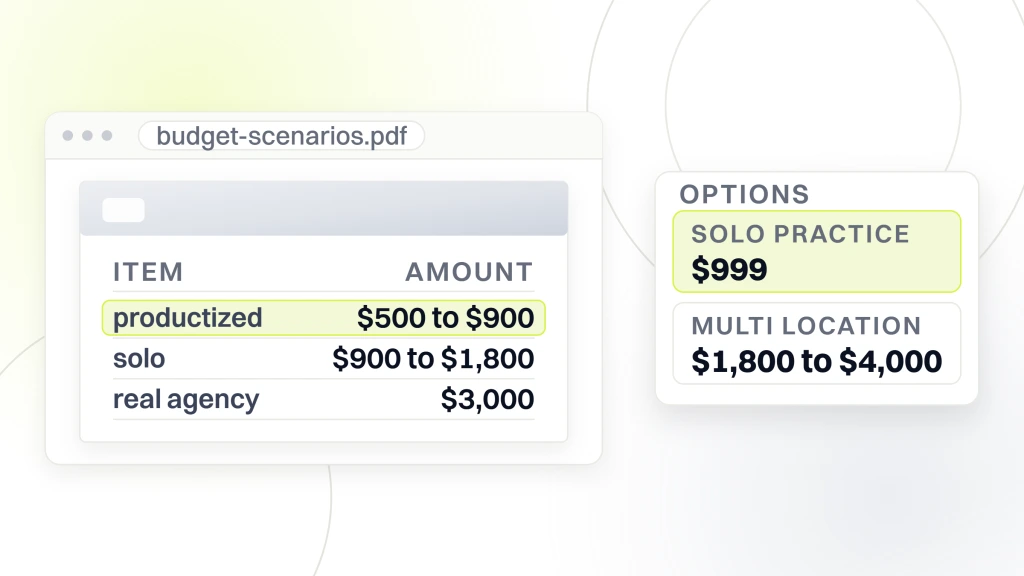
| Monthly budget | Realistic model | Expected scope |
|---|---|---|
| $500 to $900 | Productized company | Profile, citations, basic reporting |
| $900 to $1,800 | Company or solo consultant | Above plus 1 to 2 posts per month |
| $1,800 to $3,000 | Small agency or solo expert | Content, technical, 2 to 4 links |
| $3,000 to $6,000 | Full agency | Full stack, 4 to 8 posts, link building |
| $6,000 plus | Multi-location agency | Multi-office coordination, DSO scale |
The underspending trap
Practices spending under $500 per month on SEO are usually paying for a directory submission service dressed up in agency branding. Rankings do not move. The invoice arrives every month. 6 months later the practice concludes SEO does not work. In reality, SEO works and the vendor did not do SEO. Underspending on the wrong vendor is a slow way to burn money and lose faith in the channel entirely. Better to save 6 months and buy a real 90-day pilot at a proper budget.
The overspending trap
Practices spending $8,000 per month on SEO when a $2,500 scope would cover it are paying for meetings, deliverables, and reports they do not need. The extra spend does not proportionately move rankings. The threshold flattens fast. For a solo suburban practice, spending past $2,500 per month usually returns better ROI reallocated to PPC or a website rebuild. Match the spend to the scope your local competitive setup justifies, not to the biggest vendor package on the shelf.
Where our team fits on the dental SEO company vs agency split
Redefine Web runs the agency model with productized starting points. Solo practices onboard on a $999 per month retainer that covers Profile tuning, citation checks, one blog post per month, and a monthly video call. Multi-location practices scale to $1,800 to $4,000 depending on office count and technical scope. We publish the exact deliverable list per tier so you know what lands each month before you sign.
Our writers and strategists sit in one team, not siloed departments. The person on your monthly call owns the strategy behind the posts, the citation cleanup, and the link outreach. Practices that want the checklist rigor of a productized company plus the depth of an agency tend to land here. For the full silo view, our dental seo services page covers deliverables, timelines, and pricing math.
Our scope shape and monthly rhythm
Every month covers a fixed cadence. Weeks 1 and 2 focus on Profile updates, citation checks, and content publishing. Week 3 runs the reporting call and quarterly re-audits. Week 4 handles link outreach and technical fixes. That rhythm creates a repeatable pattern the practice can plan around, and gives us the room to react when a Google update reshuffles rankings inside 48 hours. Our dental seo writeup covers the full strategy layer behind the rhythm.
Where we decline the dental SEO work
We decline engagements that ask for guaranteed rankings, refuse to give access to Search Console, or want us to run link networks. We decline productized $299 per month starter tiers since the math does not work for real delivery. We decline national brand campaigns since local pack rules do not scale past a defined service area. The engagements we take are the ones we can actually move the numbers on. For a broader marketing view, our dental marketing hub covers the full playbook.
How to pick your dental SEO vendor with confidence
Start with your baseline. Open the Google Business Profile on your phone. Count photos posted in the last 90 days. Count reviews from the last 30 days. Open Search Console. Look at last month clicks. Look at the top 10 queries. Open your site on mobile. Note load speed and any broken UX. That 5-minute audit tells you whether your problem is Profile tuning, technical debt, or content depth. Which side of the dental SEO company vs agency split fits you comes out of that answer.
When you are ready to compare specific vendors, our dental marketing services covers tiered options plus real case studies.