
How to choose a dental SEO company well is the difference between a retainer that books 8 to 14 new patient calls per month from organic search and one that delivers polished ranking screenshots while the front desk phone stays silent. Most practices signing a new SEO contract have already burned through one or two agencies that missed the mark, so the vetting on the third or fourth try deserves more scrutiny than the first sales call ever got.
This guide covers the working checklist to vet an agency before signing. The questions to ask on the first call. The deliverables that separate a real retainer from a padded invoice. The red flags that surface early. The pricing bands that make sense across market sizes. North County Dental Care in Vista, CA, a Redefine Web case study, drove +1,000% patient growth from 2021 to 2024 and 500% marketing ROI, booking 12 to 16 new patients monthly.
How to read case studies before you sign
Every dental SEO case study should carry four numbers. Starting state on rankings, traffic, and patient calls. Program duration. Ending state on the same three numbers. Cost per organic patient call. Case studies missing any of the four are marketing pieces, not results reports, and any shortlist candidate should hand them over on request.
The trickiest number to read is cost per organic sourced patient call. Practices routinely track total marketing cost per new patient, but organic sourced calls need to be broken out separately from paid, referral, and walk-in sources. Vendors that can’t produce this number in a case study usually can’t produce it in the monthly report either, which means you’ll never know whether the retainer is paying for itself.
- Starting state. Ranking positions, monthly organic traffic, monthly patient calls at kickoff.
- Program duration. Months from kickoff to the reporting snapshot.
- Ending state. Same three numbers at the reporting snapshot.
- Cost per organic call. Retainer cost divided by monthly organic sourced calls.
- Vertical match. At least one case study inside your specialty and practice size range.
Practices vetting on case studies at their size range plus documented cost per organic call rarely regret the choice. Practices choosing on price alone, or on a case study from a completely different vertical, typically regret it inside two quarters. Ask for three case studies with real practice names, not initialed placeholders like “Dr. J. in the Midwest.”
Pricing bands to expect in 2026
Retainer pricing splits into four bands. The bottom band under $1,500 covers Google Business Profile plus basic on-page work with no link building. The middle band from $1,500 to $2,500 adds treatment page content plus citation cleanup. The upper band from $2,500 to $4,500 covers the full six-workstream program including link building. The multi-location band above $4,500 covers group practices where the scope multiplies per location.
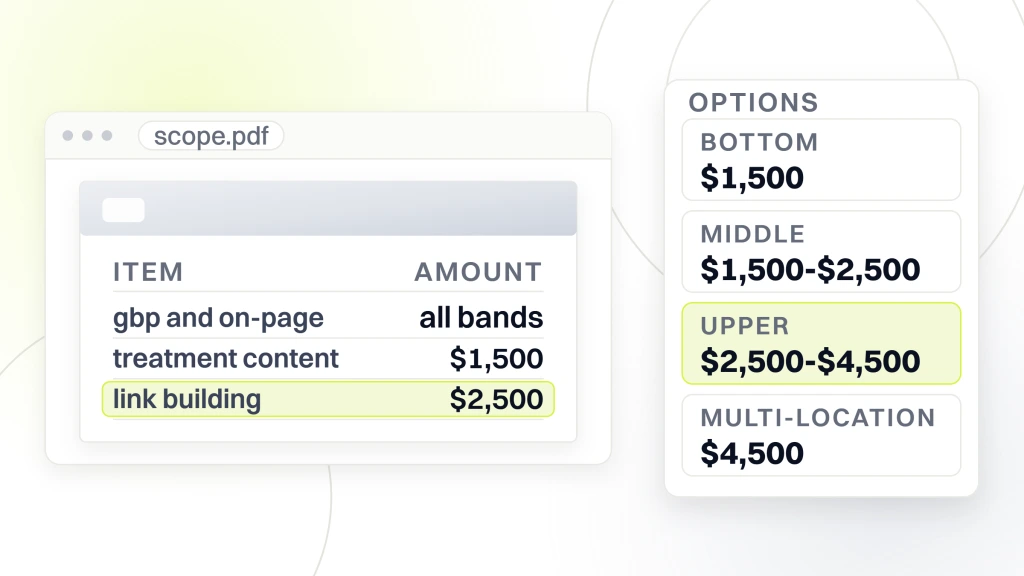
Most of the best dental seo companies work in the $2,500 to $4,500 range for single-location practices, since that band produces the strongest return. Below $2,500 the link building layer usually gets stripped, which is where rankings plateau by month eight. Above $4,500 the incremental deliverables often overlap with what an in-house marketing coordinator could handle at similar cost. Practices in the low band that outrank practices in the upper band do so because their market is less competitive, not because the retainer bought more work.
| Retainer band | Monthly cost | Includes | Skips | Best fit |
|---|---|---|---|---|
| Local pack only | $800 to $1,500 | GBP, citations, on-page basics | Link building, ongoing content | Solo practices, uncompetitive markets |
| Local plus on-page | $1,500 to $2,500 | Above plus treatment content, technical fixes | Active link building outreach | Small practices, moderate competition |
| Full program | $2,500 to $4,500 | All six workstreams including link building | Advanced multi-location work | Single-location, competitive markets |
| Multi-location | $4,500 to $12,000 | Above plus per-location coordination, custom reporting | Not applicable | DSOs, groups with 3-plus offices |
The pricing band is only one factor. Two vendors quoting $3,000 monthly can produce wildly different outcomes depending on which specific deliverables they include and how much account manager time they dedicate to your account. Get the deliverable list in writing before comparing quotes across shortlist candidates, and put every promised item on the SOW. Redefine Web’s tiers run $999, $1,499, $2,499, and from $4,500 per month, and the mid-tier is where most single-location practices land.
Vet the best dental seo companies on 2026 search channels
In 2026, dental search isn’t one thing, it’s three channels, and the best dental seo companies cover all three by default. Local pack visibility runs through Google Business Profile, reviews, and NAP citations. Organic rankings run through treatment pages, service pages, and content depth. AI search citations run through structured schema, answer-first content, and verified provider bios. Ask every candidate to walk through exactly how their program touches each channel.
A strong answer names specific schema types (Dentist, MedicalBusiness, FAQPage, Person for each provider), question-style H2s that read as direct answers, sameAs links tying provider bios to verified external profiles, and monthly citation testing across ChatGPT, Perplexity, and Google AI Overviews. A weak answer is vague, deflective, or ends in “we’re still exploring that.” Vendors still exploring AI citations in 2026 are running an 18-month-old playbook.
- Local pack. Business Profile optimization, NAP citation cleanup, review generation cadence.
- Organic search. Treatment page content, service page structure, technical SEO, link building.
- AI search. Schema markup depth, answer-first formatting, provider bio sameAs links, monthly citation checks.
Google AI Overviews now appear on a growing share of treatment plus city queries, and the shops producing strong citations share four traits. Structured treatment content with clear cost blocks. Real before-and-after content with case details. Recent verified reviews maintained through active review generation. Provider bios with credentials tagged in schema. Anything less, and the shop is a year behind the channel that now sits above the local pack for many patient queries.
Contract terms and exit clauses to demand
A working dental seo agency contract structure runs 90 days initial commitment with defined kickoff milestones, then converts to a rolling monthly or a six-month renewal at the practice’s option. The 90-day initial period matches how long it takes to complete the setup workstreams. Technical audit, Business Profile optimization, initial content, first link building outreach, and the first useful monthly report on outcomes all fit inside the first quarter.
Contracts locking practices into 12 months with no exit after 90 days favor the vendor. If the retainer is producing results, you won’t want to exit. If it isn’t, you deserve the option to leave without paying for six more months of underperforming work. Any vendor confident in its deliverables will accept a 90-day performance clause, since they never expect to trigger it. The ones that resist are telling you they’ve triggered it before.
- 90-day initial period with defined kickoff milestones.
- Milestone list. Technical audit complete, Business Profile optimized, first content published, first citations updated, first links secured.
- Exit clause. 30-day notice after day 90 if milestones missed.
- Data ownership. Practice owns all content, backlinks, and analytics access after termination.
- Non-solicit. Mutual, capped at 6 months post-termination.
The data ownership clause matters more than most practices realize at signing. Vendors that keep ownership of the content they wrote, the backlinks they built, or the Business Profile they optimized can technically pull all of it at termination. Working contracts assign ownership of all work product to the practice from day one, and the vendor retains only its own methodology and workflow templates. Read that clause twice before you sign.
Reporting standards that separate real dental seo agency work
Monthly reporting from a real vendor should cover six categories. Ranking movement on core treatment plus city queries. Organic traffic split by page and query type. Organic sourced patient calls tracked through call tracking software. Google Business Profile calls, direction requests, and website clicks. Links secured or lost during the reporting period. Next month’s priority workstream, in writing, before the report lands.
Reports stopping at rankings and traffic hide the outcome that matters, which is organic sourced patient calls. Reports touching organic patient calls without a link back to ranking positions produce numbers you can’t act on. The two need to sit side by side so you can see which specific query improvements translated into call volume. That’s where the tuning cycle either learns and improves, or drifts on generic monthly deliverables that never move the needle.
- Ranking table. Top 30 treatment plus city queries with month-over-month movement.
- Traffic breakdown. Organic sessions by landing page, top queries per page.
- Organic patient calls. Tracked through CallRail, WhatConverts, or equivalent.
- Business Profile stats. Calls, direction requests, website clicks, review count and rating.
- Link report. New links secured, lost links, domain authority movement.
- Priority workstream. What the shop will focus on next month and why.
The quarterly business review is where the reporting layer either builds trust or breaks it. Every 90 days the account manager should meet with the practice owner for a 60-minute review covering results against goals, upcoming priorities, and any strategic pivots. Skipping the quarterly review is a common tell that the vendor has stopped paying attention to your account. See our dental marketing roi guide for how the reporting layer ties into overall marketing performance.
Red flags during vetting
Certain patterns during the sales process predict future problems with high accuracy, and knowing them is half of the vetting job. Guaranteed rankings on specific keywords is the biggest single red flag, since no legitimate shop can guarantee Google positions. Vague answers about who owns your account day to day signal you’ll get pooled resource time from junior team members. Pricing well below market usually means the vendor runs a template playbook without customization.
Two more subtle red flags surface only in follow-up questions. Refusal to share a sample redacted monthly report suggests the reports themselves are thin. Reluctance to provide two current client references suggests the client roster is either small or unhappy. Vendors producing strong outcomes routinely have clients willing to speak, since those clients want their partner to succeed. Ones with weak outcomes protect their client list from reference calls for a reason.
- Guaranteed rankings on specific keywords or “first page guarantee” language.
- Vague account ownership. No specific team member assigned by name.
- Pricing well below market. Usually template-driven without vertical customization.
- 12-plus month contracts with no 90-day exit clause.
- Refusal to share sample report from a comparable client.
- Reluctance to provide references from current or recent clients.
- Vague deliverable descriptions like “full-service strategy” without specifics.
Any three of these on the same sales call is a walk-away signal. Any one is a follow-up question. Practices ignoring red flags because the sales rep was persuasive typically pay for six months of underdelivered work before the pattern the vetting missed comes into focus. Trust the checklist, not the pitch.
Reference checks and case study validation
Reference checks with two current or recent clients produce more useful signal than any sales-call pitch. Ask each reference three questions. Would you sign again today knowing what you know now. What has the shop done well and what have they missed. How responsive is the account manager on urgent requests. The answers reveal the day-to-day working relationship the sales call can’t show.
Case study validation runs a parallel check. Look up the practice named in the case study on Google Business Profile and check the current review count, rating, and Profile completeness. If the case study claims strong local pack visibility, run a search on the treatment plus city query it mentions and see whether the practice actually ranks today. Case studies that check out on this validation are usually accurate. Ones with mismatched public data are usually inflated.
- Reference question 1. Would you sign again today?
- Reference question 2. What has the shop done well, and what has it missed?
- Reference question 3. How responsive is the account manager on urgent requests?
- Case study validation. Check the practice’s current Business Profile against the claim.
- Live ranking check. Search the treatment plus city query mentioned and verify the ranking.
The reference check plus case study validation together take 90 to 120 minutes of practice manager time and knock out most of the risk in vendor selection. Skipping either step is where most practices end up on their second or third shop inside two years. North County Dental Care in Vista, CA is the kind of case study worth checking this way. Its record names the starting point, the window and the result, from 1 to 2 new patients a month to 12 to 16 between 2021 and 2024, at a 500% marketing ROI.
In-house versus agency versus dental seo consultant
The question of vetting sometimes leads back to the deeper question of whether to hire an outside shop at all. Practices choosing between in-house, agency, or fractional dental seo consultant models each face different tradeoffs. In-house marketing hires cost $60,000 to $95,000 fully loaded per year for a mid-level dental marketing coordinator. Outside shops cost $18,000 to $54,000 per year at the retainer bands above. Consultant engagements sit between, typically $1,500 to $3,500 per month for a fractional expert running 8 to 20 hours weekly on the account.
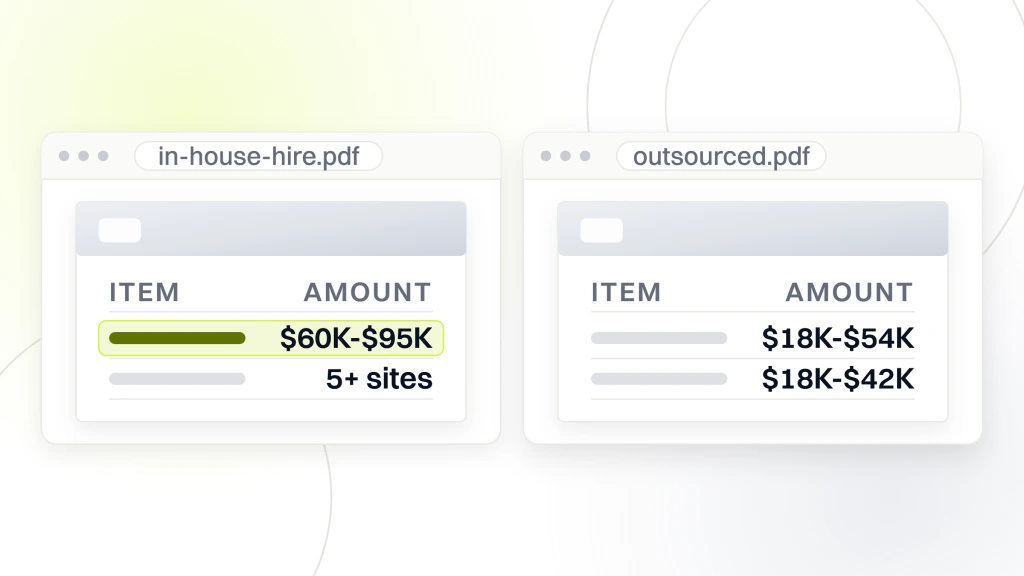
The in-house model works best for multi-location groups with 5-plus offices where the coordinator’s time gets fully absorbed. Below that, the fixed cost outweighs the flexibility, and the coordinator ends up handling social media plus events plus SEO plus internal communication, which dilutes SEO output. The agency model works best for single-location practices where specialist depth matters more than dedicated hours. The fractional consultant path works best for practices that already have some in-house marketing but need specialist SEO guidance monthly.
- In-house hire. $60K to $95K per year, works for 5-plus location groups.
- Agency retainer. $18K to $54K per year, works for single-location practices.
- Fractional consultant. $18K to $42K per year, works for practices with existing in-house support.
- Hybrid. In-house lead plus specialist support, works for growing practices building toward a marketing department.
See our dental marketing agency vs in house guide for the fuller comparison across all marketing functions, not just SEO. The choice between models often depends more on the practice’s stage of growth than on which model is theoretically stronger. A three-op practice at $1.2M in production has a different math problem than a five-location DSO at $12M.
How to choose a dental SEO company (final checklist)
The full vetting checklist runs 24 items across five categories. Sales process quality. Case study depth. Contract terms. Deliverable clarity. Reference validation. Run all 24 items on two or three shortlist candidates before signing, score each on a 1-to-5 scale per item, and let the scoreboard pick the winner rather than the sales rep with the best deck.
Google AI Overviews now appear on a growing share of treatment plus city queries. The shops producing strong AI Overview citations for their clients share four traits. Structured treatment page content with clear cost blocks. Real before-and-after content with case details. Recent verified reviews maintained through active review generation. Provider bios with credentials tagged in schema. Vendors without a working answer on how they optimize for AI Overviews are working from a 2023 playbook.
If your current retainer has stopped producing measurable movement, or you’re signing your first retainer and want to avoid the common mistakes, the checklist above runs cleanly on any comparable evaluation. See dental seo services, our dental seo consultant vs agency guide, or the Google spam policies documentation for the reference standards to hold any shortlist candidate to during vetting.