
E-commerce PPC Advertising What It Is and How It Works
- E-commerce ppc advertising is paid clicks across Google, Meta, TikTok, and Amazon.
- Every platform runs an auction that rewards quality signal, not just bid.
- Topps Tiles took 33 percent unique-visitor share on the same ROAS target.
- Server-side tagging surfaces 15 to 25 percent more matched conversions.
- Target ROAS beats Target CPA on any e-commerce account with revenue values.
- Bid strategies inside ppc in e commerce accounts
- Budget decisions inside e-commerce ppc advertising
- Tracking basics every e commerce ppc advertising account needs
- Common mistakes inside ppc advertising for e-commerce
- Timeline to see real results from e commerce ppc advertising
- In-house versus outsourced e-commerce ppc advertising
- Wrapping up e-commerce ppc advertising as a discipline
E-commerce ppc advertising is paid media for online stores where the retailer pays only when someone clicks the ad, and the ad shows on Google Shopping, Google Search, Performance Max, Meta Advantage+, TikTok Ads, Amazon Ads, or Microsoft Advertising depending on where the buyer is looking. In 2026, a typical Shopify or WooCommerce store past 10,000 dollars a month in ad spend runs three or four platforms at once, not one, and the auction math behind each click is different on every platform.
You’ll get the plain-English anatomy of ppc advertising for e-commerce, how the auction works on each platform, what triggers a Shopping impression versus a Meta impression, what the buyer sees at every step, and how Topps Tiles pulled 5,465 new visitors and 33 percent of the unique-visitor share in the UK tile market from a structured test-and-learn paid program inside a single 3-month window. Read this before you spend another dollar on Google Ads.
Bid strategies inside ppc in e commerce accounts
Every platform in the ppc in e commerce stack offers a menu of bid strategies. Manual CPC. Enhanced CPC. Target CPA. Target ROAS. Maximize Conversions. Maximize Conversion Value. Lowest Cost. Target Cost. Picking the right one at the right time is 50 percent of what a specialist actually does on a working account.
Choosing between Target ROAS and Maximize Conversion Value
Target ROAS works when the account has stable conversion history, revenue values on every conversion, and 30 or more conversions per month. Maximize Conversion Value works when the account is still learning and volume matters more than efficiency. New Shopping campaigns start on Maximize Conversion Value for the first 30 days, then switch to Target ROAS once the account has learned the audience. Skip Target CPA for e-commerce because it optimizes to unit count, not revenue. On e-commerce accounts, revenue-based bidding always beats action-based bidding.
Guardrails that keep automated bidding honest
Every automated bid strategy runs inside guardrails a specialist sets. Maximum daily budget. Maximum cost per click ceiling on top campaigns. Location targeting narrowed to shipping zones. Ad schedule limited to hours the customer service team can respond. Product segments the campaign is allowed to bid on. Guardrails are what stop Target ROAS from pursuing cheap conversions on out-of-stock SKUs. Set them at setup and re-audit them monthly, because campaign-level changes routinely drift them wider than the specialist expects.
Budget decisions inside e-commerce ppc advertising
Every store setting up paid media faces the same three budget calls. How much per platform. How much per campaign inside each platform. How to shift budget when a channel outperforms or drops. These decisions run every 7 to 14 days on a working account. Skip them and the account settles into a stable-but-suboptimal spend curve for months.
Starting budgets by store revenue
Stores under 50,000 dollars in monthly revenue start at 2,000 to 5,000 dollars a month in ad spend. Stores 50K to 250K in monthly revenue run 5,000 to 20,000 in ad spend. Stores past 250K a month usually run 15 to 25 percent of revenue back into paid media. These are starting points, not universal targets. Product margin, LTV, and inventory levels shift the math. A subscription skincare brand with a 70 percent gross margin runs a very different spend curve from a 25 percent margin apparel brand.
Rebalancing budget across platforms
Every 30 days the specialist pulls blended ROAS by platform from Triple Whale or Northbeam and moves 10 to 20 percent of budget from the worst-performing platform to the best. Not more than 20 percent because bigger shifts reset learning phases across every campaign inside that platform. Not less than 10 percent because smaller shifts do not move the needle. The 10 to 20 percent monthly rebalance is what keeps blended ROAS climbing 30 to 60 percent above the pre-engagement baseline inside 6 months.
Tracking basics every e commerce ppc advertising account needs
Every scale decision inside ppc for e-commerce rests on tracking. Broken tracking sends the wrong signal to Smart Bidding and Advantage+, and the model burns budget on cheap clicks that never turn into paid orders. Every serious campaign launch starts with a tracking audit that closes the loop from ad click to Shopify or WooCommerce purchase with matching revenue value on both ends.
Server-side event forwarding
iOS 14 and browser privacy changes dropped client-side event coverage 20 to 40 percent between 2021 and 2024. Server-side event forwarding through Google Tag Manager server container or Shopify’s server-side pixel restores most of that coverage. Every store past 15,000 in monthly ad spend should run server-side tagging on Google Ads, Meta CAPI, and TikTok Events API. According to Google’s server-side tagging guide, stores that switch see 15 to 25 percent more matched conversions surfaced to the ad platforms.
Attribution tools that pull the truth out
Triple Whale, Northbeam, Rockerbox, and Polar Analytics run multi-touch attribution across Google, Meta, TikTok, and Amazon. License costs sit at 199 to 900 dollars a month depending on the store’s monthly revenue. Serious e-commerce ppc advertising engagements use one of them because the last-click reports inside each platform overstate the platform’s own contribution by 30 to 60 percent. Blended ROAS pulled from a real attribution tool is what the store owner should price paid media against. Anything else is a guess dressed as a report.
Platform-reported ROAS double-counts. Pull Shopify revenue, divide by total ad spend. That number is real. Anything else is Meta grading its own homework.
Common mistakes inside ppc advertising for e-commerce
Every store owner running paid media for the first time makes 3 or 4 of the mistakes below. Every specialist auditing a new account finds 5 or 6 of them. Skipping the ones you can catch upfront saves 30 to 60 days of budget waste and a lot of frustrated Monday calls.
- Running one campaign across every product category. Category-level bidding is impossible without campaign splits.
- No brand Search campaign defending brand queries. Competitors bid on your brand and pull 10 to 20 percent of traffic away.
- Product feed with generic titles and no GTIN. Impression share caps below 40 percent regardless of bid.
- Meta Advantage+ Shopping without a product catalog uploaded. The system runs on interest audiences only and delivery is 40 percent lower.
- Last-click ROAS reports treated as truth. Blended ROAS almost always tells a different story.
- Creative refresh cadence of once a quarter. Meta and TikTok performance decays inside 14 days on stale creative.
Every store owner also runs into one really tempting proposal a quarter: an AI-powered PPC tool the agency invented last week that promises to run every platform on autopilot for 149 dollars a month with zero human labor. The math says the tool is Smart Bidding with a rebranded PowerPoint, the specialist is a ChatGPT tab in a browser somewhere, and the 149 dollars barely covers the Zoom subscription. Neither scales past month two.
Fixes that pay back inside 30 days
Split campaigns by product category. Wire up brand Search at a low bid ceiling. Rewrite the top 100 product titles in the Merchant Center feed. Upload the product catalog to Meta Business Manager. Install Triple Whale or Northbeam. Set a creative refresh cadence of 4 to 6 assets per week on Meta and TikTok. Every one of these fixes pays back inside 30 days on a store spending over 5,000 dollars a month in ads. Skip them and blended ROAS drifts down through the next quarter.
Timeline to see real results from e commerce ppc advertising
Store owners arrive at ppc advertising for e-commerce with wildly different expectations. Some expect a 5x ROAS in week one because a proposal promised it. Others expect nothing because prior vendors let them down. Real outcomes sit in a narrow window shaped by category, ad spend, and how clean the tracking wired up. The bands below reflect roughly 40 e-commerce accounts we manage or have audited in the last 18 months.
Month-by-month what to expect
Month one covers tracking QA, feed audit, campaign restructure, and first creative refresh. Blended ROAS often dips 10 to 20 percent while learning phases reset. Month two shows the first real signal as the model learns on cleaner data. Month three is where most stores hit break-even against ad spend plus retainer. Months four through six are where compounding kicks in and blended ROAS climbs 30 to 60 percent above the pre-engagement baseline. Skip the tracking and feed audit in month one and every downstream number lands 3 to 5 months late.
Returns by category with clean tracking
Apparel and lifestyle: 3x to 5x blended ROAS by month 6. Home decor and furniture: 4x to 8x by month 6 given higher average order value. Beauty and skincare: 2.5x to 4x on first purchase, 6x to 10x on lifetime value once subscription flows work. Consumer electronics: 3x to 5x on high-margin SKUs, 1.8x to 2.5x on commodity items. According to Think with Google’s paid search benchmarks, e-commerce accounts running Smart Bidding on clean tracking outperform industry averages by 40 to 60 percent on cost per acquisition.
In-house versus outsourced e-commerce ppc advertising
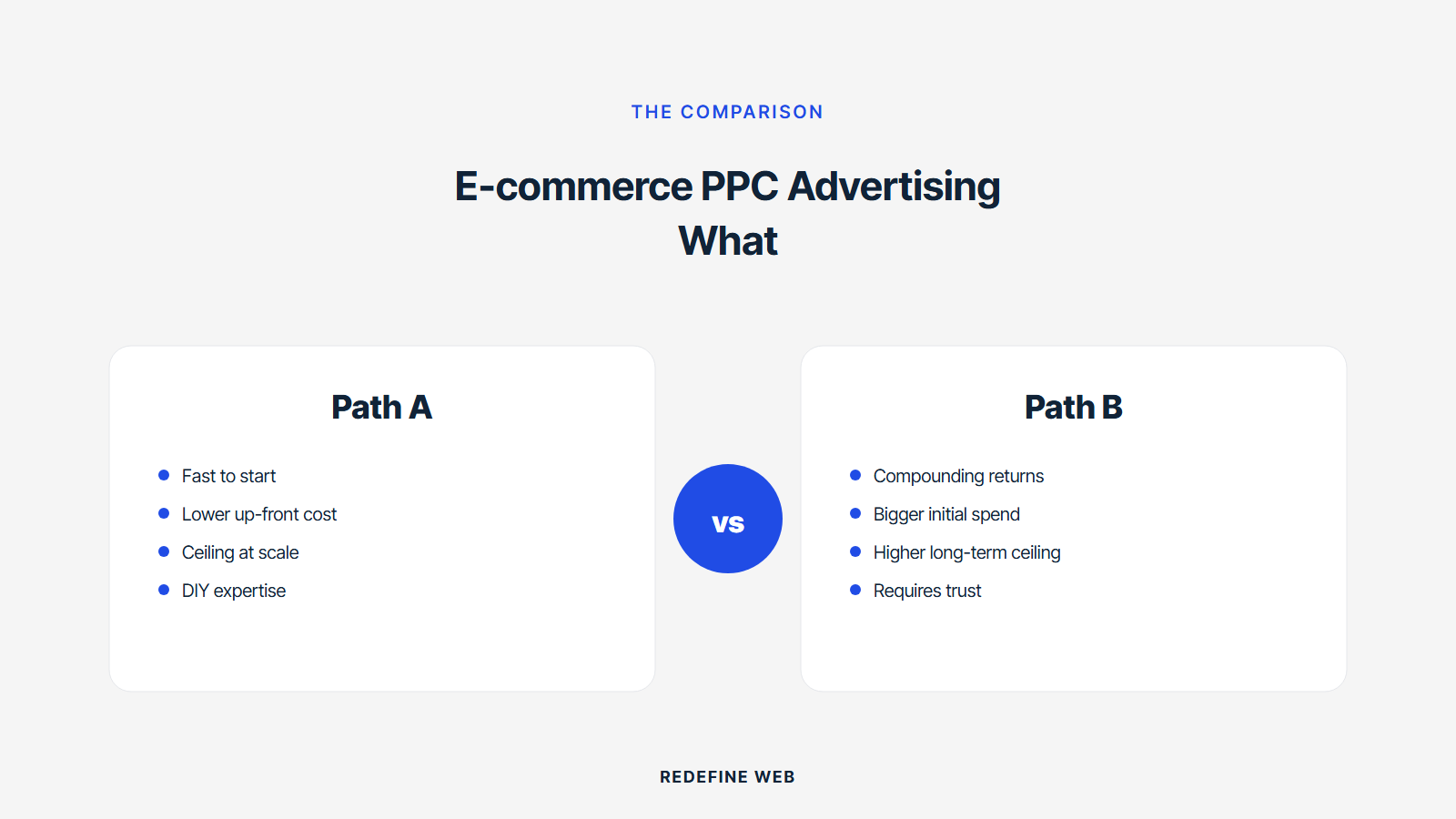
Every store owner eventually asks whether to run paid media in-house or hire an agency. The answer depends on ad spend, in-house creative capacity, and whether the founder has time to review reports every Monday. Below 15,000 dollars a month in ad spend, an agency retainer wins on math because the tool licenses alone eat 500 to 900 dollars. Above 100,000, a hybrid model with an in-house lead plus agency oversight usually wins.
Tool license math for in-house
Triple Whale (199 to 900 dollars a month), DataFeedWatch (100 to 800), Optmyzr (250 to 500), and Adalysis (150 to 300) sit at 700 to 2,500 dollars a month in stack costs for a single in-house lead. Agencies spread those license costs across 15 to 20 accounts, so per-account share drops to 50 to 130 dollars. That is one of the biggest cost efficiencies an agency delivers on e-commerce work. Founders who insist on in-house tooling below 30,000 dollars in monthly ad spend usually spend 3x what they need to.
When in-house wins
In-house wins when the store spends over 100,000 dollars per month, custom conversion logic needs daily internal collaboration, and the founder wants permanent paid media capability on the team. Even then an agency oversight arrangement catches blind spots a solo in-house lead misses. Full replacement of external oversight rarely pays off below 300,000 dollars in monthly spend. Our PPC management services team runs into this decision often with mid-market Shopify stores.
Wrapping up e-commerce ppc advertising as a discipline
E-commerce ppc advertising in 2026 is not one platform. It is a stack of platforms (Google Shopping and PMax, Meta Advantage+, TikTok, Amazon) that a human specialist orchestrates on top of clean tracking, a healthy product feed, and a creative refresh cadence baked into the plan. Every platform runs its own auction. Every auction rewards quality signal as much as bid. Skip either and the paid stack quietly drifts.
Real accounts see 3x to 8x blended ROAS inside 6 months when the specialist, the tracking, and the creative rotation all show up every week. Topps Tiles pulled 5,465 new visitors and 33.3 percent of the UK tile market’s unique-visitor share on the same ROAS target through a structured test-and-learn program. Ask three vendors for line-item scopes, look for the campaign structure they name upfront, and pick the one that names both bid strategy and creative refresh cadence in writing. Redefine Web offers a fixed-scope Ecommerce PPC Agency for DTC Brands package with the full stack included, plus a Google-first Google Ads Management Services program and a broader Ecommerce Marketing Agency for DTC and Shopify Brands retainer.
For DTC founders buying paid search for the first time, our plain-language walkthrough of what is ppc in ecommerce covers the auction, the channel mix, and the first budget math before any of the tactical playbooks above apply.
Frequently asked questions
What is e-commerce ppc advertising in 2026?
E-commerce ppc advertising is pay-per-click paid media for online stores across Google Shopping and Search, Performance Max, Meta Advantage+, TikTok Ads, Amazon Sponsored Products, and Microsoft Advertising. The store pays only when a shopper clicks the ad. Each platform runs its own real-time auction that ranks eligible advertisers by bid, quality signal, and audience match. The specialist owns campaign structure, bid strategy, creative rotation, and product feed hygiene inside one weekly budget. Stores past 10,000 dollars a month in ad spend usually run three or four platforms at once, not one, because different buyer intents show up on different surfaces.
How does the Google Ads auction actually work for e-commerce?
Google multiplies your maximum bid by Quality Score, then adds ad extension and format bonuses to calculate Ad Rank. The winning advertiser is not the highest bidder, it is the highest Ad Rank. A store with a 10 Quality Score can beat a competitor bidding twice as much with a 5 Quality Score. Quality Score is built from expected click-through rate, ad relevance to the keyword, and landing page experience. Improving Quality Score from 5 to 8 typically drops cost per click 30 to 50 percent on the same targeting. This is the single highest-return lever inside Google Ads work for online stores.
How is Meta Ads different from Google Ads for e-commerce?
Meta Ads has no keyword. Advantage+ Shopping and catalog campaigns match ads to users based on interest signals, purchase history, and lookalike audiences pulled from your customer list. The advertiser uploads 6 to 10 creative assets plus a product catalog, and Advantage+ decides which creative shows to which user with which product overlay. Meta multiplies bid by estimated action rate divided by user experience score. Creative that gets scrolled past fast drops delivery. Creative that gets stopped on and clicked raises delivery. That is why refresh cadence at 4 to 6 new assets per week matters so much on Meta and TikTok.
What is Performance Max in e-commerce ppc?
Performance Max is a Google Ads campaign type that runs across every Google surface at once, including Search, Display, YouTube, Discover, Gmail, and Maps. The model decides which asset shows on which surface based on user signals and conversion probability. The specialist provides asset groups (headlines, descriptions, images, videos), audience signals from customer lists and interests, conversion values on every conversion, and account-level negative keyword lists. PMax now accounts for 25 to 40 percent of Google Ads spend on most e-commerce accounts and works especially well for stores with a clean product feed and revenue values wired into GA4.
How much does e-commerce ppc advertising cost per month?
Stores under 50,000 dollars in monthly revenue start at 2,000 to 5,000 dollars a month in ad spend. Stores between 50K and 250K in monthly revenue run 5,000 to 20,000 in ad spend. Stores past 250K a month usually reinvest 15 to 25 percent of revenue back into paid media. Agency retainers add 750 to 12,000 dollars a month on top of ad spend depending on the platform mix. Tool licenses like Triple Whale, DataFeedWatch, and Optmyzr add 200 to 500 dollars a month bundled inside a working retainer at agency-negotiated rates.
What are the biggest mistakes in ppc advertising for e-commerce?
Running one campaign across every product category is the biggest mistake because it hides category-level performance and prevents category bidding. No brand Search campaign defending brand queries is the second, competitors bid on your brand and pull 10 to 20 percent of traffic away. Product feed with generic titles and no GTIN is the third, impression share caps below 40 percent regardless of bid. Meta Advantage+ Shopping without a product catalog uploaded is the fourth, delivery drops 40 percent. Last-click ROAS treated as truth is the fifth, blended ROAS almost always tells a different story. Creative refresh cadence of once a quarter is the sixth, Meta and TikTok performance decays inside 14 days.
How long does e-commerce ppc advertising take to work?
Month one covers tracking QA, feed audit, campaign restructure, and first creative refresh. Blended ROAS often dips 10 to 20 percent while learning phases reset. Month two shows the first real signal as the platform models learn on cleaner data. Month three is where most stores hit break-even against ad spend plus retainer. Months four through six are where compounding kicks in and blended ROAS climbs 30 to 60 percent above baseline. Apparel and lifestyle stores routinely see 3x to 5x blended ROAS by month six. Home decor stores see 4x to 8x given higher average order value.
Book your free 30-minute strategy call.
No spam, no sales rep. We use your email to schedule your call with a senior strategist. That is it.
More from the blog
View all articles → PPC
PPC Healthcare PPC Advertising Channels Compliance and Targeting
Read article PPC
PPC Dental Facebook Ads Guide for Practices That Book Patients
Read article PPC
PPC