
Food Influencer Marketing Agency for DTC and CPG Brand Growth
- A food influencer marketing agency runs four distinct program types.
- Seeding, gifted, paid partnerships, and ambassador rosters each fit specific stages.
- Nano and micro creators outperform macro on food category conversion.
- Retainer bands sit at $599 to $28k depending on program depth.
- Six-month contracts match the ramp cycle for seeding programs.
- Paid partnerships a food influencer marketing agency negotiates
- Ambassador programs a food influencer marketing agency runs
- Retainer bands for a food influencer marketing agency
- Case study on Sansa Interiors and creator-driven growth
- Screening questions for a food influencer marketing agency
- Measuring a food influencer marketing agency retainer
- Platform coverage a food influencer marketing agency spans
- Making the pick on a food influencer marketing agency
A food influencer marketing agency runs creator seeding, gifted product programs, paid partnership deals, and always-on ambassador rosters tuned to the exact buyer profile a packaged food or beverage brand needs to reach. The channel does real work when the creators actually match the category (a hot sauce collab with a home-cook creator with 40k engaged followers moves more units than a $12k deal with a 400k lifestyle creator whose audience doesn’t cook). Category shops know which creators actually convert. Generalists rent lists from Aspire and hope.
You get the four types of creator programs a food influencer marketing agency runs, retainer bands per program depth, the six screening questions that separate a real category shop from a generalist influencer platform, a named client teardown with real numbers, plus how the four program types coordinate across a 12-month brand plan. Read straight through in twelve minutes and you’ll know which program mix fits your brand stage.
Paid partnerships a food influencer marketing agency negotiates
Paid partnerships pay creators for scripted content with brand messaging, usage rights, and posting cadence commitments. Rate cards run $180 to $850 for nano creators (1k to 10k followers), $850 to $3,400 for micro (10k to 100k), $3,400 to $14k for macro (100k to 500k), and $14k to $80k for mega (500k-plus). Rates vary by content type (a Reel costs 2 to 3 times a static post), usage rights window (paid ads add 40 to 80 percent), and exclusivity clauses (category exclusivity adds 30 to 50 percent).
Paid partnership math works when the creator’s audience actually converts. A micro coffee creator at 45k followers with 6 percent engagement rate on food content moves 220 to 340 units at a $34 AOV per paid Reel deal costing $1,800. That works out to $8k to $12k in attributed revenue against $1,800 in cost, plus organic follow-on reach. Category shops calculate deal math per creator before signing. Generalists sign the deal, hope the creator posts on time, and report impressions to a founder who wanted revenue. See our food social media marketing agency breakdown for adjacent channel coordination.
Usage rights clauses that matter
Usage rights clauses determine whether the brand can boost the creator’s post as a paid ad, repost the content on brand channels, or use the creator’s image in retail collateral. Every clause costs money. Whitelist rights (running the ad from the creator’s handle) add 40 to 80 percent to base rate. Perpetual usage rights add 60 to 120 percent. Category exclusivity (creator won’t work with competitors for 90 days) adds 30 to 50 percent. Category shops negotiate rights cleanly upfront. Generalists sign standard contracts and lose the ability to boost the best-performing content.
Content brief standard for creators
Content briefs make or break a paid partnership. A well-built brief covers hook style (3-second attention grab), body content (product-in-hand, taste reaction, use-case demo), call-to-action (“tap the link in bio”), disclosure requirement (#ad in the first line), posting date, and cross-post rules. Bad briefs try to script every word and produce stiff content nobody watches. Category shops give creators structural guardrails plus creative freedom. Generalists write bullet-point requirements the creator ignores.
Ambassador programs a food influencer marketing agency runs
Ambassador programs lock 8 to 15 creators on 6-month or 12-month terms with monthly content commitments and performance bonuses. Ambassadors get a monthly retainer plus product plus performance bonuses tied to affiliate code sales, referral link clicks, or attributed Meta paid conversions. Ambassador rosters build compounding brand association over 12 months because the same creators consistently show the product in context.
Ambassador math works at scale. A $2,400 monthly retainer per ambassador times 12 ambassadors is $28,800 monthly retainer cost. Ambassadors deliver 3 to 5 pieces of content per month each, totaling 36 to 60 pieces of monthly content across the roster. Attributed revenue through affiliate codes and Meta paid retargeting on ambassador content lands at $180k to $340k monthly at scale, driving a 6x to 12x return on the ambassador program spend.
Performance bonuses that align incentives
Performance bonuses align ambassador incentives with brand outcomes. Bonuses tied to affiliate code revenue (10 to 15 percent of sales) reward ambassadors who drive real purchases. Bonuses tied to Meta paid ROAS on their content (a bonus if the ad hits above 3.0 ROAS) reward ambassadors whose content converts. Bonuses tied to follower growth on tagged posts reward ambassadors who grow the brand’s owned audience. Category shops structure 2 to 3 bonuses per ambassador. Generalists pay flat retainers and see ambassador content quality drift after month three.
Roster diversity for coverage
Ambassador rosters need diversity across content style, audience demographic, and geographic region. A food brand roster with 12 ambassadors covers home cooks, food stylists, wellness-forward eaters, on-the-go professionals, and mom-focused family cooks across four to six US regions. Roster overlap on content style produces redundant reach and wasted retainer spend. Category shops audit roster diversity quarterly. Generalists let the roster drift toward whichever creators are easiest to sign, which usually means a homogeneous roster that hits the same audience five times.
Retainer bands for a food influencer marketing agency
Retainer pricing depends on program depth. A seeding-only program covering 60 creators per quarter sits at $2,400 to $4,800 per month plus product costs. A gifted-plus-paid program adding 4 to 8 paid partnerships per month sits at $6,400 to $12,800 per month. A full-scope program including ambassador roster management sits at $14,000 to $28,000 per month plus ambassador retainer pass-through. Product costs and paid partnership fees pass through separately at cost.
Our own food and beverage marketing retainer starts at $599 per month for smaller brands running lighter influencer programs inside a wider marketing scope. That’s the entry point for brands under $1M in revenue seeding 20 to 30 creators per quarter as part of an integrated retainer. Above that revenue band the influencer program moves to the depth-based retainer bands above. A food influencer marketing agency retainer looks nothing like a paid social retainer, and the sales call should confirm scope match before signing.
| Program depth | Retainer band | Scope |
|---|---|---|
| Seeding only, 60 creators / quarter | $2,400 to $4,800 / mo | List + fulfillment + tracking |
| Gifted + paid, 4-8 partnerships / mo | $6,400 to $12,800 / mo | Add paid negotiation + briefs |
| Full-scope + ambassador roster | $14,000 to $28,000 / mo | Add roster management + bonuses |
| Integrated retainer entry | $599 / mo | 20-30 seeded per quarter inside wider scope |
Cost per post benchmarks
Cost per organic post from a seeding program sits at $32 to $58 fully loaded (product plus fulfillment plus retainer allocation). Cost per paid partnership post sits at $180 to $18k depending on creator tier. Cost per ambassador post sits at $200 to $600 (retainer plus product plus bonus allocation, divided across monthly posts). Category shops track cost-per-post per program type. Generalists lump all program spend into one number and can’t tell the founder which program is working.
Contract length for retainer clarity
Six-month contracts are the standard for food influencer retainers because seeding programs need 60 to 90 days to hit steady-state post rate and ambassador programs need 90 to 120 days to compound content library depth. Shorter contracts don’t give the program time to prove its work. Category shops explain the ramp math on the sales call and ask for the six-month commitment upfront. Generalists offer short-term contracts and get replaced at month three when the seeding list overlaps with the founder’s next agency hire.
A home-cook creator with 40k engaged followers moves more hot sauce than a 400k lifestyle account. Ask any agency for engagement rate cutoffs, not follower minimums.
Case study on Sansa Interiors and creator-driven growth
Sansa Interiors Inc. is a Toronto interior design firm specializing in modern residential spaces and hospitality venues, particularly cafes and restaurants. The digital-PR-driven growth pattern parallels how a food brand builds category authority through creator partnerships. Sansa relied on trial-and-error marketing before the engagement. Sporadic inquiries, thin press recognition, and no consistent content voice across owned and earned channels.
The 24-month program delivered 641 percent organic traffic growth, moved annual inquiries from 18 to 133, and secured features in DesignMilk, Casa Vogue, Elle, and Chic Haus. Digital PR compounded brand credibility, and the coverage seeded downstream referral inquiries from readers of those publications. The same compounding pattern applies to a food brand seeding creators quarterly. Every earned post seeds the next one because algorithms favor accounts with recent brand association, and creators check what their peers are posting about before they post themselves.
| Sansa Interiors metric | Baseline | After 24 months |
|---|---|---|
| Organic traffic | Flat | +641 percent |
| Annual inquiries | 18 | 133 |
| Press features | None | DesignMilk, Elle, Casa Vogue |
| Top-3 rankings | Zero | Multiple target queries |
Earned media parallels creator seeding
Earned press features and creator seeding both compound because each success signals credibility that unlocks the next. A press feature in Casa Vogue makes the next Elle pitch easier. A seeded post from a 30k follower home-cook creator makes the next 50k follower creator more receptive to the same product. Category shops treat both channels as compounding assets. Generalists treat each pitch or send as an independent event and see zero compounding gain.
Content library as a byproduct
Seeded and paid creator content becomes a content library the brand owns through usage rights. Twenty organic seeded posts per quarter plus 6 paid partnerships per quarter gives the brand 104 pieces of usable content per year at content library cost of $200 to $600 per piece. That library feeds paid Meta ad rotation, PDP hero image sequences, retail-collateral for wholesale accounts, and Amazon A+ content. Category shops track library growth as a first-class KPI. See our food content marketing agency breakdown for the wider content library math.
Screening questions for a food influencer marketing agency
Category agencies answer creator-specific questions specifically. Repurposed influencer platforms answer with dashboards showing follower reach. The screening happens in the first 45-minute call, and there are six questions that separate the two. Ask them and you’ll know before the proposal arrives whether the shop actually runs food creator programs.
- Name five food creators under $15k GMV per post you’ve worked with in the last six months and the conversion outcomes they delivered.
- What’s your target organic post rate on a seeding program of 60 creators per quarter?
- How do you calculate cost per attributed sale on a paid partnership with a 45k follower coffee creator?
- Which usage rights clauses do you negotiate into every paid partnership contract, and what’s the rate premium?
- Show a sanitized ambassador roster from a past client with content-style tags and monthly deliverable counts.
- What’s your process for measuring creator content performance versus generic brand content on paid Meta?
Creator name check as a signal
Ask for five specific creators the shop has worked with in the last six months. Category shops rattle off names with follower counts, engagement rates, and specific product placements. Generalists stall, ask if they can email the list later, or name three creators every food brand has worked with. The stall is the tell. Real category shops track their working creator relationships as a first-class asset and can recite the top 20 from memory.
Attribution answer as a category signal
Ask how the shop measures creator content performance versus generic brand content on paid Meta. Category shops explain view-through attribution, tagged UTM tracking, and A/B testing creator versus non-creator ads on the same audience. Generalists talk about “engagement gains” and hand-wave the specifics. Real attribution work matters because paid partnership contracts often cost 10 to 40 times a static seeding send, and the math needs to justify the difference. See the FTC endorsement disclosures guide for the compliance layer that has to sit alongside attribution.
Our favorite pitch to a cold brew brand came from a generalist influencer platform proposing a “strategic partnership with a $340k mega creator who has 2.4M followers and drives massive brand awareness.” The founder asked how many of the mega creator’s followers actually drink cold brew. The account director said “the reach is the value.” We asked what the cost per attributed sale worked out to at the mega creator’s typical 0.4 percent conversion on food content. Seventeen seconds of silence and a rough guess of $840 per unit sold. The brand signed a nano-and-micro seeding retainer with us the next week.
Measuring a food influencer marketing agency retainer
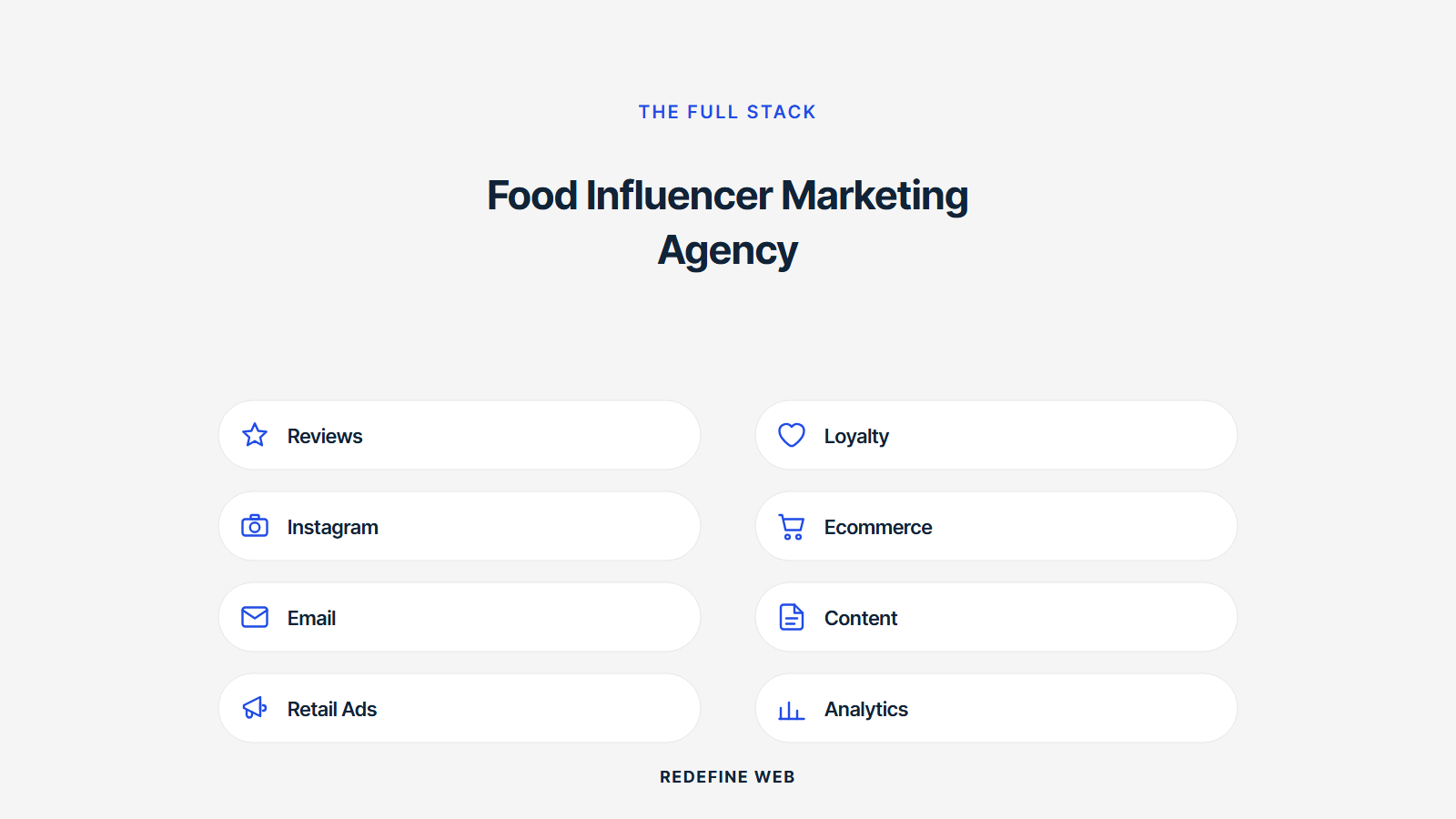
Three dashboards keep a food influencer retainer honest. A weekly seeding dashboard with sends completed, organic post rate, and cost per post. A monthly paid partnership dashboard with contracted posts, attributed revenue by creator, and cost per attributed sale. A quarterly ambassador dashboard with content produced per ambassador, affiliate code revenue by ambassador, and roster diversity by content style. Anything more granular is a report, pulled on request.
Leading indicators beat lagging ones. Seeding post rate at week 4 predicts total quarterly organic post volume. Ambassador content-produced rate predicts affiliate revenue by month three. Paid partnership creative fatigue signal (frequency crossing 3.0 on retargeted audiences) predicts ROAS drop by 10 to 14 days. Category shops report on leading indicators and adjust the retainer scope weekly. Generalists report last month’s impression count as if it matters to a founder’s P&L.
Post rate benchmarks per program
Seeding post rate should land at 30 to 45 percent by month 6 on a well-vetted list. Gifted post rate should land at 55 to 70 percent because the ask is explicit. Paid partnership post rate should land at 100 percent (that’s what the money is for). Ambassador content-produced rate should hit 90 to 100 percent of monthly commitments. Below these bands and either the creators aren’t fitting the brand or the shop is under-managing the relationship. Category shops publish the benchmark bands upfront. Generalists don’t have the numbers.
Attribution tools that actually work
Affiliate codes plus UTM tracking plus post-purchase surveys triangulate creator attribution reliably. Affiliate codes catch direct clicks. UTM tracking catches multi-touch clicks. Post-purchase surveys (“where did you first hear about us?”) catch the view-through customers who didn’t click but bought a week later. Category shops run all three. Generalists rely on affiliate codes alone and underreport creator revenue by 40 to 60 percent, making the ROI math look worse than it is.
Platform coverage a food influencer marketing agency spans
Food creators live across Instagram, TikTok, YouTube, Pinterest, and Substack. Each platform has a different content format, a different algorithm, and a different creator ecosystem. A food influencer marketing agency worth its retainer covers all five with tuned playbooks per platform. Instagram Reels for taste-reaction moments and PDP-quality static shots. TikTok for satisfying preparation loops and duet trends. YouTube for long-form recipe development and creator ambassador docuseries. Pinterest for recipe pin discovery driving evergreen search traffic. Substack for founder-led food newsletter placements.
Platform mix varies by SKU category. Coffee brands lean heavier on Instagram Reels and Pinterest recipe pins because morning-ritual content converts well there. Snack brands lean heavier on TikTok because impulse buys respond to fast-format content. Beverage functional brands lean heavier on YouTube because education wins for wellness-forward buyers. Category shops split creator lists by platform. Generalists post the same content to every platform and see reach collapse on the algorithm mismatch.
Platform-native creative wins
Platform-native creative outperforms cross-posted content by 3 to 6 times on engagement. A TikTok video cross-posted to Instagram Reels sees 40 to 60 percent lower reach because the algorithm penalizes the TikTok watermark. Category shops brief creators to shoot format-specific versions per platform. Generalists ask for one asset and cross-post everywhere. See our food and beverage marketing retainer detail for how platform coverage fits into scope.
Pinterest longevity for food brands
Pinterest posts have compounding half-lives measured in months versus Instagram Reels measured in days. A recipe pin from a food creator can drive traffic for 12 to 24 months after posting. Category shops build Pinterest seeding into every long-term food creator program. Generalists skip Pinterest because the platform feels dated to a marketer used to real-time engagement metrics. The compounding traffic tells a different story on the founder’s Google Analytics dashboard six months later.
Making the pick on a food influencer marketing agency
Pick a food influencer specialist if you sell packaged food or beverage DTC and need creator content that actually converts. Pick an integrated retainer entry package if you’re under $1M in revenue and want lighter creator programs inside a wider marketing scope. Skip an influencer platform (Aspire, Grin, Creator IQ standalone) if you’re above $5M in revenue because the platform-only model doesn’t include category-vetted creator relationships or negotiation depth. Pattern library beats platform access on every food creator program above that revenue band.
The last piece of advice is simpler than most of this guide. Have the sales call, ask the six creator-specific questions, watch the sanitized ambassador roster demo, and trust the answers. Category shops rattle off creator names from memory. Generalists stall and ask if they can email the list. The stall is the tell. See our food and beverage marketing services page for the specific retainer scopes we run across seeding, gifted, paid, and ambassador programs today.
Platform benchmarks help too. The Later Instagram benchmark report gives a sanity check on engagement rates by follower tier before you commit to a paid partnership rate card with any influencer marketing food agency.
Frequently asked questions
What does a food influencer marketing agency actually do?
A food influencer marketing agency runs four distinct program types: creator seeding (sending product to 40 to 80 creators per quarter with no posting requirement), gifted programs (product plus a soft ask for a post), paid partnerships (paying creators for scripted content), and always-on ambassador rosters (locking 8 to 15 creators on 6-month terms). Each program has different budgets, different creator tiers, and different KPIs. Category shops mix all four based on brand stage. Generalists run one program type and pretend it fits every brand. Ask on the first call which mix the shop recommends for your specific stage and product category.
How much should a food influencer marketing agency retainer cost per month?
A seeding-only program covering 60 creators per quarter runs $2,400 to $4,800 per month plus product costs. A gifted-plus-paid program adding 4 to 8 paid partnerships per month runs $6,400 to $12,800 per month. A full-scope program including ambassador roster management runs $14,000 to $28,000 per month plus ambassador retainer pass-through. Our own food and beverage marketing retainer starts at $599 per month for smaller brands running lighter influencer programs inside a wider marketing scope. Product costs and paid partnership fees pass through separately at cost. Match retainer band to program depth and total spend stays predictable.
Do nano and micro creators actually convert better than macro for food brands?
Yes on cost-per-engagement and cost-per-attributed-sale, almost every time. Nano creators (1k to 10k followers) run 6 to 12 percent engagement rate on food content. Micro (10k to 100k) run 3 to 7 percent. Macro (100k to 500k) run 1.5 to 3 percent. Mega (500k-plus) run 0.8 to 1.8 percent. A 45k micro coffee creator with 6 percent engagement rate moves 220 to 340 units at $34 AOV per paid Reel costing $1,800. A 2M mega creator at 0.4 percent conversion on food costs 10 times as much per attributed sale. Category shops build lists heavy in nano and micro. Generalists chase macro for vanity reach.
How do I screen a food influencer marketing agency in one 45-minute call?
Ask six creator-specific questions. Name five food creators under $15k GMV per post worked with in the last six months and the outcomes they delivered. Target organic post rate on a seeding program of 60 creators per quarter. How they calculate cost per attributed sale on a paid partnership with a 45k follower coffee creator. Which usage rights clauses they negotiate into every paid partnership contract. Show a sanitized ambassador roster with content-style tags. Process for measuring creator content performance versus generic brand content on paid Meta. Category shops rattle off creator names and specific benchmark numbers. Generalists stall and ask if they can email the list later.
What's the difference between creator seeding and paid partnerships for food brands?
Creator seeding sends product to 40 to 80 creators per quarter with no posting requirement; 30 to 45 percent post organically within 60 days if the product resonates. Total cost is $32 to $58 per organic post fully loaded. Paid partnerships pay creators for scripted content at rates from $180 for nano creators to $18k for macro. Total cost is $180 to $18k per contracted post. Seeding works for awareness and early-stage brands. Paid partnerships work for conversion and scale-stage brands. Category shops recommend a mix based on brand stage. Pre-launch brands go seeding-heavy. Growth-stage brands run mixed programs. Scaling brands run paid-heavy with ambassador anchors.
How does a food influencer marketing agency measure attribution across creator content?
Category shops use three tools together. Affiliate codes catch direct clicks that convert. UTM tracking on creator link-in-bio catches multi-touch clicks across the funnel. Post-purchase surveys ("where did you first hear about us?") catch view-through customers who saw the creator content but didn't click and bought a week later through another channel. Running all three tools triangulates creator attribution reliably. Generalists rely on affiliate codes alone and underreport creator revenue by 40 to 60 percent because view-through and multi-touch customers get credited to the wrong channel. Ask on the sales call which tools the shop runs and whether they triangulate.
Book your free 30-minute strategy call.
No spam, no sales rep. We use your email to schedule your call with a senior strategist. That is it.
More from the blog
View all articles → Digital Marketing
 Dental Marketing Tips That Compound Into New Patients
Read article Digital Marketing
 Ecommerce Marketing Strategies That Drive Real DTC Revenue
Read article Digital Marketing