5.0 · verified April 2026
"They kept the process simple and focused. Understood our goals as a dental practice and stayed focused on improvements that would make the website and ad campaigns more effective."

Food and beverage marketing retainer that runs on-store SEO, Klaviyo flows, Meta and TikTok, Amazon, Instacart advertising, and retail sell-through content for your CPG brand. CPG marketing retainer and beverage marketing packages from $599 per month with quarterly reviews built in, cancel with 30 days notice.
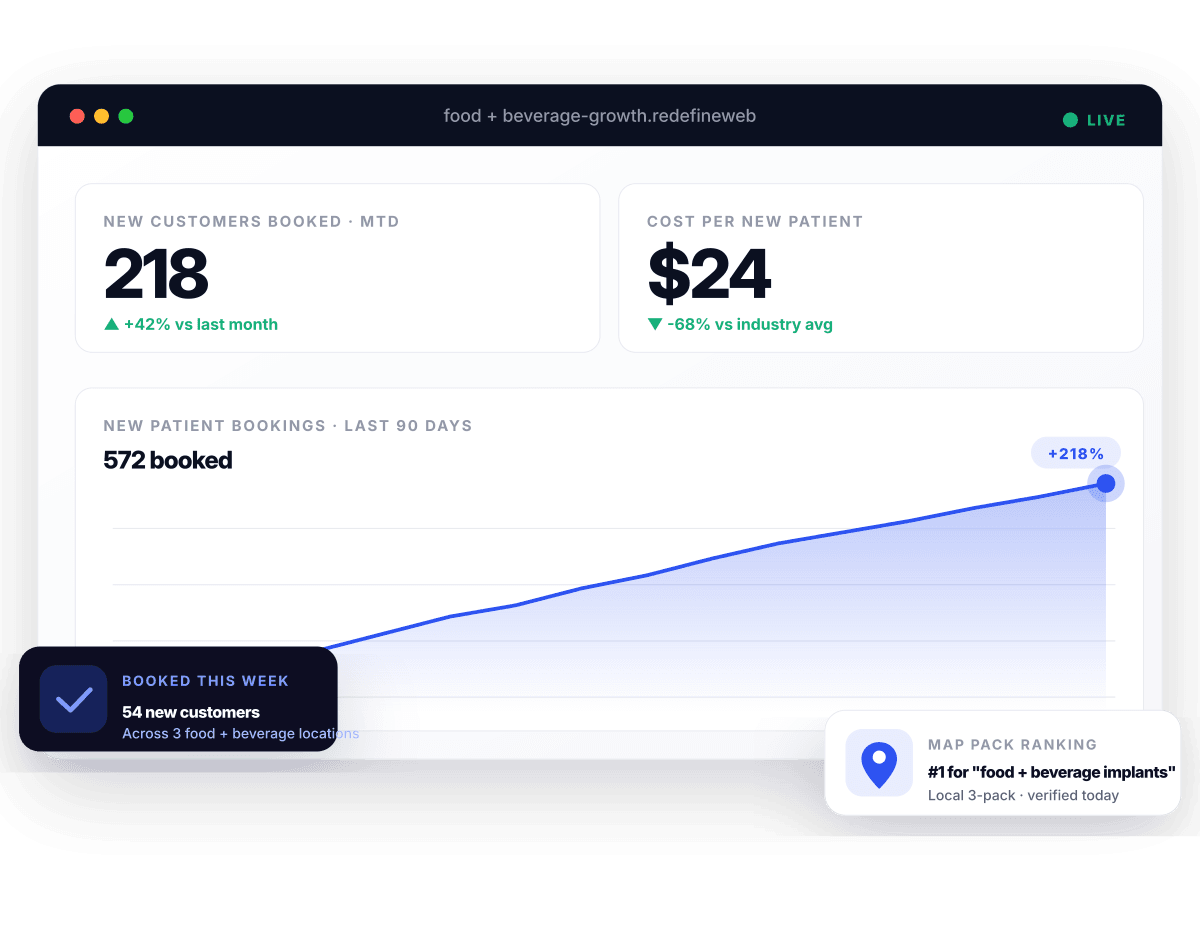


























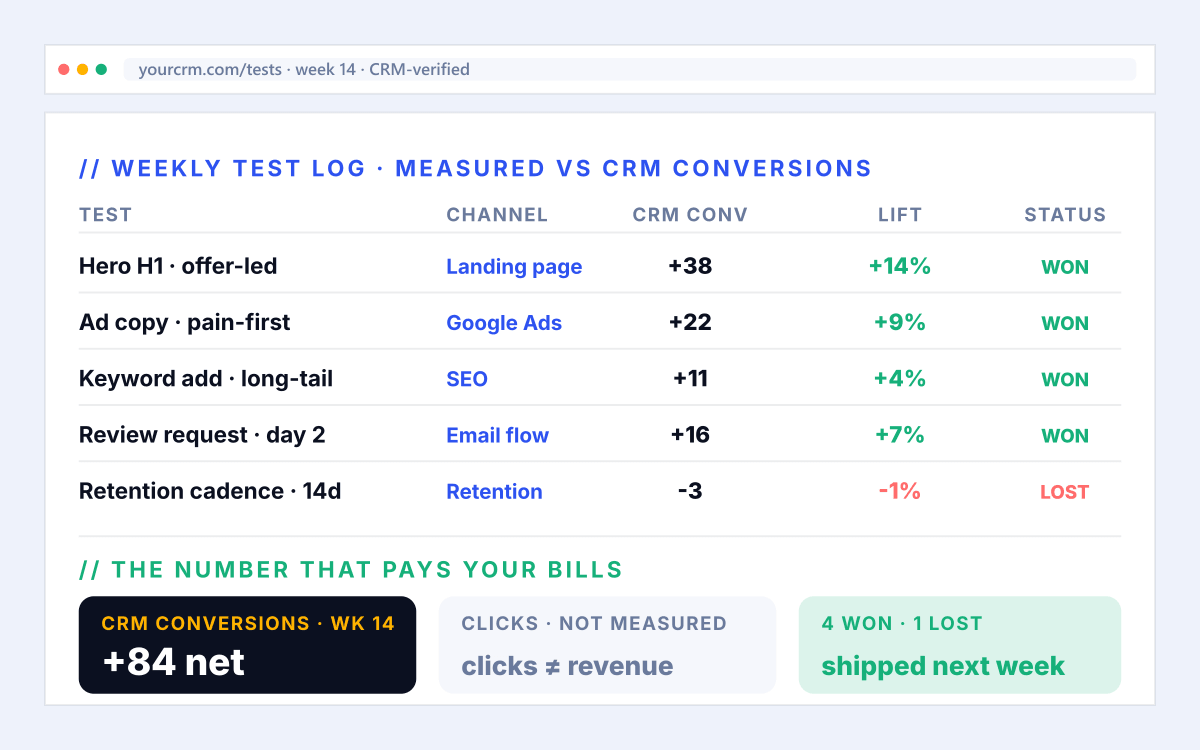
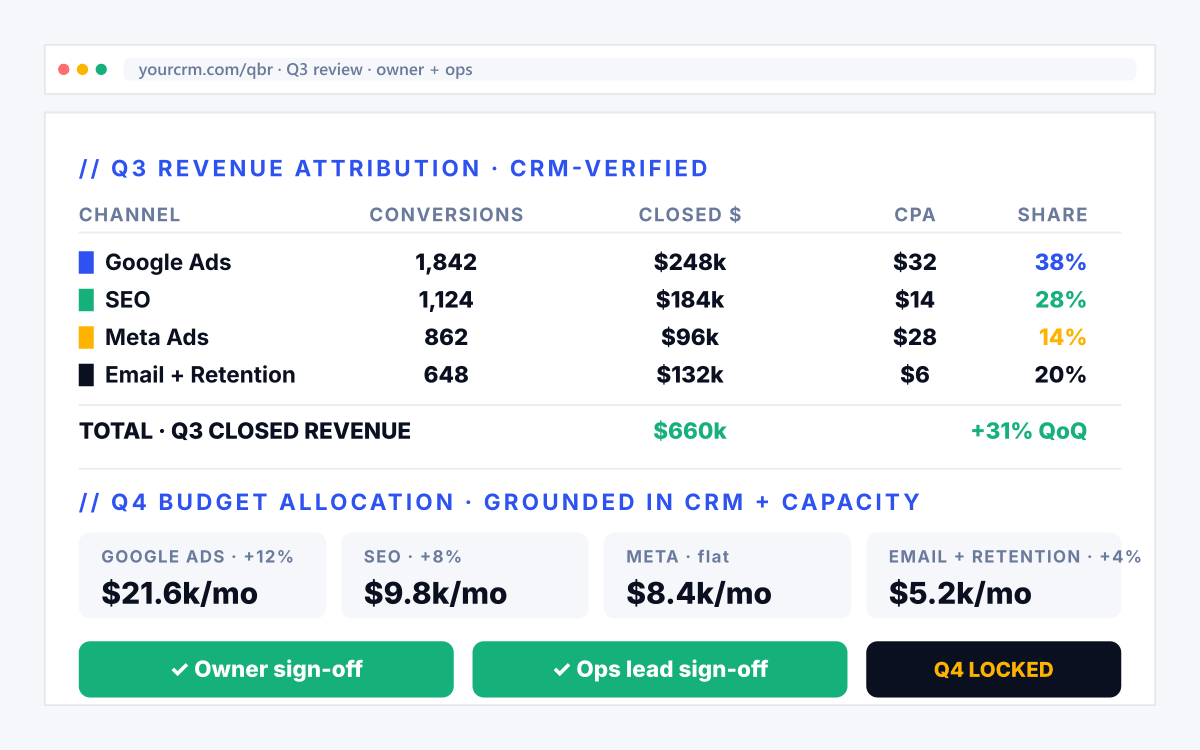
Nothing here is "reach" or "impressions". Every outcome maps to a case moved off the shelf, a DTC repeat purchase, or an Instacart share point.
Instacart advertising, retailer-specific landing pages, and shelf-talker QR flows all reporting into one dashboard. IRI or Nielsen scan trends now sit next to trade spend so you can tell demo dollars from real velocity.
Klaviyo welcome, replenishment, and swap-suggestion sequences tuned by SKU reorder velocity. Retainer clients typically move DTC repeat purchase rate from 12 to 22 percent inside 90 days on non-perishable SKUs.
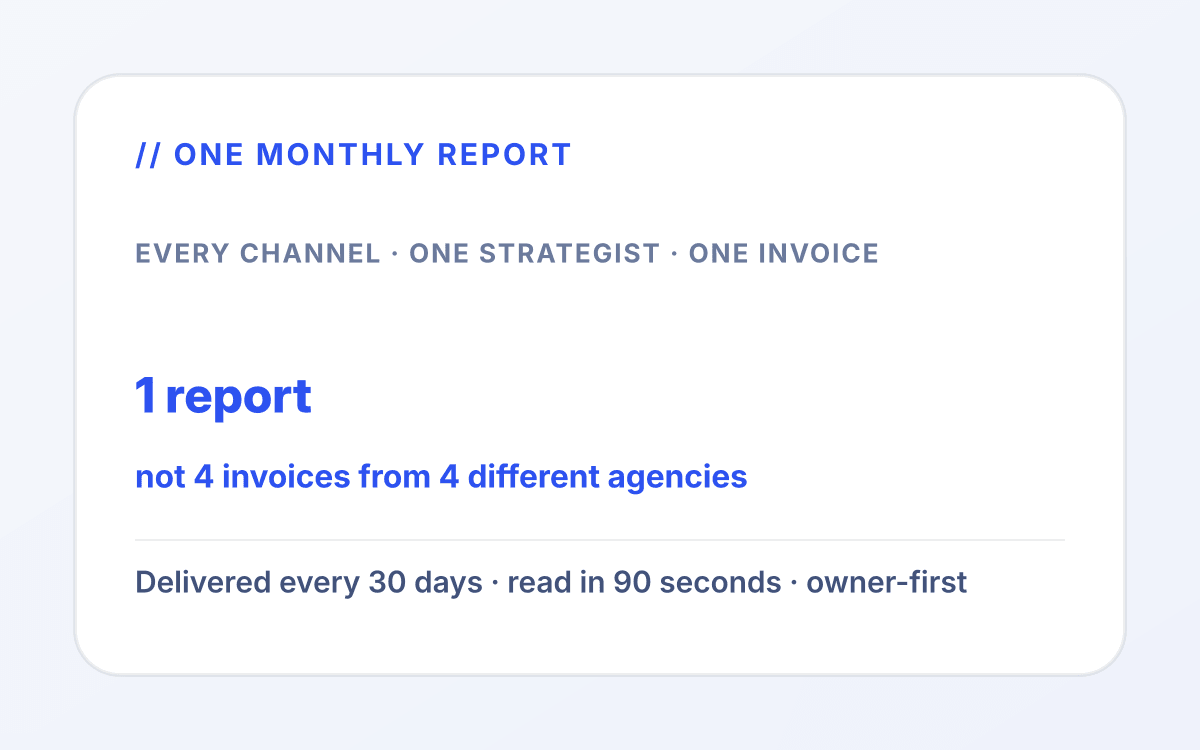
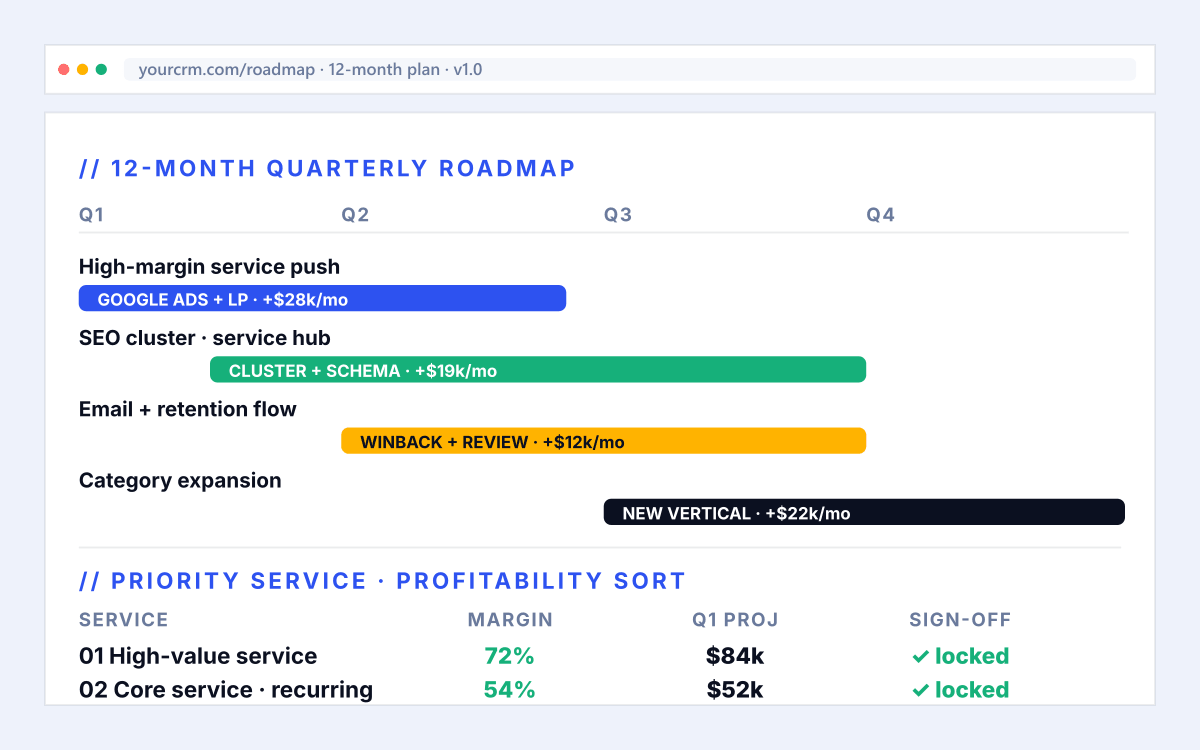
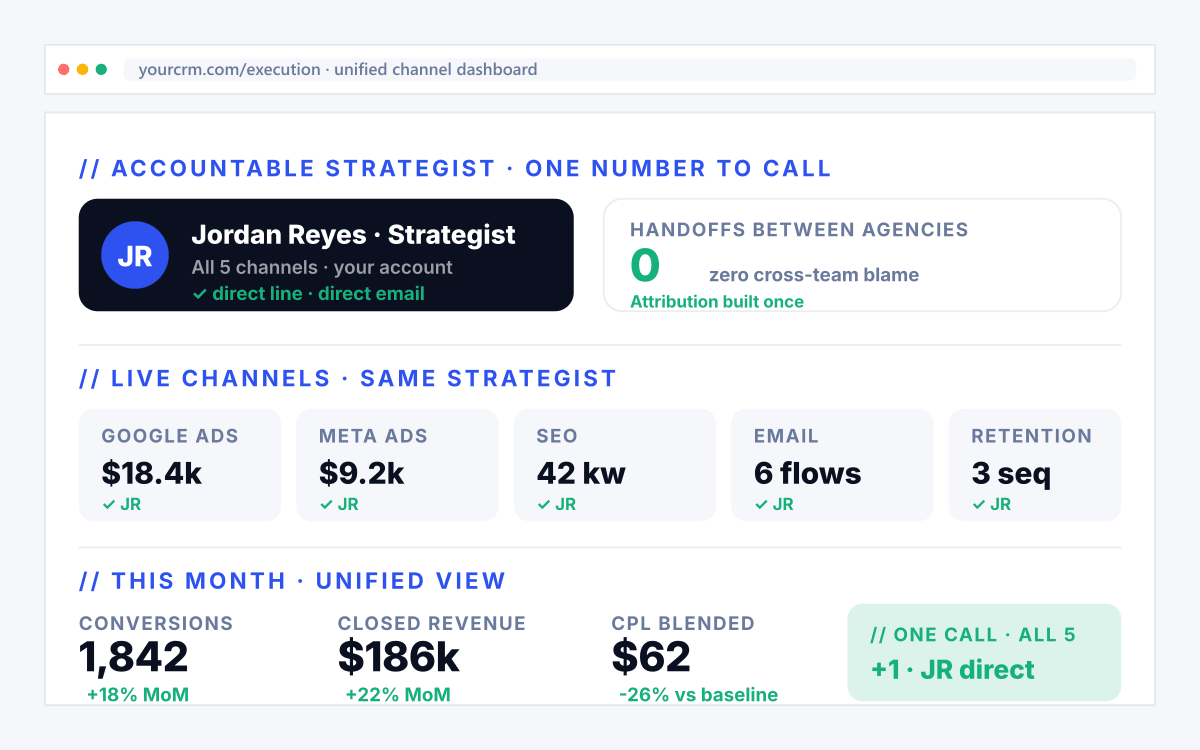
You stop paying five vendors and getting five conflicting spreadsheets. A CPG growth strategist owns the roadmap, pushes the work live, and shows up on the monthly call with what moved on sell-through, DTC repeat, and Instacart share.
Pick the tier that matches your brand stage. Move up or down anytime with 30 days notice. Ad spend billed separately at pass-through. Hover any feature name for a plain-English explanation.
Solo CPG brands that want an accountable growth program running without a five-vendor stack. On-store SEO, Klaviyo core flows, DTC CRO patches, and reporting, run monthly.
Growing CPG brands ready to add Meta and TikTok prospecting, product-page tests, and a monthly repeat-purchase campaign on top of the Foundation stack.
Multi-channel CPG brands running Instacart, Amazon, or retail placement alongside DTC. Adds retail sell-through content, Instacart advertising, Amazon management, and sampling tracking.
Multi-region CPG operations, brands doing significant retail placement, or category-defining DTC that wants Instacart and Amazon at scale plus a dedicated CPG growth strategist.
Need scope beyond the Scale tier? We also run full-service food and beverage marketing retainers from $4,000/mo for brands with significant retail placement, Instacart and Amazon programs at scale, or multi-region DTC + retail operations.
Tap any section to expand or collapse. Hover a feature name for a plain-English explanation.
| Feature | 01 · Foundation | 02 · GrowthPopular | 03 · Scale | 04 · Enterprise |
|---|---|---|---|---|
| Content pieces per month | 2 | 2 | 4 | 6+ |
| Retail sell-through content | 1/mo | 2+/mo | ||
| Programmatic recipe SEO | ✓ |
| Feature | 01 · Foundation | 02 · GrowthPopular | 03 · Scale | 04 · Enterprise |
|---|---|---|---|---|
| Klaviyo core flows | ✓ | ✓ | ✓ | ✓ |
| Repeat / replenishment campaigns | Monthly | Bi-weekly | Weekly | |
| Sampling tracking program | ✓ | ✓ |
| Feature | 01 · Foundation | 02 · GrowthPopular | 03 · Scale | 04 · Enterprise |
|---|---|---|---|---|
| Meta Ads management | Up to $3k | Up to $6k | Unlimited | |
| TikTok Ads management | Up to $2k | Up to $4k | Unlimited | |
| Instacart Ads management | Up to $3k | Unlimited | ||
| Amazon Ads management | Up to $3k | Unlimited |
| Feature | 01 · Foundation | 02 · GrowthPopular | 03 · Scale | 04 · Enterprise |
|---|---|---|---|---|
| Server-side tracking + CAPI | ✓ | ✓ | ✓ | |
| Cold-chain shipping optimization | ✓ |
| Feature | 01 · Foundation | 02 · GrowthPopular | 03 · Scale | 04 · Enterprise |
|---|---|---|---|---|
| Reporting cadence | Monthly | Monthly | Bi-weekly | Weekly |
| Strategy calls | 45 min/mo | 45 min bi-wk | Dedicated | |
| Dedicated strategist | ✓ |
Every quote is verified by Clutch through a direct call with the client. Reviews shown span our verticals; sector-specific references available on the strategy call.
Recent engagements matched to this vertical. Numbers verified with the client.
A sampling of recent engagements that match this work.
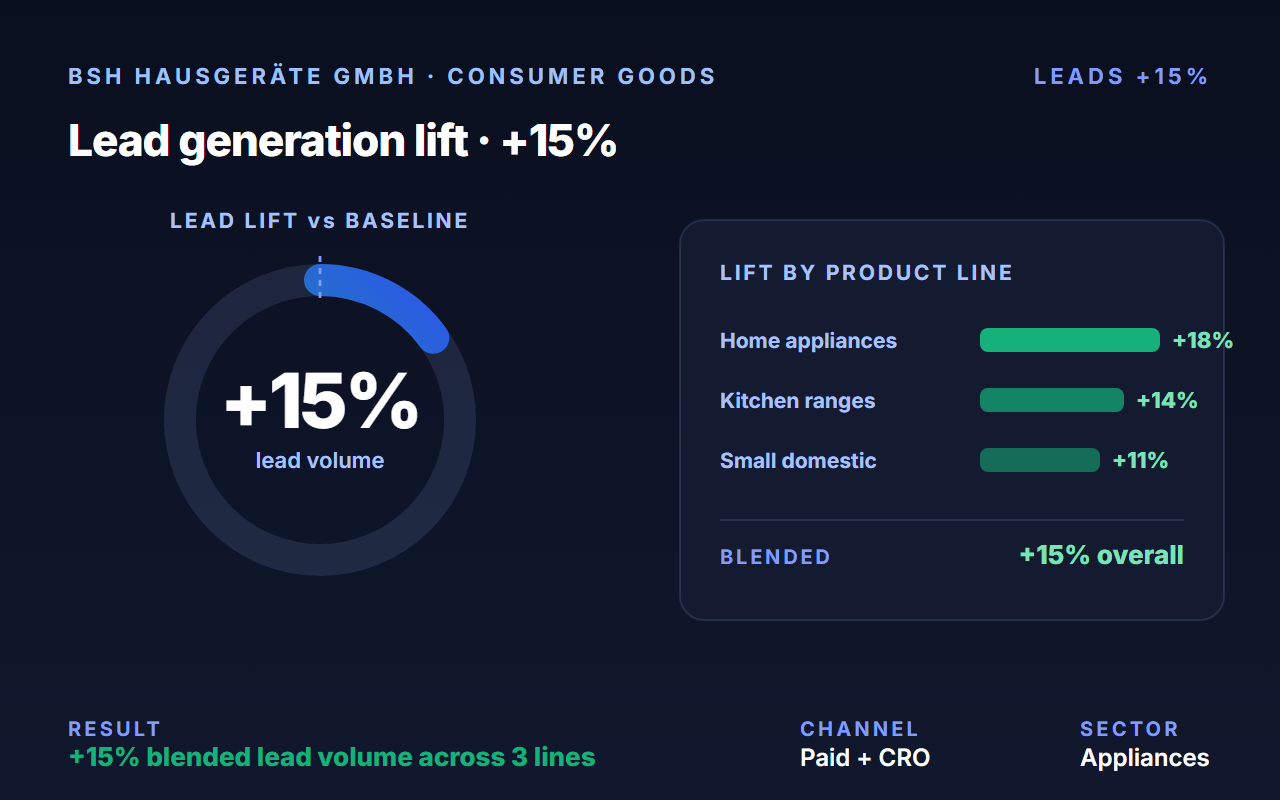 Consumer Goods · Home Appliances · Europe
Europe's largest home appliance maker (Bosch, Siemens, Gaggenau, Neff) optimized BSH Turkey's site for engagement — 15% lead growth, 3% organic lift, 45s longer…
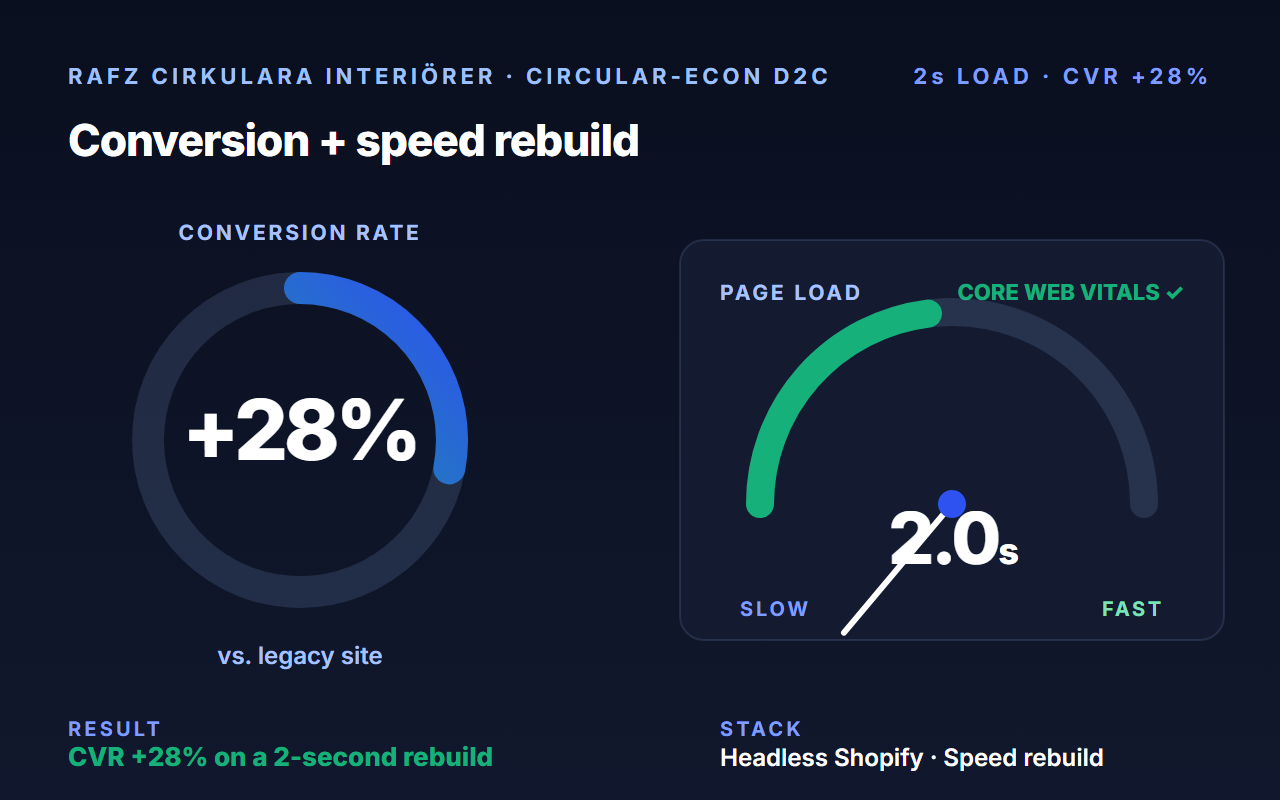 Ecommerce · Sustainable Furniture · Sweden
A Swedish sustainable furniture brand replaced a plugin-bloated 15-second site with a custom lightweight rebuild — 28% conversion lift, 82% fewer server requests, place2place…
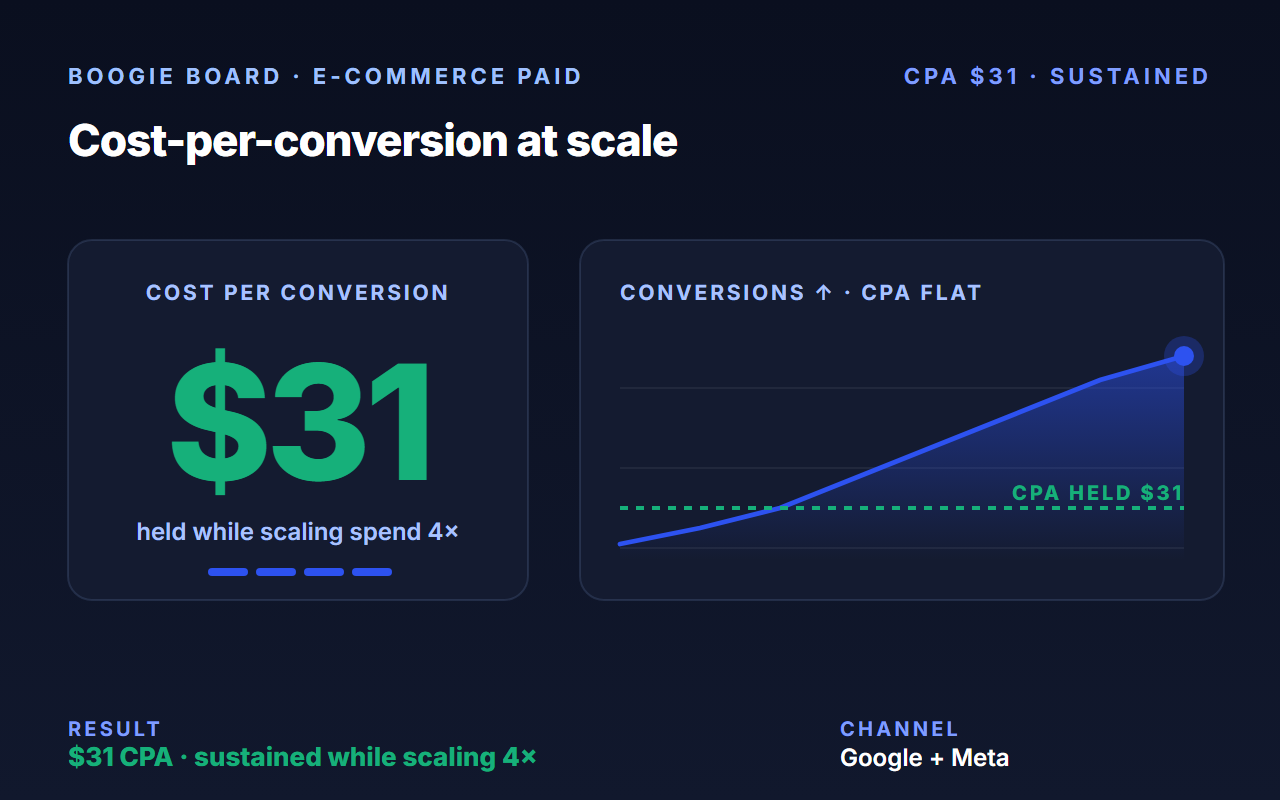 Ecommerce · Reusable Writing Tablets
A pioneering reusable-writing-tablet brand cut acquisition costs to $31 per conversion + boosted conversions 11% — managing $650K in ads with sustainable ROI.
If your question is not here, book the 30-minute strategy call. A CPG growth strategist answers on the call, not a sales rep.
Most CPG brands doing $80K to $400K/mo revenue split roughly 55/45 DTC to wholesale on the retainer's attention, not spend. The $999/mo Growth tier of the food and beverage marketing retainer keeps DTC ads and Shopify running while carving out real hours for retail-support work: Whole Foods buyer decks, Sprouts and Kroger sell-through tracking, and UNFI or KeHE distributor communication.
What decides the split. If the brand is already on Whole Foods shelves in one region and trying to expand, wholesale support gets 60% of the strategist's time. If the brand is DTC-only trying to prove velocity before pitching KeHE, wholesale planning is 20% and DTC ROAS drives the calendar. If the brand is at $2M+/yr with retail placement across 3 chains, the Scale tier ($1,499/mo) or Enterprise makes more sense than trying to split $999 in half.
The one thing this retainer will not do. Pretend DTC and wholesale run on the same numbers. DTC bills orders shipped and CAC. Wholesale bills sell-through velocity and door count. Reporting keeps them separate.
Yes, on Scale ($1,499/mo) and Enterprise tiers. Amazon Sponsored Products, Sponsored Brands, and Amazon DSP for retargeting are covered up to $4K in monthly ad spend on Scale, with no cap on Enterprise. Subscribe & Save enrollment strategy sits inside Scale as well because it is where most beverage brands (coffee, functional drinks, hydration, snacks with a repeat rhythm) see the fastest margin gain.
Real Subscribe & Save math for a $28 4-pack of RTD coffee. First-order CAC on Amazon Sponsored Products runs $9 to $14 with a 3.2 ACoS target. Subscribe & Save at 5-10% off + one-cent coupon program locks 42% of first orders into recurring. Retention across 6 refills averages 68%. The Amazon LTV curve alone justifies the Scale tier's fee for most beverage brands doing $50K+/mo on the channel.
Amazon Fresh is a separate program with its own listing standards and its own vendor negotiation. If you are pursuing Amazon Fresh placement, Enterprise tier is the honest recommendation. It is buyer management, not marketing.
Landing the buyer meeting stays on the brand's founder or broker. Making the brand pitch-ready is inside the CPG marketing retainer. Whole Foods regional buyers weigh three things heavily in category reviews: DTC velocity as proof of demand, TikTok and Instagram community signal, and a clean UNFI or KeHE distribution setup that will not blow up their reorder rhythm.
What we do on Growth and Scale tiers. Build category-page SEO ranking your brand for the queries retail buyers Google before category reviews ("best organic coconut water," "clean label protein bar," etc.). Push social proof by shipping structured UGC prompts on every DTC order. Run geotargeted Meta campaigns around specific store doors once you are on shelf so pull-through velocity looks strong on the 6-week check-in.
Sprouts and Kroger both work off similar mechanics. Kroger has its own KrogerNet ad platform on the Enterprise tier for brands that need Kroger-specific media buying alongside the physical shelf placement. This is where a food and beverage marketing retainer earns its keep versus a generic DTC agency.
Slotting fees are paid directly by the brand to the distributor. They are not inside the food and beverage marketing retainer fee. What the retainer covers is the marketing work that justifies paying slotting fees in the first place: proving your brand pulls product through the shelf fast enough to keep UNFI or KeHE re-ordering.
Slotting fee ranges we see quoted in 2026. UNFI regional slotting: $500 to $3,000 per SKU per region. KeHE natural channel: $200 to $1,500 per SKU per warehouse. Whole Foods regional slotting on top of UNFI: often waived for local vendors, $1,500 to $5,000 per SKU per region for national. New Item Free Fills usually run 1 to 2 cases per store on top.
What we do on Scale tier. Track weekly velocity per SKU per region so the strategist can flag slow-movers before your distributor does. Coordinate demo scheduling with brand ambassador teams. Push Meta and TikTok geo-campaigns around the doors where velocity is soft. The CPG marketing retainer wraps around the wholesale machine, not through it.
Cold-chain shipping operations belong to the brand's 3PL, not the marketing retainer. What the food and beverage marketing retainer does cover is the marketing-side edges: shipping-cost messaging on PDPs, Klaviyo transactional email templates that set proper cold-chain arrival expectations, ship-day cutoff logic on the Shopify checkout, and Meta ad claim compliance around "arrives cold" promises.
Real perishable ship-cost math to be honest with. A frozen meal brand shipping 8 lbs of dry ice from California to New York on 2-day UPS runs $32 to $48 in shipping cost per box. Passing 100% of that to the customer kills conversion. Absorbing 100% kills margin. Most perishable CPG brands land on $9.95 flat-rate shipping under $60 AOV and free above, absorbing the rest into unit economics. The retainer builds the Shopify cart threshold math and the "free shipping over $60" Klaviyo nudge sequence around that reality.
Cold-chain logistics providers we integrate reporting with. ShipBob Freezer, Nice Packs and DryIceUSA for packaging feeds, Shopify Cart Attributes for zone-aware freight rules. Deep 3PL rebuild is out of scope. Marketing wrap around the 3PL is in scope.
Ad copy and PDPs get run through claim compliance before publish on every tier of the food and beverage monthly plans. Meta, Google, and TikTok all reject food and beverage ads with unproven health claims and can suspend the ad account. FDA and USDA rules are stricter than most founders realize.
Common food and bev claim traps we screen out. "Boosts immunity" (FDA structure/function claim, requires substantiation). "Detox" or "cleanse" (FDA drug claim without approval). "Zero sugar" if there are more than 0.5g/serving (mandatory disclosure). "Made with real fruit" if not the majority ingredient. "Organic" without USDA National Organic Program certification on file. "Non-GMO" without Non-GMO Project Verified or an audited supply chain letter.
What we swap in. Substantiated language mapped to the brand's actual COA (Certificate of Analysis) or third-party lab. Meta's Commerce Policy compliance layer. A 1-page claims sheet kept in shared docs so every agency member and every freelance UGC creator is briefed off the same rules. The beverage brand marketing retainer treats compliance as a marketing safety net, not a legal team's problem after the ad already ran.
DTC packaged food (snacks, meal kits, pantry) typically runs $28 to $58 blended CAC per first-purchase order. Non-alcoholic beverage (RTD coffee, functional drinks, sparkling water) runs $22 to $65, higher when trial packs are the first-purchase offer. Alcohol and premium beverage (craft spirits, low-abv, non-alc spirits) runs $45 to $110 because ad targeting is heavily restricted.
What actually moves CPG food and beverage CAC. AOV via multi-packs: a snack brand selling $12 singles has painful CAC math. Sell a 4-pack at $38 with free shipping over $35 and CAC to LTV starts working. Subscribe & save enrollment rate: brands that hit 25%+ subscription enrollment on first order see effective CAC drop 30 to 45% by month 4. Sample-pack economics: sample packs pull first orders cheaper but only pay back if the sample-to-full-size conversion rate hits 18%+, which is where we set the tracking benchmark.
The food and beverage marketing retainer reports blended CAC weekly, not just Meta-attributed CAC, and does the full first-order-vs-recurring split. That is the difference between a beverage brand marketing retainer that reads the numbers honestly and one that lets Meta take credit for orders your subscription program earned.
Yes, on Growth and Scale tiers. Sample packs and free-shipping offers are usually the highest-conversion first-purchase offer for CPG food and beverage, but they only work if the unit math is real. The retainer builds the offer, the fulfillment SKU on Shopify, and the Klaviyo sample-to-full-size conversion sequence.
Real sample program math for a $6 sample pack (4 SKUs, 1 serving each) with $3.99 free shipping absorbed by brand. Blended landed cost per sample pack: $4.20 (product COGS + pick/pack + shipping). Ad spend to acquire one sample buyer on Meta: $9 to $15 at $12 AOV. Sample-to-full-size 30-day conversion rate needs to hit 22% at $34 full-size AOV to net positive. If the conversion rate lands below 15%, the offer bleeds and we kill it before it eats the ad budget.
The sample offer gets its own funnel in reporting: sample orders shipped, sample-to-full conversion rate at 14/30/60 days, and net contribution margin per sample buyer. The CPG marketing retainer treats sample programs as a math problem, not a growth-hack.
Every food and beverage marketing retainer builds seasonality into the annual plan from month 1. Q4 alone drives 30 to 45% of annual DTC revenue for most snack and gift-oriented food brands. Q1 is where hydration, wellness, and low-cal beverage brands take off. Q2 to Q3 owns grilling, outdoor, and functional-beverage brands.
What changes with seasonality on the retainer. Ad budget is front-loaded 60 to 90 days before peak (September for holiday, mid-December for New Year wellness push). Klaviyo flow content is planned in blocks: holiday gifting flow, back-to-school lunchbox flow, summer hydration flow. Content briefs shift to seasonally relevant queries 90 days ahead of intent. Retail-side, we push demo and endcap requests 6 to 8 months ahead of category reviews because slotting decisions get locked in earlier than founders expect.
Q4 gets its own written plan by August every year. If you sign the retainer in September for holiday, we still ship a truncated Q4 plan, but the honest answer is: Q4 needs a 90-day runway to fire on all channels. Signing in October means we save what we can and rebuild the following Q4 from month 1.
Paid channel revenue starts moving in 14 to 28 days once Meta CAPI, Google Enhanced Conversions, and Klaviyo flows are wired. First-order CAC stabilizes by day 45 to 60. SEO on ingredient, dietary, and category pages usually starts pulling ranked traffic by month 3 and steady DTC orders by month 4 to 6.
Retail-side wins take longer and honestly should. UNFI velocity trends need 6 to 10 weeks of clean POS data before a distributor rep will act on it. Whole Foods regional buyer meetings sit on a 90-day cycle. Amazon Subscribe & Save retention data is only reliable after 90 days of new-subscriber cohorts have cycled through their first refill.
The 30-60-90 day plan written in week 1 spells out what pays back fast and what compounds. If a food or beverage brand is looking for a 3-month agency test with a "prove ROAS or fire us" mandate, the honest recommendation is not this retainer. This is a 6-month contract because CPG revenue works on a 6-month time horizon.
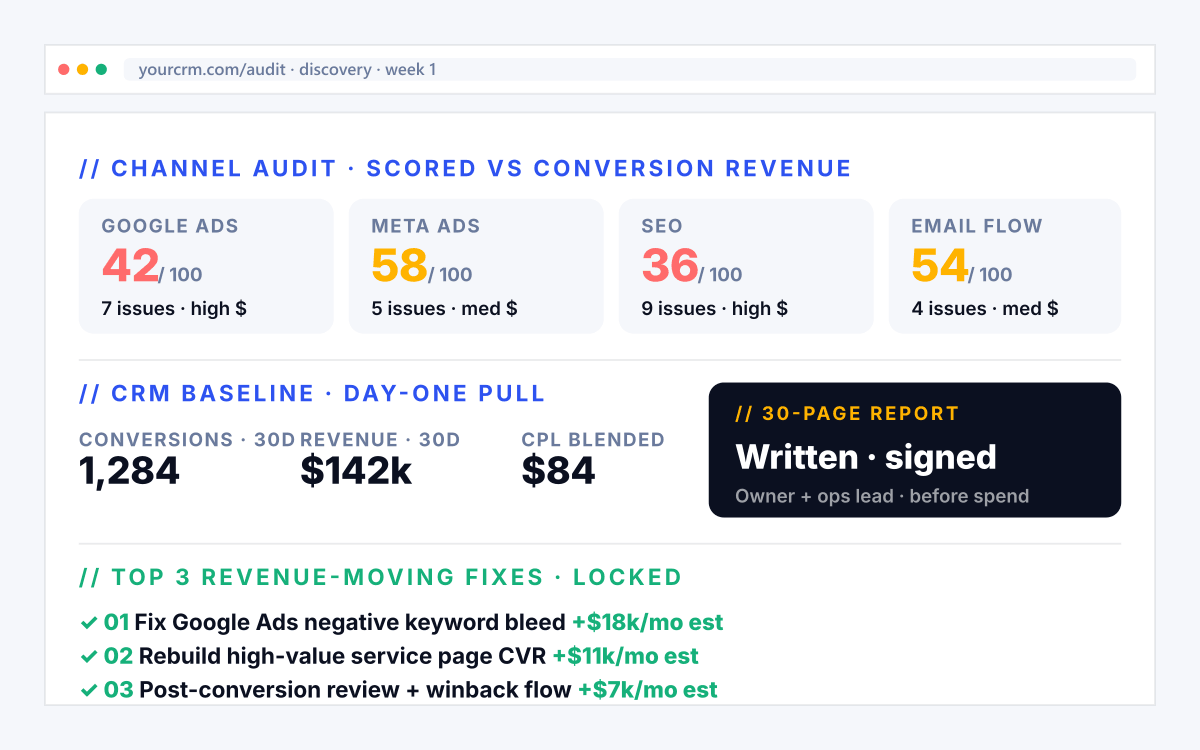
Week 1. Kickoff call with a CPG growth strategist, account handover (Shopify, Klaviyo, Meta Ads, Google Ads, TikTok Ads, Amazon Seller Central, Instacart Ads if applicable), and a full audit of your Shopify checkout, Klaviyo flows, current ad tracking, and PDP claim compliance. Written 30-60-90 plan delivered by end of week 1.
Weeks 2-3. Klaviyo core flow rebuild if needed (welcome, abandoned cart, browse abandon, post-purchase, subscription winback). Meta CAPI and Google Enhanced Conversions validation. Amazon listing audit if Amazon is in scope. First round of ad creative into rotation with claim-compliant copy. Cold-chain shipping messaging on PDP fixed if you sell perishable.
Week 4. First monthly report. What moved, what did not, and what ships in month 2. Content briefs approved for month 2. If retail wholesale support is in scope, the first UNFI or KeHE velocity report goes out.
By day 30 you have moving numbers, honest reporting, and a written plan that spells out where the CPG marketing retainer takes you by day 90.
Honestly, no. Pre-launch CPG brands should hold off on a food and beverage marketing retainer until three things are true. Inventory that ships on time from a real 3PL. A Shopify store with functional checkout and a proper product page for each hero SKU. At least $1,500/mo in ad budget available. Below any of those, agency work is premature.
What we recommend pre-launch. Get 50 friends-and-family orders out through paid ads or Instagram organic to test the checkout, the packaging, the shipping experience, and the post-purchase Klaviyo email. Nail down cost of goods, gross margin per SKU, and blended landed cost including shipping. If revenue is under $10K/mo you likely need a fractional CMO on Upwork for $100/hr, not an agency retainer.
Once you are at $15K to $40K/mo with product-market fit signals (repeat purchase rate above 15%, organic reviews rolling in without paid prompts), the $599/mo Foundation tier makes sense. The beverage brand marketing retainer works when there is something to market, not before.
CPG growth strategist on the call. Three specific growth fixes you can apply, with or without us. Written summary in your inbox the next business day.
Drop your email. A CPG growth strategist reviews your brand and books the 30-minute audit within one business day.