
Healthcare Website SEO That Fixes the Website-Level Problems
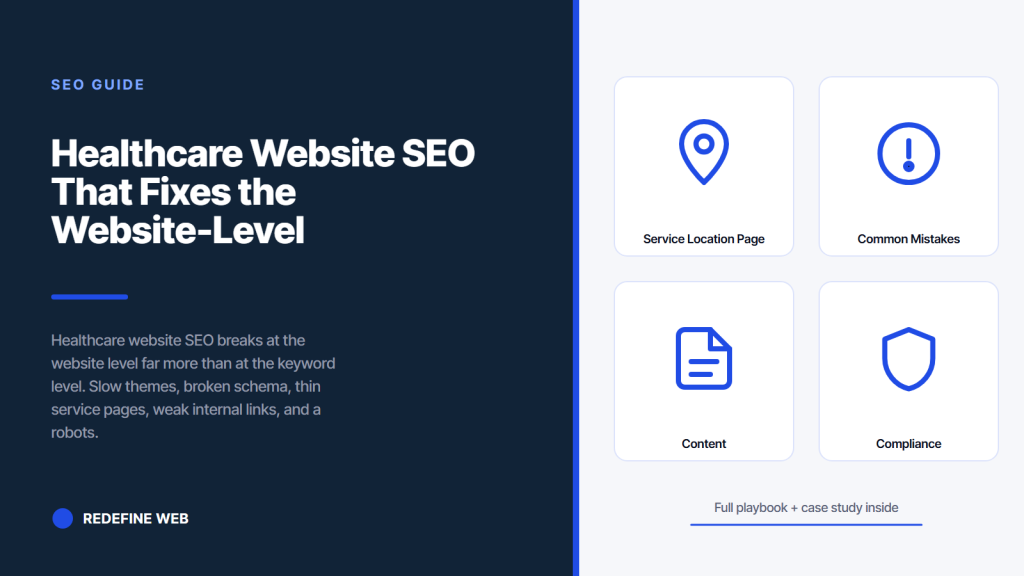
- Fix the site-level foundation before writing more content.
- Mobile Core Web Vitals matter more than desktop PageSpeed.
- Schema for Physician and MedicalCondition opens knowledge panels.
- Orphaned service pages waste crawl budget and content investment.
- Location pages need 20 to 40 percent unique neighborhood copy.
- Internal Linking and Topic Clusters for Healthcare Website Optimization
- Service and Location Page Depth in Healthcare Website SEO
- Local SEO Fixes Inside Healthcare Website SEO
- Real Numbers From a Healthcare Website SEO Rebuild
- Where Healthcare Website SEO Fits in a Retainer
- Common Mistakes in the Importance of SEO for Healthcare Websites
Healthcare website SEO fails at the website level more often than at the keyword level. You brief a writer, publish 12 posts, and rankings barely move. The problem sits underneath the content. A slow theme, broken schema, thin service pages, an internal link graph that goes nowhere, a robots.txt file nobody has opened in three years. This post is the audit list we run on healthcare sites before touching a single editorial brief.
You’ll get the fixes in the order we run them on real retainer sites. Speed and Core Web Vitals first, because the mobile LCP score sets the ceiling on every other ranking gain. Indexation and crawl budget second, because Google can’t rank pages it can’t find. Schema and E-E-A-T signals third, because YMYL scoring on healthcare content magnifies the effect of missing markup. Then the internal link graph, service page depth, and the local SEO stack. Fix these in order and the content you already have starts pulling weight it never did before.
Internal Linking and Topic Clusters for Healthcare Website Optimization
Internal linking is where healthcare sites most consistently underperform. The homepage links to five service pages. The service pages link back to the homepage. Blog posts orphan themselves under a Recent Posts widget. Nothing connects. Google can’t figure out which page you want ranking for what topic. That confusion sits in the linking graph, not in the copy.
The hub-and-spoke pattern
Every service area should have a hub page (the main service page) plus 3 to 8 spoke pages (education content) all linking back to the hub with descriptive anchor text. The hub links out to the top 3 or 4 spokes. Every spoke links to at least 2 sibling spokes. That structure concentrates authority on the hub, which is the page you want ranking on the money keyword. Our Healthcare SEO Pillar covers the full cluster strategy end to end.
Descriptive anchor text over click here
Google reads anchor text as a hint about the destination page’s topic. “Click here to learn more” tells Google nothing. “Dental implants cost breakdown” tells Google the linked page is about implant costs. Every internal link should carry a descriptive anchor. Search-and-replace the “click here” and “read more” strings on the site and rewrite them into descriptive anchors. It’s a one-day project that produces measurable ranking movement inside 60 days.
Auditing orphan pages
Any page with fewer than 3 internal links pointing at it is functionally orphaned. Google spends less crawl budget on orphaned pages and ranks them lower. Screaming Frog produces an orphan report in one crawl. Every orphan needs either 3 to 5 new internal links or a canonical redirect to a similar page. Fix the orphans and the whole cluster rises together. See our Healthcare SEO Audit for the full audit flow.
Service and Location Page Depth in Healthcare Website SEO
Service pages and location pages are the conversion layer. They target the highest-intent searches. When they’re thin, everything upstream in the funnel wastes budget. A 300-word service page loses to a 1,500-word service page. A location page with no unique content loses to a location page with real neighborhood information.
The service page inventory audit
List every service page. For each, capture word count, current ranking, current traffic, and current conversion rate. Any page under 800 words gets flagged for expansion. Any page over 800 words with a conversion rate under 2 percent gets flagged for a rewrite. That inventory produces the priority list for the next quarter without having to guess where to start.
| Page type | Word count floor | Sections required | Refresh cadence |
|---|---|---|---|
| Service (procedure) | 1,500 | What, cost, candidacy, consult, proof, CTA, FAQ | 6 to 9 months |
| Service (condition) | 1,800 | Symptoms, causes, treatment options, when to see a provider, provider bios, FAQ | 9 to 12 months |
| Location | 900 | Address, hours, insurance list, provider list, driving directions, neighborhood context | 6 months |
| Provider bio | 500 | Credentials, focus areas, languages, patient philosophy, photo | 12 months |
Location page copy that avoids duplication
Multi-location practices ship location pages that duplicate 80 percent of the copy across offices, differing only in the address. Google flags that as duplicate content and picks one page to rank. The fix is 60 to 80 percent shared boilerplate plus 20 to 40 percent unique per-location copy. Neighborhood context, the specific insurance networks accepted at that location, driving directions from local landmarks, and provider photos from that specific office.
Provider bio pages as ranking assets
Provider bio pages rank for “[provider name] [specialty]” searches, which are high-intent branded searches from patients researching their doctor. Every bio needs credentials, board certifications, medical school, residency, focus areas, languages spoken, patient philosophy, and a proper photo. Skip the credential detail and Google can’t populate the knowledge panel that shows up when a patient searches the provider by name.
Local SEO Fixes Inside Healthcare Website SEO
Local SEO is a separate discipline from technical SEO, but the website changes it requires overlap with the audit. Every practice loses ranking to a NAP inconsistency, a missing embedded map, or a Google Business Profile that hasn’t been updated since 2023. The fixes take one afternoon each. Practices delay them for years because nobody owns them.
NAP consistency across the site
Name, address, phone number should match verbatim across the homepage, the contact page, every location page, the footer, and the Google Business Profile. One character off (a period after “St” on the footer, no period on the location page) is enough to weaken the local pack ranking signal. Search-and-replace the site to enforce one canonical NAP format. Then fix the citations that carry stale data.
Embedded maps and schema alignment
Every location page needs an embedded Google Map pointing to the exact Business Profile listing. Not a generic pin at the address. The embed connects the page to the Business Profile in Google’s local graph. Pair the embed with LocalBusiness or MedicalOrganization schema that references the same address, phone, and coordinates. Alignment across those three data sources reinforces the local ranking signal.
Reviews on the site and in schema
Pull the top 10 to 20 Google reviews onto the site and mark them up with Review schema. Google no longer displays star ratings in SERPs based on self-emitted Review markup for most business types, but the schema still contributes to E-E-A-T signals. Fresh reviews on the site also carry ranking weight and CRO weight. See our Local SEO for Healthcare post for the full local stack.
40 posts on a broken theme rank nothing. Run PageSpeed on your top service page today. If mobile LCP is over 2.5s, that's your first fix, not more content.
Real Numbers From a Healthcare Website SEO Rebuild
Pelvic Rehabilitation Medicine, a specialized pelvic-pain medical group across 14 locations, ran a website-level SEO rebuild focused on the audit categories in this post. The rebuild covered performance, schema, internal linking, service page expansion, and a new patient-community platform. The numbers below are the 12-month result.
Keyword and traffic growth
Organic keyword rankings expanded 174 percent year-over-year. Organic traffic grew 166 percent alongside the ranking gains. Both came from the same set of fixes: a lighter theme, cleaner schema, a rebuilt internal link graph, and the addition of a patient-community platform that attracted top-of-funnel search traffic on pelvic-pain and endometriosis queries.
What the audit surfaced first
The first audit surfaced three site-level problems. A theme adding 900 milliseconds of unnecessary render time on mobile. A schema layer with no Physician or MedicalCondition markup on 14 provider bios and 22 condition pages. An internal link graph where every service page linked only to the homepage. Fixing those three drove most of the ranking gain inside the first six months.
Operational takeaway
The content team didn’t triple. The writers didn’t get better overnight. The site started emitting the signals Google needed to rank the content the team was already producing. That’s the pattern. Site-level fixes redeem the content investment you’ve already made. Our Technical SEO post covers the deep-dive engineering side of the same audit.
Where Healthcare Website SEO Fits in a Retainer
Website-level SEO fixes split into two workloads. A one-time engineering project to fix the biggest structural problems (theme, schema layer, robots.txt, sitemap, internal linking). Then an ongoing maintenance cadence to keep the site clean as content grows and providers change.
The one-time engineering project
Budget 30 to 80 hours of specialist work for the initial rebuild. Theme evaluation and possible replacement. Schema layer redesign across every template. Internal link graph audit and rebuild. Robots and sitemap cleanup. Service and location page expansion for the top 10 pages by revenue impact. That project runs over 6 to 12 weeks depending on complexity.
The ongoing retainer scope
Monthly retainer at $599 for a single-location practice covers Core Web Vitals monitoring, quarterly Search Console coverage review, schema validation on new templates, internal link updates as new content publishes, and service page refresh work on a rolling six-month cadence. Multi-location groups scale from there. When you’re ready to run the audit end-to-end, our Healthcare SEO Services covers the full retainer scope.
How the workload shifts over time
In year one, the retainer skews toward fixing new problems as they surface. In year two, the balance shifts to monitoring and small refinements. By year three, the site is usually clean enough that the retainer is 60 percent content and 40 percent technical maintenance. Practices that skip year-one technical work find themselves rebuilding in year two anyway, at a higher cost. Fix the foundation first, then compound the content investment on top.
Common Mistakes in the Importance of SEO for Healthcare Websites
The mistakes we see most often. Publishing content on a broken site. Ignoring Core Web Vitals because the desktop score looks fine. Assuming a plugin handles schema when it handles only Article and FAQ. Skipping location page copy because “they’re all the same anyway.” Each of these caps ranking on pages the practice is already paying to produce.
Publishing content on a broken site
The most common mistake. You spend $3,000 a month producing content that gets published to a site with a 3.5-second LCP and orphaned internal links. The content ranks, but 6 positions lower than it should. Multiply that gap across 40 posts and you’re leaving a lot of unclosed traffic on the board. Fix the foundation first, then the content investment pays properly.
Trusting the desktop PageSpeed score
Desktop PageSpeed scores are meaningless for healthcare SEO. Almost 70 percent of healthcare search happens on mobile. Google indexes mobile-first. The desktop score can be 95 while the mobile score is 42 and you’re losing ranking on the mobile score. Always test mobile. Always use real-device profiles rather than the emulator alone. The gap between emulator and real-device performance is usually 15 to 25 percent.
Assuming the plugin handles schema
Rank Math and Yoast handle a small slice of schema well. They do not handle Physician, MedicalCondition, MedicalProcedure, or fully qualified MedicalOrganization schema without configuration or code. Most healthcare sites we audit emit the wrong schema type on provider bio pages. The fix is a one-hour configuration change plus custom code for the specialized types. Skip it and you never get the Physician knowledge panel treatment.
Skipping location page copy
Multi-location practices routinely duplicate 80 to 95 percent of location page copy across offices. Google picks one page to rank, orphans the rest, and the practice loses ranking in half its markets. Invest 4 to 8 hours per location page in unique neighborhood copy, provider photos, and per-office proof. That work pays for itself inside a quarter through recovered local pack ranking.
Healthcare website SEO gets easier once the site-level foundation is right. The content you’re producing starts ranking. The service pages start converting. The location pack starts pulling. And the retainer budget stops going to plug the same three holes every quarter. Fix the foundation, then invest in content on top. That order is the whole game.
Frequently asked questions
What is healthcare website SEO and why does it break at the site level?
Healthcare website SEO is the practice of optimizing a healthcare site's technical foundation, structure, and page-level depth so Google can properly crawl, index, and rank the pages. It breaks at the site level when performance is slow, schema is missing, indexation is confused, internal linking is weak, or service pages are thin. Those five categories account for most of the ranking gaps we see when auditing healthcare sites. Fixing the site-level foundation typically opens 30 to 60 percent more ranking capacity from the content the practice is already producing. Content problems get most of the attention, but site-level problems produce most of the ranking cap in practice.
How do I improve Core Web Vitals on a healthcare WordPress site?
Start by testing the top five pages by revenue impact on mobile through PageSpeed Insights and the Search Console Core Web Vitals report. Fix the LCP first by compressing hero images, deferring non-critical JavaScript, and switching to a lightweight theme if the current one carries 400 kilobytes or more of unused CSS and JavaScript. Fix INP by removing chat widgets and slow analytics scripts that block the main thread. Fix CLS by setting explicit width and height attributes on every image and reserving space for embedded elements before they load. Most healthcare sites clear the thresholds within 4 to 8 weeks of focused work when the fixes are prioritized in that order.
What schema types matter most for healthcare website SEO?
The five schema types that matter most are MedicalOrganization or LocalBusiness for the practice itself, Physician for each provider bio, MedicalCondition and MedicalProcedure for condition-explainer and procedure content, FAQPage for question-and-answer sections, and Review with AggregateRating for testimonial content. Rank Math and Yoast handle Article and FAQPage well but do not handle Physician, MedicalCondition, or MedicalProcedure without custom code. That means most healthcare sites emit generic Article schema for provider bios when they could emit rich Physician schema with credentials, board certifications, and languages spoken. Custom schema on provider pages opens knowledge panels for individual providers, which is worth the 4-hour engineering investment.
How many internal links should a healthcare service page have?
Every service page needs at least 3 to 5 inbound internal links from related content and 3 to 5 outbound internal links to related education content or sibling service pages. Service pages with fewer than 3 inbound links are functionally orphaned and rank lower than they should. Every internal link should carry descriptive anchor text that names the destination page topic. Generic "click here" and "read more" anchors waste the ranking signal. A one-day project to rewrite generic anchors as descriptive anchors typically produces measurable ranking movement inside 60 days. Screaming Frog produces an orphan report in one crawl so you know exactly which pages need internal linking work.
How do multi-location healthcare practices avoid duplicate content on location pages?
Multi-location practices should build location pages with 60 to 80 percent shared boilerplate content plus 20 to 40 percent unique per-location copy. The unique portion should include neighborhood context, specific insurance networks accepted at that office, driving directions from local landmarks, provider photos from that specific location, and per-office reviews or testimonials. Google flags 95 percent duplicate location pages as duplicate content and picks one to rank, orphaning the rest. Investing 4 to 8 hours per location page in unique copy pays for itself inside a quarter through recovered local pack ranking. The alternative is losing ranking in half the practice's markets while paying for the pages anyway.
How often should healthcare service pages be refreshed?
Service pages should be refreshed on a 6 to 9 month cadence for procedure pages and 9 to 12 month cadence for condition pages. Location pages need a 6-month refresh cadence because insurance networks, hours, and provider rosters change more often than the underlying procedure content. Provider bios can go 12 months between refreshes unless credentials or focus areas change. A substantial refresh (new H2 sections, updated statistics, rewritten intro, refreshed internal links) usually moves the page 3 to 8 positions inside a month. Cosmetic changes without substantive updates do not produce the same ranking impact and can waste the refresh window.
How much does a healthcare website SEO retainer cost?
Retainer starts at $599 a month for a single-location practice with a clean site. Multi-location groups scale from there based on location count and content volume. The retainer covers Core Web Vitals monitoring, quarterly Search Console coverage review, schema validation on new templates, internal link updates as new content publishes, and service page refresh work on a rolling six-month cadence. Practices with major site-level problems need a separate one-time engineering budget of 30 to 80 hours to rebuild the foundation before the retainer starts producing full ranking impact. Fix the foundation first, then the ongoing retainer compounds properly on top of a clean site.
Book your free 30-minute strategy call.
No spam, no sales rep. We use your email to schedule your call with a senior strategist. That is it.
More from the blog
View all articles → SEO
SEO Organic Search Engine Optimization Services That Grow Real Traffic
Read article SEO
SEO SEO for Pet Groomers That Fills the Appointment Book Weekly
Read article SEO
SEO