
Dental DSO Marketing That Grows Every Office in the Group
- Dental dso marketing drives EBITDA growth in the sponsor hold.
- Central attribution across offices is the growth foundation.
- Per-office paid media beats consolidated campaign structure.
- Local brand protection preserves earned patient trust.
- Monthly reporting keeps paid media accounts optimized.
- Local brand protection in dental dso marketing
- The dental dso marketing growth comparison table
- Monthly reporting cadence in dental dso marketing
- Case study on dental dso marketing growth
- Payer mix work inside dental dso marketing growth
- Common dental dso marketing growth mistakes
- Preparing your practice for dental dso marketing conversation
- Final read on dental dso marketing growth
Dental dso marketing drives EBITDA growth during the sponsor hold. Central attribution captures the data. Per-office paid media delivers the patient volume. Local brand protection preserves the earned trust. Monthly reporting keeps the paid accounts optimized against changing performance. Well-run platforms compound these four elements over 24 months into 15 to 25 percent EBITDA growth that flows straight into the sponsor exit story and the second-bite math for rolled sellers. Underperforming platforms miss the compounding effect and deliver 5 to 10 percent EBITDA growth or less across the same window.
This guide walks the dental dso marketing playbook that produces real growth. Central attribution infrastructure across every office. Per-office PPC account structure that beats consolidated approaches. Central SEO strategy plus per-office local SEO. Local brand protection through the integration window. Monthly reporting cadence to office leadership. Case value optimization through payer mix work. And how sellers should evaluate a platform’s dental dso marketing capability during LOI diligence before signing definitive documents. Every pattern here traces to platforms our team either watched close or executed directly across 2024 to mid-2026.
Local brand protection in dental dso marketing
Local brand protection through the integration window preserves the earned patient trust the platform paid for at close. Central rebranding within 60 days of affiliation typically damages the local reputation the acquisition was supposed to preserve. Well-run platforms protect the local brand in writing at LOI with specific commitments around local practice name, local Google Business Profile ownership, and local domain preservation across the seller employment term at minimum.
Practice name on signage and website
Practice name on signage and website preservation means the local practice name stays in primary position with the DSO parent name in secondary position. Signage changes should preserve the local practice name recognition patients already associate with the office. Website URL should stay live at the existing domain rather than redirecting to a central platform domain. Well-run platforms brand offices with local practice names in primary position. Poorly-run platforms rebrand offices with generic DSO names within 60 days of close, which typically causes patient confusion and short-term new patient volume drops that hurt EBITDA growth during the sponsor hold.
Google Business Profile continuity
Google Business Profile continuity means office-level ownership rather than central migration. Central migration typically loses reviews and wipes local history that drives local search rankings. This damage compounds because reviews and profile history drive local search rankings, which drive new patient acquisition. Well-run platforms preserve office-level GBP ownership with central team support. Poorly-run platforms migrate GBP centrally within 90 days of close, which typically loses 20 to 40 percent of review history along with the local search authority tied to profile continuity. Sellers should negotiate written protection at LOI against central GBP migration for at least the length of the seller employment term.
Local domain preservation
Local domain preservation means the practice’s existing domain stays live with the local content preserved rather than redirecting to a central platform domain. Central redirect typically damages the practice’s earned SEO authority because links to the old domain lose pass-through value if the redirect handling is sloppy. Well-run platforms maintain the local domain with the local branding while adding central platform integration on the back end. Sellers should verify the platform’s plan for the practice domain during LOI diligence and require written commitment to preserve the domain and content through the seller employment term at minimum with specific language covering redirect handling standards.
The dental dso marketing growth comparison table
The table below compares dental dso marketing growth outcomes at well-run platforms versus underperforming platforms across the key mechanisms that drive EBITDA growth during the sponsor hold. Sellers should use these benchmarks during LOI diligence to filter target platforms into the well-run bucket based on concrete operational data rather than platform pitch decks that emphasize aspirational metrics without practice-level detail.
| Mechanism | Well-run platform | Underperforming platform |
|---|---|---|
| New patient volume growth | 15-25% in 12 months | 5-10% or flat |
| Cost per new patient | 150-220 dollars | 280-400 dollars |
| Cost tightening | 20-30% over 12 months | Flat or worsening |
| Case value optimization | 5-10% higher | Flat |
| EBITDA growth | 15-25% in 24 months | 5-10% or less |
| Central attribution | Full stack deployed | Partial or missing |
Read the EBITDA growth row with sponsor exit math in mind. A platform that grows EBITDA 15 to 25 percent over the sponsor hold typically earns 1.5 to 2 turns of multiple expansion at exit through the combined growth story plus scale story. A platform with flat or 5 percent EBITDA growth typically earns no multiple expansion at exit and often accepts multiple compression during less favorable market windows. The difference between the two outcomes materially affects rolled seller second-bite return. Our DSO Dental Marketing for Multi-Location Groups program supports platforms moving into the well-run column through central marketing infrastructure work across their office network.
Read the cost per new patient row with practice-level P&L context in mind. A well-run platform running at 150 to 220 dollars per new patient generates roughly double the new patient volume of an underperforming platform at 280 to 400 dollars per new patient on the same marketing budget. That volume difference compounds across office visits, referred family members, and repeat visits over the patient tenure. The compounding effect on practice-level revenue over 24 months is meaningful and drives the EBITDA growth differential between well-run and underperforming platforms across the sponsor hold cycle inside the DSO transaction structure.
Read the central attribution row as the foundation for everything else. Without central attribution the marketing team cannot optimize spend across offices, cannot identify weak funnel stages by geography, and cannot demonstrate marketing execution against practice-level results. Attribution is the operational infrastructure that makes every other marketing service actually work. Sellers should verify attribution stack maturity during LOI diligence before signing definitive documents because attribution investment gaps typically translate directly into weaker EBITDA growth over the sponsor hold cycle across every office in the network operationally.
Monthly reporting cadence in dental dso marketing
Monthly reporting cadence in dental dso marketing keeps the paid media accounts optimized against changing performance patterns. Weekly reporting overburdens the office. Quarterly-only reporting misses short-term shifts. Monthly is the right rhythm for actionable practice-level reporting that supports office managers in optimizing team behavior around new patient volume, review capture, and reactivation activity across the calendar. Well-run platforms build monthly reporting as a written service standard from day one of affiliation close.
What monthly reports should contain
Monthly reports should contain new patient volume by channel, cost per new patient by office, conversion rate at each funnel stage, review count and rating trends over the month, and marketing spend against budget with variance analysis. Office leadership uses this data to identify weak funnel stages, adjust team behavior on review capture and reactivation, and confirm the marketing team delivers against expected practice-level volume. Well-run platforms deliver this data in a standardized dashboard format that office managers can read in 15 minutes rather than a 40-page slide deck that nobody reads inside the office manager workflow.
How offices should use monthly reports
Offices should use monthly reports to identify one or two focus areas per month rather than trying to optimize every metric simultaneously. Weak call conversion in a specific month typically calls for front desk training. Weak reactivation rate typically calls for hygiene team focus. Weak review capture typically calls for treatment coordinator focus on the post-appointment review request workflow. Well-run platforms provide coaching support alongside the monthly reports so office managers know how to act on the data. Poorly-run platforms deliver the reports without coaching, which typically produces awareness without action across the network operationally over sustained hold cycles.
Quarterly board reporting rollups
Quarterly board reporting rolls up the monthly practice-level data into platform-level trends over the trailing three months, cohort retention data on new patient lifetime value, cross-office benchmarking against network averages, and capital allocation recommendations for the next quarter. Sponsor board uses this data to confirm platform-level marketing operations are delivering against management fee. Sellers rolling equity should ask to see the quarterly board report format during LOI diligence to preview the reporting quality they can expect during the hold period across the seller employment term at each target platform under consideration.
Consolidated PPC saves invoice pain and kills performance. Pull cost per new patient by office. Variance above 40% means split accounts before the next pass.
Case study on dental dso marketing growth
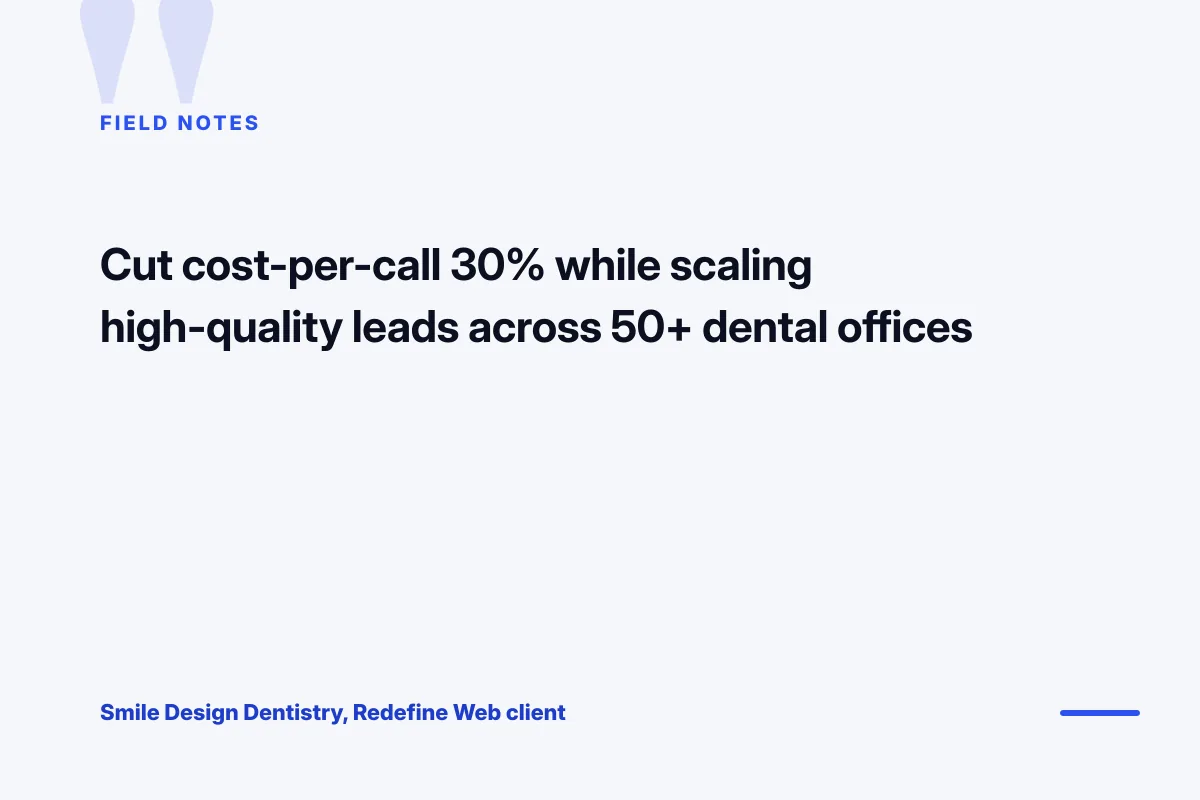
Smile Design Dentistry runs 50-plus locations across Central Florida and Tampa Bay under a mature dental dso structure with a well-run central marketing operation. When our team engaged with the group, the digital marketing operation was fragmented across every office. Each location ran its own PPC accounts and landing pages without central coordination on messaging, budget allocation, or attribution. That fragmentation left roughly 30 percent of the marketing budget captured by duplicate audience targeting and unoptimized landing page flows across the network. This kind of fragmentation is exactly what dental dso marketing at platform scale is supposed to fix within 12 months of proper central deployment.
Our team restructured the PPC accounts by funnel stage and geography inside a central MSO marketing infrastructure. Tailored landing pages went live for each core service line. Full-funnel paid social layered on top of the search program with audience data flowing from a unified attribution stack. Cost per call fell 30 percent across the network within 12 months. PPC conversion rate rose 20 percent year over year. New patient volume grew across every office. Fifty-plus offices reported on one unified dashboard for the first time with practice-level drill-downs available on demand to office managers across the network.
What this shows about dental dso marketing growth
The results at Smile Design show what dental dso marketing at platform scale should produce over 12 months. Cost per call drop of 30 percent. Conversion rate gain of 20 percent. New patient volume growth. Unified reporting across 50 offices. This is exactly the operational efficiency well-run platforms deliver against solo practice benchmarks. Sellers should ask target platforms for comparable practice-level results during LOI diligence. Platforms that share the results willingly typically deliver real execution. Our Dental SEO Services team runs comparable central-domain plus per-office SEO work at platform scale for growing groups.
Payer mix work inside dental dso marketing growth
Payer mix work inside dental dso marketing growth optimizes case values through better commercial payer share, group PPO contract negotiation on stronger scale than solo practice, and targeted marketing that attracts higher-value payer mix patients. This work compounds with the marketing volume growth to drive EBITDA higher than volume growth alone would deliver. Well-run platforms treat payer mix work as a first-class operational priority alongside marketing volume growth.
Commercial payer targeting
Commercial payer targeting through paid media focuses ad spend on the geographic areas and audience segments most likely to hold commercial insurance rather than Medicaid or self-pay coverage. This targeting delivers higher case value new patients from the same marketing spend. Solo practices typically cannot afford the audience segmentation infrastructure needed to run this targeting at scale. Platform-scale marketing operations deploy the segmentation across offices with central creative and targeting infrastructure that produces measurable payer mix shifts within 12 to 18 months across office networks in specific metros with mixed payer environments. Industry data at groupdentistrynow.com tracks payer mix trends across active DSO platforms quarterly.
Group PPO contract negotiation
Group PPO contract negotiation at platform scale produces better rates than solo practices can negotiate individually. Platforms with 50-plus offices in a metro negotiate PPO contracts from stronger footing than solo practices. These rate improvements compound with marketing volume growth to drive case value gains across every office in the network. Sellers should ask target platforms about recent PPO contract negotiation results during LOI diligence. Well-run platforms track rate improvements as a quarterly operational metric. Poorly-run platforms often skip formal PPO negotiation and simply accept default network rates that leave meaningful case value on the table across the sponsor hold period.
Treatment plan optimization
Treatment plan optimization through central protocols raises the treatment plan quality across every office in the network. Central clinical education, standardized case presentation protocols, and treatment coordinator training combine to raise case acceptance rates and average case values simultaneously. Solo practices without central protocol infrastructure typically accept treatment plan variance across doctors that leaves case value on the table. Well-run DSO operations deploy central protocols within 6 to 12 months of affiliation close with measurable case value improvements typically visible within the same window across offices participating in the protocol rollout process.
Common dental dso marketing growth mistakes
Common dental dso marketing growth mistakes concentrate in a handful of predictable areas that separate well-run platforms from underperforming platforms. Sellers who ask about these areas during LOI diligence surface operational quality faster than sellers who accept general capability claims. Reading the mistakes carefully before LOI signing helps sellers filter platforms into the well-run bucket versus the underperformer bucket based on real diligence data rather than pitch decks.
Consolidated single-account paid media structure
Consolidated single-account paid media structure dilutes local relevance across offices and typically produces weaker cost per new patient across the network by 25 to 40 percent versus per-office structures. Sellers should ask target platforms specifically about paid media account structure during LOI diligence. Platforms that show consolidated single-account structures typically underperform against practice-level benchmarks and rarely produce the geographic granularity individual offices need for local patient acquisition operationally. Per-office account structure is the baseline that separates real dental dso marketing operations from marketing operations that merely capture management fee without delivering equivalent value.
Aggressive central rebranding
Aggressive central rebranding within 60 days of close typically damages the local reputation the platform paid for at close. Signage changes, website URL changes, Google Business Profile migration, and generic DSO copy replacement across offices typically cause patient confusion and short-term new patient volume drops that hurt EBITDA growth during the sponsor hold period. Sellers should watch for this pattern during LOI diligence and require written protection against aggressive central rebranding for at least the length of the seller employment term at target platforms with meaningful acquisition activity across their office network. Industry commentary at dentaltown.com covers rebranding experiences across DSO transitions in candid seller forums.
Quarterly-only reporting cadence
Quarterly-only reporting cadence produces weak paid media execution because monthly attention keeps the paid media accounts responsive to changing performance patterns. Platforms that report only quarterly typically miss short-term shifts in auction dynamics, seasonal patterns, and competitive pressure that require monthly optimization cadence. Sellers should verify reporting cadence during LOI diligence and require monthly reporting as a written service standard. Reporting cadence is one of the clearest signals of marketing execution quality across target platforms under consideration during the seller preparation process ahead of a serious market entry decision.
Preparing your practice for dental dso marketing conversation
Preparing your practice for dental dso marketing conversation takes 12 months of consistent work on attribution, per-office marketing infrastructure, and staff continuity planning. The preparation itself gives sellers the operational readiness needed to demonstrate practice-level results to buyer QoE teams during diligence. Practices with 12 months of clean attribution earn top-of-range multiples. Practices without attribution earn bottom-of-range multiples with buyer QoE surprises during diligence that further compress the multiple.
Attribution installation
Attribution installation covers call tracking, form fill tracking, GA4 conversion event mapping, and monthly reporting for at least 12 months. Buyer QoE teams pay premium multiples for practices with clean attribution because they can model the acquisition economics into the platform playbook. Solo practices without attribution get discounted with a marketing risk premium. Our Dental Marketing Retainer at 599 dollars per month covers attribution installation, monthly reporting, and content plus SEO work across a 12 month preparation window ahead of market entry.
Multi-office central infrastructure
Multi-office groups should build central marketing infrastructure 12 to 18 months before market entry. Central attribution across offices. Central creative production standards. Consistent branding while preserving local practice names. Central reporting to one dashboard with practice-level drill-downs. Buyer QoE teams pay premium multiples for groups with the infrastructure already in place because they can model the acquisition economics into the platform playbook cleanly. Multi-office preparation is often the highest-return investment sellers make during the 18 month runway to market entry across the group practice segment operationally.
Staff continuity planning
Staff continuity planning covers documenting key staff relationships, formalizing employment agreements with clear job descriptions, and confirming the practice manager and lead hygienists have current employment contracts with reasonable notice provisions. Buyers value staff continuity through the integration window because staff turnover in the first 90 days directly affects patient retention and marketing performance. Practices with tight staff continuity plans earn a quarter turn premium at LOI. Practices with loose staff arrangements earn a quarter turn discount because the buyer models integration risk into the multiple across the diligence review process at LOI negotiation.
Final read on dental dso marketing growth
Dental dso marketing drives EBITDA growth during the sponsor hold when the platform deploys central attribution, per-office paid media, local brand protection, and monthly reporting cadence together. Well-run platforms compound these four elements over 24 months into 15 to 25 percent EBITDA growth that flows straight into the sponsor exit story and the second-bite math for rolled sellers. Underperforming platforms miss the compounding effect and deliver 5 to 10 percent EBITDA growth or less across the same window.
Sellers evaluating target platforms during LOI diligence should filter aggressively for the well-run bucket based on concrete operational data rather than platform pitch decks. Ask to see central attribution dashboards. Ask for practice-level results at 3 comparable offices. Ask about paid media account structure. Ask about local brand protection commitments. Ask about monthly reporting content. Platforms that share the data willingly demonstrate real dental dso marketing execution. Platforms that dodge the questions typically capture management fee without delivering equivalent EBITDA growth over the sponsor hold cycle inside the DSO transaction structure.
Frequently asked questions
How does dental dso marketing drive EBITDA growth during the sponsor hold?
Dental dso marketing drives EBITDA growth during the sponsor hold through three compounding mechanisms. First, central attribution and per-office paid media grow new patient volume across the network by 15 to 25 percent within 12 months of proper deployment. Second, tighter cost per new patient across offices frees marketing budget for expansion into new geography or new service lines. Third, higher case values from better payer mix optimization compound over the treatment lifecycle. Combined effect typically produces 15 to 25 percent EBITDA growth in the first 24 months post-affiliation across well-run platforms. That EBITDA growth flows straight into the sponsor exit story and drives the second-bite math for rolled sellers at the sponsor exit.
What per-office paid media structure does dental dso marketing require?
Dental dso marketing requires per-office paid media structure with separate PPC accounts for each office grouped under a central manager account. Each office runs its own campaign structure targeting the specific geo service area with tailored landing pages for each core service line. Weekly optimization cadence keeps the accounts responsive to changing performance patterns. Consolidated single-account structures dilute local relevance and typically produce weaker cost per new patient across the network. Sellers should verify per-office paid media structure during LOI diligence by asking to see actual account structure at the target platform. Platforms that show consolidated single-account structures typically underperform against practice-level benchmarks.
Why does local brand protection matter in dental dso marketing?
Local brand protection matters in dental dso marketing because the platform paid for the local reputation at close. Central rebranding within 60 days of close typically damages the local reputation the acquisition was meant to preserve. Local practice name on signage and website preserves patient recognition. Local Google Business Profile continuity protects the review history and local search authority. Local domain preservation holds the earned SEO authority through the transition. Well-run platforms protect all three in writing at LOI. Underperforming platforms replace all three with generic DSO branding within 60 days. The written protection typically returns 5 to 10 percent additional EBITDA growth over the sponsor hold compared to aggressive central rebranding approaches.
What reporting cadence should dental dso marketing follow?
Dental dso marketing should report at monthly cadence to office leadership with quarterly board-level rollups. Monthly reporting includes new patient volume by channel, cost per new patient by office, conversion rate at each funnel stage, review count and rating trends, and marketing spend against budget with variance analysis. Weekly reporting overburdens the office and produces noise without insight. Quarterly-only reporting produces weak paid media execution because monthly attention keeps the accounts responsive to changing performance patterns. Sellers should verify reporting cadence during LOI diligence and require monthly reporting as a written service standard in the definitive documents package.
How does central attribution enable dental dso marketing growth?
Central attribution enables dental dso marketing growth by giving the central team the data needed to optimize spend allocation across offices. Call tracking captures phone inquiries. Form fill tracking captures web inquiries. GA4 captures site behavior. A data warehouse layer consolidates practice-level data for cross-office comparisons. The full stack costs 3,000 to 8,000 dollars per month at 20 to 50 office scale and pays back within 6 months through better spend allocation. Without central attribution the marketing team cannot demonstrate cost per new patient by office, cannot identify weak funnel stages by geography, and cannot optimize creative production against actual conversion data across the network.
How much EBITDA growth does dental dso marketing typically produce?
Dental dso marketing typically produces 15 to 25 percent EBITDA growth in the first 24 months post-affiliation across well-run platforms. The growth compounds from three mechanisms working together. New patient volume grows 15 to 25 percent within 12 months of central attribution and per-office paid media deployment. Cost per new patient tightens 20 to 30 percent through better spend allocation across offices. Higher case values from payer mix optimization add another 5 to 10 percent. The combined effect produces 15 to 25 percent EBITDA growth in the first 24 months. Underperforming platforms deliver 5 to 10 percent growth or less because marketing execution stays weak against solo practice benchmarks.
Book your free 30-minute strategy call.
No spam, no sales rep. We use your email to schedule your call with a senior strategist. That is it.
More from the blog
View all articles → Digital Marketing
 Dental Marketing Tips That Compound Into New Patients
Read article Digital Marketing
 Ecommerce Marketing Strategies That Drive Real DTC Revenue
Read article Digital Marketing