
Knowing how to evaluate Google Ads management companies decides whether your next agency grows the account or quietly drains the budget. Most owners and marketing directors pick on reputation or price. Both signals miss what real evaluation catches. A 7-row scorecard fixes that. Reporting depth, MCC access, contract length, account-lead assignment, pricing model, past results, and reference calls. This guide walks the exact scorecard we use when auditing a competing agency’s proposal for a client considering a switch.
Nine minutes gets you a printable framework you can mark up during discovery calls. The same scorecard works whether the proposal comes from Marwick, Wpromote, Neil Patel Digital, HubSpot partner shops, or a boutique running 20 accounts. What shifts is the weight per row. A DSO paying $28,000 a month cares more about account-lead tenure than a solo owner paying $1,400 a month, who cares more about contract flexibility.
Why evaluation beats the sales pitch
Every Google Ads management company sells the same three things. Certified account leads. Data-backed results. Transparent reporting. Every proposal reads the same way for a simple reason. Sales scripts are close copies of each other. Buyers who decide on the pitch pick the smoothest talker, not the strongest operator. The scorecard flips that pattern by forcing every bid into 7 scored rows against the same rubric.
Buyers who skip the scorecard usually stay with an underperforming agency for 4 to 7 extra months before switching. That is the average window we see in intake calls when a new client explains why they left the previous vendor. In dollars, an underperforming account at $6,000 per month in media plus a 20% management fee costs $28,800 over a 6-month drift. The scorecard sits between you and that loss.
Pitch versus operations
Sales pitches describe the operating model in aspirational terms. Operations describe the operating model in specifics. Ask any agency what happens in week 1, week 4, and week 12 of the engagement. Weak agencies answer in themes (“we will optimize your campaigns”). Strong agencies answer in tasks. Week 1 they rebuild conversion tracking in GA4 and audit the current campaign structure. Week 4 they launch two new campaigns tied to your top 3 procedures. Week 12 they run the first quarterly review. The specificity gap tells you which one shows up on Tuesday morning.
How to evaluate Google Ads management companies with a 7-part scorecard
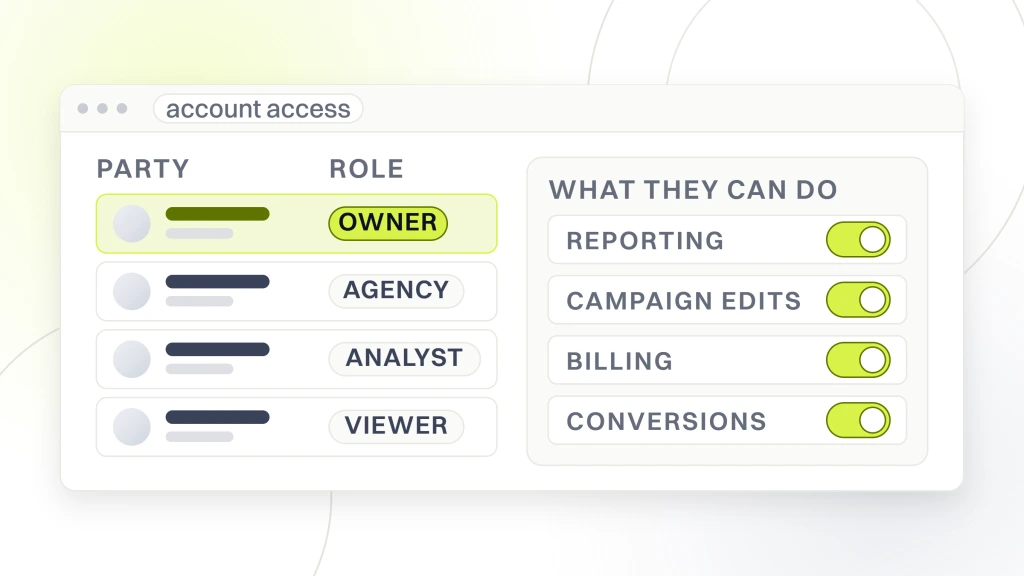
Score every proposal from 1 to 5 on each row. A 5 is strong, documented evidence. A 1 is missing or evasive. Weights let you tune for account size. Reporting depth, MCC access, and pricing model matter for every buyer. Account lead tenure matters more as spend grows. Contract flexibility matters more when the account sits under $4,000 per month in media.
| Scorecard row | What a 5 looks like | What a 1 looks like |
|---|---|---|
| Reporting depth | 14+ metrics with commentary and a next-step plan | Clicks and impressions only |
| MCC access model | You own the account, they get MCC access | They own the account, you get a login |
| Contract length | 3 to 6 months with clear performance clauses | 12 to 18 months with no offramp |
| Account-lead assignment | Named senior with 5+ years, one point of contact | Rotating pod or offshore junior |
| Pricing model | Flat fee or 15 to 25% of media, itemized | Bundled with hidden creative or platform fees |
| Past results | Two references in your vertical with numbers | Case study PDFs only, no reference calls |
| Onboarding plan | Written 30 to 90 day plan with weekly milestones | “We will kick off after signing” |
Sum the seven scores. Above 28 out of 35 is a strong partner. 21 to 27 is workable if the top rows (reporting, MCC, contract) hit 4 or 5. Below 21 is a red flag no matter how strong the sales pitch felt. Give the scorecard 20 minutes per proposal. Cheaper than the 6-month drift.
Reporting depth as the first filter
Reporting depth predicts long-term account health better than any other single input, and it is the first row to score when you evaluate Google Ads management companies. Agencies reporting on clicks and impressions are not running the discipline that turns spend into revenue. Agencies reporting on cost per lead, cost per booked outcome, funnel conversion, keyword-level ROAS (return on ad spend), and week-over-week deltas are. Ask for a sample monthly report during discovery. A vendor without one to share is not running one.
Look for four things in the sample report. A metrics table with 12 or more lines. Commentary that ties the numbers to a decision. A next-month plan with 3 to 5 tests. Attribution across calls, forms, and chats. If any of the four is missing, the report is a screenshot, not a management artifact. Score the row a 2.
Attribution across every conversion action
Every dental, medical, home services, and B2B account has three conversion actions at minimum. Phone calls. Form fills. Chat interactions. A report that tracks form fills alone misses the phone calls and the chat conversations entirely. Ask the agency how they set up call tracking. If the answer does not include CallRail, CallTrackingMetrics, or an equal dynamic number insertion service, score attribution a 1. Google’s conversion tracking documentation covers the setup end to end.
Weekly versus monthly rhythm
Weekly reporting keeps pacing tight and catches waste inside 7 days. Monthly reporting alone lets a bad week of spend hide until the report lands. Ask whether the agency sends a weekly pacing email. If the answer is no, you will not know about a runaway campaign until the month closes. Bump the score down by one point for monthly-only reporting.
MCC access and account ownership
Account ownership is the single most protective clause in the engagement, and it is the tiebreaker when two proposals score close on everything else. You own the Google Ads account. The agency gets MCC access. If you leave, the account stays with you, historical data intact, ready for the next manager. Agencies that own the account and hand you a login are protecting a black box. Walk away and they can revoke access, taking the historical performance data with them.
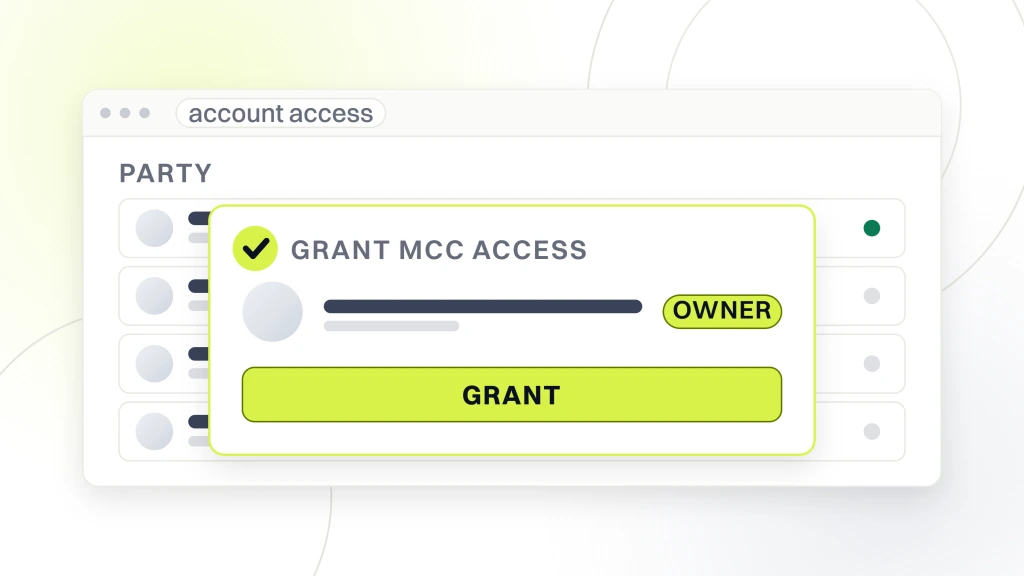
Ask directly. “Will the account be created under my Google account, with your MCC granted access?” A yes is a 5 on this row. A no is a 1. Any variation on “we run everything through our shared account for efficiency” is a soft no dressed up. The efficiency argument does not hold up. MCC access takes 90 seconds to grant and preserves your ownership. There is no operational reason to pool client accounts, so the pooling is about offboarding use, not about running a tighter shop.
Data portability at offboarding
Ask what the offboarding process looks like. A confident agency describes a documented handoff. Access transfer. Final report. Naming conventions summary. Handoff call with the incoming manager. A weak agency deflects with “we hope it never comes to that.” Deflection means offboarding is not documented, so the transition will be painful when it happens. Score this a 2 if the process is not written down. When you want a live sample of what documented handoff and reporting look like, our free Google Ads audit walks through both.
Contract length and performance clauses
Contract length signals confidence and is the fourth row on the scorecard when you weigh the exit clause against the pitch. Agencies that stand behind their work sign 3 to 6 month terms with clear renewal clauses. Agencies that need 12 or 18 month contracts to survive attrition are running a churn-heavy operation and holding clients through the underperformance window. Redefine Web engagements run a 6-month initial term for a plain reason. 90 days is not enough runway for a Google Ads account to stabilize and prove out. Renewal ties to specific performance clauses so the client always has a clear off-ramp.
Read the contract for the exit clause before anything else. Written notice period. Data ownership at termination. Refund policy if targets get missed. A well-drafted contract answers all three inside two paragraphs. A contract that needs a lawyer to parse the exit clause is protecting the agency, not you.
- 3 to 6 month initial term is standard
- 30 day written notice for renewal cycles
- Performance clauses tied to CPL or booked outcomes
- Data ownership clause names the account holder
- Refund or credit clause when targets get missed
- Cancellation for cause language covering non-performance
- Renewal by written affirmation, not auto-rollover
Performance clauses that hold weight
A performance clause needs three parts to hold up. A specific metric like cost per lead, cost per booked patient, or ROAS. A defined target with a range. A remedy if the range gets missed for two consecutive months. Clauses that say “we will use commercially reasonable efforts” are legally meaningless. Clauses that say “if CPBP exceeds $180 for two consecutive months, month three is credited” are enforceable in court.
How to evaluate Google Ads management companies on account-lead assignment
Ask who runs the account day to day. Get the name. Get years of experience. Get the count of other accounts they hold. A person running 8 to 12 accounts has real time for yours. A person running 25 to 40 accounts is a coordinator, not an operator, and the account will drift within the first two quarters.
Rotating pods are a red flag. When the account gets split across five people who all touch it a little, no one owns the outcome. Weekly negative additions get missed since everyone assumed someone else did it. Monthly reallocation math slips when no one has been reading the search terms report for four weeks straight. Ask directly whether the account has one point of contact who does the analytical work. If the answer is “our team” without a name, the account is going into a pod.
Ask for the account lead’s LinkedIn and read it before the second call. Confirm the years of experience match the pitch. A person described as “senior lead” whose LinkedIn shows two years in paid media is a sales title, not an operating one. Ask what their client load looks like on Tuesday morning. If they open eight accounts, do the negatives pass, then move on, you have an operator. If they open three dashboards, glance at spend, and hand the analysis to a junior, you have a coordinator. The distinction shows up on your monthly report in month three, not month one.
Pricing model and hidden fees
Three pricing models cover 95% of the market and shape how you compare Google Ads management companies on total cost, not headline fee. Flat monthly fee. Percentage of media spend, usually 15 to 25%. Hybrid retainer bundling management, creative, and reporting. All three can work. The trap is not the model. It is what the model leaves out. Ask what is not included. Landing page changes. Ad copy production. Call tracking fees. Reporting platform fees. Any of those becomes a surprise line item.
Ask for the total cost of ownership in month one and month twelve. Month one usually includes onboarding fees, tracking setup, and creative production. Month twelve should be pure management plus any variable creative. If the numbers diverge sharply, ask why. A vendor whose month twelve is $6,000 above month one on the same media spend is either running annual price bumps or lumping variable work into the retainer without warning.
Percentage of media spend
Percentage models align the agency’s incentive with growing spend, which can create pressure to push budget past efficiency. Cap the percentage with a ceiling and a floor. Below $3,000 in media, use a minimum monthly fee. Above $30,000 in media, negotiate the percentage down to 12 to 15%, since the marginal management work per dollar decreases at scale.
Flat fee model
Flat fee models work well when the account is stable and predictable. The agency and the client both know what the month costs. The trap is the ceiling. When the account grows past the volume the flat fee was priced for, the agency either raises the fee mid-contract or lets service quality slip. Ask what the fee looks like at 2x and 3x current spend before you sign.
Reference calls and past results
Reference calls are the sixth row on the scorecard. Ask for two references in your vertical or in a comparable size band. Not case study PDFs. Live calls with real clients. A confident agency delivers them inside 48 hours. A weak agency stalls, offers to send more case studies instead, or produces one reference that turns out to be the CEO’s brother-in-law. Reference calls tell you what the agency delivers in practice, not what the sales deck promised.
On the reference call, ask five direct questions. What was the account like at month one versus month six. What surprised you positively. What surprised you negatively. How responsive is the account lead during a crisis. Would you sign again knowing what you know now. Any hesitation on the last question is a strong signal. References who say “probably” or “we are looking at other options” are telling you something the sales team will not.
- What was the account status at month one
- What was the account status at month six
- What surprised you positively during onboarding
- What surprised you negatively during onboarding
- How does the account lead handle a crisis week
- Would you sign again today
- What would you change about the engagement
Reading reviews on Marwick, Wpromote, Neil Patel Digital, and HubSpot partners
Named agency reviews on Clutch, G2, and Google are useful as background but rarely decisive. Look for patterns in negative reviews, not the presence of them. Every agency at scale has some 1 and 2 star reviews. What matters is the failure mode. Reviews that repeatedly mention “stopped responding after month three” or “account lead changed without notice” describe the same operating gap. Reviews that mention “the reporting was heavier than I wanted” describe a style preference, not a red flag.
Marwick, Wpromote, Neil Patel Digital, HubSpot partner shops, Semrush partner shops, and Moz partner referrals all have their own review patterns. Read 15 to 25 reviews across each platform before you form an opinion. Clutch’s PPC agency directory is a reasonable starting point for verified reviews. Weight recent reviews more heavily than older ones since operating models change. An agency that had strong reviews in 2021 and weaker ones in 2025 has probably drifted operationally and is coasting on brand.
Clutch versus G2 versus Google reviews
Clutch verifies clients before publishing reviews, which raises the bar. G2 is heavier on self-reported reviews with lighter verification. Google reviews are the most likely to include disgruntled former staff and competitors, so read them last. Cross-check the same client name across all three when possible. A client review that says one thing on Clutch and another on Google is either fake or the client changed their mind, and either signal is worth understanding.
Watching for review manipulation
Agencies that jump from 3.8 to 4.7 stars in a two-month window are either running a review-solicitation campaign or hiring reputation services. Both are legal. Neither tells you the account will be well-managed. Look at the distribution of review dates. Even review counts month over month usually mean organic growth. Sudden spikes usually mean solicitation.
Written onboarding plan as the last check
Ask for the 30, 60, and 90 day plan in writing before signing. This is the last row on the scorecard before signature. A confident agency emails it inside 48 hours. A weak agency waits until after signature. The plan should name specific tasks and specific owners at each stage. Week 1 tasks. Week 4 milestone. Week 8 review. Week 12 quarterly business review. Anything vaguer means the agency will figure it out after the check clears, which is where most of the drift begins.
We ran this scorecard on a competing agency’s proposal last month for a home services client evaluating three options. Reporting depth scored a 2. MCC access scored a 5. Contract length scored a 3 (12 month initial). Account-lead assignment scored a 2 (pod-based). Pricing scored a 4 (flat fee, itemized). References scored a 3. Onboarding plan scored a 2. Total: 21 out of 35. The client picked us. Nine months later the account is at 40% lower cost per lead. The scorecard is not magic. It just forces the questions the sales pitch is designed to avoid.
Milestones that matter
Week 1 has to include a conversion tracking audit, MCC access confirmation, and current-state benchmark. Week 4 has to include the first campaign launch or restructure, first search terms review, and first weekly report delivered. Week 8 has to include the first ad copy test result and first landing page hypothesis running. Week 12 is the QBR (quarterly business review) where the account gets tuned against the first quarter of real data.
What missing milestones tell you
An onboarding plan that skips the conversion tracking audit means the agency will optimize toward whatever conversion action was already firing, whether or not it maps to revenue. An onboarding plan that has no landing page hypothesis means every campaign will get routed to whatever page is already there, even a weak one. Missing milestones are not oversights. They are cost centers the agency plans to leave alone.
Automation Anywhere case study on how to evaluate Google Ads management companies
Automation Anywhere came to us in the same spot every buyer faces mid-evaluation. They were paying $1,936 per lead through their prior Google Ads management setup, chasing impression share, lead volume, and awareness all at once. Global campaigns lived in one bucket. Language coverage was English only. The offer at the end of the ad journey was a contact form. On the scorecard, the incumbent scored a 2 on reporting, a 1 on account-lead ownership, and a 2 on onboarding. Total: 22 out of 35. That is exactly the mid-band where sales feel fine and operations quietly fail.
We ran the 7-row scorecard on our own proposal for them. Reporting depth scored a 5 with 14 metrics, weekly pacing, and per-region attribution. MCC access scored a 5 with the account under Automation Anywhere’s ownership and our MCC granted. Contract length scored a 4 with a 6 month initial and performance clauses tied to CPL. Account-lead assignment scored a 5 with a named senior owning the account end to end. Pricing scored a 4 as an itemized flat fee. References scored a 5 with two live SaaS references delivered inside 48 hours. Onboarding plan scored a 5 with a written 30 to 90 day plan. Total: 33 out of 35.
They signed. We separated campaigns by objective so impression share stopped starving lead volume. We ran a content audit that mapped high-value assets to real buyer stages. We expanded language coverage past English so global campaigns matched the actual buyer geography. We swapped the flat contact form for staged offers tied to funnel intent. Cost per lead dropped from $1,936 to $63. That is a 97% cut. Qualified lead volume scaled 100x in the same window. The scorecard did not manufacture the outcome. It picked the operator whose plan matched what the account needed, and it flagged the mismatch on the other two bids before signature.
Putting the scorecard to work this week
Print the scorecard. Score every proposal on the table. Do not weight anything on gut feel before the seven rows are filled in. The scorecard is designed to override sales-pitch bias, and it only works when you fill it in before the follow-up call.
Any row that scores below 3 gets a specific follow-up question sent by email. Agencies that respond with specifics and a plan to fix the gap earn the benefit of the doubt. Agencies that respond with reassurance and no specifics have told you what the year of engagement will feel like. If you want a second set of eyes on the scorecard for a proposal you are considering, our Google Ads management services team runs the audit as part of discovery. When the scorecard points to a bigger PPC rebuild, our PPC management services retainer covers the end-to-end operating model. Dental groups can compare against the vertical-specific rhythm on our dental PPC services page.
One final check before you sign
Read the master services agreement in full, not the proposal deck. The MSA is where the offramp, data ownership, and remedy clauses live. If the MSA disagrees with anything the sales team said verbally, the MSA wins in court. Any verbal promise that is not in the MSA does not exist. Ask for redlines on the two or three clauses that scored below 4 on your scorecard. Agencies that redline are working with you. Agencies that refuse have told you the boilerplate is written to protect them, not you.
Turn the scorecard into your hiring decision
The best time to score a Google Ads management company is before the second sales call. The scorecard is a printable rubric, a shared vocabulary across your buying committee, and a filter that survives the smoothest sales script. Score every open proposal, send follow-up email on every row that landed below 3, and give the top row (reporting depth) roughly twice the weight of the bottom row when spend runs above $10,000 a month in media. That single weighting rule catches more drift than any other rubric tweak.