You want the best Google Ads management agencies that actually move pipeline, not the ones that mail a monthly slide deck padded with impression counts. This is the 2026 shortlist, filtered by real ROI, transparent pricing, and Clutch-verified reviews. You get four buyer archetypes that clear our bar, plus the criteria we use to vet each one on the first call. Read it straight through in about 12 minutes and pick two to shortlist by tomorrow.
Every shop on our version of the best Google Ads management agencies list shares three things. A senior account lead on every account with 5+ years of Google Ads under their belt. Pricing that scales with ad spend, not a hidden retainer creep. And a reporting dashboard that opens with booked meetings or closed revenue, not clicks and impressions. Miss any of the three and you end up with a big agency name and a junior media buyer running your account. Read the criteria first, then the shortlist.
Best Google Ads management services pricing bands for 2026
The best Google Ads management agencies price the work across four bands in 2026. Solo-metro accounts under $10,000 monthly ad spend, mid-market single-vertical accounts, multi-region accounts, and enterprise accounts with in-house teams. Each band has a typical retainer range, a typical scope, and a typical agency profile. Pick the band before the agency, not the other way around.
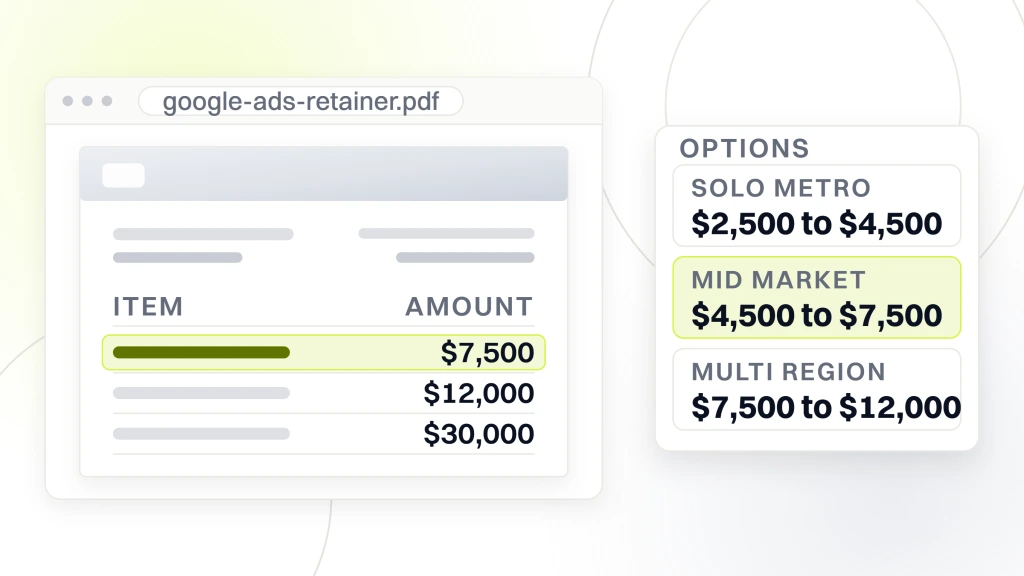
| Band | Monthly retainer | Ad spend range | Best fit agency |
|---|---|---|---|
| Solo-metro | $2,500 to $4,500 | Under $10,000 | Small shop, 5 to 15 people |
| Mid-market single vertical | $4,500 to $7,500 | $10,000 to $40,000 | Vertical specialist, 15 to 60 people |
| Multi-region | $7,500 to $12,000 | $40,000 to $150,000 | Multi-region shop, 40 to 200 people |
| Enterprise plus in-house | $12,000 to $30,000 | $150,000+ | Big-agency hybrid or holding-co |
What each band actually buys you
A $2,500 retainer buys one media planner for 25 to 30 percent of their capacity, one analyst for 10 percent, and a biweekly 30-minute call. A $7,500 retainer buys a dedicated planner at 60 percent, a full-time analyst, a landing page designer on-call, and weekly reviews. A $12,000+ retainer buys a full pod on your account with executive reporting for the CFO and quarterly business reviews. The math is simple. You get more senior time as the retainer grows. Any shop offering $2,000 with senior attention is either bait-and-switching or losing money on your account.
Performance clauses that share the risk fairly
Performance-based pricing lands three ways in 2026. Per-SQL bonuses ($150 to $400 per qualified meeting above a monthly threshold). Percentage-of-pipeline (2 to 5 percent of attributed pipeline dollars). Retainer step-ups tied to cost-per-lead reduction. The cleanest is per-SQL. The definition is clear on day one. Percentage-of-pipeline sounds compelling but needs agreed attribution windows and a shared pipeline stage definition. Retainer step-ups reward the agency for lowering cost, which is exactly the incentive you want.
Reading Clutch, G2, and Google reviews without being fooled
Best Google Ads management companies Clutch listings are a starting point, not a verdict. Filter by 4.8-star minimum, 20+ reviews, and vertical match. Then read the two-star and three-star reviews first. Five-star reviews all sound the same. Real complaints show you the shop’s actual failure mode. Slow response, junior swaps, missed reporting, unclear pricing. Pick the pattern that would break your engagement, then pass on shops with that pattern.
Cross-reference at least two review platforms
A shop with 4.9 stars on Clutch and 3.2 stars on G2 is worth a second look. The delta is the story. Maybe Clutch reviews come from long-tenure clients and G2 comes from short-tenure clients who churned early. Maybe the shop pays for Clutch review campaigns and G2 stays organic. Either way, one platform alone is not enough signal. Google Business Profile reviews from local clients add a third data point. If your top-three shops score above 4.5 across all three platforms, you have a real shortlist.
Reference calls beat platform reviews every time
Ask each shop for three client references. Call two. Ask each reference three questions. How responsive is the account manager on Slack. What was the biggest surprise in the first 90 days. What would they change about the engagement if they were starting over. The best reference conversations happen when you catch the client on a Wednesday afternoon and get 15 minutes on the phone. Anything scripted through the agency’s account team is theater. Real references sound like they are venting a little, which is exactly what you want.
The shortlist of top Google Ads management agencies
Twelve shops make our short list based on the criteria above. We are not going to name each one here, since agency lineups shift quarterly and the shortlist gets stale fast. Instead, we describe the four archetypes you should look for, name the questions to ask each, then point to the sibling posts covering the specific evaluation frameworks in detail. Pick the archetype, then interview two shops inside it.
Archetype 1. The boutique with founder involvement
Ten to 30 people, founder still involved on the biggest accounts, one or two verticals of deep specialty. Boutiques fit mid-market accounts spending $10,000 to $40,000 monthly ad spend. You get direct access to the strategy lead, faster turnaround on account changes, and a media planner who knows your industry cold. The trade-off is capacity. If they win a big new account, your response times slip for a month during team rebalancing. Ask about their team growth plan on the first call.
Archetype 2. The mid-sized agency with process
Forty to 200 people, formal onboarding process, dedicated verticals with named lead planners. Mid-sized shops fit multi-region accounts spending $40,000 to $150,000 monthly ad spend. You get consistent onboarding, backup coverage when someone goes on leave, and a documented reporting cadence. The trade-off is layered communication. Your day-to-day contact is often an account manager, not the lead planner. Ask how requests flow from you to the media planner and how long it takes to change ad copy.
Archetype 3. The vertical specialist
Twenty to 80 people, all clients in one or two verticals (dental, legal, home services, SaaS, ecommerce). Vertical specialists know the buyer, the keyword universe, and the competitor accounts inside out. Their retainers often run 20 to 30 percent higher than a generalist, yet the ramp time drops in half. If your vertical is well-served by a specialist shop, they are usually the right pick. Ask how many current clients are direct competitors of yours, plus how they handle competitive conflicts.
Archetype 4. The holding-company agency
Two hundred plus people, part of a holding company (Publicis, WPP, IPG, Dentsu), enterprise focus. Holding-co shops fit accounts spending $150,000+ monthly ad spend with in-house marketing teams that need process-heavy execution. You get scale, multi-country coverage, and integrated media planning across channels. The trade-off is speed and cost. A single ad copy change may route through three approvers. Retainers start at $12,000+ and often clear $30,000. If you are asking about pricing, you are probably not their target buyer.
A named example. Automation Anywhere
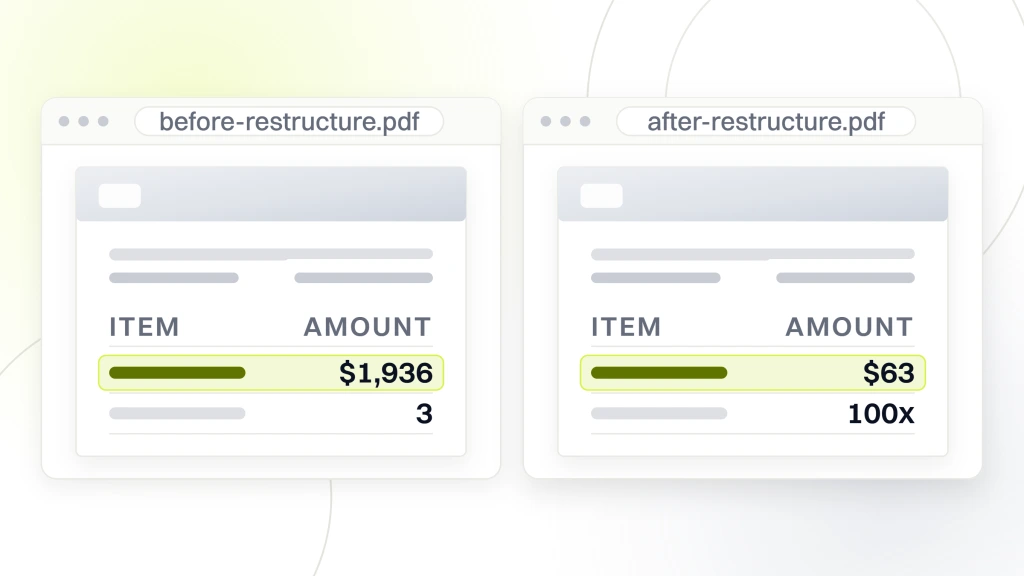
Automation Anywhere, the enterprise RPA platform, came to Redefine Web with unsustainable acquisition math. Paid campaigns were burning $1,936 per lead, chasing three conflicting goals at once (impression share, lead volume, brand awareness). Global campaigns ran only in English with zero regional adaptation. Landing pages did not match the keywords driving traffic, so quality scores stayed low and CPCs stayed high. Ad copy pitched features when buyers wanted problem-solution language. The main call-to-action was a stock contact form up against competitors offering analyst reports and free trials.
The rebuild
Redefine Web ran a structured multi-phase rebuild. Phase one was a strategy audit that split campaigns by objective and killed the conflicting internal KPIs. Phase two was a content audit that aligned analyst reports and white papers to the right funnels, then rebuilt landing pages to match keyword targeting one to one. Phase three swapped feature-first copy for persona-driven, problem-solution ad copy. Phase four refined keyword targeting, moved bid strategy to conversion efficiency over rank position, and iterated the offer set until each region had a competitive hook against the RPA field.
The numbers, real
Cost per lead dropped from $1,936 to $63. That is a 97 percent cut. Qualified lead volume scaled 100x on the new structure. Automation Anywhere walked into board reviews with pipeline numbers tied to a rebuilt CPL curve, not an impression report. Numbers like these are only possible when the account structure is tight, campaigns match objectives one to one, and offers land in front of the right persona.
Red flags on the first discovery call
You can spot 80 percent of bad fits in the first 45 minutes of a discovery call. The signals stay consistent. The rep does most of the talking. The rep cannot name your top three competitors’ account structures. Pricing shifts based on your reactions. Onboarding gets described in vague weeks. Any one of these is a yellow flag. Two of them is a pass.
The rep does most of the talking
A good discovery call runs 60 percent you talking, 40 percent them asking questions. If the rep spends 45 of 60 minutes walking you through slides about their process, they have learned nothing about your account. They will guess at your keyword strategy after you sign. Ask three concrete questions in the first 10 minutes. What is your team’s turnover rate on account managers. How do you handle Performance Max asset groups. What is your churn rate on accounts under 12 months old.
Pricing shifts mid-call
Watch for pricing that changes based on your reactions. You say “$3,000 is our max” and suddenly there is a special package at $2,950. You say “we are talking to three other shops” and the retainer drops 15 percent. Real pricing does not shift on the first call. Real shops have three tiers with fixed scope per tier. If the pricing is fluid on discovery, it will stay fluid at renewal too. That is when the scope creep starts and the invoice quietly grows by $800 a month.
Reporting cadence that keeps your account healthy
Weekly readouts (30 minutes), monthly reviews (60 minutes), quarterly business reviews (90 minutes). That is the standard cadence for the best Google Ads management services in 2026. The weekly is tactical, the monthly is strategic, the quarterly is executive. Any shop that skips the quarterly runs your account without a strategy. Any shop that skips the weekly runs your account without oversight. Both are bad, in different ways.
Weekly readout agenda
Six items, 30 minutes, no slides. Sales-qualified meeting count for the week. Cost per meeting trend versus baseline. Top two tests running now. Top two tests launching next week. Account health flags (budget pacing, quality score drops, disapproved ads). Open questions for your team. If the weekly runs longer than 30 minutes, someone is padding. If it runs shorter than 15, the media planner is not paying attention.
Monthly review agenda
Twelve slides, 60 minutes, one clear ask at the end. Slide one, booked meetings versus target. Slide two, cost per meeting trend. Slide three, attributed pipeline dollars. Slide four, channel mix (spend and meeting contribution). Slide five, top three account wins. Slide six, top three tests running next month. Slides seven through twelve, drill-down on the biggest campaigns. If your monthly does not open with meeting count, the shop is reporting on activity, not outcomes.
AI Google Ads management tools versus hiring an agency
AI Google Ads management tools have gotten sharper in 2026. Optmyzr, Adzooma, WordStream Advisor, and half a dozen newer platforms run your account with less human input than five years ago. But tools do not replace strategy. A tool cannot tell you which offer to promote next quarter or rebuild your landing pages when the campaign message changes.
For a deeper comparison, see our writeup on AI Google Ads management tools versus hiring an agency.
Tools do execution well
AI tools handle bid adjustments, negative keyword sweeps, and ad copy generation faster than any human. If your account runs steady with a clear offer and a stable landing page, an AI tool plus a part-time analyst can hold the account inside plus-or-minus 10 percent of an agency-managed account. That covers 30 to 40 percent of small business accounts under $8,000 monthly ad spend. Above that threshold, the volume of account changes exceeds what tools handle without human strategy behind them.
Agencies do strategy well
The best Google Ads management agencies bring three things a tool cannot. A media planner who has run your competitor’s account and knows what wins. A landing page designer who can turn a new offer into a converting page inside two weeks. A quarterly strategy review that reads your account against your business goals. If any of these three matter to you, hire an agency. If none of them matter, a tool plus a good analyst is fine. Match the choice to the account, not to the current wave of AI hype.
Local Service Ads versus national campaigns
Local Service Ads (LSA) sit above Google Search Ads in the SERP for local intent queries. If you run a home services business, a dental practice, or a legal firm in a metro, LSA belongs in your account structure alongside Search. National ecommerce accounts skip LSA and focus on Performance Max plus Shopping. Regional B2B services run both depending on the vertical. Our sibling post on Google Local Service Ads management covers the specific setup for local businesses.
Verified review weight is the LSA game
LSA ranking depends heavily on verified review count. Ten reviews puts you in the mix. Fifty reviews puts you above most competitors. Two hundred reviews makes you unbeatable in your metro. If your review count is low, LSA spend gets throttled by the algorithm regardless of your bid. Your Google Ads management agency should own a review generation workflow as part of the LSA scope. If they do not have one, ask why. The gap is fixable inside 60 days with the right playbook.
Performance Max drives national accounts
Performance Max is now the default campaign type for ecommerce accounts running Shopping. It combines Search, Shopping, Display, YouTube, Gmail, and Discovery into one automated campaign type. Setup needs a full asset library (headlines, descriptions, images, videos, product feeds), plus offline conversion imports for lead-gen accounts. Agencies that still avoid Performance Max in 2026 are behind the curve. Ask on the first call how many current accounts run Performance Max and how they structure asset groups.
Best Google Ads management companies Clutch evaluation walkthrough
Best Google Ads management companies Clutch listings show four data points to focus on. Review count above 20. Star rating above 4.7. Vertical match to your industry. Reviewer role at the client company. The higher the seniority of the reviewer, the more weight the review carries. A VP of Marketing review beats an anonymous “Marketing Specialist” review every time.
Pattern-match the complaints, not the compliments
Read every three-star and lower review. If the same complaint shows up in three reviews (slow response, junior swaps, reporting gaps, unclear billing), that is the pattern. That is the pattern you will experience in month six. Compliments cluster around “great communication” and “helpful team,” which stays table stakes. Complaints tell you where the shop actually breaks. For the full framework, our writeup on how to evaluate Google Ads management companies covers the 15-question rubric.
Industry match matters more than star count
A shop with 4.9 stars overall and zero clients in your vertical is worse for you than a shop with 4.6 stars and 15 clients in your vertical. Google Ads playbooks vary sharply by vertical. Dental keyword strategy has nothing to do with SaaS keyword strategy, which has nothing to do with HVAC or legal keyword work. Every vertical has its own auction dynamics, conversion rates, and seasonal patterns. If the shop has never run an account for a business like yours, they will learn on your budget for the first 90 days. That is a real cost, not a hypothetical one. Filter Clutch by vertical first, star rating second.
Contract terms the best Google Ads management agencies offer
Six-month initial term with a 60-day termination clause after month three is the fair standard. Data ownership stays with you. Your Google Ads account, your GA4, your CRM, your dashboards. The agency has admin access, not ownership. On exit, they hand back everything within 10 business days. Any shop that pushes back on data ownership terms is a red flag. You are renting expertise, not selling them your accounts.
Six months is the honest floor
The offline conversion model needs a full quarter to learn before you can judge the engagement fairly. Below six months, you are switching agencies before the model matures, and every switch costs you a fresh 3-month learning curve. Agencies pushing 12-month or 24-month agreements are locking in revenue, not protecting the account. Six months plus a rolling 60-day out clause is the middle path that protects both sides. Fair to you, fair to them.
Scope creep protection that actually works
Scope creep looks like extra retainer line items showing up quietly. Landing page redesign, extra reporting cadence, competitor research, ad copy variants for a new campaign. The contract should name what is included in the retainer and what triggers additional billing. Vague clauses like “additional services billed hourly” without an hourly cap invite scope creep. Cap hourly work at 10 hours per month before it triggers renegotiation. If they push back on the cap, you learned something useful before signing.
Who should not hire a Google Ads management agency
Not every account needs the best Google Ads management agencies. Below $2,000 monthly ad spend, agency fees ruin your ROI math. Retainer plus ad spend more than doubles your total cost. Without a clear buyer persona, no agency can build a converting account for you regardless of skill. Without CRM access, they run a lead-gen account, not a pipeline account, and you never learn which channel actually books meetings. Fix those three first, then hire.
Below $2,000 ad spend, use a tool
At $2,000 monthly ad spend, a $2,500 agency retainer more than doubles your total cost. The math never works. Use an AI Google Ads management tool like Optmyzr or WordStream Advisor at $300 to $500 per month, plus a virtual assistant for 10 hours a week on account hygiene. That gets you into the right ballpark until your ad spend clears $5,000 and the agency math starts penciling out.
Unclear buyer persona kills any account
If your sales team cannot describe your ideal customer profile in one paragraph, no Google Ads agency can build a converting account for you. Persona clarity comes first. Get sales, marketing, and product in one room. Agree on the top three buyer titles, the top three job functions, the top three industries. Then hire the agency. The number one reason Google Ads engagements fall apart in month four is that the buyer persona was fuzzy from day one, and the agency had no clean signal to optimize against.
Onboarding timeline for a new Google Ads agency
Four weeks from signed contract to campaigns live. Week one, discovery, sales team interviews, CRM audit, closed-won pull. Week two, account rebuild, keyword universe, negative keyword lists, landing page inventory. Week three, launch prep, offline conversion import setup, tracking QA, ad copy sign-off. Week four, go-live and the first weekly readout. Any shop that promises campaigns live in seven days is skipping discovery. Any shop that stretches onboarding to eight weeks is dragging.
Data you hand over on day one
- Last 90 days of closed-won deals with source attribution (CRM export).
- Current keyword lists and negative keyword lists from Google Ads.
- Landing page URLs for every active buyer-intent theme.
- Access to Google Ads, GA4, Search Console, and your CRM.
- Current cost-per-lead baseline (if measurable).
- Sales-qualified lead definition your sales team accepts.
Handing this over inside week one saves 10 to 15 hours of back-and-forth. Handing it over inside week three delays launch by two weeks. The prep discipline sets the tone for the whole engagement.
Kickoff meeting agenda that locks the engagement
Sixty minutes, five people, three outcomes. Attendees. Your marketing lead, the agency account manager, the media planner, someone from sales operations who owns the CRM, and someone from finance who owns the SQL definition. Outcomes. Signed-off SQL definition, signed-off attribution window (typically 30 to 90 days), signed-off reporting cadence. If any of the three drift after week one, the account starts wobbling in month two. Lock them at kickoff.
Warning signs the engagement is drifting
Even the best Google Ads management agencies drift on some accounts. You can spot a failing engagement inside 45 days. The signs stay consistent. The account manager gets swapped in the first 60 days. The weekly readout gets moved to biweekly, then monthly, without a clear reason. The monthly report still opens with impressions in month three. Offline conversions never got imported. The media planner cannot name your top three buyer personas without checking notes.
The junior media buyer tell
You met a lead planner during the sales cycle. You are working with a junior buyer 60 days in. That is the bait and switch. Ask on the first call who the media planner is, how many years they have run Google Ads, and how many other accounts they are on. If the answer is more than four active accounts, they are stretched. If the answer is under three years of experience, they are learning on your budget.
The attribution loop never closed
Offline conversion imports are the single biggest predictor of engagement quality. If day 30 comes and imports are still not wired, the shop either does not know how to wire them or does not prioritize the work. Neither is fine. Escalate on day 30. Ask for a screenshot of the offline conversions arriving in Google Ads. If the answer is a stall, you have your read. The Google Ads offline conversion import documentation walks through the setup any shop should already know cold.
First 90 days with a Google Ads management agency
The first 90 days show you whether you picked the right shop. By day 30, expect a full account rebuild, offline conversions imported, and one landing page test running. By day 60, expect lower cost per sales-qualified lead than your baseline. By day 90, expect pipeline attribution numbers you can hand to the CFO. If the monthly review at day 90 still opens with impressions and click-through rate, the shop is selling media buying, not pipeline. Ask for a swap or walk.
Day 30 milestones
Discovery done, account rebuilt, offline conversions imported, first landing page test running. The day 30 readout should show the new account structure alongside the old one, with a plain-language explanation of what changed and why. If the readout is a data dump without narrative, the media planner is not doing strategic work. Ask for the narrative version. Any good planner can talk through the account changes in five minutes without slides.
Day 90 milestones
Cost per sales-qualified lead below baseline. Pipeline attribution running clean into your CRM. Landing pages tested and iterated at least twice. Three tests documented with results (win, loss, or inconclusive). If the shop has run zero tests in 90 days, they are running your account on autopilot. If they have run 15 tests, they are testing for the sake of testing without letting anything reach statistical significance. Three to six tests in 90 days is the honest range.
Consent mode and privacy readiness in 2026
Any Google Ads management agency running paid traffic into Europe must sit inside Google’s consent mode v2 framework. Not optional in 2026. Miss the consent-mode wiring and Google throttles conversion signals, which starves smart bidding of the data it needs. The best Google Ads management agencies wire a Google-certified CMP (gold-tier where budgets warrant it), map consent states to GA4 events, and confirm that modeled conversions show up in Google Ads inside the first 14 days. Ask any shortlisted shop to walk you through their consent mode setup on a live account. Vague answers mean vague setup.
First-party data is the moat
Google’s automated bidding runs on the signal you feed it. Weak first-party data means weak bidding, no matter how good the shop is. Enhanced conversions, CRM audience uploads, offline conversion imports, and consent-aware GA4 events all belong in the first 30 days. If your shortlisted shop can name each one and tie it to a specific business goal, they are worth interviewing. If they treat first-party data as an afterthought, keep looking.
Where to start with a Google Ads management agency this quarter
Book three discovery calls with three archetypes. Boutique, mid-sized, and vertical specialist. Ask each the five questions in the red flags section. Score the answers. Shortlist two. Get anonymized account structures on the second call. Sign a 6-month agreement with a 60-day out after month three. That is the whole playbook, tightened into two weeks of buyer work.
Internal alignment before you hire
The best Google Ads management agency will fail if your sales team has not agreed on the sales-qualified lead definition. Fix internal alignment first. Get sales, marketing, and finance in one room. Agree on what qualifies. Agree on the attribution window. Agree on the reporting cadence. Then hire the agency. The HubSpot definition of a sales-qualified lead is the standard we align every client’s SQL bar to on day one.
When to call our team
If you want to skip the discovery-call marathon and see what a working Google Ads engagement looks like at $2,500 to $10,000 per month, our Google Ads management services page walks through scope. Retainer starts at $2,500, discovery inside 14 days, first campaigns live inside 30 days. One media planner, one dashboard, tied to booked meetings from day one. If you want to compare pricing across shops first, our Google Ads management pricing writeup covers the full range.