
How to Choose a SaaS Website Design Agency for Startups
- Baseline your own funnel before the first agency intro call.
- Apply four shortlist filters to cut the list from 40 to 6.
- Run the twelve interview questions on every shortlisted agency.
- Read the termination clause before signing anything else.
- Confirm IP ownership including Figma, CMS, and git repository.
- Real case pattern when you choose a saas website design agency well
- Interview questions to run when you choose a saas website design agency
- Can you recommend some top saas website design agencies for a startup like mine
- Red flags in the process of learning how to choose a saas website design agency
- Best saas website design agencies for b2b companies versus horizontal marketing
- Termination clauses and IP ownership when you choose a saas website design agency
- Wrapping the how to choose a saas website design agency guide
Learning how to choose a saas website design agency is a decision most founders make once every three years and get wrong the first time. Wrong pick costs you six to twelve months of growth. Right pick compounds for years. This guide walks you through the shortlist filters, the pricing bands, the interview questions, and the red flags. Read straight through in about nine minutes. The goal is to give you a repeatable process instead of a gut call on the founder who sounded confident on the second Zoom.
You’re likely reading this because a redesign is on the roadmap and you don’t want to hire a portfolio-heavy agency that ships a beautiful site that converts at the same rate as the old one. You want an agency that ties every design decision to a funnel number, keeps clients past twelve months, and can prove both with named references. Read on, mark the shortlist filters, and steal the twelve interview questions in section seven.
Real case pattern when you choose a saas website design agency well
Rocket Software, Inc. picked us for a redesign after underperforming with two previous agencies. The engagement hit three surfaces at once: homepage rebuild, pricing page A/B iteration, and onboarding funnel rewrite. Results were 300 percent activation rate gain, 3,000 customers in the launch week, and 400 daily subscribers thirty days after launch.
The Rocket Software, Inc. redesign is the case we walk through on kickoff calls because it shows a three-surface pattern rather than a homepage refresh alone. The homepage rebuild moved the trial CTA above the fold and simplified the hero copy to a single benefit sentence with a numeric proof point. The pricing page rewrite added a three-tier structure with the middle tier as the anchor recommendation, and removed the previous “contact sales” fourth tier that was suppressing signups from mid-market accounts. The onboarding flow got cut from 11 steps to 4, with a magic-link email replacing password creation at signup.
Reporting cadence during the engagement was weekly, with a shared Looker Studio dashboard tracking trial signups, activation rate, and week-two retention. Every design change went out as an A/B test with a defined success metric before it went live to 100 percent of traffic. The engagement ran 22 weeks from kickoff to launch, and continued as a $9,000 monthly optimization retainer for the following 14 months. This is the durability the right partner builds into every engagement, and the pattern that separates a real growth partner from a portfolio-only vendor. It’s the concrete answer to how to choose a saas website design agency that will still be adding value in month eighteen. External benchmarks on the design-to-conversion mapping sit on Smashing Magazine’s UX design archive.
Interview questions to run when you choose a saas website design agency
The intro call decides more than the pitch deck when you choose a saas website design agency. Ask questions that reveal operational depth, reporting maturity, and honesty about weaknesses. Twelve questions, ninety minutes, real signal on whether this team can carry a two-year engagement.
These questions are the ones we use ourselves when we vet strategic partners. They are ordered from easiest to hardest, which surfaces the agency’s comfort level with hard questions. A confident agency answers all twelve without deflecting. A struggling agency deflects on the last four. The questions about weaknesses and failures are the most diagnostic. Any agency that claims to have no recent failure has stopped trying new things, which is a slow death for a design operator running SaaS accounts through fast test cycles.
- What is the median tenure of a client on your active roster right now
- Show me a live client dashboard, redacted for account name is fine
- What was the trial signup rate before and after your last SaaS redesign
- Who runs my account by name, and what is their prior SaaS project experience
- How do you handle account team continuity when someone leaves
- Walk me through the test cadence for the first ninety days post-launch
- What was your most recent client failure and what did you change after
- How does your pricing tie to scope, team, and timeline
- Which platform do you recommend for our stage and why
- Who owns the design files, source code, and CMS data at engagement end
- What is your termination clause and notice period
- Which three named references can I call this week
Can you recommend some top saas website design agencies for a startup like mine
When founders ask can you recommend some top saas website design agencies, the honest answer is that the best fit depends on your stage, your vertical, and your funnel gap. A recommendation without knowing those three things is worse than useless. The recommendation process needs to be scoped, not blanket.
At seed to Series A, you want a founder-friendly generalist who will run a $5,000 to $12,000 monthly retainer with a heavy hands-on presence and a willingness to test three or four channels in parallel until one hits. The founder is usually still writing the copy and vetting the campaigns weekly, so pick an agency where the person selling you is also the person doing the work. Big-name agencies with account managers between the founder and the operators are wrong for this stage. So are pure freelancers with no team behind them, because your growth needs will outrun a single operator by month four.
At Series B to C, you want an agency with channel depth, pipeline reporting, and 4 to 6 people assigned to the account. The retainer is $18,000 to $32,000 monthly. The scope covers paid, SEO, content, and lifecycle in some combination. The reporting cadence is weekly on operations and monthly on strategy. This is the stage where the wrong agency choice costs you 12 months of growth. Take longer on the shortlist, interview twice, and do a paid pilot for 60 days before signing an annual retainer.
The most predictable moment on any SaaS agency intro call is the pitch deck slide titled “Our Design Process” followed by a five-step diagram where step three is called Discovery. If you see this slide, close the browser tab. Real agencies talk about hypothesis logs, test velocity, and pricing page iteration count. Fake agencies talk about brand storytelling and design thinking. The pitch deck says everything about the operator behind it, every single time you sit through one.
SaaS design agencies pitch every startup on the same case studies. Ask which finalist bids they lost last quarter. Silence means they never compete for real work.
Red flags in the process of learning how to choose a saas website design agency
Every shortlist round in the process of learning how to choose a saas website design agency surfaces the same red flags. Vague scope. Unnamed teams. No client references. Vanity metrics in the pitch deck. Pricing without a plan behind it. Any two of these together is a strong reason to move on to the next agency on your list.
Red flags are usually visible in the first 30 minutes of an intro call, if you know what to listen for. The pattern below is the one we see repeatedly across founders who share bad agency stories. Save yourself the twelve months by walking away when any two of these show up in the same conversation. The agency that gives you clean answers on all six is worth another interview. The agency that dodges four of the six is not worth a follow-up email, no matter how nice the portfolio site looks or how confident the account lead sounds on the call.
- Scope written in marketing language instead of deliverable counts and page limits
- Named team refuses to reveal seniority or prior SaaS project experience
- References are testimonials on the website, not live phone calls with real clients
- Portfolio shown only as static screenshots, never as a live site link
- Reporting cadence is monthly PDF, never weekly working session or shared dashboard
- Pricing is one flat number with no linkage to scope, team size, or timeline
Best saas website design agencies for b2b companies versus horizontal marketing
The best saas website design agencies for b2b companies differ from horizontal marketing shops in the level of vertical proof they carry. Named SaaS clients past $10 million ARR. Vertical experience in fintech, devtools, or vertical SaaS. Case studies with sourced pipeline numbers. Content strategy that respects a 90-day sales cycle instead of a 4-week one.
Vertical fit shows up in three places. Ad copy that speaks the buyer’s actual language. Content strategy that respects the sales cycle length. And compliance awareness on landing pages, particularly for regulated verticals. A fintech landing page written by an agency without fintech experience will trip the compliance team on day one and get rewritten by legal. That rewrite costs two weeks and a lot of goodwill. Pick an agency that has already learned those lessons on someone else’s account, or budget the learning curve into your timeline.
Ask any agency you shortlist how they onboard a new vertical and how long that ramp takes before campaigns go live. A specialist with your vertical already in the portfolio can start work in week one. A specialist without your vertical will need 4 to 8 weeks to ramp before real work starts. A generalist without vertical experience will never fully catch up, and your engagement will pay the tax on that gap every month. Reference frameworks for the vertical-onboarding shape live in the Nielsen Norman Group research archive.
Termination clauses and IP ownership when you choose a saas website design agency
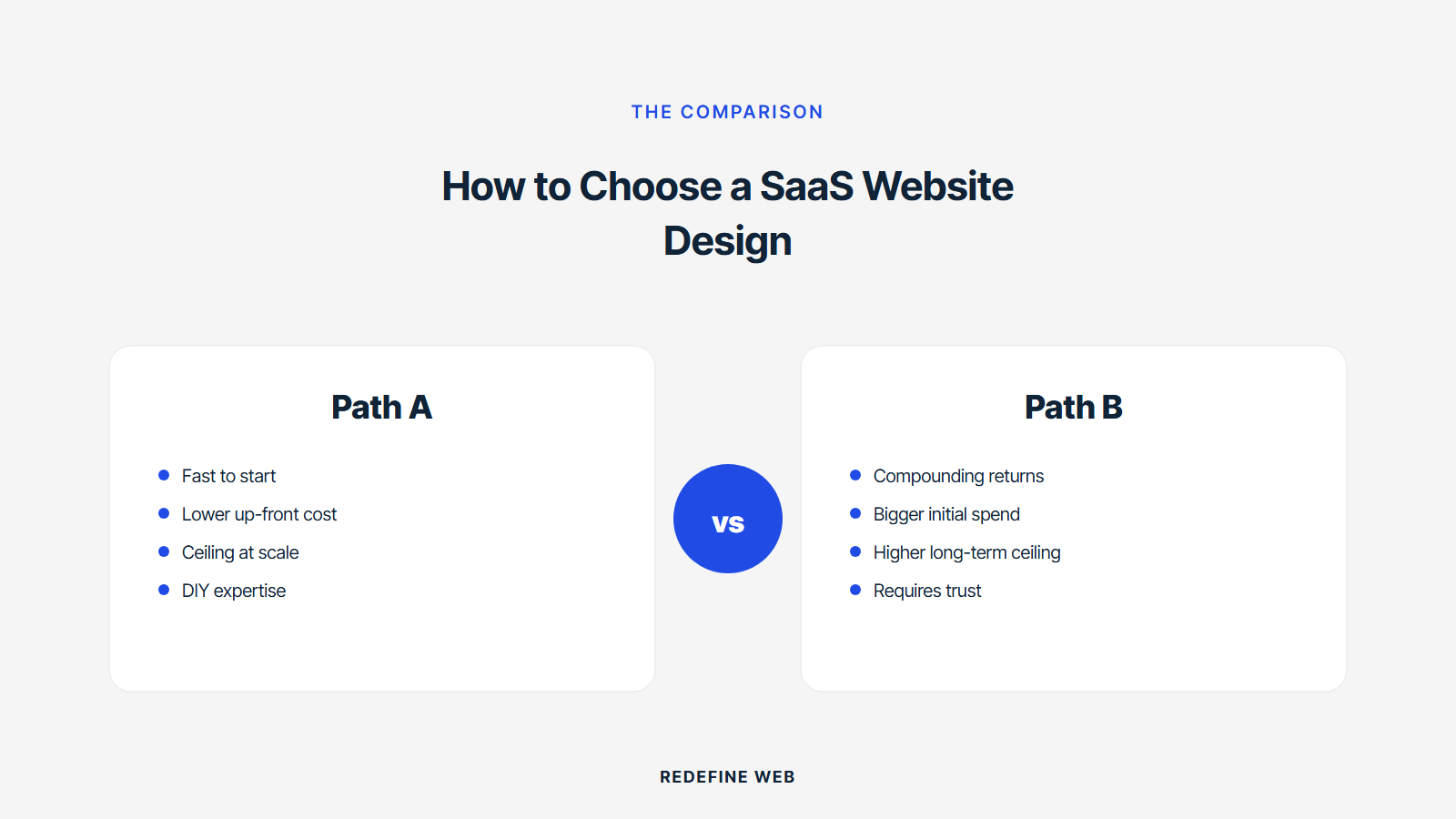
Termination clauses and IP ownership reveal how confident the agency is in their ongoing value. A 30-day notice period is standard and healthy. A 90-day notice period signals the agency knows they will not earn the last month of the contract. IP ownership should transfer to you at delivery, with full source files and CMS data included.
Read the termination clause before you read anything else in the contract. It tells you what the agency believes about their own retention. A no-cause termination clause with 30 days is the sign of an agency confident enough to let you leave if the work stops delivering. A 90-day clause with mandatory reason codes is the sign of an agency that expects to underperform and wants a runway to keep billing while they scramble. This clause alone can save you six figures across a bad engagement, and it is the first thing our own contract review checklist looks at when we’re helping a founder review an outside agency proposal.
IP ownership is the second contract detail worth scrutinizing in the process of learning how to choose a saas website design agency without regret. Content produced under the retainer should be yours outright, with full transfer of copyright and source files. Some agencies retain rights so they can reuse patterns across clients. That is fine for anonymized frameworks. It is not fine for finished pieces you paid to produce. Read the IP clause. If it is vague, get it in writing that finished content transfers to you at delivery, and that source files, working documents, and design files come with the transfer, including the Figma project, the CMS export, and the git repository.
Wrapping the how to choose a saas website design agency guide
Learning how to choose a saas website design agency comes down to a repeatable process. Baseline your funnel. Apply the four shortlist filters. Run the twelve interview questions. Read the termination clause and the IP clause before signing. Sign only after a paid pilot or a reference call with a client whose engagement matches yours.
If you take one thing from this guide, take the twelve interview questions and run them on every shortlisted agency. The pattern in the answers will tell you more than any portfolio site. If you take two things, add the four shortlist filters at the start of your research process, and cut your interview list from forty agencies to six before you spend real time. When you’re ready to talk about the SaaS growth motion in specifics, our B2B SaaS Marketing Agency Tied to Pipeline team walks through the shape in a 30-minute call, no pitch deck attached. For the ongoing retainer shape after launch, our SaaS Marketing Retainer Plans from $599/mo service publishes the exact cadence up front.
Frequently asked questions
How to choose a saas website design agency without wasting six months?
The repeatable process is a four-step filter. Step one, baseline your own funnel metrics: trial signup rate, demo request rate, and activation rate 14 days out. Step two, apply the four shortlist filters to cut the market from 40 candidates to 6. Step three, run the twelve interview questions on every shortlisted agency, focusing on the failure question and the retention question as the most diagnostic. Step four, read the termination clause and IP ownership clause before signing. Sign only after a paid pilot or a reference call with a client whose engagement stage matches yours. Skip any step and you're rolling the dice on a two-year investment.
What retainer band should I expect from saas website design agencies for startups?
Saas website design agencies for startups price initial redesigns between $28,000 and $65,000 as fixed projects, depending on page count and platform. A homepage plus pricing page runs $28,000 to $45,000 for an early-stage SaaS. Adding four templates and a light design system pushes the project to $45,000 to $65,000. Post-launch optimization retainers start at $5,000 monthly for a two-page rolling test and climb to $12,000 for a broader iteration program. Below $28,000 you're getting a template swap, and above $65,000 for a startup is usually scope creep or unnecessary senior-staff involvement that a Series A doesn't need.
How do agencies that specialize in saas website design differ from generalists?
Agencies that specialize in saas website design differ from generalists in three ways. Working model of the subscription funnel, meaning they know CAC payback, net revenue retention, and activation rate as first-class metrics rather than vanity numbers. Test discipline for post-launch iteration, meaning they run one primary A/B test every two weeks against a defined success metric. And a portfolio that skews toward B2B SaaS clients past $2 million ARR rather than a random mix of ecommerce, agencies, and local business sites. Ask what percentage of the active roster is B2B SaaS. Below 60 percent means generalist. Above 80 percent means real specialist.
Can you recommend some top saas website design agencies for a Series A?
At Series A, look for a founder-friendly agency running a $5,000 to $12,000 monthly retainer with heavy hands-on presence and willingness to test three or four channels in parallel until one hits. The founder is usually still writing the copy and vetting the campaigns weekly. Pick an agency where the person selling you is also the person doing the work. Big-name agencies with account managers between the founder and the operators are the wrong shape for this stage, because they optimize for account preservation instead of experiment velocity. Pure freelancers with no team behind them are also risky, because your growth needs will outrun a single operator by month four.
What questions actually reveal the best saas website design agencies for b2b companies on an intro call?
The best saas website design agencies for b2b companies reveal themselves through consistent answers to twelve questions. Ask for the median tenure of the current client roster. Ask for a live dashboard walk-through. Ask for the trial signup rate before and after their last SaaS redesign with source data. Ask who runs your account by name and their prior SaaS experience. Ask what happens when a team member leaves. Ask about the most recent client failure and what changed after. The failure question is the single most diagnostic. Confident agencies answer directly, unconfident agencies deflect or blame the client, and the pattern shows up inside the first 90 minutes.
What red flags should I walk away from when I choose a saas website design agency?
Six red flags together are enough to walk away. Scope written in marketing language instead of deliverable counts. Named team that refuses to reveal seniority or prior SaaS experience. References that are testimonials on the website instead of live phone calls. Portfolio shown only as static screenshots instead of live site links. Reporting cadence set at monthly PDF instead of weekly working session. Pricing that is one flat number with no linkage to scope or team size. Any two of these together in the same intro conversation is a strong reason to move on. Any three and you should thank them for their time and never call back.
Book your free 30-minute strategy call.
No spam, no sales rep. We use your email to schedule your call with a senior strategist. That is it.
More from the blog
View all articles → Web Design
 Core Web Vitals Healthcare Websites Actually Need to Book Patients
Read article Web Design
 Professional Services Website Design Best Practices for 2026
Read article Web Design