
How to Choose Web Design Services for Small Business Owners
- Score every vendor against the same 12-question rubric.
- Design fee alone is not the total cost. Add hosting, care, updates.
- Small business sites should launch in 6 to 10 weeks, not 6 months.
- Own your domain, your files, and your admin. Non-negotiable.
- Ask to see a live site that books customers, not a mockup gallery.
- Why how to choose web design services for small business owners matters most
- The 12-question scoring rubric to run on every vendor
- Web design services for small business cost bands that hold up in 2026
- Choosing between template, semi-custom, and full custom
- Red flags to catch during the vendor sales call
- Questions to ask in the final call before you sign
- Choosing local vs remote web design services
- A real client story on choosing web design services for small business use
- What to do the week after you pick the web design vendor
- Budget planning for how to choose web design services for small business needs
- Building a long-term relationship after the initial build
- Making the final decision with confidence
Learning how to choose web design services for small business owners is less about design taste and more about scoring vendors against a real rubric. Most owners open five agency websites, get overwhelmed by the same buzzwords, and pick the one with the prettiest portfolio. Six months later the site is live, the phone still is not ringing, and the owner is $12,000 lighter with no clear answer on why. The picking is the whole game. Get that part wrong and the rest of the build wastes the money.
This guide walks through the 12-question scoring rubric we hand small business owners before their first agency call. Cost bands that hold up in 2026. The red flags that show up on the sales call. The five questions that filter serious vendors from the pack. And a real client story from Passion Built, a Sydney renovation firm we rebuilt after two prior sites failed. Read it once, keep the rubric open during your sales calls, and pick with confidence in a week instead of six.

Why how to choose web design services for small business owners matters most
How to choose web design services for small business owners is the single most consequential vendor pick most owners make in a decade. A bad choice costs the $3,500 to $12,000 build fee, 12 to 18 months of underperforming site, and the rebuild fee to fix it. The picking sets the ceiling on the site’s whole outcome.
Small business owners spend an average of 84 hours across a six-week search picking a web design vendor, according to a 2024 Smashing Magazine survey of 412 owners. That is two full work weeks of sales calls, discovery forms, and portfolio reviews. The math punishes any owner who picks the wrong vendor by a wide margin, month after month, across 12 to 18 months of quiet underperformance.
The vendor sets the ceiling on what the site can do. A vendor without copy chops delivers a beautiful site that reads like a template. A vendor without conversion training delivers a site that ranks and never books a customer. A vendor without a real support process delivers a site that breaks the first time a plugin updates. Knowing how to choose web design services for small business use cases means scoring for all three: copy, conversion, and support. The design is table stakes. Every serious framework for how to choose web design services for small business owners scores the vendor against these three qualities before any portfolio is opened.
The real cost of picking wrong
A small business that picks a bad web design vendor typically pays three costs. The initial build fee at $3,500 to $12,000. Twelve to 18 months of lost customer bookings, which for a home services business running $150 to $400 average ticket lands at $18,000 to $72,000 in missed revenue. The rebuild fee to fix the site, which is often 60 to 100 percent of the original build. Total real cost of picking wrong sits between $25,000 and $85,000 for most service businesses. The picking rubric costs an hour to run.
What a good pick looks like at 90 days
The site launches inside the promised window. Mobile page speed sits under 2.5 seconds. Google Analytics shows real visitors reading real pages. Contact form submits or booking calls arrive in the owner’s inbox weekly by day 60, monthly volume climbing by day 90. The vendor answers a support ticket inside 24 business hours. The owner has admin access to the site, the hosting account, and the domain. That is the 90-day scorecard. Any vendor that clears every line stays. Any that misses two goes on the do-not-refer list.
The 12-question scoring rubric to run on every vendor
Score every vendor against the same 12 questions. One point per clean answer. Any vendor scoring under 9 gets dropped. Any scoring 10 or higher earns a second call. The rubric works because it forces vendors to answer specifics they usually leave vague, and it forces the owner to compare apples to apples across five or six sales calls that would otherwise blur into one pitch deck.
Print the rubric. Every real framework for how to choose web design services for small business decisions boils down to a written scorecard. Fill it in during each sales call. Do not skip questions to be polite. Vendors comfortable with the questions score fast, close the call, and send a proposal within two business days. Vendors uncomfortable stall on the pricing questions, promise to check with the team, and rarely follow up in writing. That behavior sorts the shortlist for the owner. The 12 questions run in this order, and every answer either scores a point or does not.
- Ownership: Who owns the domain, files, and admin after launch? Correct answer: the client, unambiguously, from day one.
- Live proof: Can you show me three live sites you built in the last 18 months that book more than 10 customers a month? Correct answer: yes, with client names and URLs.
- Copy source: Who writes the copy? Correct answer: a named copywriter on your team, or a named contractor with a portfolio.
- SEO scope: What on-page SEO is included in the build? Correct answer: title tags, meta descriptions, alt text, schema, sitemap, and speed work.
- Total year one cost: What is the total cost across the build fee, hosting, care plan, and any bolt-ons for the first 12 months? Correct answer: one number, in writing.
- Timeline: When will the site launch, assuming I respond to every request within 48 hours? Correct answer: 6 to 10 weeks with a milestone chart.
- Post-launch process: What is your process for testing and improving the site in the first 90 days? Correct answer: a written playbook with metrics.
- Support SLA: How fast do you respond to support tickets? Correct answer: named business-hour window and after-hours emergency line.
- Exit terms: What happens if I want to move to another vendor in year two? Correct answer: full export of files, clean handover of the platform.
- Payment terms: What is the payment schedule? Correct answer: 30 to 50 percent upfront, milestone-based balance, final at launch.
- Reporting: How will I know the site is performing? Correct answer: monthly dashboard with real metrics, not a screenshot of Google Analytics.
- Named lead: Who on your team runs my account day to day? Correct answer: one named person with a real title and a real email.
How to score the rubric in real time
Open the 12-question list on a second screen. Take five-word notes on each answer as the vendor speaks. Do not interrupt. Do not signal your score. Ask the follow-up question the vendor’s answer prompts, then move on to the next rubric item. A vendor giving clean answers finishes all 12 in a 45-minute call with time for two extended discussion points. A vendor stalling on more than three items uses up the hour and never gets to the last four questions. That stall pattern is itself a score.
How to weight the answers on your shortlist
Not every rubric question carries the same weight for every business. Owners running a booking-heavy service business weight support SLA and post-launch process at double points. Owners running a content or retail brand weight copy source and SEO scope at double points. Owners with a fixed launch date (a store opening, a trade show, a seasonal push) weight timeline and payment terms at double. Decide the weighting before the first sales call. Score consistently. The weighting scheme predicts which vendor is the right fit for the business the site actually needs to serve.
Web design services for small business cost bands that hold up in 2026
Pricing is where most small business owners get lied to. Vendors quote the design fee and stay quiet on the hosting, the care plan, the domain, the third-party integrations, and the copy work. The owner signs a $4,500 design contract and finds out later that the true first-year cost sits closer to $8,200 once every add-on lands. The cost band comparison below groups vendors by their honest all-in first-year cost, not the misleading design-fee sticker.
Numbers below assume a five-to-ten-page site for a service or retail business with a booking form, transactional email, basic SEO, and a first-year care plan. Ecommerce sites, membership sites, and heavy custom builds sit outside this range. If your project needs any of those, add 40 to 100 percent to the numbers below and rework the timeline to 12 to 16 weeks. The full website design package tiers Redefine Web offers land inside this framework.
| Vendor tier | Design fee | All-in year one | What you get | Where the risk sits |
|---|---|---|---|---|
| Freelance template drop | $800 to $2,000 | $1,600 to $3,500 | Template, generic copy, basic hosting, no SEO scope | No support, no updates, replaced inside 18 months |
| Solo consultant semi-custom | $3,000 to $6,500 | $4,800 to $9,500 | Semi-custom design, some copy, on-page SEO, first-year care | Bus factor of one, slow support during their busy weeks |
| Small agency custom | $6,500 to $14,000 | $9,500 to $18,500 | Custom design, real copy, full SEO scope, dashboard, care plan | Fit is the risk, not quality; wrong-fit agency wastes budget |
| Full-service agency build plus paid search | $12,000 to $28,000 | $18,000 to $42,000 | Custom site, brand, copy, SEO, first 90 days of ads and reporting | Overspend for a pre-revenue business, right for $500k+ shops |
| DIY on Wix, Squarespace, or Shopify | $0 to $500 | $400 to $1,600 | Whatever the owner finds time to build across 80 to 120 hours | Owner’s time is the cost, not the tool fee |
What drives the price up inside each band
Custom photography adds $500 to $2,500. Real copywriting done by a human writer adds $1,500 to $4,000. Ecommerce and payment integration adds $1,500 to $6,000. Membership or gated content adds $2,000 to $8,000. Multi-language sites add 40 to 70 percent. Real accessibility work to Web Content Accessibility Guidelines 2.2 AA adds $1,000 to $3,000. Every one of these is optional at launch. Cut them from year one, launch the site, and add them in year two after the site is producing revenue that funds the upgrades.
The recurring line items every quote should include
Managed WordPress hosting at $30 to $150 a month. Domain renewal at $15 to $80 a year. SSL certificate (usually free through the host). Care plan at $50 to $250 a month covering plugin updates, backups, uptime monitoring, and small change requests. Email deliverability tools like Postmark or Fastmail at $10 to $25 a month. Analytics stays free through Google Analytics 4. Add these up before signing anything. A $5,000 design fee with $200 a month of recurring costs is really a $7,400 first-year commitment.
Portfolios show wins. Ask which recent clients rebuilt with a different vendor and why. The rebuild rate tells you more than the case studies.
Choosing between template, semi-custom, and full custom
The template versus custom debate wastes more small business owner hours than any other design decision. The right answer for 80 percent of small business owners in 2026 is semi-custom. A proven starter framework, custom sections for the two or three pages that book customers, and a real copy pass on every page. That combination costs 30 to 50 percent of a full custom build and delivers 85 to 95 percent of the conversion performance.
Full custom makes sense only when the business has a distinctive product story a template cannot express, or when the business already runs $2M or more in revenue and the site needs to scale complex workflows. Pure template drops make sense only for a pre-revenue business testing an idea in month one before it commits budget. Every other small business belongs in the semi-custom band, and the vendors who work in that band are the ones worth interviewing.
The template trap most owners fall into
The trap works like this. Vendor offers a Wix or Squarespace template rebrand for $1,200. Owner signs. Vendor changes the logo, swaps three photos, and hands over a site that looks like 4,000 other sites in the same vertical. The site ranks nowhere because the copy is unchanged from the template default. The forms are generic. The mobile speed is fine because the template is fine. Nothing books customers. Owner blames “web design” broadly instead of the specific choice to buy a rebranded template.
What semi-custom actually buys
A proven framework (Elementor Pro, Divi, GeneratePress plus a starter, or a real Shopify theme). Custom-designed homepage, service pages, and a booking page written for the specific business. Real photography or brand-styled illustrations. On-page SEO on every page. A working booking or contact flow tested on mobile and desktop. A care plan covering the first 12 months. Ownership of the domain, files, and admin. That combination lands in the $4,500 to $9,500 all-in first-year range and outperforms a pure template rebrand by two to four times on conversion.
Red flags to catch during the vendor sales call
Red flags rarely show up in the vendor’s portfolio. They show up in the sales call, in the follow-up email, and in the contract. Every owner who got burned on a web design purchase saw at least one of these red flags before signing. Most owners saw two or three. The signals were there, and the owner ignored them because the vendor’s portfolio looked polished. Learn the signals and the pattern breaks.
The 12-question rubric filters most of these. This section names the specific behaviors that indicate a vendor about to underdeliver, so the owner catches them the first time and moves on. Not every red flag is fatal on its own. Two or more in the same conversation is fatal every time. Trust the pattern. A vendor who cannot answer basic questions on a sales call will not answer basic questions on the support desk six months in.
- Owns your domain “for you”: Vendor registers the domain in the vendor’s own name. Full stop. Domain must be registered in the owner’s name at Namecheap, Cloudflare, or Google Domains, with the owner as the registered contact.
- Cannot show live client sites with traffic: “Our portfolio is on our site” is not enough. Ask for three specific live URLs and check them on PageSpeed Insights and Similarweb during the call.
- Guarantees first-page Google ranking in 30 days: Impossible for any competitive keyword. Any vendor promising this either does not understand SEO or is willing to lie to close the sale.
- Full payment upfront before design starts: Legitimate vendors take 30 to 50 percent to start, tie milestones to progress, and collect the final at launch.
- No written scope in the proposal: A one-page proposal saying “modern responsive website” is not a scope. It is a setup for change orders that inflate the final bill.
- Charges extra to hand over files or move hosts: The vendor treats the site as its own asset. Any contract with an “exit fee” or “migration surcharge” gets rewritten or the deal ends.
- Ghosts between the pitch and the proposal: If the vendor takes five business days to send a written proposal after a warm sales call, that pace is exactly the pace of the project support desk in month four.
The contract clauses that protect the owner
Ownership clause naming the client as owner of the domain, files, design assets, and admin at final payment. Named deliverables list with page count and section detail. Payment schedule tied to milestones, not calendar dates. Change order process with a written rate for out-of-scope work. Termination clause allowing either party to end with 30 days notice and a clean handover. Warranty clause covering bug fixes for 30 to 60 days post-launch at no cost. Every one of these is standard. Any vendor pushing back on any of them is signaling how the working relationship will run.
The portfolio check that catches lies
Vendors sometimes list sites in their portfolio that they did not build. Cross-check three ways. Search the client name plus “designed by” on Google. Look at the site’s footer for a credit line. Ask the vendor for the client’s contact and email the client to confirm the vendor did the build. Two out of three cross-checks passing is the bar. A vendor claiming a site they only maintained but did not build is trying to inherit credibility they did not earn.
Somewhere in the average small business web design search, an owner is on their eighth vendor call this month and the person on the other end just said “we can absolutely craft a bespoke digital experience that reimagines your brand narrative.” The owner nods politely. The owner has no idea what that sentence means. The owner is going to hang up and pick the vendor who said, in the first two minutes, “here are three live sites we launched last quarter and here is what they book each month.” The bespoke digital experience is going to have to find another buyer.
Questions to ask in the final call before you sign
Once the shortlist is down to two vendors, the final sales call decides. The owner runs one last round of questions specific to the top two. These questions are not repeats of the rubric. They are questions that surface how the vendor will actually behave once the retainer is paid and the honeymoon ends. Take notes. Compare the two vendor answers side by side. Sign the one that answers cleanly on more of them.
The final call runs 30 to 45 minutes. The vendor knows this is the decision call and comes prepared. The owner comes prepared too. Read the two proposals side by side beforehand and mark every place they diverge on scope, price, or process. Ask the vendor to explain each divergence in plain English. The vendor that talks through every divergence patiently is the vendor who will explain a bug fix patiently at month five. The vendor who gets defensive is the vendor whose support desk gets defensive.
The five questions that decide the choice
What happens in week three if I hate the first design comp? What happens in week seven if the copy needs a full rewrite? What happens two weeks after launch if the forms stop firing? What happens six months in if I want to add an ecommerce catalog? What happens in year two if I want to move to a new agency? A vendor comfortable answering all five in plain English earns the signature. A vendor deflecting any of them costs themselves the deal.
How to decide when both vendors answer well
When both finalists score cleanly, decide on three tiebreakers. Which vendor’s live client sites converted better on the pages you tested at PageSpeed Insights. Which vendor answered emails inside 24 hours during the sales cycle. Which vendor’s account lead sounded like a real person you would want to work with once a week for a quarter. Those three tiebreakers are more predictive of a good outcome than any price gap under 20 percent. Split the difference on price only when the other three match.
Choosing local vs remote web design services
Small business owners often start the search looking for a local agency. Local feels safer. Google Meet solved the “you need to meet in person” question five years ago. In 2026, remote vendors deliver equal or better outcomes because the talent pool is 20 times larger and the pricing is 15 to 30 percent lower for equal quality. Local still wins for a specific set of use cases. Remote wins for most.
Local vendors make sense when the business is heavily local (restaurant, dental practice, boutique retail) and the vendor understands the local market’s photography, copy references, and buyer behavior. Local vendors also make sense when the owner strongly prefers in-person kickoff meetings. Remote vendors win on price, on turnaround time, on breadth of talent, and on scale. Redefine Web is fully remote, and every deliverable delivers without an in-person meeting through a documented process.
When local wins
The business runs primarily on foot traffic and the site is a local discovery tool. The owner wants monthly in-person planning meetings as part of the working relationship. The vendor has produced multiple sites for direct competitors in the same city and understands the local search patterns intimately. The business owner is not comfortable working over video and Slack. Any of those four is enough to justify the local premium of 15 to 30 percent over comparable remote work.
When remote wins
The business serves a regional or national market. The owner values price efficiency and turnaround speed. The vendor’s process is documented and delivery-ready. The team includes specialists in copy, design, and development the local market does not offer at the same price. All four apply to most small business web design projects in 2026, which is why remote share of the small business web design market grew from 34 percent in 2020 to 71 percent in 2025, per Nielsen Norman Group’s 2025 agency selection report.
A real client story on choosing web design services for small business use
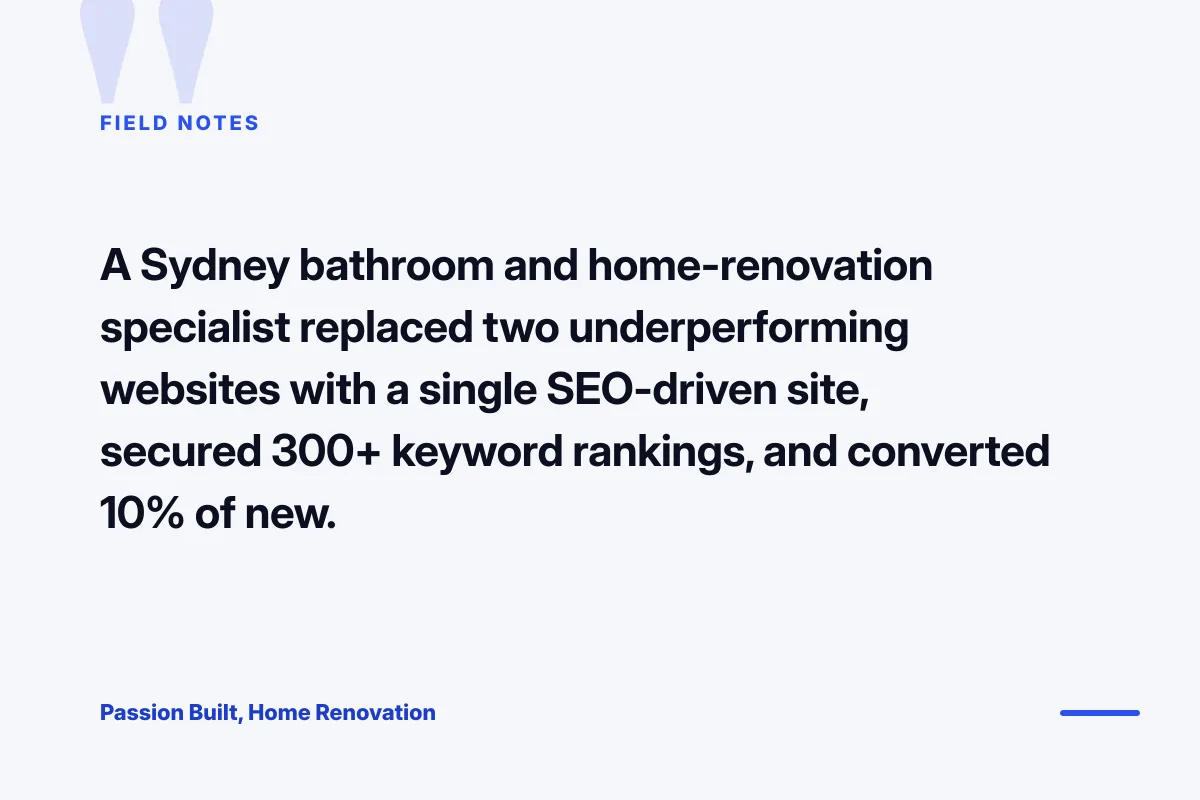
Passion Built, a Sydney-based bathroom and home renovation specialist, is the case study we walk small business owners through when they ask what a good picking process actually produces. The team came in running two separate underperforming websites, ranking for six keywords, and converting under one percent of visitors. Two prior agency picks had gone wrong. The owner ran our 12-question rubric on us during the sales call, scored us honestly, and signed based on the answers.
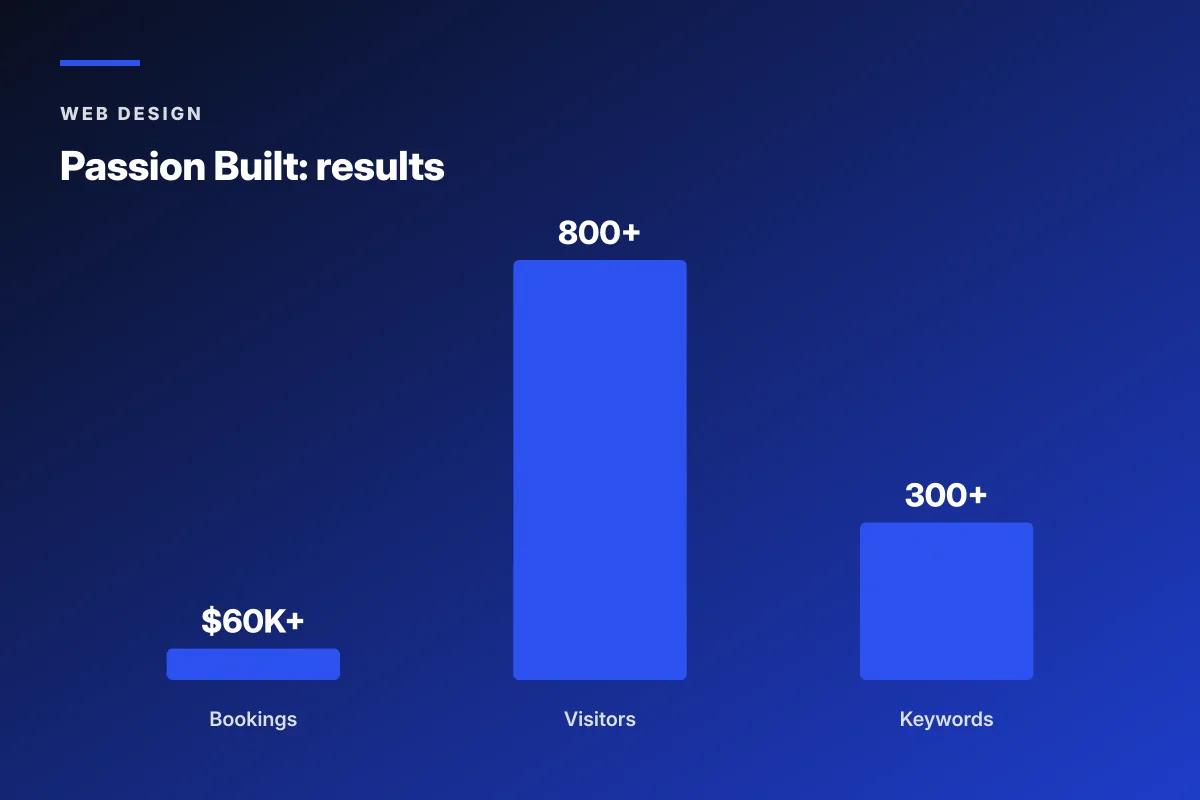
We consolidated the two sites into one SEO-driven build, rewrote every service page around real renovation customer language, and rebuilt the booking flow to work cleanly on mobile. Twelve months after launch, Passion Built ranked for more than 300 competitive keywords, drew more than 800 monthly visitors, and generated over $60,000 in renovation bookings directly from the new site, SEO, and advertising work. The 10 percent conversion rate on new visitors was 10 times the baseline. Read more about the responsive web design services that carried this rebuild.
What the owner did right during the picking
The owner ran the 12-question rubric on three vendors. Scored honestly. Two vendors deflected the ownership and exit questions. The third answered every question with a specific number. The owner did not pick on price. The owner picked on scoring. The vendor with the highest score was 15 percent more expensive than the lowest and cleared 11 of 12 rubric points against 6 of 12 for the runner-up. That single decision saved the project. Owners who pick on score rather than price consistently build better sites.
What launched inside the promised window
Discovery and copy strategy in week one and two. First design comp on week three, with feedback returned inside 48 hours. Second design comp on week four. Development in weeks five and six with the client reviewing copy at the same time. Quality-assurance testing on mobile and desktop through week seven. Launch in week eight. Every milestone landed inside the promise. The owner used the sales call rubric as a filter and got the result the rubric predicted. That is the whole point of picking on score.
What to do the week after you pick the web design vendor
Signing the contract is not the end of the picking. The first week of the engagement decides whether the vendor works out. Owners who set clear terms in week one get clean projects. Owners who set nothing get scope creep, missed deadlines, and finger-pointing at launch every time.
Five actions in the first week protect the project and the relationship. Every one takes under an hour. Every one prevents a specific failure mode that shows up in weeks four through eight when scope pressure builds. Run all five.
Confirm the launch date, the milestone chart, the payment schedule, the point of contact, and the shared workspace all in writing before the discovery call. Any confusion here compounds through the project. A vendor who happily confirms every detail is a vendor whose process is set. A vendor who resists writing things down is a vendor whose process is not set. Rethink the pick if that pattern shows up.
The first-week checklist
Sign the contract with every named clause protecting ownership. Send the deposit inside 48 hours. Confirm access to the domain registrar, hosting account, and existing site admin. Book the discovery call. Assemble the brand assets, existing photography, and existing copy in one shared folder. Confirm the point of contact on the owner side and the vendor side. Confirm the shared workspace (Notion, Asana, ClickUp, or a shared Google Drive). Six items, one week, all in writing. The project starts strong or does not start at all.
What not to do in week one
Do not send the vendor a Pinterest board of 40 designs. Do not send screenshots of five competitor sites and say “make it like these.” Do not change the scope inside the first week. Do not skip the discovery call to save time. Every one of these compounds into a bad design comp on week three, which triggers a rewrite, which slides the launch date. Trust the process the vendor sold you. If the vendor cannot handle you saying “make it match our brand and book customers,” the picking went wrong before week one.
Budget planning for how to choose web design services for small business needs
Owners running the picking without a budget in mind get quoted whatever the vendor thinks the owner can pay. Owners running with a firm budget get quoted the scope the vendor can fit inside the budget. The second conversation is always better. Set a budget before the first sales call. Share it during the second sales call. Watch which vendors work the scope to fit the budget and which vendors quietly walk away because the budget is under their floor.
The right budget for a first small business website in 2026 lands between $4,500 and $9,500 all-in year one for the semi-custom band. Businesses at less than $250,000 annual revenue should stay inside this range. Businesses at $250,000 to $1M can stretch to $9,500 to $15,000 all-in. Businesses over $1M annual revenue should budget $15,000 to $30,000 for a first serious site plus a real conversion program. Budget beyond that band belongs to enterprise, not small business.
Where to cut if the budget is tight
Cut the photography budget by using existing owner-taken photos or brand-styled illustrations for launch. Cut the ecommerce scope by launching with a booking or contact form and adding transactional pages in year two. Cut the page count from 12 to seven and add pages as the site produces revenue. Cut the custom illustration budget by using a licensed illustration pack. Every cut here saves $500 to $2,000 and delays a low-priority feature by 90 days. None of these cuts hurt the site’s ability to book customers in the first six months.
Where cutting hurts the site
Do not cut the copy budget. Generic copy books almost no customers regardless of how the design looks. Do not cut the SEO scope. A pretty site nobody finds books nothing. Do not cut the mobile page speed work. Slow sites lose 20 to 40 percent of paid ad clicks before the visitor reads a word. Do not cut the care plan. An unmaintained WordPress site breaks inside 12 months. These four are the load-bearing costs. Cut any of them and the site under-performs by a wide margin.
Building a long-term relationship after the initial build
The first build is the start, not the finish. Small businesses that keep the same design vendor for two to three years typically run two to three refresh cycles, three to six major feature adds, and dozens of small conversion improvements that compound into a doubling or tripling of booked customers over that window. The vendor who understands the business by month 18 does better work than the vendor who is just starting to understand it. Continuity earns compounding returns.
The relationship works when both sides invest. The owner shares real revenue and conversion numbers with the vendor monthly. The vendor delivers a written report with recommendations quarterly. Both sides review the working relationship at 6 and 12 months and adjust the scope. Relationdelivers that survive year one usually survive years two through five. Relationdelivers that fracture in year one always fracture on communication, not on quality.
The monthly cadence that keeps momentum
One 30-minute video call the first week of every month. Vendor shares the last month’s metrics (traffic, form submits, page-speed, uptime). Owner shares last month’s revenue and any operational changes affecting the site. Both sides agree on the two or three small improvements for the current month. Vendor delivers them by end of month. Report closes at month 30 to prep for the next call. This cadence catches problems inside 30 days and compounds small wins across a year into meaningful outcome improvement.
When to move on to a new vendor
Move on when three signals appear together. Support tickets take longer than 48 business hours to answer for two months running. The vendor stops sharing metrics without being asked. Quarterly recommendations dry up. Any one of these is a warning. All three together mean the vendor has moved on internally even if they have not said so. Migrate off cleanly using the ownership clauses in the original contract. The exit should take three to four weeks with the vendor’s cooperation, or five to eight without.
Making the final decision with confidence
By the time the owner reaches the final decision, the rubric has done most of the work. Two vendors remain. Both scored 10 or higher on the 12-question rubric. Both showed live client sites with real traffic. Both quoted a total year one cost in writing. Both explained the timeline. The final decision comes down to which vendor’s account lead felt like a real working partner and which vendor’s proposal read cleaner. Trust the answer that emerges from those two questions.
Sign the contract inside seven days of the final call. Delay past that and the vendor’s calendar fills. The vendor who was ready to start next week will be starting six weeks out by the time the delayed owner signs. Momentum is real. Every owner who signs inside seven days of the final call reports a smoother project. Every owner who takes three weeks to sign reports friction throughout. The picking is done. The signing seals the outcome. Trust the process the rubric produced.
What to do the day the contract signs
Send the signed contract and deposit the same afternoon. Book the discovery call for the following week. Share access to the current site, the current domain registrar, and the current hosting account. Introduce the vendor’s account lead to the owner’s team over email. Confirm the shared workspace. Every action inside two business days sets the tone that this project is going to move. Vendors match the client’s pace. A client who moves fast in week one gets a vendor who moves fast every week after.
Scoring the first 90 days post-launch
Site launched inside promised window. Mobile page speed under 2.5 seconds. Real form submits or booking calls arriving weekly. Owner has admin access to everything. Vendor responds to tickets inside 24 business hours. Monthly report arrived at the end of month one. Six items, six passes. Any vendor clearing all six earned the retainer. Any vendor missing two or more triggers the exit clause. The rubric predicted the outcome at the picking. The scorecard confirms it at 90 days. Read the guide to affordable web design services for small businesses for the pattern of the winning outcome shape.
Learning how to choose web design services for small business owners is not about picking the shiniest portfolio. The picking is a scoring exercise, run against a clear rubric, on a shortlist of two to three vendors who have already earned the phone call. Owners who follow the rubric build better sites in shorter windows at fairer prices. Owners who skip the rubric and pick on gut usually pay a 12 to 18 month tuition on a bad choice. If you want a picking partner who runs the rubric with you and stands behind every answer, the Redefine Web team is ready to talk. Start with the small business web design services page or book a discovery call directly through the site. The rubric is free. The site that follows is not free, but it earns its cost inside the first year.
Frequently asked questions
How much do web design services for a small business actually cost?
Web design services for small business owners in 2026 cost between $3,500 and $18,000 for the initial build, plus $50 to $300 a month for hosting and care. Solo consultants and franchise-style template shops sit at the low end, custom agency work with copy and conversion design lands in the middle, and full brand plus site plus paid search fit-outs sit at the top. Beware of anything under $1,500. A site that price is a templated shell with a rushed copy job and no support, and it usually gets replaced within 18 months.
How long should a small business website take to build?
A well-scoped small business site should launch in 6 to 10 weeks from kickoff, assuming the owner returns feedback inside 48 hours at each round. Anything over 12 weeks means the scope keeps growing or the vendor is understaffed. Anything under 4 weeks means it is a template drop with no discovery, no copy, and no testing. The 6 to 10 week window is the sweet spot for real discovery, real copy, real design, testing, and launch.
Should a small business use a template or a custom web design?
For most small businesses the answer is a semi-custom design built on a proven template framework, not a fully bespoke custom build. A pure template drop feels generic and rarely converts above 2 percent. A fully bespoke build costs three to four times more and rarely earns the premium back inside two years. The middle path buys a real starting framework, adds custom sections for the pages that book customers, and keeps the total under $10,000 for a first site.
What questions should I ask before hiring a web design service?
Ask five questions and listen to every answer. First, show me a live site you built that books more than 10 customers a month. Second, who owns the domain, files, and admin after launch. Third, what is the total first-year cost including hosting, care, and updates. Fourth, what happens if I want to move to another vendor in year two. Fifth, what is your process for testing and improving the site after launch. Any vendor that dodges any of these is not the right fit.
What red flags should I watch for when choosing a small business web design service?
Six red flags kill the deal every time. A quote under $1,500 for a real business site. A vendor that will not show a live client site with real traffic. A contract that keeps the domain or files in the vendor's name. No mention of hosting, security, or updates. A promise of first-page Google ranking in 30 days. Payment terms that ask for the full amount upfront before design starts. Any one of these turns up in the sales call and the answer is politely no.
Do I need SEO and copy included with my web design service?
Yes, and this is where most small business owners get burned. A pretty site with generic copy books almost no customers, and adding SEO plus copy as bolt-ons three months later costs twice as much as bundling them in from the start. Insist on copy, on-page SEO, and page-speed work inside the build scope. Read the internal Redefine Web guide to affordable web design services for small businesses for the copy patterns that book customers on a first visit.
Can a small business owner build the site themselves and save the money?
The owner can, but the math usually does not favor it. A small business owner earning $75 an hour who spends 80 hours learning Wix, choosing a template, writing copy, sourcing photos, and troubleshooting has spent $6,000 in time on a site that would have cost $5,000 done for them by a vendor who delivers it in six weeks. The DIY path only wins when the owner already knows the tools and the business is pre-revenue. Every other case is a false economy.
Book your free 30-minute strategy call.
No spam, no sales rep. We use your email to schedule your call with a senior strategist. That is it.
More from the blog
View all articles → Web Design
 Core Web Vitals Healthcare Websites Actually Need to Book Patients
Read article Web Design
 Professional Services Website Design Best Practices for 2026
Read article Web Design