
Influencer Marketing for Pet Products Creator Playbook
- Pet creators pay back at 40 to 65 percent lower cost than paid.
- Seed 200 to 400 creators before paid tier decisions.
- Use per-creator codes plus UTMs plus a weekly dashboard.
- FTC disclosure and vet-claim guardrails go on every brief.
- Ambassador retainers run $600 to $4,500 monthly per creator.
- Why Influencer Marketing for Pet Products Works So Well
- Sourcing Pet Creators for a Real Program
- Seeding Versus Paid in Influencer Marketing for Pet Products
- FTC Disclosure Rules Every Pet Brand Has to Follow
- Tracking Creator Programs Inside Your Shopify Stack
- Content Formats That Convert Pet Audiences
- Category Examples Inside Influencer Marketing for Pet Products
- How Mission Pet Health Grew With Influencer Marketing for Pet Products
- Managing Creator Relationships Past the First Quarter
- Budget Planning for Influencer Marketing for Pet Products
- Common Mistakes in Influencer Marketing for Pet Products
- Where Influencer Marketing for Pet Products Fits Your Stack
You already know your pet brand’s Meta account is paying more per acquired customer than it did two years back. Influencer marketing for pet products is the retention-adjacent acquisition layer that quietly earns the trust paid social keeps renting on a monthly basis. Pet creators sit on tightly bonded niche audiences (bully-breed owners, senior-dog rescuers, small-mammal parents, exotic reptile keepers) where a single reel from a trusted account outperforms a $4,000 test budget on a cold prospecting campaign. This read walks the creator playbook our team runs on live DTC pet brand accounts across treats, food, oral care, subscription boxes, and grooming, from sourcing the right pet accounts through the seeding versus paid decision, FTC disclosure rules, tracking setup, and real category examples our team measures monthly on Klaviyo and Shopify dashboards. Every rule and number below comes off client work our team reads weekly, not off a Shopify blog post. Finish this read with a written 90-day priority order for a real creator program.
Why Influencer Marketing for Pet Products Works So Well
Influencer marketing for pet products earns 40 to 65 percent lower cost per acquired subscriber than paid social because pet creator audiences behave like tightly bonded communities rather than broadcast audiences. A rescue account with 82,000 followers converts sharper than a general dog page with 900,000 followers on the same offer.
Niche Audiences Behave Like Communities
You pull sharper conversion on a 40,000-follower bully-breed rescue account than on a 900,000-follower general dog page in eight cases out of ten. The reason is signal density. A bully-breed audience knows exactly which supplement dose fits a 68-pound dog with joint issues. They already ask each other about food sensitivity in the comments. A well-placed treat sample from a small-batch brand carries the same weight as a vet recommendation for that audience. You buy the community trust that already exists, not a generic dog demographic.
Retention Payback Beats Paid Prospecting
Blended customer acquisition cost on paid social keeps climbing 15 to 30 percent year over year across pet categories our team operates. A creator seeding program pays back at 40 to 65 percent lower cost per acquired subscriber than a cold prospecting Meta campaign on the same offer. The math holds because a creator’s audience already self-selected into the specific pet type. You skip the top-funnel qualification burn a paid prospecting audience needs. Retention rate at 90 days on creator-acquired subscribers usually beats paid-acquired subscribers by 6 to 12 points across treats, oral care, and supplements.
Sourcing Pet Creators for a Real Program
Sourcing is the layer most pet brands get wrong on the first attempt. Founders reach for the biggest dog account they can find and pay $8,000 for a single post that quietly converts at 0.3 percent. A real sourcing pass builds a working roster of 40 to 120 pet creators across follower tiers, animal types, and content angles before any outreach opens. The roster reads back to the specific product line, not to a generic pet category.
Pet Creator Types Worth Building Into a Roster
A working pet roster carries five creator archetypes running against your product. Named-pet accounts like @popeyethefoodie or @tuckerbudzyn build brand affinity through the dog’s personality. Dog trainer accounts on TikTok pull authority for treats and enrichment toys. Vet creators on Instagram convert supplements and oral care faster than any other type. Rescue and adopter accounts move ethically-anchored subscription boxes. Breed-specific accounts (French bulldog, senior labrador, small mammal) open hyper-niche category slots. You want 8 to 20 of each type on your active roster.
Tools and Sourcing Rhythm
Your sourcing stack runs on three tools working together. Modash or Grin for scaled discovery against pet keyword filters and engagement rate floors. Manual TikTok search on niche hashtags (#seniordogsoftiktok, #reactivedogtok, #frenchietok, #reptilesoftiktok) for creators who never surface in databases. A saved Instagram folder for accounts you spot organically. Every week you add 10 to 20 new creators to the roster and mark last outreach date, response, and content status against each one. The HubSpot influencer marketing guide covers the wider sourcing rhythm across categories.
Seeding Versus Paid in Influencer Marketing for Pet Products
The seeding versus paid decision inside influencer marketing for pet products drives 60 to 70 percent of the program’s return. Seeding sends free product to creators with no post required, betting on organic content from the ones who genuinely like the product. Paid pays a flat fee for scoped deliverables against a brief. Both work. They pay back on different math.
| Program type | Typical spend | Post rate | Cost per post | Best for |
|---|---|---|---|---|
| Cold seeding, 100 boxes | $1,800 to $3,500 | 18 to 32 percent | $50 to $120 | Treats, toys, low-cost consumables |
| Warm seeding, 40 boxes | $1,200 to $2,400 | 55 to 78 percent | $40 to $75 | Supplements, oral care, curated relationships |
| Paid micro (10K to 100K) | $150 to $900 per post | 100 percent | $150 to $900 | Subscription boxes, launches, breed niches |
| Paid mid (100K to 500K) | $800 to $4,500 per post | 100 percent | $800 to $4,500 | Category authority, food, premium supplements |
| Paid macro (500K plus) | $5,000 to $30,000 per post | 100 percent | $5,000 to $30,000 | Brand-level launches, PR moments, category leaders |
Your first 90 days almost always start on cold and warm seeding. You need a working sample of 200 to 400 creators receiving product before you know which ones convert against your specific offer. Paid budget rides on top of the seeding data once conversion patterns become clear. Most pet brands our team operates land on a 60/40 split between seeding budget and paid budget after the first two quarters. The Influencer Marketing Hub pet creator overview is a useful outside read for category benchmarks.
Small niche pet accounts convert sharper than big general dog pages. Search a niche like your customer's breed on Instagram, DM the top 5. That's your seeding list.
FTC Disclosure Rules Every Pet Brand Has to Follow
Disclosure discipline is the layer founders skip until an FTC warning letter shows up on the office manager’s desk. The rules read simple. If a creator gets free product, an affiliate commission, or a paid fee from your brand, the endorsement has to carry a clear and conspicuous disclosure inside the post itself. The 2023 revised FTC Endorsement Guides tightened enforcement across TikTok, Instagram, and YouTube and raised the bar on what counts as clear.
What Counts as Clear and Conspicuous
A #ad or #sponsored tag placed above the fold in the caption. A verbal callout inside the first three seconds of a video. The Instagram Paid Partnership label active for paid work. TikTok’s Branded Content toggle switched on. A #gifted tag on any seeded product post even without a paid arrangement. Vague terms like #partner or #collab buried in a caption’s fifth line do NOT clear the bar anymore. Your brief includes the specific disclosure requirement, the format, and the placement expectation. Read the FTC endorsement guides Q and A before a single creator agreement gets signed.
Vet and Health Claim Guardrails
Pet supplements, oral care, and functional treats sit under a second layer of scrutiny beyond FTC disclosure. Your brief cannot ask a creator to promise the product cures anything, prevents disease, or replaces veterinary care. Vet creators need to keep their state licensing rules front of mind, which usually means their scope stays inside general education instead of specific product prescriptions. A brand that lets a creator claim a dental chew prevents periodontal disease invites both an FTC challenge and a lawsuit. Every brief carries an approved language list and a banned language list at the top.
Tracking Creator Programs Inside Your Shopify Stack
Tracking sits at the center of any creator program past the first 90 days. A brand that runs 200 seeded creators without a per-creator tracking layer cannot tell which ones drove subscribers versus which ones sat on a shelf. The three-part tracking rhythm most pet brands our team runs uses per-creator discount codes, per-creator UTM parameters on affiliate links, and a shared reporting dashboard the whole team reads weekly.
Per-Creator Codes and UTMs
Every creator on the roster gets a unique discount code (BUDZ10, POPEYE15, VETMARIA20) tied to their name or handle. Shopify’s discount reporting rolls up revenue per code monthly. Every affiliate link gets a UTM tagged with utm_source, utm_medium, utm_campaign, and utm_content set to the creator handle. Google Analytics 4 attributes revenue per creator through the acquisition report. The paired code and UTM catches both the buyer who typed the code at checkout and the buyer who clicked the link but did not type the code.
The Weekly Dashboard
Your weekly creator dashboard carries eight columns per active creator. Handle, follower count, posts published this month, code redemptions, affiliate clicks, attributed revenue, cost per acquired subscriber, and retention rate at 60 days. The team reads it every Monday morning during the marketing standup. Creators who converted below your target cost per acquired subscriber move onto the paid tier. Creators who never posted after seeding get dropped from the next box round. That single discipline pushes program return on investment 40 to 70 percent higher inside the second quarter.
Content Formats That Convert Pet Audiences
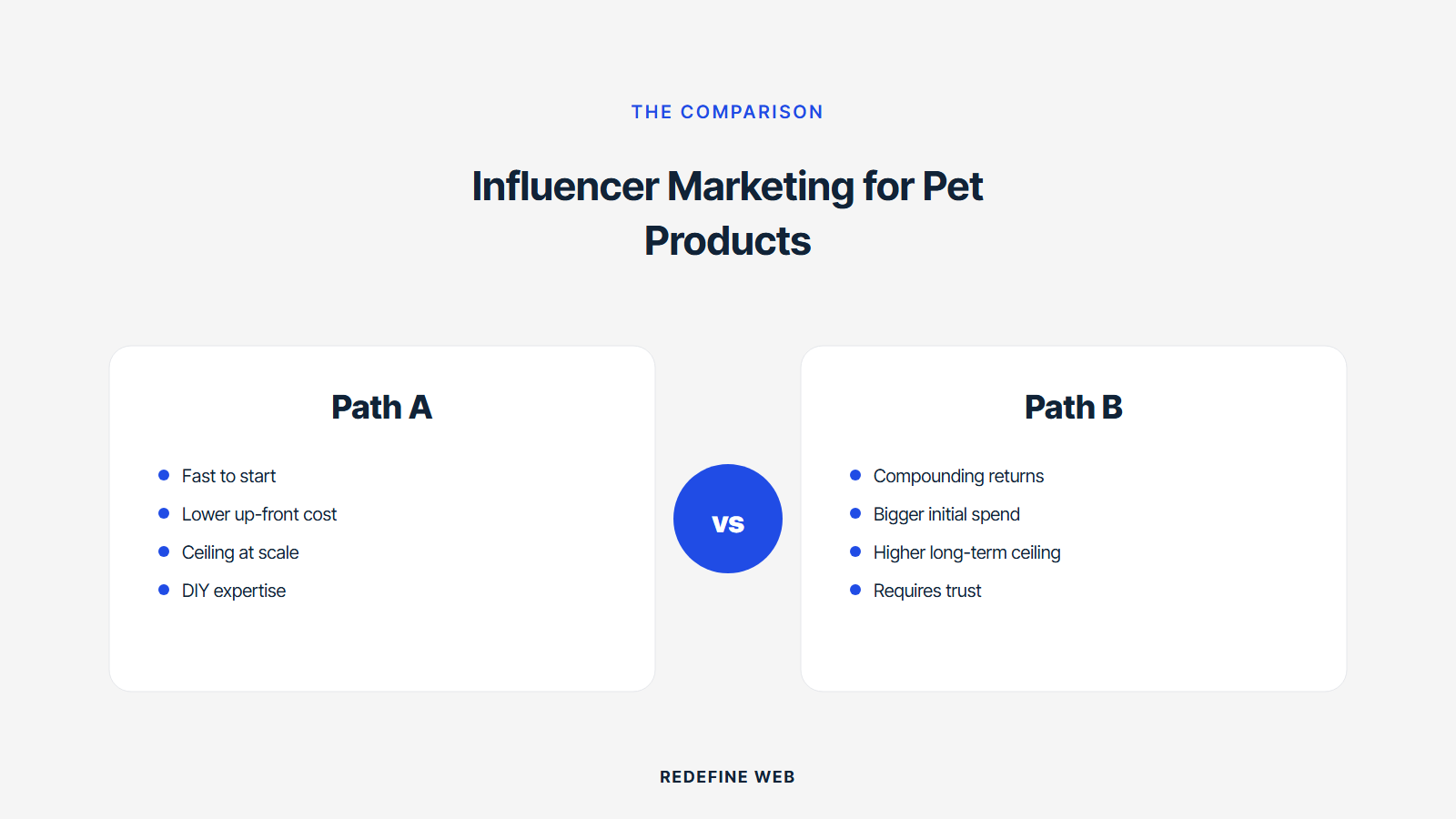
Not every creator format converts pet audiences at the same rate. The format that pays back a treat brand differs from the format that pays back a supplement or an enrichment toy. Your brief specifies the format, the hook, the on-camera pet behavior, and the call to action for each creator based on the product line.
- First-taste reaction reel · works for treats, food, dental chews, functional supplements with tasty carriers
- Before and after enrichment · works for puzzle toys, snuffle mats, chew toys, reactive-dog training aids
- Vet or trainer explainer · works for supplements, oral care, senior-dog products, prescription-adjacent items
- Subscription unboxing · works for BarkBox-style monthly boxes, seasonal boxes, breed-specific curations
- Rescue transformation story · works for foundational products (bed, collar, food) tied to a redemption narrative
- Day-in-the-life integration · works for repeat consumables where the product weaves into a normal routine
- Founder plus creator interview · works for premium supplements and functional treats where sourcing story matters
Your creative direction reads back to the specific format for every creator. A brief that says make a fun post about our new treat gets you generic phone-in content. A brief that says a first-taste reel with your dog’s honest reaction, hook line delivered off camera in the first three seconds, product visible against a neutral background in the second beat, and the discount code overlaid at the end gets you sharper conversion. The affiliate program layer sits alongside this creator program. Read the wider affiliate rhythm inside the affiliate marketing pet products deep read.
Category Examples Inside Influencer Marketing for Pet Products
Category examples inside influencer marketing for pet products get more useful when they are pinned to a real product line, a real creator tier, and a real revenue outcome our team measured on live client dashboards. The examples below come off our own work across treats, oral care, and small-mammal subscription boxes.
Small-Batch Treat Brand at $1.2M Yearly Revenue
A single-flavor beef liver treat brand engaged our team to build a creator program from a standing start. The first 90 days sent 240 seeded boxes across cold and warm outreach against a bully-breed and senior-dog roster. Post rate landed at 26 percent cold and 68 percent warm. Cost per acquired subscriber landed at $18 against a paid Meta baseline of $42. The program drove 340 new subscribers inside the first quarter and pushed 60-day retention on creator-acquired subscribers to 72 percent against a paid baseline of 58 percent.
Dental Chew Brand With Vet Creators
A functional dental chew brand at $2.6M yearly revenue engaged our team on a vet-creator layer sitting above their existing seeding rhythm. The roster ran 22 vet creators on Instagram at $400 to $1,800 per post, plus 8 dog dentists doing longer YouTube explainer content at $2,400 to $6,000 per video. The vet layer drove 14 percent of monthly attributed revenue by month four, with cost per acquired subscriber at $28 against a paid social baseline of $61. Retention at 90 days landed at 78 percent versus 52 percent from Meta prospecting.
How Mission Pet Health Grew With Influencer Marketing for Pet Products
Mission Pet Health, a veterinary group covering 400-plus clinics, engaged Redefine Web in 2023 with a fragmented account structure and a paid mix carrying most acquisition. The pet parent audience across the clinic footprint held obvious creator potential because trusted-vet content converts supplements at rates paid social rarely matches.
The creator rebuild started with a 90-day sourcing pass against 160 vet, dog trainer, and rescue accounts running on Instagram and TikTok. Seeding sent 200 boxes across the first quarter with a Modash-tracked outreach rhythm and per-creator discount codes on every box. Paid tier ran 24 creators in the micro and mid tier at $400 to $2,800 per post. Tracking moved onto per-creator discount codes and UTMs feeding a Looker Studio dashboard the whole team read weekly. Content direction pulled off product-hero shots onto scenario-anchored reels showing the product inside a real pet parent’s morning routine with a real dog or cat.
Results across the 2023 to 2024 window. Leads climbed 54 percent across the 400-plus clinic footprint on the paired paid plus creator plus retention rebuild. Non-branded search traffic climbed 74 percent through the content and creator content assets being repurposed as landing page proof. Cost per acquired customer through creators landed 11 percent lower than the paid social baseline on the same offer windows. The creator program went from an ad-hoc PR line item to a compounding acquisition channel that shared the paid social load through the entire calendar.
Every pet founder eventually reaches the Monday morning where a $12,000 macro post from a golden retriever account with 900,000 followers drives 41 subscribers, while a $180 seeded treat sample sent to a scruffy-terrier account with 8,400 followers drives 89 subscribers, and the founder learns for the third time this year that follower count and revenue share are not on speaking terms. Somewhere in the DMs of every pet brand, a 12,000-follower reptile account is quietly outperforming a golden retriever with a book deal.
Managing Creator Relationships Past the First Quarter
Relationship discipline separates a one-off seeding blast from a compounding program. The creators who posted in month one are the same ones you want posting in month four, month eight, and month twelve. Every returning post builds audience familiarity with the brand and pushes conversion rate on their audience higher. Losing a productive creator through poor communication burns months of trust and forces a fresh sourcing pass on that audience segment.
The Communication Cadence That Works
Your creator relationship manager owns weekly outbound touches on the active roster. A short DM checking on the pet, a note about new product coming to their pet’s flavor preference, a heads-up on a seasonal box shipping their way. Pet creators respond to the brand caring about the specific animal, not to a monthly newsletter blast. A treat brand that DMs a follow-up asking how the dog liked the new peanut butter formula gets a repeat post 40 to 60 percent more often than a brand that ships product without a check-in.
Long-Term Ambassador Structure
Your top 12 to 20 creators graduate from ad-hoc post work into a formal ambassador structure with monthly retainer payments, quarterly product exclusivity windows, and co-created product moments. Ambassador retainers run $600 to $4,500 monthly depending on tier, with a scoped deliverable of 2 to 6 posts per month plus stories. The ambassador tier gives you predictable content output for the campaign calendar and locks the creator out of competing brands in the category. Read the wider marketing rhythm inside the pet product marketing agency deep read that covers the paid, creator, and retention stack end to end.
Budget Planning for Influencer Marketing for Pet Products
Budget planning inside influencer marketing for pet products sits on stage-appropriate math. Your first 90 days on a launch account run different math from an established brand at $3M yearly revenue rebuilding an underperforming program. The one common rule across stages: budget the program on a trailing 90-day return on investment basis, not on a single month’s return.
Launch and Early-Stage Brands Under $500,000 Yearly Revenue
Your first 90-day creator budget lands at $3,600 to $9,000 total. Product cost of 200 seeded boxes at $8 to $18 landed cost each. Modash or Grin tool subscription at $250 to $600 monthly. Zero paid creator fees in month one. Zero macro tier engagement. The whole spend goes into seeding and warm outreach against a working roster of 40 to 80 creators. You measure post rate, code redemption, and cost per acquired subscriber weekly, and you keep the seeding rhythm going every single week without exception.
Growth Brands at $1M to $10M Yearly Revenue
Your quarterly creator budget lands at $18,000 to $85,000. Seeding continues at $6,000 to $18,000 per quarter with 400 to 800 boxes shipped. Paid micro tier at $8,000 to $28,000 per quarter against 30 to 80 creator posts. Paid mid tier at $4,000 to $30,000 per quarter against 4 to 10 higher-authority creators. Ambassador retainers at $8,000 to $22,000 per quarter across a 6 to 12-creator retained roster. The mix earns 15 to 25 percent share of monthly revenue by quarter four when the tracking discipline stays tight. See the wider pet-brand budget rhythm inside the how to market pet products deep read.
Common Mistakes in Influencer Marketing for Pet Products
Common mistakes inside pet creator programs cluster around a handful of predictable patterns our team sees on every audit. Fixing any two of them usually pushes program return up 40 to 80 percent inside a quarter. The audit reads back to a checklist the brand marketing lead runs quarterly against the working roster.
Chasing Follower Count Instead of Engagement
You know the story. A founder gets excited about a 900,000-follower general dog account. The post costs $8,000. The 30-day attribution shows 47 subscribers acquired and 12 code redemptions. Meanwhile a $180 seeded box sent to a 6,000-follower senior-cocker-spaniel rescue drove 68 subscribers in the same window. Engagement rate, audience niche match, and creator authenticity beat follower count in nine cases out of ten across pet categories. Your roster grades every creator on engagement rate against tier average, not on follower count alone.
Skipping the Brief and the Guardrails
A brand that sends product with no brief gets generic content that fails to convert. A brand that sends product with a 12-page brief gets rejected creators who bail on the arrangement. The right brief runs one page. Product name, three approved language points, three banned claims, disclosure requirement, format specification, hook line direction, and posting window. Every brief the team sends carries the vet-and-health-claim guardrail block at the top. Every returning creator sees the brief refresh quarterly with new product angles inside the same one-page format.
Where Influencer Marketing for Pet Products Fits Your Stack
Influencer marketing for pet products sits as the retention-adjacent acquisition layer of your marketing stack. Paid social sits above it as the volume prospecting layer. Email and SMS retention sit alongside it as the compounding revenue layer once the subscriber base grows. SEO and content sit underneath as the demand-generation layer. Your creator program threads through the whole stack because the same content assets get repurposed into paid social ads, retention email hero blocks, and category landing page proof.
Founders ready to build a real pet creator program from a working roster can start with a free 30-day plan of sourcing, seeding boxes, and tracking setup. That plan produces a written priority order before any retainer conversation opens. Whether the brand runs a starter DTC pet treat account under $500,000 yearly revenue or a scale account past $10M, anchoring on a working roster of 40 to 120 creators plus disciplined tracking plus stage-appropriate budget beats chasing the next macro post every quarter. Read the wider vertical view inside our pet products marketing hub for the full stack, then book a free audit call for a written 90-day plan.
Frequently asked questions
What is influencer marketing for pet products and why does it matter for DTC brands?
Influencer marketing for pet products is the acquisition channel where pet creators (named-pet accounts, dog trainers, vets on TikTok, rescue accounts) post about your product to their niche audience of pet parents. It matters because cost per acquired customer on paid social keeps climbing 15 to 30 percent year over year while creator programs pay back at 40 to 65 percent lower cost per subscriber on the same offer. Pet creator audiences behave like communities rather than broadcast audiences. Retention on creator-acquired subscribers beats paid-acquired subscribers by 6 to 12 points at 90 days across treats, oral care, and supplements.
How do you source the right pet creators for a working roster?
You build a working roster of 40 to 120 pet creators across five archetypes running against your product line. Named-pet accounts for brand affinity, dog trainers for treats and enrichment, vet creators for supplements and oral care, rescue and adopter accounts for subscription boxes, and breed-specific accounts for hyper-niche audiences. Your sourcing stack runs Modash or Grin for scaled database discovery, manual TikTok hashtag search for creators who never surface in databases, and a saved Instagram folder for accounts spotted organically. You add 10 to 20 new creators weekly and mark last outreach date, response, and content status against each.
Should you seed pet creators or pay them for posts?
Your first 90 days almost always start on cold and warm seeding rather than paid posts. Seeding sends free product to creators with no post required and pays back at $40 to $120 per organic post depending on cold or warm outreach. Paid tiers run $150 to $30,000 per post depending on follower size. You need a working sample of 200 to 400 seeded creators before you know which ones convert against your specific offer. Paid budget rides on top of seeding data once conversion patterns become clear. Most pet brands land on a 60/40 split between seeding and paid after the first two quarters.
What FTC disclosure rules apply to influencer marketing for pet products?
The 2023 revised FTC Endorsement Guides require clear and conspicuous disclosure on any endorsement where the creator receives free product, an affiliate commission, or a paid fee. That means a #ad or #sponsored tag placed above the fold in the caption, a verbal callout in the first three seconds of a video, the Instagram Paid Partnership label active for paid work, TikTok's Branded Content toggle switched on, and a #gifted tag on seeded product posts. Vague terms like #partner buried in a caption's fifth line do not clear the bar. Pet supplements and dental products carry additional health-claim guardrails against implying cure or prevention.
How much does a pet influencer marketing program cost across brand stages?
Launch brands under $500,000 yearly revenue run first 90-day creator budgets at $3,600 to $9,000 total, mostly seeding cost plus tools with zero paid creator fees. Growth brands at $1M to $10M yearly revenue run quarterly budgets at $18,000 to $85,000 split across seeding, paid micro, paid mid, and ambassador retainers. Ambassador retainers on top-tier creators run $600 to $4,500 monthly per creator with a scoped 2 to 6 posts per month plus stories. Every retainer engagement with our team runs on a six-month contract starting from $599 monthly with monthly plan reviews and a shared reporting dashboard the whole team reads weekly.
Book your free 30-minute strategy call.
No spam, no sales rep. We use your email to schedule your call with a senior strategist. That is it.
More from the blog
View all articles → Digital Marketing
 Dental Marketing Tips That Compound Into New Patients
Read article Digital Marketing
 Ecommerce Marketing Strategies That Drive Real DTC Revenue
Read article Digital Marketing