
How to Market Pet Products for DTC Founder Launches
- Positioning and category work happen before any paid channel spend.
- Channel mix maps to product category, not to founder preference.
- First 30 days build assets, day 31 turns on paid, day 61 builds retention.
- Launch budgets sit between $60,000 and $120,000 across the first 90 days.
- Content and creator engine compounds past paid across year two.
- What how to market pet products actually means for a DTC founder
- Market research founders skip when learning how to market pet products
- Positioning that separates a launch brand from the pet aisle
- Channel mix by category inside how to market pet products
- First 30 days of a how to market pet products launch playbook
- Days 31 to 60 of how to market pet products (paid and affiliate ramp)
- Days 61 to 90 of how to market pet products (retention loops)
- What budget do you need to market pet products at launch
- Content and creator engine that compounds past ads
- A real how to market pet products engagement in production
- Where how to market pet products fits your DTC growth stack
You are twelve weeks from launching a pet DTC brand. The Shopify theme is picked, the freight-broker quote is signed, the first 4,000 units are in the fulfillment warehouse, and the founder Slack has a channel titled marketing that contains three links to competitor Meta ads and a screenshot of a Reddit thread. Learning how to market pet products at launch is the moment where most first-time founders quietly light $80,000 on Meta prospecting inside 90 days and cannot explain what they got back.
This guide is the plan we run with pet DTC founders on retainer. What market research to do before spending a marketing dollar, how to position a launch brand against a $147 billion pet aisle that already stocks the shelf, which channels convert by product category (food, treats, toys, accessories), and the first 90-day playbook that gets a launch brand to a repeatable acquisition motion by day 91. Every number here comes from real 2024 and 2025 retainer engagements our team runs weekly.

What how to market pet products actually means for a DTC founder
How to market pet products at the launch stage is a positioning question, a category question, and a math question stacked in that order. It is not a channel question yet. Founders who open with which Meta creative should we test first skip the positioning work and pay for it in low return on ad spend.
The three questions before any channel gets touched
The three questions we walk every launch-stage founder through inside the first two weeks. What specific pet parent is buying the product on the first order, described in a sentence with a species, a life stage, a household income band, and a purchase trigger. What existing product on the pet aisle shelf loses a customer to this brand and why. What repeat purchase interval the product creates over the first 90 days after the first order. Founders who cannot answer all three inside two weeks are not ready to spend money on paid acquisition yet. Founders who can answer all three cleanly usually reach payback on cost of acquisition inside month five.
Why category matters more than channel
A fresh food brand, a hard treat brand, a plush toy brand, and a stainless bowl accessory brand each need a different channel mix because their buyers behave differently at the moment of purchase intent. Fresh food converts on subscription-driven paid social with a strong email nurture. Treats convert on Amazon plus impulse-driven display and retargeting. Toys convert on TikTok and creator content. Stainless accessories convert on search intent and gift guides at Q4. Trying to run one channel mix across all four categories is the mistake that produces a marketing spend that never lands. Our ecommerce digital marketing strategy channels guide covers the broader channel logic that sits under this category-specific work.
Market research founders skip when learning how to market pet products
Market research at the launch stage is not a 40-page slide deck. It is four artifacts that fit on one A4 page each and get updated quarterly through year two. Founders who skip these four spend the first six months of paid acquisition testing what a two-week research sprint would have told them for free.
The four research artifacts every launch needs
A shelf audit that photographs every competing product on the top three retail shelves plus the top ten Amazon subcategory listings, priced and positioned. A buyer interview log of 20 to 40 pet parents recruited through Facebook groups, breed subreddits, and rescue newsletters, each 25 minutes, focused on their last purchase decision. A pricing sensitivity table that compares your unit economics against three price bands (retail parity, 12 percent premium, 24 percent premium) with a floor tied to blended contribution margin. A jobs-to-be-done map that names three functional jobs and three emotional jobs the product does for the pet parent. These four artifacts feed every positioning and channel decision after them. Skipping any one produces a launch that guesses its way through the first two quarters.
What buyer interviews actually surface
Buyer interviews at the launch stage always surface the same three patterns and one surprise per project. The three patterns: pet parents research obsessively before the first order, they buy the first order at a lower price point than the second order, and they read at least two reviews from named pet parents before they trust a new brand. The surprise per project is the specific trigger that drove the last purchase, which is almost always different from what the founder assumed while designing the product. That surprise is what feeds the paid creative concepts we ship in month one. Our content marketing for ecommerce guide covers the pillar and distribution logic that scales this research into ongoing content assets.
Positioning that separates a launch brand from the pet aisle
Positioning in pet is a fight against a $147 billion American Pet Products Association reported category that already stocks every shelf. A launch brand that says premium ingredients or family-owned recipe loses that fight before the first ad runs. Positioning that wins names a specific problem the aisle underserves and points at a specific pet parent who feels that gap.
The one-sentence positioning frame
We run every pet launch client through the same one-sentence frame. For [specific pet parent] who [specific unmet need] our [product category] is the [product frame] that [specific outcome] because [proof point]. A fresh food brand for senior small-breed dogs whose owners cannot find portion-controlled fresh food at grocery weights. A calming treat for storm-anxious sporting breeds whose owners have tried three OTC options and want a natural formulation. A slow-feeder bowl for enthusiastic labradors whose owners are worried about bloat. Every winning positioning names a segment small enough that the founder can picture five specific customers by name inside week one.
Positioning that carries across every channel
Once the positioning sentence is locked, it carries across every channel touch: paid social hook, email subject line, product detail page hero, Amazon A+ content, packaging copy, creator brief. The consistency is what earns trust from a pet parent researching across seven tabs before the first order. Brands that let each channel drift into its own positioning language usually see a click-through rate that reads fine on the ad and a conversion rate that collapses at the product detail page. The American Pet Products Association industry trends report is the outside read every pet founder should keep on the desk while running positioning work, because it names the category shifts that reshape positioning windows every 12 to 18 months.
Founders spend 80k on Meta before answering who buys, why they switch, and how often they reorder. Write those 3 answers today. Ad spend waits.
Channel mix by category inside how to market pet products
Channel mix is where the category-specific logic pays for the market research work. Different pet product categories buy through different channels because the buyer decision moment happens on a different surface. Cramming every category into a single Meta-plus-Google mix is the reason most launch brands hit a ceiling at month four.
| Category | Anchor channel | Second channel | Retention driver | Realistic month-9 revenue share |
|---|---|---|---|---|
| Fresh food and functional food | Meta prospecting (subscription hook) | Email plus SMS | Subscription auto-ship | 52 to 68 percent of revenue on subscription |
| Treats and chews | Amazon plus Google Shopping | Meta retargeting | Retargeting plus loyalty | 28 to 42 percent of revenue on repeat |
| Toys and enrichment | TikTok organic plus TikTok Shop | Creator affiliate program | Seasonal launches | Bursty revenue tied to launches |
| Accessories (bowls, leashes, beds) | Google search plus Pinterest | Gift guide placements Q4 | Cross-sell to food buyers | Q4 spike 44 percent of annual revenue |
| Health and supplements | Vet clinic affiliate plus content SEO | Meta retention audiences | Subscription plus vet trust | 62 to 74 percent of revenue on subscription |
The table above is what a healthy channel split looks like for a launch brand by month nine, after the first 90-day playbook has stabilized. Founders who try to force fresh food into a treats channel mix, or toys into a supplements channel mix, usually see cost of acquisition run 2.4 to 3.8 times higher than the category benchmark. Category-specific channel work is not optional. It is the difference between a launch that reaches payback in month five and a launch that never reaches payback because the channel mix never matched what the buyer actually shops through.
Anchor channel decisions lock in the tracking stack too. Fresh food and supplements need server-side event tracking through Meta CAPI and Google Enhanced Conversions from day one because the subscription math depends on clean lifetime value attribution. Treats and accessories can start on the platform’s default pixel and add server-side later. Toys and enrichment often start on TikTok pixel only for the first 90 days and layer Google and Meta at month four once the launch content library seeds a steady audience.
First 30 days of a how to market pet products launch playbook
Days 1 through 30 of a pet DTC launch are a positioning and asset build phase, not a paid acquisition phase. Founders who turn on Meta prospecting on day one usually burn $12,000 to $28,000 of runway that a slower start would have kept in the bank. The first 30 days build the artifacts the next 60 days need.
What gets built in the first 30 days
The positioning sentence, locked in one meeting. The product detail page rewritten around that sentence, with three photo variations and a review-collection widget wired in. The email welcome flow (5 emails over 14 days) drafted and connected to Klaviyo or Postscript. The paid creative concepts (12 image concepts, 6 video concepts) shot with a real pet in a real home, not stock photography. The Amazon listing rewritten (if applicable) with A+ content that mirrors the store positioning. The founder story page written for the About link that every pet parent clicks before the first purchase. This artifact set is what unlocks paid channels in day 31.
What gets validated before day 31
Small validation buys land inside the first 30 days on very small budgets. $200 to $600 in Meta boost buys to test three positioning hooks against friends-and-family lookalike audiences. $150 to $400 in TikTok Spark Ads to test whether the founder-narrated product video pulls a hook rate above 25 percent. Zero paid Google spend yet because search demand does not exist for a brand nobody has heard of. The validation buys are not looking for return on ad spend at this budget. They are looking for which hook wins the click-through comparison so day 31 spends against the winner.
Days 31 to 60 of how to market pet products (paid and affiliate ramp)
Days 31 to 60 turn the validated hooks into a real paid motion. Meta prospecting scales from $200 daily to $800 to $1,600 daily depending on category. TikTok Spark Ads scale to $400 to $900 daily. Google Shopping switches on if the product falls in the Shopping-eligible categories. Affiliate outreach begins to the first cohort of vet clinics, breeders, and creators.
Meta scaling rules that hold across pet
Meta scaling rules that consistently hold for pet launch brands. Never scale a campaign more than 20 percent per 48 hours in the first 60 days. Never kill a creative concept before 3,000 impressions of served data. Never turn off a campaign that is producing a cost per purchase within 130 percent of target while creative testing is still active. Every winning creative concept gets three variants (color grade, hook order, caption length) tested in parallel to lock the best combination before scaling. Founders who ignore these rules usually break scale inside 90 days and blame the platform when the account learning breaks. Disciplined testing at this scale is what separates launches that break through $500,000 monthly revenue from launches that stall at $180,000 and blame the platform.
Affiliate outreach starts small
Affiliate outreach in the first 60 days is a warm-network motion, not a cold-outreach motion. Ten vet clinics closest to the fulfillment center, five breeders inside the founder’s network, and 20 pet creators tagged in competitor content are the entire universe of week five to eight outreach. The point is not to build a 400-creator program by day 60. The point is to sign 8 to 15 partners who prove the tracking stack works and produce the first cohort of case studies for the wider recruitment push starting day 61. Our pet product marketing agency guide covers the wider retainer motion that runs both paid and affiliate in parallel.
Days 61 to 90 of how to market pet products (retention loops)
Days 61 to 90 shift focus from first-order acquisition to second-order retention. Every pet DTC brand loses 50 to 70 percent of first-order buyers before month three unless the retention loops are built in the first quarter. Subscription mechanics, email flows, and community touches all get wired in this window.
Subscription mechanics that actually work
Subscription mechanics for pet split into three patterns. Auto-ship at a 12 percent discount is the default option that captures 32 to 48 percent of fresh food and supplements buyers on the first order. Skip-a-shipment must exist and must be visible in the customer portal at three clicks or less, because pet parents who cannot skip cancel instead. Referral-a-friend credits at $15 to $25 per referral run through Yotpo or Loyalty Lion produce 8 to 14 percent of new customer acquisition by month six for brands that seed the mechanic through the welcome email flow. Programs that skip any one of the three usually watch subscription revenue plateau at 22 to 28 percent of monthly revenue instead of climbing to the 52 to 74 percent range the category rewards.
Email flows for the first 90 days
Email flows for a pet launch cover six triggered sequences by day 90. A welcome flow (5 emails over 14 days). An abandoned cart flow (3 emails over 48 hours). A post-purchase flow (4 emails over 30 days). A win-back flow (3 emails between day 45 and day 75 for lapsed buyers). A subscription reminder flow (2 emails before the next auto-ship). A birthday flow for the pet, which sounds silly but pulls a 34 to 44 percent open rate because pet parents love it. All six live in Klaviyo, share a unified template, and integrate with the customer portal to skip when a subscription is paused. The HubSpot ecommerce marketing strategy guide covers the wider email retention logic that sits under this flow set.
What budget do you need to market pet products at launch
A first-90-days pet DTC launch typically needs $45,000 to $180,000 in blended marketing spend depending on category. Fresh food and supplements launches sit at the top of that range because subscription math demands more paid volume to fill the cohort. Toys and accessories launches sit at the low end because organic TikTok can carry more of the acquisition load.
- Weeks 1 to 4 (research and asset build): $2,000 to $8,000 for photography, Klaviyo setup, and validation buys.
- Weeks 5 to 8 (paid ramp): $15,000 to $60,000 for Meta prospecting, TikTok Spark Ads, and Google Shopping starter budgets.
- Weeks 9 to 12 (retention and affiliate): $8,000 to $40,000 for scaled paid, first-cohort affiliate payouts, and email tooling.
- Creative production month one: $6,000 to $18,000 for founder-narrated video, product photography, and 12 to 24 static concepts.
- Tooling and platforms first 90 days: $2,400 to $7,200 for Klaviyo, Refersion, Yotpo, and analytics infrastructure.
- Retainer or in-house talent: $5,400 to $27,000 for either a launch retainer at $1,800 to $4,800 per month or one full-time growth hire during the launch quarter.
Founders who try to launch on under $30,000 blended spend across the first 90 days usually cannot generate enough first-order data to prove which channel and creative combination scales. Founders spending over $200,000 in the first quarter usually pour money into channels before the positioning work is done and see cost of acquisition run 2 to 3 times higher than a slower, more disciplined start would have produced. The sweet spot for most pet DTC launches sits between $60,000 and $120,000 across the first 90 days, tuned by category and by starting inventory.
Content and creator engine that compounds past ads
Paid acquisition alone does not build a durable pet DTC brand. Every launch that reaches $2M annualized revenue past year one has a content and creator engine running alongside the paid motion. That engine is what carries the brand through paid platform cost inflation, iOS tracking changes, and the seasonal Q1 slowdown every pet founder underestimates.
Content pillars that pull organic search
Content pillars that consistently pull organic search traffic for pet DTC brands: breed-specific care guides (Golden Retriever nutrition, French Bulldog joint health, Maine Coon dental care), symptom-driven guides (why is my puppy scratching, when to switch to senior food, storm anxiety in sporting breeds), and comparison content (fresh vs kibble, glucosamine vs green-lipped mussel, silicone vs stainless bowls). A launch brand that publishes 8 to 12 pillar articles at 2,400 to 3,600 words each across the first 90 days seeds an organic search engine that starts pulling traffic by month six and compounds through year two.
Creator seeding that pays back
Creator seeding for pet DTC works when the creator matches the specific pet persona the positioning names. A senior small-breed fresh food brand seeds to Yorkie parents, Papillon parents, and Chihuahua parents on Instagram and TikTok. A calming treat for storm-anxious sporting breeds seeds to Labrador retriever parents in thunderstorm-heavy states like Florida and Texas. Persona-matched seeding produces a 4 to 7 times higher content posting rate versus generic pet creator seeding because the product actually fits the creator’s audience. Our marketing ideas for ecommerce brands guide covers the wider creative and channel ideas that sit under this creator work.
Every pet DTC founder meeting eventually reaches the moment where the co-founder pulls out their phone and shows the marketing team a video of their own dog attempting to unbox the product on the kitchen floor. The dog gets distracted by the packing peanuts. The founder narrates for 90 seconds about ingredient sourcing. The video has 22 views on the founder’s private Instagram. Everyone agrees it is charming. Nobody wants to run paid budget behind it. Somewhere in the archive of every pet DTC brand, a 90-second dog-and-packing-peanuts video sits quietly generating more meetings about itself than actual purchases of anything.
A real how to market pet products engagement in production
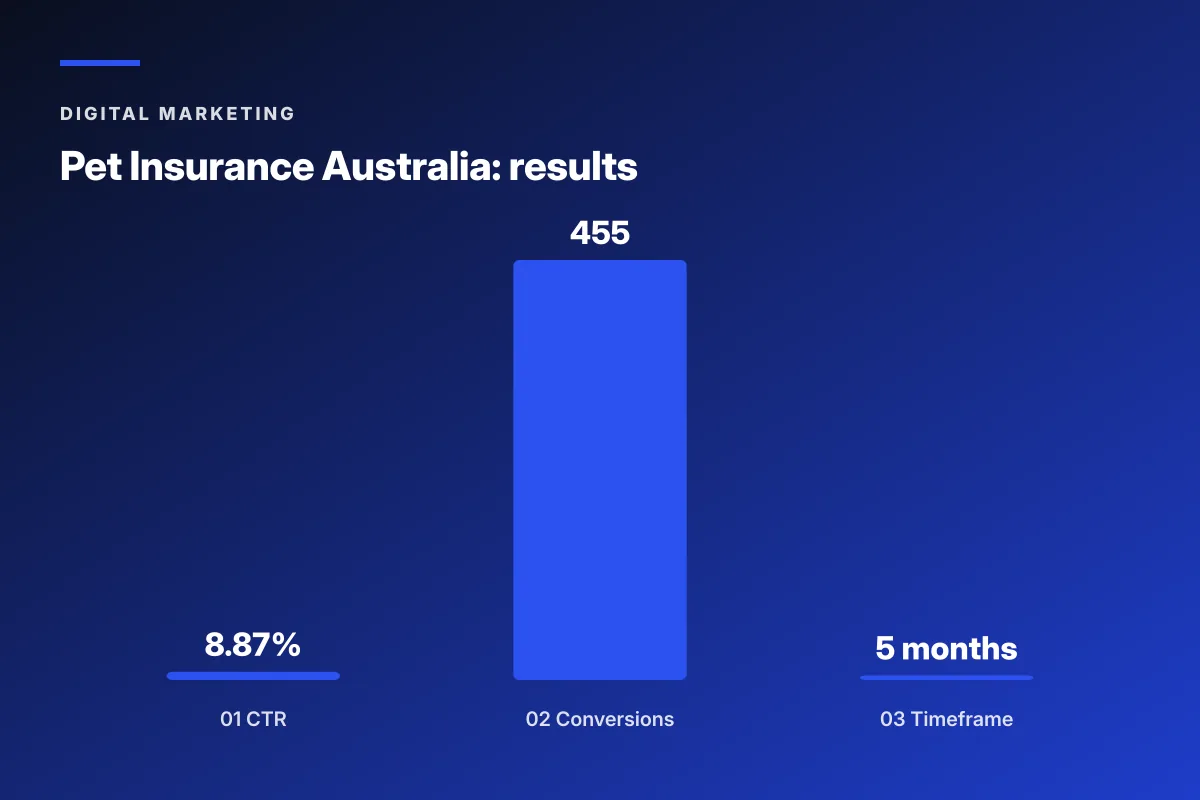
Pet Insurance Australia came to our team as an adjacent pet vertical with a Google Ads engine that had plateaued at a 1 to 3 percent click-through rate and no compounding organic channel to catch the buyers Google was starting to filter out of the paid results.
We ran the same launch discipline our pet DTC playbook uses. Rebuilt the positioning around a specific pet parent segment (first-time puppy owners in urban Australia between age 28 and 42). Rewrote the product detail pages around that positioning with buyer-interview language. Rebuilt the Google Ads account into a Search plus Performance Max split with proper server-side conversion tracking. Ran creative testing at a 3-variant-per-concept cadence for eight weeks before scaling. Seeded a small affiliate cohort of 24 vet clinics against the puppy-owner persona.
Over five months, click-through rate climbed to 8.87 percent from the 1 to 3 percent baseline, and the account produced 455 qualified conversions against the target persona. The affiliate cohort added a stable 6 to 8 percent of monthly conversions with a 23-month retention window on referred customers. The pattern that worked for Pet Insurance Australia is the same pattern we run for pet DTC launches: positioning first, category-appropriate channel mix second, disciplined creative testing third, retention loops built in parallel with acquisition.
The engagement did not treat paid acquisition as a lever pulled harder every month. It treated positioning and buyer research as the top of the stack and let every channel choice below flow from those two artifacts. That is why the click-through rate climbed instead of the cost per acquisition, and why the compounding math held past month five instead of collapsing on the next platform algorithm change.
Where how to market pet products fits your DTC growth stack
How to market pet products at the launch stage sits at the top of the DTC growth stack. Every subsequent decision on paid channels, affiliate programs, retention loops, and content investment either compounds through the positioning and channel-mix work done in the first 90 days or fights against it. Founders who budget for tactics without doing the launch playbook work usually end up with tactical wins that never add up. Founders who build the playbook first end up with tactical wins that compound into a durable brand across year two and year three.
Retainer pricing at Redefine Web starts at $599 per month at the entry tier and runs up to $4,800 per month at the full-service tier, with 6-month contracts standard. Entry covers strategy and asset build for a single-category launch. Mid tier covers paid channel management, creative production, and affiliate seeding for a multi-channel launch. Full tier covers dedicated founder support, weekly creative production, and cross-channel attribution for launches that need to hit $2M annualized inside twelve months. Full terms live on our pet products marketing retainer page for the full engagement breakdown by launch stage.
The two outside reads worth keeping on hand while running the launch: the American Pet Products Association industry trends report for category context and the HubSpot ecommerce marketing strategy guide for retention infrastructure. The launch playbook covered in this guide pairs with the paid and organic disciplines every pet DTC brand runs once the first quarter closes and the brand shifts from launch mode into scaling mode across year two. Founders sizing the eco slice separately should also read our sustainable pet products market analysis alongside the wider category view.
Frequently asked questions
How to market pet products at the DTC launch stage without wasting budget?
How to market pet products at launch starts with positioning and market research, not with paid channels. Founders who open with Meta prospecting on day one usually burn $12,000 to $28,000 of runway that a two-week research sprint would have kept in the bank. The disciplined sequence: two weeks of buyer interviews and shelf audit, one week of positioning sentence work, one week of asset build (product detail page, welcome email flow, creative concepts), then day 31 turns on paid channels against a validated winning hook. Following this sequence pushes cost of acquisition down 32 to 48 percent versus a paid-first launch across the first 90 days.
Which channels work best when learning how to market pet products by category?
Channel mix maps to product category. Fresh food and supplements convert on Meta prospecting with a subscription hook plus email retention, targeting 52 to 74 percent of revenue on subscription by month nine. Treats convert on Amazon plus Google Shopping with Meta retargeting. Toys convert on TikTok organic plus TikTok Shop plus a creator affiliate program. Accessories convert on Google search plus Pinterest with a Q4 gift-guide push. Cramming every category into one Meta-plus-Google mix is the mistake that produces a marketing spend that never lands. Category-specific channel work is the difference between payback in month five and no payback at all.
What budget do founders need to market pet products in the first 90 days?
A first-90-days pet DTC launch typically needs $45,000 to $180,000 in blended marketing spend depending on category. Fresh food and supplements launches sit at the top because subscription math demands more paid volume. Toys and accessories launches sit at the low end because organic TikTok can carry more of the acquisition load. The sweet spot for most launches sits between $60,000 and $120,000 across the first 90 days. Founders launching on under $30,000 blended spend usually cannot generate enough first-order data. Founders spending over $200,000 usually pour money into channels before the positioning work is done.
How long before a pet DTC launch reaches payback on acquisition cost?
Payback on cost of acquisition typically lands between month five and month seven for pet DTC brands that follow the disciplined 90-day playbook. Fresh food and supplements reach payback faster because subscription auto-ship at a 12 percent discount captures 32 to 48 percent of first-order buyers and produces predictable second-order revenue inside 30 days. Treats and accessories reach payback in month six to month eight because repeat purchase intervals run longer and retention depends more on email flows and retargeting. Launches that skip the positioning and market research phase in the first 30 days usually never reach payback and stall around month nine.
What positioning framework works best when marketing pet products for the first time?
The one-sentence positioning frame we run every pet launch client through: for this specific pet parent who has this specific unmet need, our product category is the product frame that produces this specific outcome because of this proof point. A fresh food brand for senior small-breed dogs whose owners cannot find portion-controlled fresh food at grocery weights. A calming treat for storm-anxious sporting breeds whose owners have tried three OTC options. A slow-feeder bowl for enthusiastic labradors whose owners are worried about bloat. Every winning positioning names a segment small enough that the founder can picture five specific customers by name inside week one, then carries consistently across paid social, email, product detail page, packaging, and creator briefs.
Book your free 30-minute strategy call.
No spam, no sales rep. We use your email to schedule your call with a senior strategist. That is it.
More from the blog
View all articles → Digital Marketing
 Dental Marketing Tips That Compound Into New Patients
Read article Digital Marketing
 Ecommerce Marketing Strategies That Drive Real DTC Revenue
Read article Digital Marketing