Rank a Beauty Business in the Local Map Pack With Local SEO
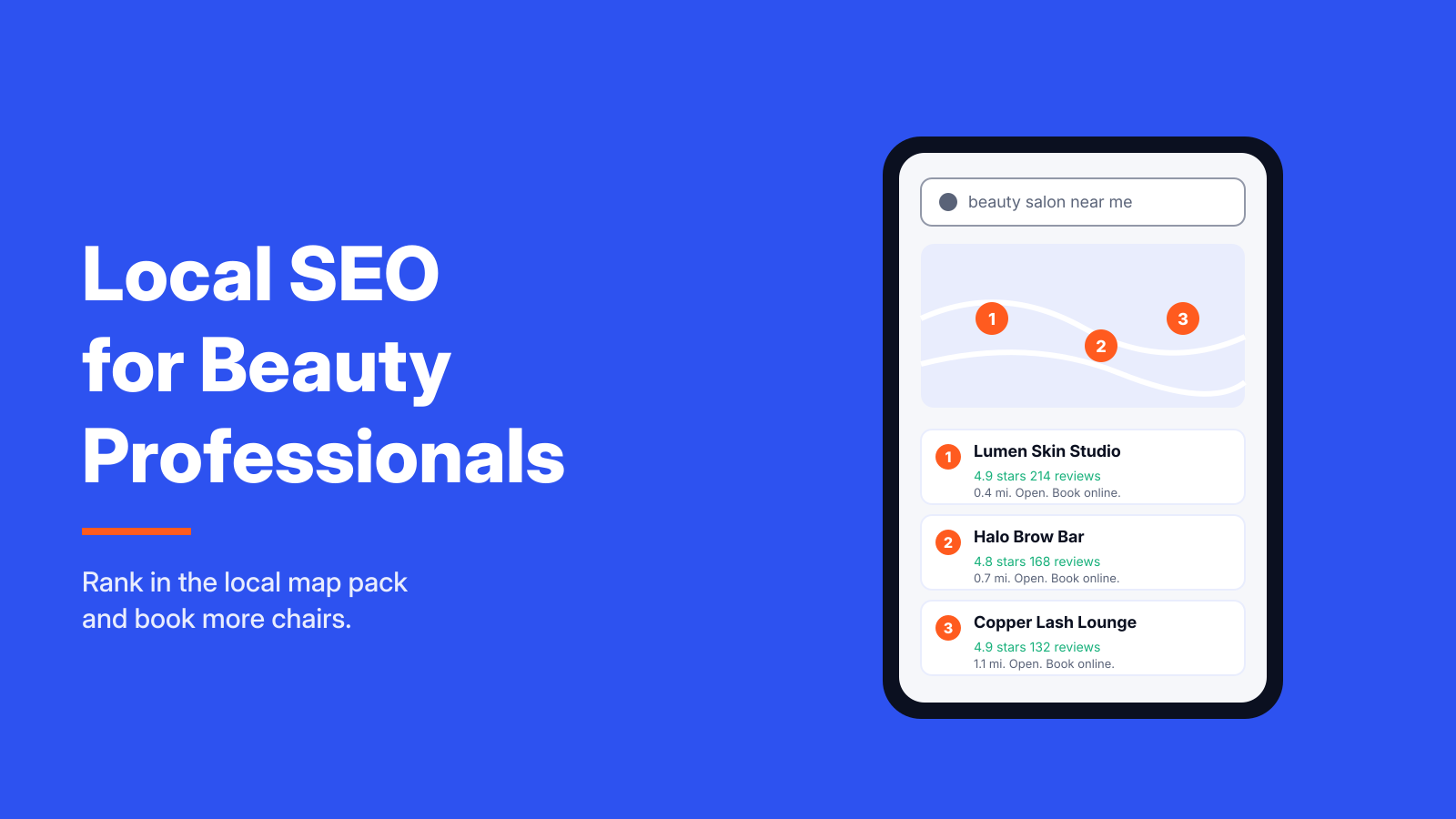
- Local SEO strategies for beauty professionals live or die in the Google map pack, and the winnable radius for a single-location salon is roughly one to three miles depending on urban density.
- The four items to fix in the first 30 days are the primary category, the full services list with prices, a review request cadence sent by text 90 minutes after the appointment, and ten fresh photos plus one Google post per week.
- Reviews are the fastest compounding lever. A cadence of four to six per week held for three months typically moves a single-location salon from position seven to ten into the top three inside 120 to 180 days.
- The website underneath the profile matters more than most beauty owners think. One page per core service, a location page, and a booking widget on every page reinforce the profile's category accuracy on the map pack.
- If day 180 has not moved both map pack rank and booked chairs, the fit with the current strategy or agency is wrong. Shortlist again with a specialist that can walk the five-metric dashboard.
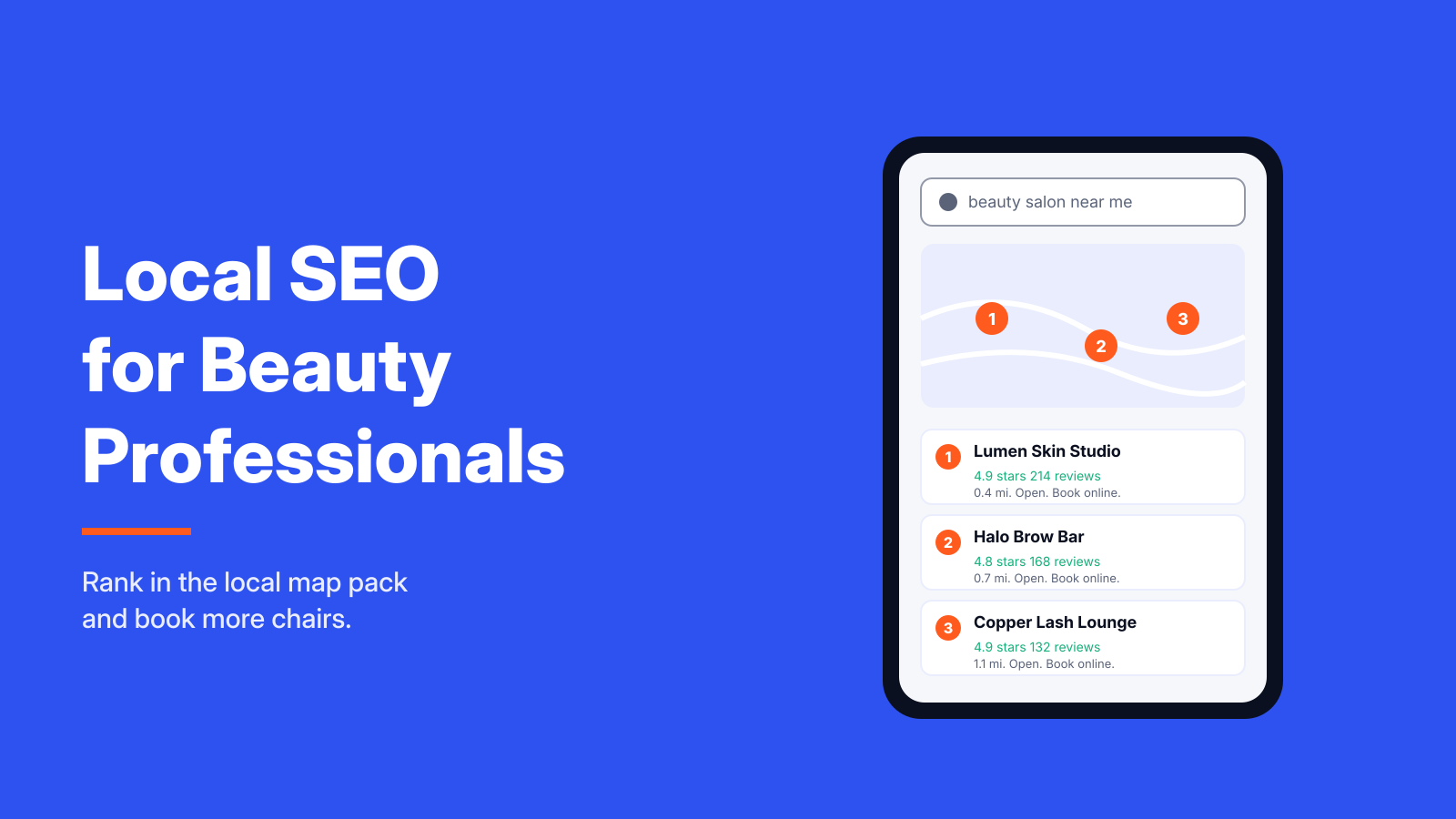
Local SEO strategies for beauty professionals live or die in the Google map pack. That three-listing box under the map is where a salon, spa, brow bar, or lash studio wins a first-time booking, and it is the single highest-leverage surface in beauty local search. This guide walks the ranking factors Google actually weighs for beauty categories, the Google Business Profile setup that separates the top three from the ninth listing, the review-generation cadence that moves the needle inside a quarter, the on-page and citation stack that supports the map play, and the tracking pattern that ties all of it to booked chairs and retail revenue.
Every play below comes from real beauty accounts our team runs or benchmarks against. Where a case study makes the point cleaner than prose we drop the client name and the exact figures. If you want the audit worksheet our team uses on the intake call, our beauty SEO service team keeps it on file.
What local SEO for beauty professionals actually competes on
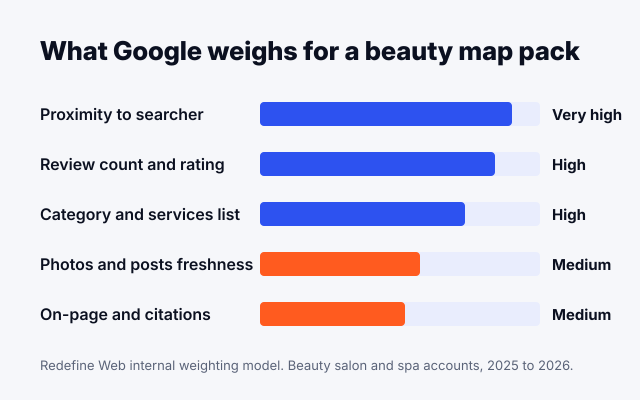
Google ranks the local map pack on three signal groups: relevance, distance, and prominence. For beauty professionals those three translate into a specific hierarchy. Proximity to the searcher does most of the heavy lifting inside a two mile radius, review count and rating decide the tie between two studios on the same block, and category plus services list decides whether Google shows the listing for "lash extensions near me" when the salon also does hair. On top of that, freshness signals like photos, posts, and Q&A activity nudge one listing above another when everything else is close.
Beauty is a proximity-heavy category because buyers do not drive across town for a manicure. That means the winnable radius for a single location salon is roughly one to three miles depending on urban density, and the fight inside that radius comes down to reviews, category accuracy, and how well the profile is built. A ten-review salon two blocks from the searcher will lose the map pack to a hundred-review studio five blocks away almost every time.
Google Business Profile setup for beauty salons and spas
A Google Business Profile that ranks in beauty needs six things dialed in on day one. Primary category set to the tightest match (Beauty Salon, Nail Salon, Hair Salon, Waxing Hair Removal Service, Skin Care Clinic, Eyelash Salon, Massage Spa), and every relevant secondary category added. Full services list populated with every service the salon actually offers, priced where honest. Business hours accurate including holiday hours. A booking link that goes straight to the online scheduler, not a homepage that forces the buyer to hunt. Ten or more photos including interior, chairs, product wall, staff, and before and after work. And a written business description that names the primary service, the neighborhood, and one or two hero services with volume proof.
The single biggest mistake we see on beauty profile audits is category dilution. A salon that offers hair, nails, brows, and lashes will list a broad Beauty Salon primary and add every secondary. That is correct. A salon that only does lash extensions and brow lamination should list Eyelash Salon primary and skip the broad category. Google reads the tighter category as a stronger relevance signal for the searches that convert. When we cleaned this up on a Brooklyn brow studio, map pack impressions for "brow lamination near me" grew 3.4x in six weeks without a single new review.
The review generation cadence that moves the map pack
Reviews are the single lever a beauty professional can pull that compounds fastest. Google weighs both count and recency, and beauty is a category where the top three listings in any dense urban zip code average 140 to 320 reviews with a rating between 4.7 and 4.9. If the salon sits at 32 reviews and 4.6, the fastest path to the map pack is a review request cadence that adds four to six reviews per week for three months.
The request that converts on a beauty client is a text sent 90 minutes after the appointment ends with a direct Google review link, the stylist or artist named in the message, and a one-line ask that references the specific service. "Hi Sarah, thank you for booking your Brazilian blowout with Marcus today. If you have 30 seconds, a Google review would mean a lot to the studio." That message opens at 78 to 84 percent and converts to a review at 22 to 30 percent when the link is one tap. Salons that email the request 24 hours later convert at 4 to 7 percent, which is what most default booking-software templates do.
When the exclusive Ukrainian distributor for Italian and French professional beauty brands came to us, their Google Ads account was running one Performance Max campaign for every product type, every audience, and every season. There was no product-type splitting, no interest-based targeting, no remarketing, no display or video supporting search. We rebuilt the account into 15 to 20 active campaigns segmented by product type, layered remarketing on top, and added separate display and video campaigns targeting beauty-interest audiences. Over three years the marketing budget grew 5x while leads grew 7x, and ROAS climbed from 425 percent to 625 percent. The pattern applies to local salons the same way it applies to a national distributor. Structure beats scale, and every proximity-weighted local business benefits when the account tells Google which service, which audience, and which offer to lean into.
On-page SEO that supports the map pack for beauty sites
The website underneath the Google Business Profile does more for the map pack than most beauty owners think. Google looks at the on-page signals to confirm what the profile claims, and a site that has one page for every core service, a location page for every physical address, an about page with the founder or master stylist named, and an appointment or booking page that links back from every service page reinforces the profile in a way an eight-page brochure site cannot.
The service pages are the lever. A lash studio needs individual pages for classic lash extensions, hybrid, volume, mega volume, and lash lift. A skin clinic needs individual pages for HydraFacial, chemical peels, microneedling, and dermaplaning. Each page targets the "service plus neighborhood" query, includes a price range, an FAQ answering the two questions buyers ask on the phone, three to five real photos of the treatment room and equipment, and a booking widget. That structure earns organic traffic on the long tail and reinforces the profile’s category accuracy on the map pack. Our beauty web design service builds this structure on every rebuild.
Local citations and directory presence for beauty
Citations still matter for beauty, just not the way generic local SEO guides describe. The citations that move the needle are the ones beauty buyers actually use to shortlist. Yelp, Vagaro, Booksy, StyleSeat, and Fresha carry more weight for a salon than the classic Yellow Pages, BBB, and Manta trio. Google reads high-authority industry directories as trust signals, and beauty buyers cross-check the salon on Yelp before they book on Google, so the profile has to hold up in both places.
The audit rule is simple. Search the salon name plus city in Google and note every directory that appears on page one or two. Every one of those needs an owned, complete, and accurate listing with matching name, address, and phone. Any listing with a stale phone or an old address is actively harming the map pack rank because it splits the citation trust across two entities. Cleaning the top ten citations on a beauty account typically takes six to ten hours across a week and moves the map pack rank one to three spots inside 30 to 60 days.
Content and blog strategy for beauty local SEO
Beauty local content earns organic traffic and reinforces the map pack when it targets the questions buyers ask before booking. Not generic "top ten skincare tips" content. Specific, neighborhood-weighted, service-anchored questions. "How long does a lash lift last for Brooklyn clients with oily lashes" beats "lash lift benefits" every time on both organic clicks and profile support. Google reads the localized content as a topical authority signal for the neighborhood, and buyers who land on the post convert to a booking at 3 to 6 percent versus 0.5 to 1 percent on generic tips content.
The publishing cadence that pays for a single-location salon is one focused post per two weeks, each targeting a specific service plus intent query, each linking to the service page and the booking widget, each with three to five real photos from the studio. Twelve posts in six months typically doubles organic sessions to the site and adds 12 to 20 percent to map pack impressions through the topical-authority halo. Our beauty marketing agency team keeps a running list of these queries by beauty category and neighborhood density.
Tracking that ties local SEO to booked chairs
Local SEO for beauty professionals is worth doing only if the reporting ties map pack rank to booked chairs and retail revenue. The dashboard a beauty owner should demand from their agency or run themselves opens with five numbers: map pack rank for the top five service queries (tracked from a fixed grid of five points inside the winnable radius), Google Business Profile calls and direction requests month over month, website sessions from Google Maps and Google Search, online bookings from Google traffic, and revenue per booked chair over 90 days. If those five are not on the report, the report is measuring vanity.
A comparison of high leverage local SEO plays for beauty
| Play | Effort | Time to move | Map pack impact |
|---|---|---|---|
| Fix primary category and add secondaries | 1 to 2 hours | 2 to 6 weeks | High |
| Build a review request cadence to 4 to 6 per week | 1 hour per week | 60 to 120 days | Very high |
| Populate full services list with prices | 2 to 4 hours | 3 to 8 weeks | High |
| Post 4 photos and 1 update per week to GBP | 30 min per week | 4 to 8 weeks | Medium |
| Build one service page per core service on the site | 1 to 2 weeks total | 60 to 120 days | Medium to high |
| Clean top 10 industry citations to match NAP | 6 to 10 hours | 30 to 60 days | Medium |
| Publish 2 posts per month targeting service plus neighborhood | 4 to 6 hours per post | 90 to 180 days | Medium |
| Answer every GBP question and message inside 4 hours | 15 min per day | 2 to 4 weeks | Medium |
What to fix first if the map pack is not moving
The first 30 days of a beauty local SEO push should touch four things and nothing else. Primary category corrected. Services list completed with prices. Review request cadence live via text at 90 minutes post appointment. Ten fresh photos uploaded and one Google post per week for four weeks. That combination alone moves most beauty profiles one to four spots in the map pack inside 30 to 60 days, and it does the work without a single new blog post, backlink, or citation cleanup.
Day 31 to 90 layers the service pages, the citation cleanup, and the first four blog posts. Day 91 to 180 measures against the five dashboard numbers above and doubles down on whichever service plus neighborhood combination is converting best. If the salon has not moved at day 180 on both map pack rank and booked chairs, the fit with the current strategy or agency is wrong and it is time to shortlist again. Our beauty marketing retainer page lists the exact monthly deliverables that hit this cadence.
When to hire specialist help and when to run local SEO in house
A single-location beauty studio with an owner who has two to four hours a week to spend on the profile can run the map pack play in house for the first year. Fix the four items above, run the review cadence, keep the photos fresh, and answer every question. Most map pack wins inside a two mile winnable radius are earned by the owner who shows up on the profile weekly, not by an agency running a broader stack.
A multi-location group, a franchise system, or a single location that has already picked the low-hanging fruit and still is not ranking benefits from specialist help. That is where citation cleanup at scale, technical on-page work, review-generation software integration, and the content publishing cadence justify a retainer. The specialist premium for beauty local SEO typically runs 1,200 to 3,500 dollars per month on top of any existing paid or email retainer, and the payback shows up in booked chairs inside 90 to 120 days when the account is set up correctly. If a shortlist call is next on the list, our comparison of a beauty and skincare digital marketing agency vs a generalist walks the five questions to ask before signing anything, and our beauty marketing agency team will walk a plain-English audit of your current profile with you.
Frequently asked questions
What are the best local SEO strategies for beauty professionals in 2026
The best local SEO strategies for beauty professionals in 2026 are the Google Business Profile fundamentals plus a review generation cadence that adds four to six reviews per week (walked step by step in our beauty salon SEO guide). Fix the primary category to the tightest match, populate the full services list with prices, post four photos and one update per week, and text every client a review request 90 minutes after the appointment ends. Layer service-specific site pages, industry citations on Yelp, Vagaro, and Booksy, and neighborhood-anchored blog posts underneath. Those plays move the map pack for beauty faster than backlinks, schema, or generic local SEO tactics.
How long does local SEO take to work for a beauty salon
Local SEO takes 30 to 60 days to move the map pack on the fundamentals like primary category, services list, and photos, and 60 to 120 days to compound on reviews and content. A single-location salon that starts at position seven to ten in the map pack for its core service and neighborhood typically moves to position four to six inside 60 days and into the top three inside 120 to 180 days when the review cadence holds at four to six per week. Multi-location groups and dense urban competitive zip codes take 180 to 270 days to top three because the incumbent listings have 200 plus reviews to overtake.
How many Google reviews does a beauty salon need to rank in the map pack
A beauty salon needs 80 to 150 Google reviews at a 4.7 or higher rating to compete for the map pack in a moderately dense urban zip code, and 200 to 350 reviews to top three in a highly competitive metro zip code. What matters more than the raw count is the recency and cadence. Google weighs the last 90 days of review activity heavily, so a salon at 90 reviews with 12 in the last quarter often outranks a salon at 180 reviews with 2 in the last quarter. Build the cadence to 4 to 6 per week and hold it for three months to see the map pack move.
Does a website matter for beauty local SEO or is the Google Business Profile enough
A website matters for beauty local SEO because Google cross-references the site against the Google Business Profile to confirm relevance, and buyers cross-check the site before they book. A salon with a well-structured site that has one page per core service, a location page, a booking widget on every page, and matching name, address, and phone will outrank a competitor with a stronger profile but a weak or missing site. The site does not have to be large. Eight to twelve well-structured pages beat a 40 page brochure site for the map pack every time.
What Google Business Profile category should a beauty salon choose
A beauty salon should choose the tightest primary category that matches its dominant service, then add every relevant secondary category. A full service salon offering hair, nails, brows, and lashes uses Beauty Salon primary and adds Hair Salon, Nail Salon, Eyelash Salon, and Waxing Hair Removal Service as secondaries. A studio that only does lashes and brows uses Eyelash Salon primary and skips Beauty Salon. The tighter primary category is a stronger relevance signal for the searches that actually convert, and the secondaries capture the adjacent searches without diluting the main ranking signal.
How much does beauty local SEO cost per month
Beauty local SEO costs between 599 dollars and 3,500 dollars per month depending on scope, location count, and competition. An entry retainer at 599 dollars per month covers profile optimization, review cadence setup, monthly reporting, and light on-page work for a single location. A mid-band retainer at 1,500 to 2,200 dollars per month adds content publishing, citation cleanup, and technical SEO. A multi-location or highly competitive metro retainer runs 2,500 to 3,500 dollars per month with dedicated reporting per location. Any honest quote separates retainer from ad spend and names the specific monthly deliverables.
See how our team runs local SEO for beauty studios across single and multi-location groups on our beauty marketing agency page.
Book your free 30-minute strategy call.
No spam, no sales rep. We use your email to schedule your call with a senior strategist. That is it.