
Manufacturing SEO Strategy That Books RFQs Not Just Traffic
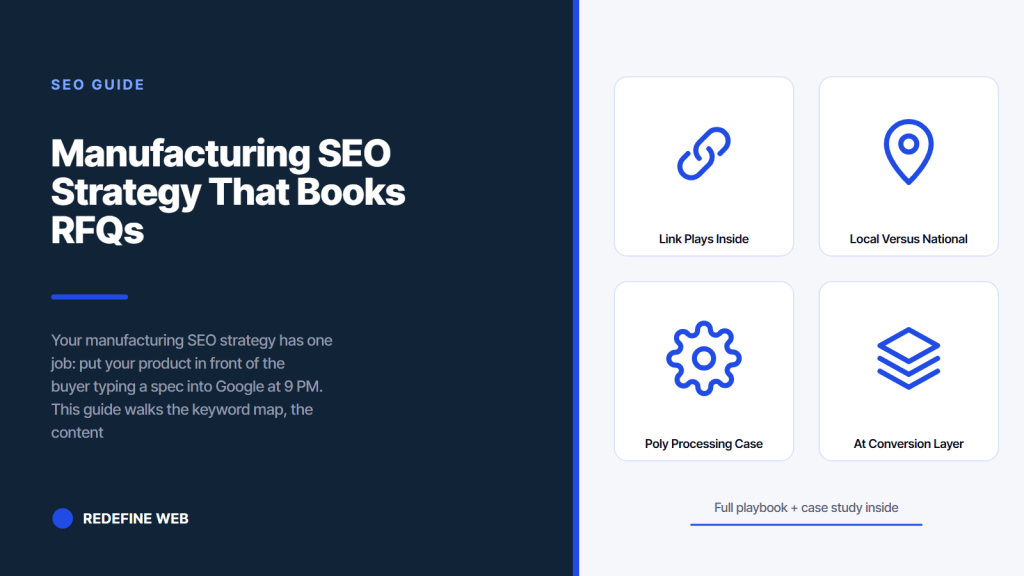
- Target spec-driven long-tail queries, not one-word head terms.
- Build product pages, application pages, technical guides, and comparison pages.
- Product schema and clean PDF indexing beat backlinks alone.
- Expect 12 to 24 months for compounding results.
- Measure RFQs and revenue, not traffic and impressions.
- Link plays inside best seo practices for manufacturers
- Local versus national inside your manufacturing seo strategy
- Poly Processing case study for a manufacturing seo strategy that delivered
- SEO for manufacturers to increase RFQs at the conversion layer
- Measuring your manufacturing seo strategy month over month
- In-house versus agency b2b manufacturing seo strategies
- Common mistakes in seo basics for manufacturing companies
- Where to start on your manufacturing seo strategy this month
Your manufacturing seo strategy has one job. Put your product in front of the engineer or purchasing manager typing a very specific spec into Google at 9 PM on a Tuesday. Not brand awareness. Not thought leadership. A booked request for quote in the inbox by Friday. Most manufacturing SEO programs miss that job by a country mile. They chase traffic. They write blog posts about industry trends. They collect impressions that never turn into a phone call from a real buyer.
You’ll get the full playbook in the next twelve minutes. The keyword map that separates a spec-buyer search from a tire-kicker search. The content stack that a purchasing manager actually reads. The technical fixes that keep your product pages indexable. The link plays that move rankings in a niche vertical. And the retainer math to price it against what an in-house hire would cost. Read straight through, then match the pieces to your site.
Link plays inside best seo practices for manufacturers
Best seo practices for manufacturers include a link layer most agencies skip because it takes real industry knowledge to execute. Manufacturing is a niche. Generic guest-post outreach fails here because the tier-one publications don’t publish generic industrial content. You have to earn links from trade associations, industry publications, and technical directories that reward real expertise.
The link plays that work run across five categories. Trade association membership pages (SME, NAM, MAPI, NEMA, industry-specific groups). Industry publication guest columns (Design World, Machine Design, IndustryWeek, Modern Machine Shop, Chemical Processing). Distributor and rep network pages that link back to manufacturer pages. Buyer’s guide directories that catalog manufacturers by capability. And university partnerships that produce case studies or technical papers with backlinks. Every one of these takes time. Every one earns a link that a competitor can’t buy on Fiverr.
Trade association link strategy
Trade association memberships already come with a member directory link. Most manufacturers pay for the membership and forget the SEO value. Audit your existing memberships this quarter: Society of Manufacturing Engineers, National Association of Manufacturers, Manufacturers Alliance, industry-specific groups like the Precision Machined Products Association or the Chemical Fabricators and Suppliers Association. Every one has a directory. Every directory link is dofollow from a niche-relevant domain. Combined, these often deliver 10 to 30 high-quality links your site is already entitled to but never claimed.
Industry publication outreach
Publication outreach in manufacturing works when a real engineer or product manager writes real content. Design World and Machine Design will publish a well-written technical column on a novel application, a failure-mode analysis, or a materials science breakthrough. IndustryWeek publishes leadership pieces from real executives. The path in isn’t a PR firm. It’s a technical editor who wants your engineer’s byline and a topic that hasn’t been covered fifteen times already this year. Pitch three ideas per publication. Expect one placement per five pitches. Each placement carries a domain rating 60-plus backlink and a topical relevance no PBN can match.
Local versus national inside your manufacturing seo strategy
Manufacturing sits in an odd SEO middle. Most manufacturers ship nationally or internationally, so pure local SEO doesn’t fit. But every manufacturer also has a physical facility that shows up in Google Business Profile and often ranks in the local pack for regional buyers who want to visit or specify a nearby supplier. Your manufacturing seo strategy should cover both surfaces without treating them the same.
The split. National SEO carries the product pages, technical guides, and application pages. The keyword targets are non-geographic, long-tail spec searches. Local SEO carries the Google Business Profile with real photos of the facility, real hours, real product category tags, and reviews from buyers you actually work with. Regional buyers who want a nearby supplier land through local search. National and international buyers land through organic product searches. Both surfaces feed the same RFQ inbox.
Google Business Profile for a manufacturer
The Google Business Profile setup for a manufacturer differs from a service business. Primary category picks the closest manufacturing type (Manufacturer, Metal Fabricator, Chemical Company). Secondary categories cover subspecialties. Photos: exterior of facility, interior of production floor, close-ups of finished products, team at work. Description: 750 characters covering products, industries served, certifications, and geographic reach. Reviews from real B2B customers with real names and companies where they’ll allow it. This surface won’t drive the big deals, but it earns local pack visibility for regional searches and builds trust for buyers who Google your company before an RFQ.
International considerations
If you export, hreflang setup matters. A manufacturer with real business in the UK, Germany, and Canada should run country-specific subfolders or subdomains with hreflang tags pointing search engines to the right version. Skip this and your Canadian buyer sees the US site with USD pricing and no CSA certification content, which kills the deal. The setup takes a few days for a manufacturer with three or four target markets. Reference the Google international targeting guide for the current recommendations.
Poly Processing case study for a manufacturing seo strategy that delivered
Poly Processing is an industrial manufacturer producing polyethylene chemical storage tanks. When they came to us, their lead source was trade shows and their cost per lead was expensive. Their online authority was minimal. The digital marketing was an afterthought. In 2022 through 2024, we ran a full inbound stack including SEO strategy, technical content, and an interactive tank configurator. The site became a destination for chemical engineers specifying storage tank systems.
The results after two years: 10x return on marketing spend, cost per lead down 90 percent, and the sales team engaging with hundreds of qualified monthly leads from inbound automation. The Poly Processing engagement details the full inbound stack. Digital marketing went from a cost center to their most profitable acquisition channel. The SEO layer alone drove the majority of the top-of-funnel volume, with the technical guides and application pages pulling engineers into the site months before an RFQ.
Transferable plays for your site
The Poly Processing plays transfer to any technical manufacturer selling a specified product. Build the interactive tool that answers the buyer’s real question (in their case a tank configurator, in yours maybe a material selector, sizing calculator, or spec builder). Publish technical guides with engineer bylines. Structure product pages around the specs the buyer needs. Layer application pages by industry. The compound effect over 18 to 24 months is a site that ranks for hundreds of long-tail spec queries and hands the sales team a steady stream of pre-qualified inbound leads.
Timeline expectations
Six months to see the technical foundation pay off. Twelve months to see real ranking gains on the product taxonomy. Eighteen months to see compounding results as application pages and technical guides mature. Twenty-four months to overtake distributor sites in your category. This is a slow-compounding investment. Manufacturers who bail at month nine because “SEO didn’t work” are the ones who never got to month eighteen where the RFQs actually started arriving. Patience is a competitive advantage in industrial SEO.
Every manufacturing site has the same About Us page. “Founded in 1947 by two brothers in a garage”. “Committed to quality”. “Our customers are family”. A stock photo of a hard hat. The page ranks for zero commercial queries. Meanwhile the competitor’s spec table for a 4-inch stainless butterfly valve outranks everyone in the category and books three RFQs a week from engineers who never once read anyone’s About Us page. The About Us page is fine. Nobody is buying because of it.
Engineers type 'stainless steel butterfly valve 4 inch flanged', not 'valves'. Build one page per spec combo. That's where the RFQs live.
SEO for manufacturers to increase RFQs at the conversion layer
Seo for manufacturers to increase rfqs finishes at the conversion layer. Traffic that never converts is a vanity metric. Your product pages need to route the qualified buyer into an RFQ form in a way that respects their time and captures the specs your sales team needs to quote fast.
The high-converting RFQ page has six elements. A clear primary CTA above the fold that says “Request Quote” or “Get Specs”, not a generic “Contact Us”. A short form with the fields your sales team actually needs (product family, quantity, delivery timeline, industry, name, company, email). An honest response-time promise (“We reply within 4 business hours”). A trust block showing certifications, years in business, notable customer logos where permitted. A phone number visible on every page. And a spec download available without a form for the buyer who needs to review internally first. That last element seems counterintuitive but pulls in more downstream RFQs than the gated version because purchasing managers reject gated PDFs on principle.
Form fields to cut
The RFQ form is where most manufacturing sites lose the deal. Every extra field costs conversion. Cut anything the sales team can look up: address, job title, company size, industry (usually inferable from the domain), how they heard about you. Keep only the fields required to price the quote. Six fields max. If you need more data, follow up after the initial exchange. The buyer’s willingness to fill out ten fields on a first visit is nearly zero.
Response time SLA
Response speed is the single highest-return conversion factor in industrial SEO. A buyer who submits an RFQ at 10 AM Tuesday expects a reply before end of day. Sites that reply within 4 hours close roughly 3x the rate of sites that reply the next business day. Automate the acknowledgement inside 5 minutes. Route the RFQ to a real salesperson inside the hour. Send the initial technical questions inside 4 hours. This process alone often doubles closed revenue from the same traffic volume.
Measuring your manufacturing seo strategy month over month
The metrics that matter in industrial SEO differ from consumer SEO. Traffic alone tells you very little. Ranking on head terms tells you even less. The metrics that predict revenue are qualified RFQ volume, cost per RFQ, close rate by traffic source, and revenue per qualified lead. Track those four monthly and the retainer’s value becomes measurable.
The monthly SEO dashboard for a manufacturer covers six sections. Organic sessions on product and application pages (not homepage, not blog, not About Us). Ranking positions on the top 20 product-family queries. RFQ form submissions attributed to organic search. Qualified RFQs (defined by the sales team’s real criteria) as a subset of total RFQs. Revenue closed from organic-sourced RFQs over trailing 12 months. Cost per RFQ calculated from retainer cost divided by RFQ count. Anything beyond these six is noise for reporting purposes.
Attribution model for long sales cycles
Manufacturing sales cycles run 3 to 18 months. That length breaks last-click attribution. A buyer who first landed via organic search in January, downloaded a spec sheet in March, requested a quote in June, and closed the deal in September will be attributed to whatever source touched them last, usually direct or a paid ad. Fix this with first-touch attribution stored on the CRM contact record. Also track assisted conversions where organic played a role even if not the last touch. The full picture always shows organic doing more of the real work than last-click reports suggest.
Leading indicators before revenue arrives
Because the sales cycle is long, you need leading indicators to know the SEO is working before revenue arrives. The ones we track: indexed pages count, average keyword rank on the top 20 target queries, referring domains from tier-two publications and directories, and time-on-page for the technical guides. Movement in these leading indicators three to six months before revenue movement is normal and healthy. Movement in leading indicators without eventual revenue movement means the intent match is off and the keywords targeted don’t map to real buyers.
In-house versus agency b2b manufacturing seo strategies
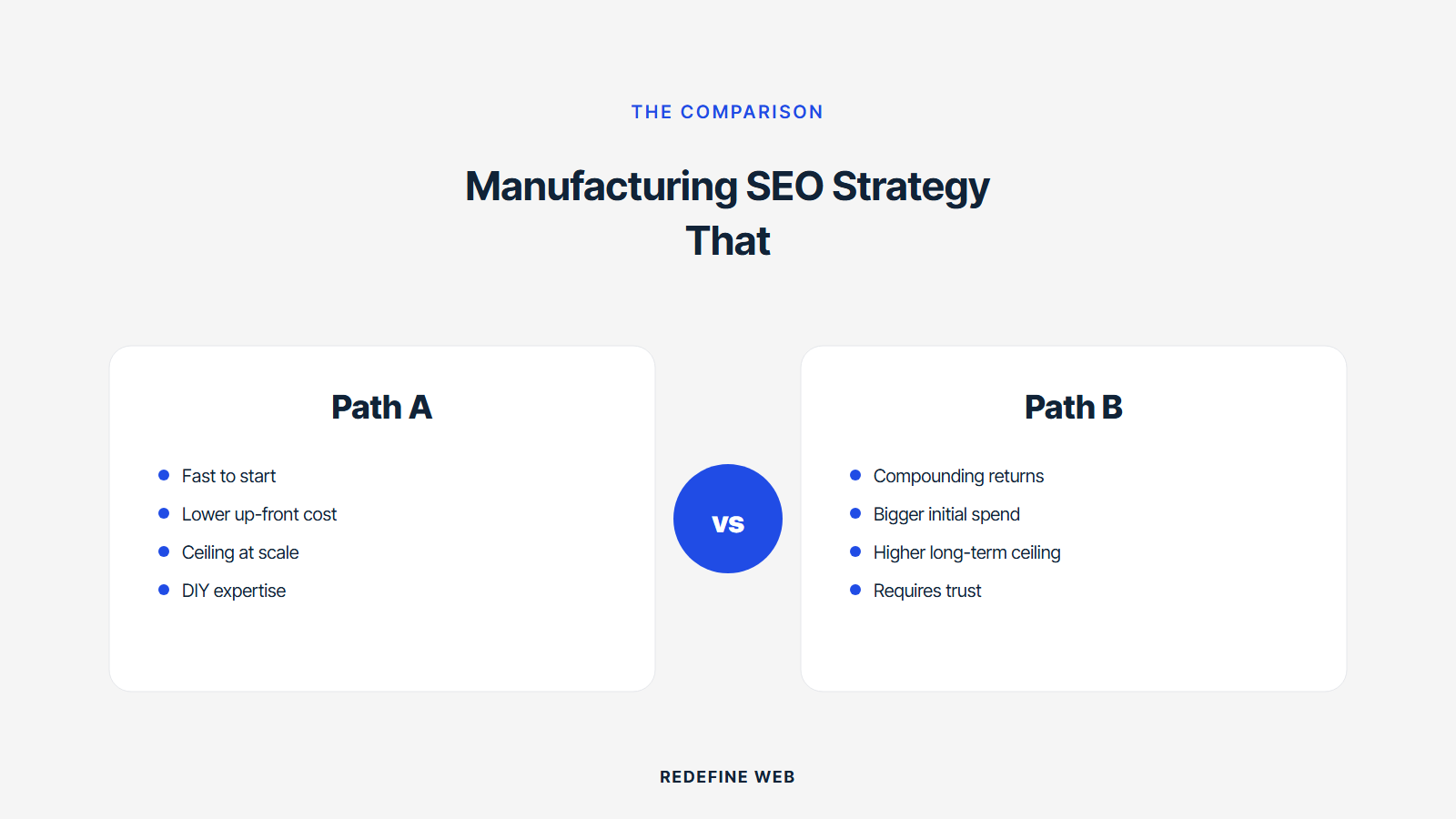
The build-versus-buy question in b2b manufacturing seo strategies has three answers depending on your size. Below $10M annual revenue: agency retainer. Between $10M and $75M: hybrid model with one internal marketer plus an agency retainer for technical depth. Above $75M: in-house SEO team led by a senior manager plus agency support for specialized work like link building and technical audits.
The reason most manufacturers stay with agencies well past $50M revenue is that industrial SEO is a niche within a niche. A generalist in-house marketer can run your social media, your email newsletter, and your paid ads. Ranking a fitting page for “stainless steel 316 sanitary tri-clamp 2 inch food grade” requires a specialist who reads through ASTM standards for context and knows the difference between 304 and 316 stainless. Those specialists cluster inside industrial SEO agencies because that’s where the interesting work is. Buying that specialization on a retainer is 3 to 5 times cheaper than hiring it.
Retainer pricing model
Retainer pricing for industrial SEO runs $2,500 to $12,000 per month depending on site size, product complexity, and target market breadth. Small industrial manufacturers with 50 to 200 SKUs and a single vertical land at $2,500 to $4,500. Mid-size manufacturers with multiple product families and multi-industry coverage run $4,500 to $8,500. Large or export-focused manufacturers with multiple sites, international targeting, or heavy compliance content run $8,500 to $12,000-plus. Every tier covers keyword strategy, on-page optimization, technical audits, content production, link acquisition, and monthly reporting. Higher tiers buy more content volume and deeper technical work.
Hybrid model for growing manufacturers
The hybrid model works best in the $10M to $75M range. One internal marketing lead owns content coordination, brand voice, and integration with the sales team. The agency owns technical SEO, link building, keyword strategy, and content production coordination. The internal marketer briefs the agency writers with product SME time. The agency delivers the production. The internal marketer reviews before publish. This split scales up to about $75M in revenue before it makes sense to bring more of the specialist work in-house.
Common mistakes in seo basics for manufacturing companies
Most manufacturing sites make the same six mistakes. Fix any three and you’ll outrank half your competition inside twelve months.
The six mistakes. Chasing head-term traffic instead of long-tail spec queries. Hiding spec PDFs behind gated forms. Writing About Us and industry-jargon posts instead of technical guides. Building the site on a platform that can’t handle 500-plus product pages (yes some manufacturers still run Wix for their catalog). Skipping schema markup because the developer said “buyers don’t care about schema”. And treating the RFQ form like an afterthought instead of the conversion primitive of the whole site.
- Head-term targeting instead of spec-driven long-tail
- Gated PDFs that never index
- About Us content instead of technical guides
- Underpowered platforms that can’t handle deep product catalogs
- Missing Product schema on SKU pages
- Ten-field RFQ forms that kill conversions
- Slow response times on the RFQs that do come in
Platform choice for a manufacturing catalog
Platform choice sets a ceiling on how far manufacturing SEO can go. WordPress with WooCommerce handles 500 to 5,000 SKUs cleanly. Shopify Plus handles ecommerce-heavy manufacturers well but limits customization on complex spec templates. Custom builds on Laravel or Django work for very large catalogs with heavy integration to ERP or PIM. Squarespace, Wix, and Weebly hit a wall around 100 pages and should never carry a real industrial catalog. If you’re on one of the last three, budget a platform migration into the SEO plan before you scale content investment.
Content strategy mistakes
The content strategy mistake most manufacturers make: publishing thin content on trending industry topics because a marketing agency told them to write “thought leadership”. Real thought leadership in manufacturing comes from named engineers or product managers with real technical depth. A generic 800-word blog post about “the future of Industry 4.0” ranks for nothing and converts nobody. A 3,000-word engineering deep dive on “selecting stainless steel grade for chemical processing at temperatures above 250 F” ranks for hundreds of long-tail spec searches and pulls specifiers into your product pages.
Where to start on your manufacturing seo strategy this month
Start with an audit. Not a 60-page PDF audit from a big agency. A three-day audit with three outputs: current indexed pages count and gap analysis, top 20 target keywords with current rank and monthly search volume, and a prioritized list of technical fixes. Cost: a few hundred dollars if you do it in-house, $2,500 to $5,000 if you buy it from an agency. That audit becomes the roadmap for the next 12 months of SEO work.
Then pick one product family to prove the model on. Not the whole catalog. One family. Rewrite the product pages, publish two technical guides, add three application pages, wire up the RFQ tracking, monitor the results for 90 days. If the model works on one family, expand to two more. If it doesn’t, adjust before scaling. Our Manufacturing Marketing Agency Built for Industrial RFQs team runs this exact playbook across three to five product families in year one. For the strategy layer that ties SEO to the full digital stack, the Search Engine Optimization Services retainer covers the full technical, content, and link work. And if you’re weighing SEO against PPC for the same budget, our PPC for Manufacturers That Lowers Cost Per RFQ page walks the PPC option. Reference the Search Engine Land SEO fundamentals guide for third-party context on the broader SEO fundamentals.
Frequently asked questions
What is a manufacturing seo strategy
A manufacturing seo strategy is the plan that routes real industrial buyers from Google searches into your RFQ form. It has four layers: a product taxonomy built around long-tail spec queries like "stainless steel 316 tri-clamp 2 inch", application and industry pages that speak the buyer's language, technical guides written by named engineers, and a technical foundation of Product schema, clean URLs, and fast page speed. Done right, the site ranks for hundreds of niche spec searches and hands the sales team a steady stream of pre-qualified inbound RFQs from buyers with real budgets and real deadlines.
How long before manufacturing SEO produces RFQs
The typical timeline runs six months to see the technical foundation pay off, twelve months to see real ranking gains on the product taxonomy, eighteen months to see compounding results as application pages and technical guides mature, and twenty-four months to overtake distributor sites in your category. This is a slow-compounding investment. Manufacturers who bail at month nine miss month eighteen where the RFQs actually start arriving. Because sales cycles run 3 to 18 months on top of the ranking timeline, use first-touch attribution and leading indicators like indexed pages and keyword rank movement to track the work before revenue arrives.
How much does a b2b manufacturing seo strategy cost
Retainer pricing for industrial SEO runs $2,500 to $12,000 per month depending on site size, product complexity, and target market breadth. Small industrial manufacturers with 50 to 200 SKUs and a single vertical land at $2,500 to $4,500. Mid-size manufacturers with multiple product families and multi-industry coverage run $4,500 to $8,500. Large or export-focused manufacturers with multiple sites, international targeting, or heavy compliance content run $8,500 to $12,000-plus. Every tier covers keyword strategy, on-page work, technical audits, content production, link acquisition, and monthly reporting.
What are the best seo practices for manufacturers in 2026
The best seo practices for manufacturers in 2026 center on five things. Target long-tail spec queries instead of head terms. Publish Product schema on every SKU page with real MPN, material, weight, and dimensions. Index your spec PDFs alongside HTML product pages instead of gating them. Publish technical guides written by named engineers with original diagrams and comparison tables. Earn links from trade associations, industry publications, and buyer's guide directories rather than generic guest posts. Also track first-touch attribution because sales cycles are long and last-click reports understate SEO's role.
Should manufacturers hire an SEO agency or build in-house
Below $10M annual revenue, use an agency retainer. Between $10M and $75M, run a hybrid model with one internal marketing lead plus an agency retainer for technical depth. Above $75M, build an in-house SEO team led by a senior manager plus agency support for specialized work. Industrial SEO specialists cluster inside agencies because that's where the interesting work is. A generalist in-house marketer can run social, email, and paid ads but usually cannot rank a fitting page for a five-part spec query. Buying that specialization on a retainer is 3 to 5 times cheaper than hiring it.
How do I measure whether my manufacturing seo strategy is working
Track six metrics monthly. Organic sessions on product and application pages, not homepage or blog. Ranking positions on the top 20 product-family queries. RFQ form submissions attributed to organic search. Qualified RFQs as a subset of total RFQs, using the sales team's real criteria. Revenue closed from organic-sourced RFQs over trailing 12 months. And cost per RFQ calculated from retainer cost divided by RFQ count. Because sales cycles run 3 to 18 months, use first-touch attribution stored on the CRM contact record. Also track leading indicators like indexed pages count and keyword rank movement that move three to six months before revenue does.
Book your free 30-minute strategy call.
No spam, no sales rep. We use your email to schedule your call with a senior strategist. That is it.
More from the blog
View all articles → SEO
SEO Organic Search Engine Optimization Services That Grow Real Traffic
Read article SEO
SEO SEO for Pet Groomers That Fills the Appointment Book Weekly
Read article SEO
SEO