
Med Spa Marketing Services That Book Real Treatment Consults
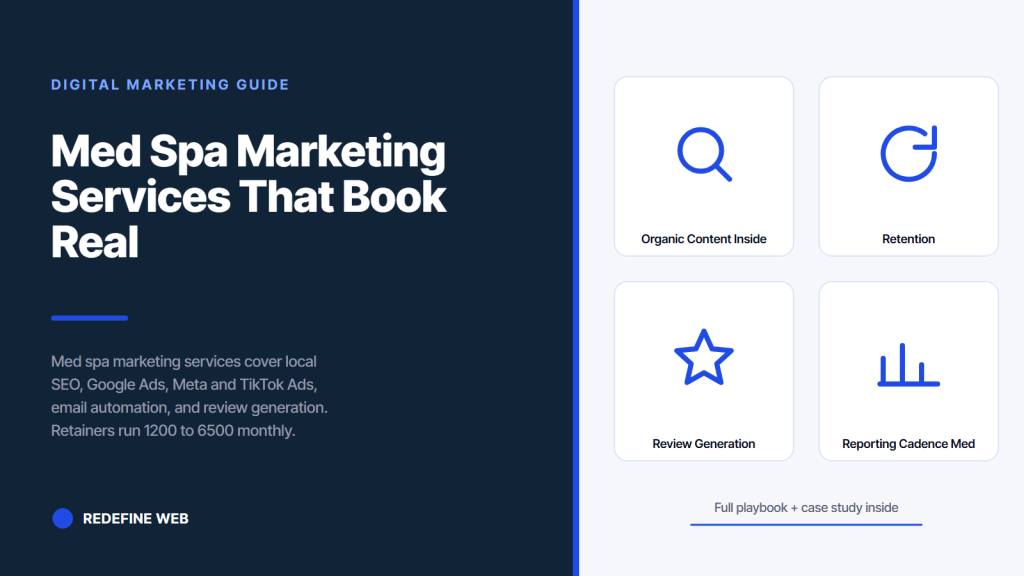
- Med spa marketing services cover seven channels.
- Retainers run 1200 to 6500 dollars monthly.
- Beauté Aesthetics grew leads 166 percent in 12 months.
- GBP and Google Ads start day one.
- Meta and TikTok layer at week four.
- Organic content inside med spa marketing services
- Retention and reactivation inside med spa marketing services
- Review generation inside med spa marketing services
- Reporting cadence for med spa marketing services
- How to vet a med spa marketing services partner before signing
- Integration between med spa marketing services and the practice EHR
- Wrapping up the med spa marketing services decision
Med spa marketing services cover the full growth stack for aesthetics practices running Botox, filler, laser hair removal, body contouring, and IV drip programs. The scope covers local SEO for the map pack, Google Ads plus Meta Ads for treatment intent, TikTok for gallery-driven awareness, HIPAA-safe email and text automation for retention, and a booking flow that closes the phone call inside two taps. Nothing exotic. Weekly discipline on a clean account plus a site that answers three questions inside three seconds.
You want the numbers before the pitch. Beauté Aesthetics New York gained 166 percent more leads, 88 percent more new users, and a 27 percent gain on conversion rate inside 12 months on the same paid budget after we ran the full med spa marketing services stack. The prior agency ran only Google Business Profile edits and reported quarterly. We ran the full stack and reported biweekly. Read the sections below and you will know the exact scope, what to ask a partner, and how the tiers compare.
Organic content inside med spa marketing services
Organic content covers the site’s blog, treatment pages, social media, and email. Working retainers publish two to four blog posts a month on treatment queries, refresh treatment pages every quarter, post to Instagram and TikTok three to five times a week, and send two to four emails a month to the patient list. Skip any one of these and organic growth flattens inside a quarter.
The content calendar rolls three months forward at a time. Each month sits in a Notion database with topic, target query, provider approval status, publish date, and post-publish check-in date. Skip the calendar and content publishing turns into a fire drill every week. Add it and the practice publishes on schedule for the whole quarter without provider pushback.
Blog cadence and topic sourcing
Blog topics come from Google Search Console query data, Ahrefs keyword research, People Also Ask boxes, and Reddit r/30PlusSkinCare threads. Working posts run 1,200 to 2,200 words on a treatment query with a booking widget above the fold on mobile. Provider review takes 20 to 40 minutes per post to fact-check medical claims. Skip the provider review and the practice ships posts with clinical errors that hurt trust.
Social media cadence and content types
Instagram Reels on before-and-after with client consent. Static posts on treatment education. Stories on daily availability. TikTok on trending transformation content. LinkedIn on provider thought leadership if the practice runs a physician-owned model. Working retainers post three to five times a week on Instagram and two to three times a week on TikTok. Skip either platform and the practice cedes reach to a competitor down the street.
Retention and reactivation inside med spa marketing services
Retention drives 60 to 75 percent of annual revenue at mature aesthetic practices. New patient acquisition costs 6 to 12 times more than a reactivation email. Working retainers build post-treatment email flows, birthday and anniversary offers, membership renewal reminders, and lapsed-patient reactivation campaigns. Skip retention and the practice runs on the acquisition treadmill for the whole year.
The tracking stack for retention connects the booking system, the CRM, and the email platform on a single customer identity. Klaviyo, ActiveCampaign, or HubSpot Marketing Hub covers the email side. Vagaro or Boulevard covers the booking side. A middleware layer sits in between and syncs treatment history to email segments. Skip the middleware and retention emails go to segmented audiences that are actually two years out of date.
Post-treatment reactivation flows
Post-treatment reactivation flows send three to five emails across 90 days. First email at day 30 with aftercare tips and referral prompt. Second email at day 60 with maintenance treatment suggestions. Third email at day 90 with membership invitation. Fourth email at day 120 if no rebook has happened, offering a discount on the next treatment. Fifth email at day 180 as a final reactivation attempt. Recovery rate across the flow lands at 18 to 32 percent.
Membership and package promotion
Memberships drive 30 to 55 percent of annual revenue at practices with three or more providers. Email flows for membership sign-up run at day 45 post-treatment with a personalized comparison of package price versus walk-in price. Text nudges at day 60 for non-openers. Skip the email flow and membership signup rate sits at 4 to 8 percent. Add it and signup rate climbs to 14 to 22 percent inside a quarter. Our website maintenance packages team keeps the email and booking system running through every plugin update.
Review generation inside med spa marketing services
Reviews drive local pack ranking and conversion rate on treatment pages. Working practices earn 8 to 22 new Google reviews a month through post-treatment text automation. Skip the automation and reviews come in sporadically at 1 to 3 a month, and the practice ranks below competitors with 40 percent fewer providers but 400 percent more reviews.
Review responses matter as much as review count. Every review needs a response inside 48 hours, whether positive or negative. Positive responses thank the patient by first name and mention the treatment. Negative responses acknowledge the concern, offer a private phone call, and never argue on the public thread. Skip response cadence and Google downgrades the profile signal even with high review counts.
Text automation for review requests
Podium, Birdeye, or NiceJob run text automation for review requests. The text fires 90 minutes after the appointment ends and delivers a direct link to the Google review form. Response rate lands at 22 to 38 percent depending on how well the front desk primes the patient before checkout. Skip the front desk prime and text response rate drops to 8 to 14 percent even with clean automation.
Review response cadence
Every review gets a response inside 48 hours. The practice owner or the marketing manager writes positive responses in first person, thanking the patient by name. Negative responses go through a two-step process: initial acknowledgment inside 24 hours, then a follow-up phone call within a business day. Skip the phone call and negative reviewers escalate to Yelp and RealSelf, where the damage compounds across additional platforms.
If your med spa agency reports quarterly, they aren't watching the account. Ask for biweekly Slack updates on consult volume by channel. Refuse quarterly PDFs.
Reporting cadence for med spa marketing services
Reporting cadence for med spa marketing services scales with tier. Under 2,000 dollars gets a monthly one-pager. Between 2,000 and 5,500 gets biweekly plus monthly deep-dive. Over 5,500 gets weekly one-pager plus monthly executive readout. Any tier that reports less often is under-communicating and hides the work.
Every report format should be shared during the pitch, not withheld until after the contract signs. Real reports look like Databox dashboards or Notion pages with attribution breakdowns across organic, paid, and referral. Skip the sample review and the practice signs a scope where the reporting turns into a PowerPoint deck with stock imagery. One prior agency we replaced sent a monthly report that opened with a full-page inspirational quote from the CEO’s LinkedIn feed. The Botox page conversion rate was buried on page 14.
Weekly one-pager metrics
Booked consults from paid and organic. Map pack rank on the top 20 treatment queries. Google Ads cost per consult by campaign. Meta Ads cost per booking widget open. Blog and social publish status against the calendar. Any critical error rates on the site over 0.5 percent. The one-pager fits on one screen, hits the inbox on Monday morning, and reads in five minutes. Anything longer buries the numbers the owner actually watches.
Monthly deep-dive metrics
Consult attribution across organic, paid, email, and referral. Cost per consult by channel. Consult to appointment conversion ratio month over month. Membership sign-ups from email flow. Review velocity plus sentiment analysis. Backlink acquisition and domain rating trend. Content publish rate against calendar. The monthly deep-dive runs six to ten pages, hits the inbox on the first Tuesday, and gets discussed on the monthly call.
How to vet a med spa marketing services partner before signing
You read three proposals and they read alike until you compare the line items. Ask these six questions before the contract signs and cross-check every answer against a written scope with named tools, deliverables, and reporting cadence. Differences show up in the specificity of the scope.
- Ask for a redacted sample monthly report from a prior med spa client at the same tier. Real reports look like Databox or Notion, not PowerPoint templates.
- Ask which specific tools the retainer includes and which cost extra as pass-through. Ambiguity hides 200 to 600 dollars a month.
- Ask which channels the agency runs in-house versus subcontracts. Subcontracted TikTok work usually adds 30 to 50 percent to cost per view.
- Ask how the agency handles Google Business Profile access, whether they need owner-level login, and how they hand off the account if the retainer ends.
- Ask what happens in month five if map pack ranking has not moved or cost per consult is climbing. Working agencies pivot scope. Bad ones stall and blame the algorithm.
- Ask for the contract length and the early termination clause. Six months is the working floor. Any contract over twelve months without a mid-point escape needs scrutiny.
Green flags in a real proposal
Green flags look like a written scope naming Ahrefs or Semrush, Local Falcon, BrightLocal, CallRail, Klaviyo or ActiveCampaign, and Podium or Birdeye. A sample monthly report shared during the pitch. A prioritization framework for the next quarter’s content calendar. Case studies with named med spa clients, real retainer lengths, and real numbers across at least six months of continuous management. A signed BAA on protected health data. A backup schedule the practice can audit. Anything short of that means the retainer scope is guesswork.
Integration between med spa marketing services and the practice EHR
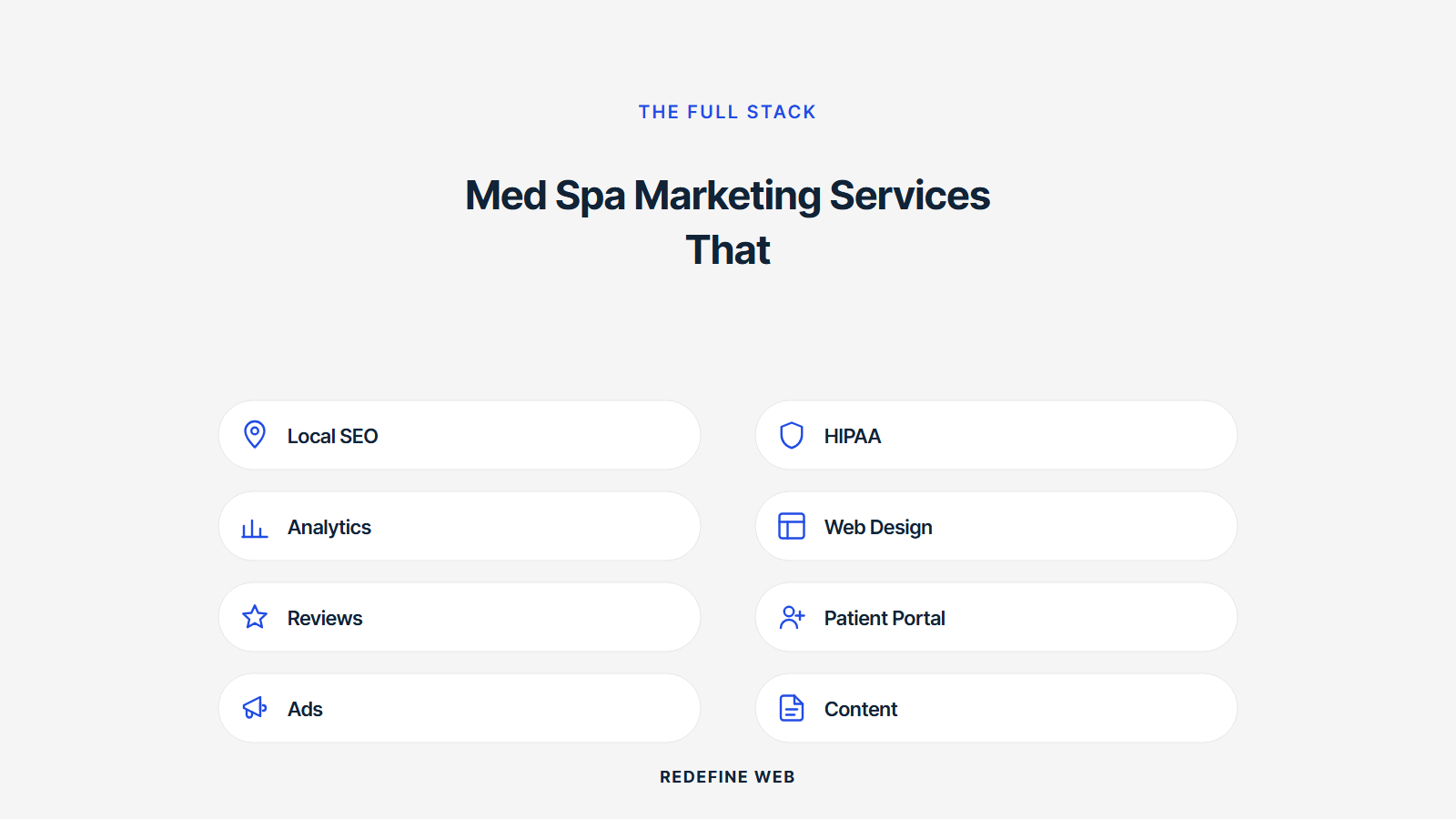
Integration between marketing and the practice EHR decides whether attribution data flows both ways. Working retainers wire the booking system to the CRM, the CRM to the email platform, and the email platform back to Google Ads offline conversion imports. Skip any link in the chain and attribution data breaks, and the practice runs on last-touch reporting that under-credits organic and email.
The technical scope for integration includes a middleware layer like Zapier or Make for lightweight sync, or a custom Node.js integration for high-volume practices. Data flows from Vagaro or Boulevard to HubSpot or Klaviyo on a 15-minute cadence. HubSpot pushes offline conversion imports to Google Ads on a daily cadence. Klaviyo pushes email engagement data back to the CRM every hour.
Booking system to CRM sync
Vagaro to HubSpot sync runs through Zapier for practices under 300 appointments a month and through a custom middleware for high-volume practices. Data mapped includes patient name, treatment history, provider assigned, appointment status, and no-show flag. The CRM segments patients by treatment history for email personalization. Skip the treatment history sync and email personalization runs on generic segments that read as spam.
CRM to Google Ads offline conversion imports
Offline conversion imports send booked and completed appointment data back to Google Ads. Google Ads uses that data to train Smart Bidding on appointment revenue rather than pageview clicks. Working practices see 20 to 35 percent lower cost per booked appointment after four to six weeks of offline conversion imports. Skip the imports and Smart Bidding trains on the wrong signal. Our med spa PPC team wires this on every retainer.
Wrapping up the med spa marketing services decision
Working med spa marketing services cover Google Business Profile, Google Ads, Meta Ads, TikTok Ads, local SEO, email and text automation for retention, and review generation. Retainers run 1,200 to 6,500 dollars a month depending on tier. Setup fees run 2,000 to 8,000 dollars one-time. Contracts run six months minimum. Report cadence scales with tier.
The math on outsourcing wins for most practices spending under 25,000 dollars a month on marketing. According to Google Ads AI updates blog, Smart Bidding paired with offline conversion imports produces 20 to 35 percent better cost per acquisition than manual CPC bidding on service-based accounts, and a working retainer sets up both from day one.
If your current retainer runs under 2,000 dollars a month and consult volume has flattened, the tier is under-scoped for a multi-provider practice. If the retainer runs over 5,000 and you cannot see the workstream line items, the scope is over-quoted for what the practice needs. Ask three vendors for line-item scopes with channels, cadence, and deliverables named. Look for the green flags above. Pick the one that names the workstreams and shares a sample monthly report. Redefine Web runs a fixed-scope program inside our med spa marketing retainer starting at 599 a month with paired med spa web design at build time. Book a call and we will walk you through Beauté Aesthetics New York’s channel mix line by line.
Frequently asked questions
What do med spa marketing services cover?
Working med spa marketing services cover seven workstreams. Local SEO for the map pack including Google Business Profile optimization and NAP cleanup across 40 directories. Google Ads on treatment-specific queries with campaigns split by service line. Meta Ads for gallery-driven awareness and retargeting. TikTok Ads on before-and-after transformation content. Email and text automation for retention and reactivation. Review generation through post-treatment text automation. And a monthly reporting cadence connecting every channel back to booked consult revenue through offline conversion imports and CRM sync.
How much do med spa marketing services cost per month?
Working med spa marketing services retainers run 1,200 to 6,500 dollars a month depending on practice size, channel coverage, and market density. Solo injector practices in mid-size markets sit at 1,200 to 2,000. Two-room practices run 2,000 to 3,500. Multi-provider metro practices run 3,500 to 5,500. Multi-location groups pay 5,500 to 12,000. Enterprise DSO groups pay 12,000 to 35,000 a month. Setup fees run 2,000 to 8,000 dollars one-time and cover tracking QA, keyword research, competitor gap analysis, and first content sprint.
Which channels should med spa marketing services start with?
Every practice starts with Google Business Profile and Google Ads Search on treatment queries. GBP anchors the map pack and drives 30 to 45 percent of new patients for a local aesthetics business. Google Ads Search captures Botox near me and best filler queries at 45 to 90 dollars per consult depending on market density. Local SEO and email flows layer at week two. Meta Ads and review automation at week four. TikTok Ads join once the account has organic content momentum, typically month three.
How do med spa marketing services measure impact?
Impact measurement runs on a tracking stack that connects the booking system, the CRM, the email platform, and Google Ads through offline conversion imports. Metrics tracked include booked consults from paid and organic, cost per booked consult by channel, consult to appointment conversion ratio, membership sign-ups from email flows, review velocity plus sentiment, backlink acquisition, and content publish rate against calendar. Data-driven attribution in GA4 handles multi-touch journeys across paid and organic, which reduces attribution error by 40 percent versus last-touch reporting.
How long do med spa marketing services take to hit results?
Month one shows setup and tracking work with modest volume changes. Month two shows first real optimization signal as negative keyword lists compound and Smart Bidding trains on cleaner data. Month three is where most practices hit break-even against the retainer plus paid budget. Months four through six is where compounding kicks in and cost per consult drops meaningfully. Practices routinely see 3x to 6x return by month six with disciplined weekly management, Meta layered on Google Ads, and offline conversion imports from the CRM back to Google Ads.
Should I hire med spa marketing services or run marketing in-house?
Below 5,000 dollars in monthly ad spend, an agency retainer wins on math. A working PPC plus SEO plus content specialist trio costs 180,000 to 320,000 dollars in salary or roughly 22,000 per month all-in with benefits and tools. That math only pencils above 25,000 dollars in monthly ad spend. Between 5,000 and 25,000 in monthly spend, a hybrid model with an in-house marketing manager plus agency oversight usually wins. Outsourced retainers at 2,000 to 5,000 dollars per month return 8,000 to 25,000 dollars in freed spend inside 90 days on a typical two-room practice.
Book your free 30-minute strategy call.
No spam, no sales rep. We use your email to schedule your call with a senior strategist. That is it.
More from the blog
View all articles → Digital Marketing
 Dental Marketing Tips That Compound Into New Patients
Read article Digital Marketing
 Ecommerce Marketing Strategies That Drive Real DTC Revenue
Read article Digital Marketing