
PPC for Chiropractors That Books New Patients From Week One
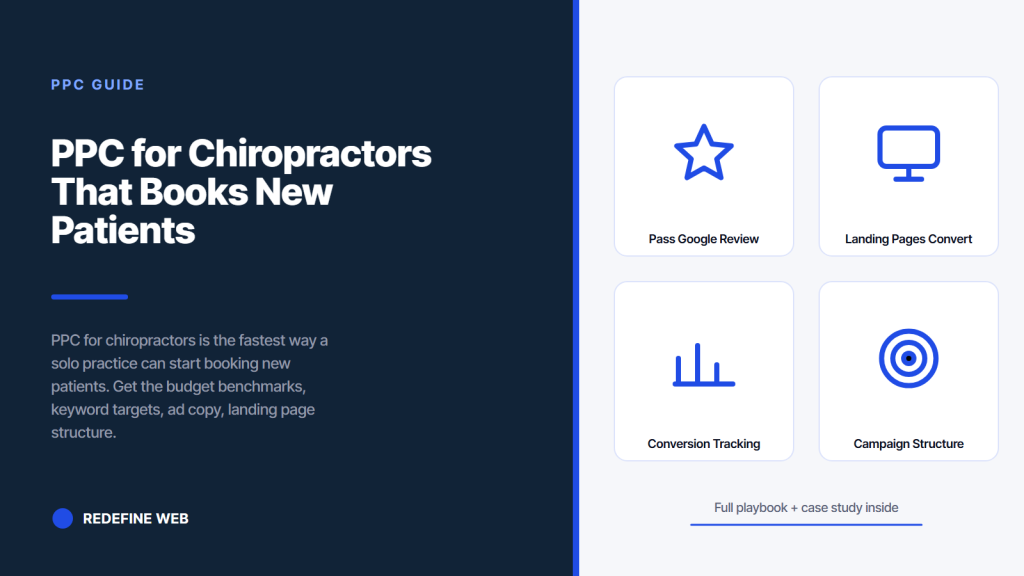
- PPC for chiropractors books new patients in week one.
- Budget benchmark for solo mid-metro is $1,500 to $3,500.
- Dedicated landing pages double booking rate over the home page.
- Pair PPC with SEO for the fastest total growth curve.
- Call tracking is required on every chiropractor PPC account.
- Chiropractor ppc ads that pass Google review and convert
- Landing pages that convert clicks to booked appointments
- Conversion tracking on chiropractor ppc that closes the ROI loop
- Google ads marketing for chiropractors campaign structure
- Chiropractor ppc agency versus in-house management
- Pain Cure Clinic transfer notes for PPC alongside SEO
- Start ppc for chiropractors this week
PPC for chiropractors is the fastest way a solo practice can start booking new patients. Local SEO takes 6 to 9 months to fully compound. Google Ads books patients in week one. You spend money on paid clicks that turn into calls and form fills the same day the campaign goes live. The math works when the campaign is built correctly around high-intent search terms, tight geo-targeting, and landing pages that convert 8 to 15 percent of clicks into bookings.
This guide covers the PPC for chiropractors playbook we run for practice clients. You get the budget benchmarks for solo and multi-location practices, the keyword targets that produce the cheapest bookings, the ad copy templates that pass Google’s health advertising review, the landing page structure that converts, and the exact ROI math a two-provider practice hits in a mid-sized metro. Read straight through in ten minutes and you have the plan a competent PPC agency should execute on your behalf.
Chiropractor ppc ads that pass Google review and convert
PPC for chiropractors ads must pass Google’s healthcare advertising review, which restricts specific claims about treatment outcomes, medical conditions, and prescription-related topics. Ads that promise pain relief or cure specific conditions get rejected. Ads that describe services, credentials, and booking convenience pass the review. See Google’s healthcare advertising policies for the current restrictions.
The ad copy structure that consistently passes review and converts includes a specific service in the headline like Chiropractor in Brookhaven or Same-Day Adjustment Appointments, a credential or trust signal in the second headline like 15 Years Serving Brookhaven or DrX Board-Certified, a benefit in the third headline like Book Online in 30 Seconds, and description lines covering hours, insurance, and location. Skip the pain relief promises. Focus on trust and convenience.
Headline templates that consistently convert
Headline templates that consistently convert include: location plus service, credential plus trust signal, benefit plus urgency. Combine three headlines from those templates for the responsive search ad format. Google mixes headlines automatically and shows the strongest combinations. Provide 10 to 15 headline variants per ad group. Provide 4 description variants. That variant depth gives Google enough material to optimize toward the best-performing combinations.
Ad extensions that add real estate on the SERP
Ad extensions add real estate on the SERP without additional cost per click. Enable sitelink extensions with 6 links to service pages, callout extensions with 6 short benefit statements, structured snippets listing service categories, call extensions with the tracking phone number, and location extensions pulled from GBP. Extensions add 30 to 60 percent to click-through rate at zero additional cost. Skipping extensions leaves free performance gains on the table.
Landing pages that convert clicks to booked appointments
Landing pages for PPC for chiropractors should convert 8 to 15 percent of clicks into booked appointments. Pages below 5 percent conversion are broken. Pages above 15 percent are exceptional. The structure that consistently hits 8 to 15 percent includes a focused H1 matching the ad copy, a 40 to 60 word answer-first paragraph, 3 to 5 benefit bullets, a booking widget above the fold, patient testimonials, and a second CTA at the bottom.
Sending PPC traffic to the general home page cuts conversion in half compared to sending it to a dedicated landing page matching the ad copy. Every ad group needs its own landing page. Sciatica ads go to a sciatica landing page. Adjustment ads go to an adjustment landing page. Brand keyword ads go to the home page. That matching structure is worth the extra design and build effort because it doubles the booking rate on the same ad spend.
Page speed on landing pages matters for both conversion and cost
Page speed on landing pages matters for both conversion and cost per click. Google’s Quality Score reads landing page experience directly into the ad auction. Pages that load in under 2.5 seconds and hit Core Web Vitals green get a Quality Score boost that drops cost per click by 15 to 30 percent. Slow landing pages cost more per click and convert fewer visitors into bookings. Both problems compound. Fix page speed before scaling ad spend.
Booking widget above the fold that captures the moment
Booking widget above the fold captures the moment when the visitor is highest intent. Integrate the practice management system’s booking widget so patients can pick a time and confirm without leaving the landing page. Add a click-to-call button on mobile that dials the tracked number. Add a form fill option for patients who prefer email over calls. Three conversion paths visible above the fold produce 2 to 4x the bookings of a single form buried below the fold.
Conversion tracking on chiropractor ppc that closes the ROI loop
Conversion tracking on chiropractor PPC closes the ROI loop by attributing every click and every dollar spent to specific booked appointments. Install Google Ads conversion tracking on the booking widget, form submissions, and phone calls. Add call tracking with dynamic number insertion through CallRail or WhatConverts to attribute phone bookings to specific keywords.
Practices that skip conversion tracking cannot optimize the campaign. Google Ads bids on keywords based on the tracked conversions. Without tracking, the campaign runs blind and burns through budget on keywords that never book. Install tracking in week one before scaling ad spend. See Google Ads conversion tracking documentation for the full setup guide. Our chiropractor PPC setup guide covers the tracking install step by step for a solo practice running the first campaign in-house before scaling to an agency retainer or hiring a specialist to hand the whole thing off.
Every practice starting Google Ads for the first time hits the same moment in week two. You log into the ads dashboard hourly. You refresh the campaign three times before your morning coffee. You watch a single click cost $8.42 and mentally calculate how many clicks it takes to pay for a family vacation. You realize the vacation math does not work out. You watch the next click cost $11.60 and briefly consider a career change. Then a form fill comes through. You book the patient. The math starts working again. Then you refresh the dashboard.
Chiro PPC accounts stall on the page, not the auction. If your ad drops traffic on the homepage, fix that before touching keyword bids or budget.
Google ads marketing for chiropractors campaign structure
Google ads marketing for chiropractors campaign structure separates Search Ads, Performance Max, and Remarketing into distinct campaigns with distinct budgets. Search Ads run 70 percent of budget targeting transactional keywords. Performance Max runs 20 percent reaching broader audiences. Remarketing runs 10 percent following up with prospects who visited the site but did not book.
Within Search Ads, structure ad groups by intent bucket: location plus service, condition, brand, and competitor. Each ad group targets 15 to 30 tightly related keywords with 3 responsive search ads and dedicated landing pages. That structure enables independent budget control on each intent bucket. Practices can scale up condition ad groups while keeping brand ad groups efficient. Structure matters more than most PPC agencies admit.
Geo-targeting that respects the service radius
Geo-targeting for chiropractor PPC restricts ad delivery to the practice’s service radius. A 5-mile radius works for dense urban markets. A 10-mile radius works for suburban markets. A 20-mile radius works for rural markets. Wider radiuses waste budget on clicks from patients who will not drive to the practice. Tighter radiuses miss patients within reasonable driving distance. Match the radius to the market density and adjust based on actual booking data over 90 days.
Day-parting that concentrates budget when patients book
Day-parting concentrates budget on the days and hours when patients actually book. Most chiropractor bookings happen Monday through Thursday between 7 AM and 8 PM local time. Weekend bookings run at 40 percent of weekday volume. Overnight bookings run at 10 percent. Set bid adjustments to spend 100 percent during peak hours, 60 percent on weekends, and 20 percent overnight. Day-parting saves 15 to 25 percent of the ad budget from being spent when the practice is closed and prospects cannot call.
Chiropractor ppc agency versus in-house management
A ppc for chiropractors agency handles keyword research, ad copy writing, landing page collaboration with the web team, bid management, negative keyword updates, conversion tracking, and monthly reporting. Roughly 15 to 20 hours a week of work for a solo practice ad account. Agency fees run $600 to $1,500 monthly on top of ad spend. In-house management with a marketing coordinator committing 15 hours a week costs $1,500 to $2,000 monthly fully loaded plus $50 in tools.
Choose the agency if the practice does not have a marketing coordinator. Choose in-house if you have dedicated marketing headcount who wants to specialize in PPC. Never choose the practice owner or the front desk lead to run PPC in-house. Both roles are too stretched to hold the daily attention PPC requires in the first 90 days. Our chiropractor PPC services writeup covers the full checklist an agency should deliver.
Agency selection criteria that avoid mismatches
Agency selection criteria that avoid mismatches include documented chiropractor experience, transparent monthly reporting, clear ownership of the Google Ads account, contract terms 6 to 12 months, and pricing that fits your ad spend. Agencies that lock you into their own Google Ads account without transferring ownership are the biggest red flag. If the agency ends the relationship, the practice loses the campaign history. Insist on the practice owning the Google Ads account from day one.
Reporting cadence that keeps the agency honest
Reporting cadence keeps the agency honest. Monthly report should include spend, clicks, cost per click, click-through rate, conversion rate, booked appointments attributed to PPC, cost per booked appointment, and top-performing keywords and ads. Weekly updates via Slack or email cover any campaign changes. Quarterly strategy calls cover scope adjustments. Agencies that go dark between monthly reports are a warning sign. Weekly touchpoint minimum is standard for accounts over $2,000 monthly ad spend.
Pain Cure Clinic transfer notes for PPC alongside SEO
Pain Cure Clinic ran PPC alongside their SEO program during the ramp period, using ads to catch transactional searches while SEO climbed the pack. The paired approach produced booked patients in week one from PPC and compounded to 205 percent new patient growth by month 24 as SEO caught up and eventually delivered more of the total bookings than PPC at a fraction of the per-patient cost.
The transferable lesson for a solo practice: pair PPC and SEO from day one. Do not wait for SEO to work before starting PPC. Do not run PPC forever expecting it to replace SEO. Both channels serve different funnel positions. PPC catches transactional intent immediately. SEO builds the compounding organic engine. Practices that run both channels together see the fastest total growth curve. Our Chiropractor marketing services covers the paired retainer scope end to end.
Budget split between PPC and SEO over 12 months
Budget split between PPC and SEO over 12 months shifts as SEO ramps. Month one starts at 60 percent PPC and 40 percent SEO to book patients while SEO builds. Month six sits at 50/50 as SEO starts producing meaningful volume. Month 12 shifts to 40 percent PPC and 60 percent SEO because organic search delivers more bookings at lower per-patient cost. Continuous rebalancing keeps the total marketing spend efficient across the compounding curve.
Cross-channel tracking that attributes correctly
Cross-channel tracking attributes bookings correctly across PPC and SEO by using the same landing pages, the same conversion tracking, and the same call tracking source. Multi-touch attribution shows which patients first found the practice through PPC and later booked through organic, or vice versa. Without cross-channel tracking, the two teams argue about credit and the practice cannot see the true ROI of each channel. Install tracking that captures both first-touch and last-touch source.
Start ppc for chiropractors this week
Start with three moves this week. Install Google Ads conversion tracking and call tracking on the site. Build one dedicated landing page for the top service ad group. Launch a small $500 test budget on 20 exact-match location plus service keywords with tight geo-targeting. That test produces the first booked patients in 3 to 7 days and reveals which keywords, ads, and landing pages the account should scale next.
Then plan the 90-day ramp. Month one hits 50 percent target budget with 4 ad groups and 4 landing pages. Month two ramps to 75 percent budget with expanded keyword lists and remarketing. Month three hits 100 percent target budget with the full campaign structure and stable optimization. Practices that follow the ramp see stable per-patient costs and no wasted spend on unproven variants. For the deeper checklist on what a good PPC agency delivers each month, see our chiropractor PPC services writeup.
Frequently asked questions
How much does PPC for chiropractors cost per month
PPC for chiropractors costs $1,500 to $3,500 monthly in ad spend for a solo practice in a mid-sized metro. Add management fees of $600 to $1,500 monthly for an agency or 15 to 25 percent of ad spend if the agency prices on percentage. Total monthly investment lands at $2,100 to $5,000 for a solo practice. Two-location practices run $3,600 to $6,500 total monthly. Multi-location groups run $6,000 to $13,500. Ad spend below $1,000 monthly rarely produces stable results because click volume falls below the optimization threshold. Above $5,000 monthly for a solo practice usually means the practice cannot handle the resulting patient volume.
How fast does chiropractor PPC produce booked patients
Chiropractor PPC produces booked patients within the first week of the campaign going live, sometimes within 24 to 48 hours for well-built campaigns targeting high-intent transactional keywords. The first month typically produces 60 to 80 percent of the target monthly booking volume as the campaign gathers data and optimizes. Months two and three produce the full target booking volume as the campaign structure stabilizes. That speed to first booked patients is the key advantage over SEO, which takes 90 days to move rankings and 6 months to compound. Most practices run both channels together for that reason.
What is the biggest chiropractor PPC mistake practices make
The biggest chiropractor PPC mistake is sending paid ad traffic to the general home page instead of a dedicated landing page matched to the ad copy. Home pages convert at 3 to 5 percent for PPC traffic. Dedicated landing pages convert at 8 to 15 percent. That difference means the same $2,000 monthly ad spend produces 8 to 15 booked patients on the home page versus 16 to 30 booked patients on dedicated landing pages. The extra design and build effort for landing pages pays back within 30 days on any account over $1,500 monthly ad spend. Skip this step and half the ad budget effectively wastes on lower conversions.
Should I hire a chiropractor PPC agency or run PPC in-house
Hire a chiropractor PPC agency if the practice does not have a dedicated marketing coordinator on staff. Run PPC in-house if you have marketing headcount who wants to specialize in PPC and can commit 15 hours a week to the workflow. Never hand PPC to the practice owner or the front desk because both roles are too stretched to hold the daily attention PPC requires in the first 90 days. Agency fees run $600 to $1,500 monthly. In-house management fully loaded at typical coordinator rates lands at $1,500 to $2,000 monthly. Agency wins on total cost of ownership for practices without dedicated marketing staff.
What Google Ads keywords work best for chiropractor PPC
The Google Ads keywords that work best for chiropractor PPC fall into four buckets. Location plus service keywords like chiropractor Brookhaven and adjustment near me produce the highest booking rate. Condition keywords like sciatica treatment and lower back pain relief produce moderate booking rates. Brand keywords protecting your practice name produce very high booking rates at low cost per click. Competitor keywords bidding on nearby practice names are optional and depend on market ethics. The optimal keyword mix is 60 percent exact match, 30 percent phrase match, and 10 percent broad match. Add negative keywords like chiropractor jobs, chiropractic school, and horse chiropractor to stop wasted spend.
Can PPC for chiropractors work alongside SEO or does it replace SEO
PPC for chiropractors works alongside SEO and never replaces SEO. PPC catches transactional intent in week one at $50 to $180 per booked patient. SEO takes 6 to 12 months to compound but eventually produces bookings at $10 to $40 per patient. Both channels serve different funnel positions and different phases of the practice's growth. Practices that run only PPC pay for every patient forever at the high per-patient cost. Practices that run only SEO wait 6 months for meaningful patient volume. Practices that run both channels together see the fastest total growth curve with the lowest average per-patient cost over 24 months of continuous operation.
Book your free 30-minute strategy call.
No spam, no sales rep. We use your email to schedule your call with a senior strategist. That is it.
More from the blog
View all articles → PPC
PPC Healthcare PPC Advertising Channels Compliance and Targeting
Read article PPC
PPC Dental Facebook Ads Guide for Practices That Book Patients
Read article PPC
PPC