
Chiropractor PPC Services (What’s Included + Checklist)
- Four campaigns cover 90 percent of intent. Condition, branded, competitor, retargeting.
- Management fees run $500 to $2,000 per month plus separate ad spend.
- Call tracking on every campaign or attribution guesses.
- Weekly negative keyword pass is the highest-value 20-minute task.
- Every ad gets a dedicated landing page. No exceptions.
- Call tracking and attribution in chiropractor PPC services
- Chiropractor PPC services checklist for month one
- Reporting cadence and KPIs the best chiropractor PPC company tracks
- How to pick a chiropractor PPC agency worth hiring
- Multi-location chiropractor PPC services scope
- Tools stack behind chiropractor PPC services
- Common mistakes in chiropractor PPC services
- How Redefine Web runs chiropractor PPC services for clients
Chiropractor PPC services are how a practice buys top-of-Google visibility on the exact search terms patients type before booking care. Not display ads. Not YouTube pre-roll. Google Ads on high-intent search queries where the CAC math actually works. When chiropractor PPC services are set up correctly, the first booked exam lands inside 48 hours of launch and cost per booked exam stabilizes by week four. When set up poorly, the same account burns budget on broad-match traffic and returns nothing. This guide walks the whole scope so you know what to buy, what to skip, and what a real PPC checklist looks like month over month.
You’ll read the full deliverables list for chiropractor PPC services at the independent-practice level, the numbers that separate a working account from a padded one, the campaign structure that keeps CPA under $75, and the reporting cadence a serious PPC agency runs. Read straight through in ten minutes, then compare it against whatever proposal is sitting in your inbox.
Call tracking and attribution in chiropractor PPC services
Call tracking on every campaign or the numbers guess. Chiropractic patients call more than they fill forms. A dynamic number swap tool like CallRail costs $45 to $145 per month for a single-location practice. It shows the source of every inbound call and lets you filter for new patients that turned into booked exams.
Without call tracking, no chiropractor PPC company can honestly report cost per booked exam. They can only report cost per form fill and cost per website click. That leaves 60 to 70 percent of real conversions invisible. Any PPC advertising for chiropractors that doesn’t include call tracking in the base scope is either lazy or hiding weak results.
Call scoring for real attribution
Advanced accounts run call scoring on every inbound call. Score categories: new patient (booked), new patient (didn’t book), existing patient, spam, non-patient inquiry. That single classification tells the strategist which campaigns produce actual booked patients versus which produce noise. Manual scoring for the first 90 days, then automated with an AI scoring tool after volume proves it out.
Conversion tracking in Google Ads
Set up two primary conversions in Google Ads: form submit and phone call. Import them from CallRail and Google Analytics 4. Assign a value to each ($150 for a form, $300 for a booked call from tracking). Set the bidding strategy to maximize conversion value with a target CPA cap. That’s the setup that keeps Google’s algorithm optimizing toward booked exams instead of clicks.
Chiropractor PPC services checklist for month one
Month one of any chiropractor PPC engagement should follow a strict deliverables checklist. If any of these are missing at day 30, the vendor is understaffed or coasting. A serious PPC company completes every item and reports back with the search terms report insights from the first 20 days of spend.
- Google Ads account audit and structure rebuild
- Conversion tracking installation and QA (form + phone)
- Call tracking with dynamic number swap on the site
- Four campaigns launched (condition, branded, competitor, retargeting)
- 40-60 keyword build across exact and phrase match
- Initial negative keyword list (200+ terms from research)
- 3-5 responsive search ads per ad group
- Dedicated landing pages for each condition campaign
- First 20-day search terms report review and negative keyword pass
- Baseline monthly report delivered by day 30
Negative keyword list that starts the account clean
The initial negative keyword list saves 20 to 40 percent of month-one spend. Standard exclusions: free, cheap, DIY, YouTube, jobs, employment, school, degree, course, education, veterinary, pet, dog, cat. Add practice-specific exclusions: insurance-only queries if the practice is cash-pay, pediatric queries if the practice is adult-only. That single list is worth $500 to $1,500 in prevented waste in month one alone.
Conversion tracking QA before spending a dollar
QA conversion tracking before turning on ad spend. Test form submits with real emails, phone calls with real numbers, and verify the conversions fire in Google Ads and Analytics 4 within an hour. Fifty percent of new PPC accounts have broken conversion tracking on day one and no one catches it until month two, at which point the entire first month’s spend was optimizing on garbage data.
Reporting cadence and KPIs the best chiropractor PPC company tracks
The best chiropractor PPC company reports on five numbers. Total spend. Cost per lead (form or call). Cost per booked exam. Booked exams count month over month. ROAS on 12-month patient case value. Everything else is diagnostic. A monthly report longer than six pages is padding. A quarterly review needs 45 minutes and covers strategic direction, not tactical details.
Weekly check-ins are unnecessary for accounts under $10K per month in spend. Monthly reviews at that spend level are enough. Above $10K in monthly spend, add a mid-month check-in call at 20 minutes to catch drift before it compounds. That cadence keeps the strategist focused on decisions, not on producing reports for their own sake.
KPI targets month over month
Month 1: baseline everything. First booked exam by day 3. Cost per booked exam elevated ($100-200) as the algorithm learns. Month 2-3: CPA drops toward target ($50-150 in most markets). Month 4-6: stable CPA, month-over-month booked exam growth. Month 7-12: scale spend if unit economics work. Cut spend if CPA drifts above ceiling. That’s the loop.
Scaling decisions after month three
After month three, scaling decisions get made monthly. If CPA sits 20 percent below the ceiling and the schedule can absorb more patients, increase daily budgets 10 to 20 percent per week. If CPA rises 15 percent above baseline, pull budget and audit search terms and keyword match types. Never scale spend faster than the practice’s capacity to book new patients into the schedule.
Serious chiropractor PPC vendors know cost per exam stabilizes in week 4, not month 4. If they can't tell you what happens after launch week, they haven't run 10 accounts.
How to pick a chiropractor PPC agency worth hiring
Picking a chiropractor PPC agency is the same shortlist framework as SEO. Three finalists, not six. Ask for two active-client references you can call. Request the last three monthly reports from a comparable account. Run a 90-day paid trial before signing a longer contract. That process filters weak vendors faster than any RFP.
Old PPC industry joke: a strategist walks into a chiropractor’s office and says “your CPA is $340 and here’s your monthly report.” The chiropractor says “great, when do I see a patient?” The strategist replies “we’re still building brand awareness.” That is the exact conversation you avoid by asking for booked exam data on the first sales call, not ranking screenshots or impression counts.
Red flags in PPC vendor conversations
Guaranteed rankings on any keyword. Percentage-of-spend pricing above 15 percent. No call tracking in the base scope. Contracts longer than 12 months on day one. Reporting on impressions and clicks with no booked-exam data. A single strategist managing more than eight active accounts. Any one of those is a warning sign. Two in the same sales call and you keep shopping.
The reference call that saves months
A five-minute call to a current client of the PPC agency beats a 30-page proposal. Ask three questions. What did the first 90 days look like? What surprised you in month six? Would you sign again tomorrow? A confident agency provides two phone numbers immediately. A weak one provides screenshots and a case study PDF. That difference decides the vendor selection faster than any decision matrix.
Multi-location chiropractor PPC services scope
Multi-location chiropractor PPC services scale differently than single-location. Each location gets its own campaigns, budget cap, and landing page. Location-specific ad copy pulls better click-through than shared campaigns. Group-level reporting rolls up all locations for the executive dashboard, then drills down to per-location performance for operational calls.
Per-location budget allocation
Allocate budget by location capacity, not by revenue. A location booking 60 percent of appointment slots can absorb more PPC-driven traffic than a location running at 90 percent capacity. Budget the underutilized locations first. That single reallocation grows group-wide new patient volume 15 to 25 percent without adding budget. Our team ran this exact rebalance on a Canadian multi-location engagement and cost per booked consult dropped 58 percent over 12 months.
Centralized reporting for the exec team
Centralize the PPC reporting into a single dashboard for the executive team. Google Data Studio or Looker Studio does the job for free. Show group-wide spend, group-wide cost per booked exam, and per-location booking rate. Drill-down views for the operations team who need per-location call volume and lead source data. Executive summary stays one page.
Cross-location testing at scale
Test ad copy and landing pages at one location, then roll winners to the group. That approach beats testing everything everywhere at once and produces cleaner learnings. Rotate the test location every quarter so no single site absorbs all the optimization risk. That single discipline drives compounding performance gains at the multi-location group level over 12 months.
Tools stack behind chiropractor PPC services
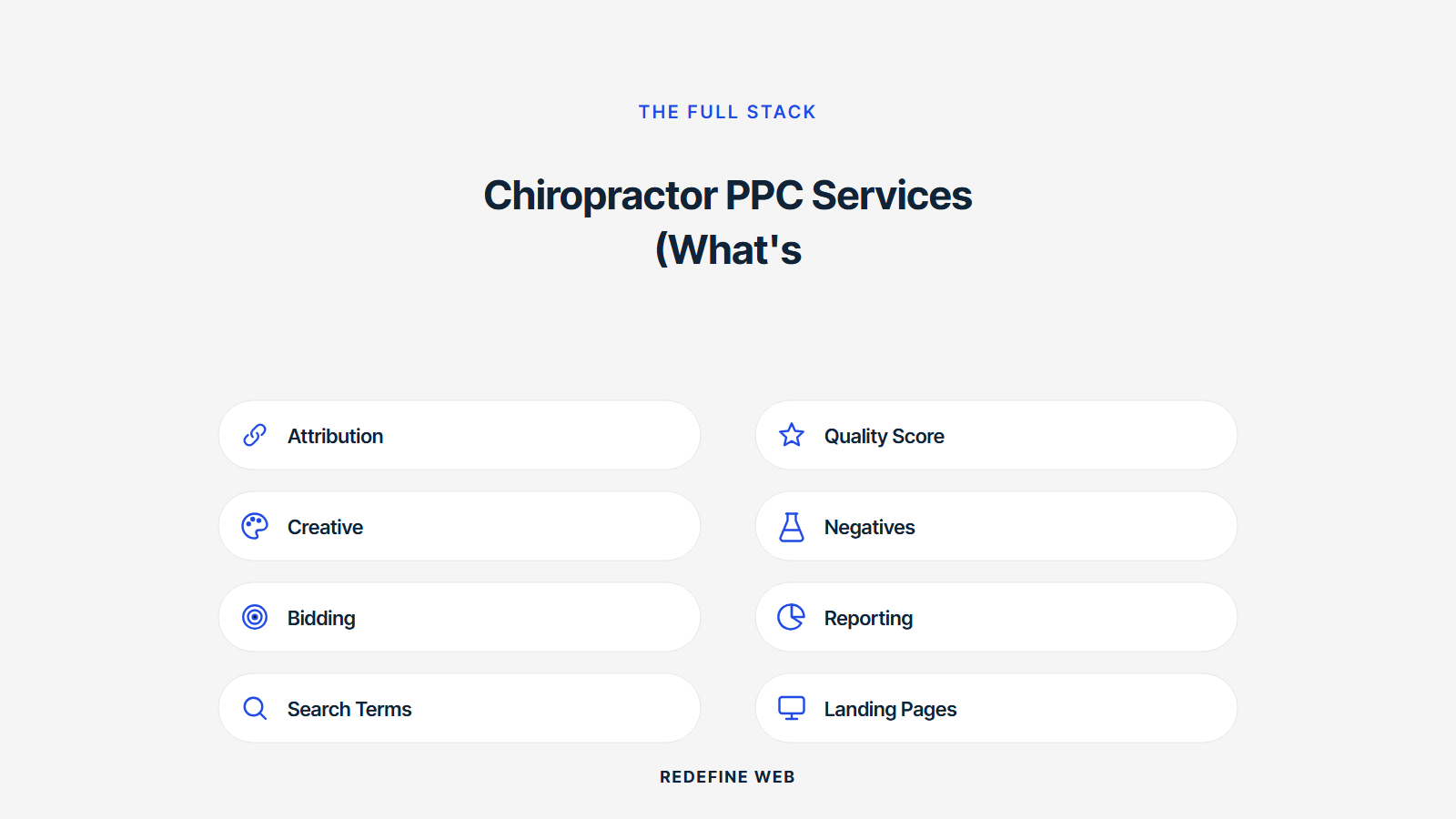
The tool stack behind chiropractor PPC services is small and cheap. Google Ads (free platform, pay-per-click). Google Analytics 4 (free). CallRail for call tracking ($45-145 per month). Optmyzr for account optimization ($208+ per month, optional). Google Ads Editor for bulk edits (free). That’s the base stack. Every additional tool needs to justify its cost against a clear reporting or optimization gain.
Landing page tools worth using
Unbounce or Leadpages for standalone PPC landing pages ($99-199 per month). Or build them inside WordPress with a lightweight page builder like Bricks or Oxygen. Standalone tools launch faster in month one. WordPress-based pages compound with the site’s SEO. Pick based on the practice’s other marketing priorities.
Reporting and dashboard tools
Google Looker Studio for dashboards (free). Sheets for weekly trend tracking (free). Any dedicated reporting SaaS above $99 per month is optional. The strategist’s judgment on the search terms report is worth more than any automated report tool. Reporting exists to inform decisions, not to prove the agency worked.
Call recording and QA tools
CallRail’s call recording and transcription add-on runs $30 extra per month and unlocks real call scoring. Every inbound call gets transcribed. The strategist listens to 10 to 20 calls per month to spot conversion barriers (front desk asking about insurance too early, missing appointment offers, poor call opens). That single practice moves booking rate 10 to 20 percent inside 60 days without changing a single ad or keyword.
Common mistakes in chiropractor PPC services
Common mistakes come from mixing PPC playbooks written for e-commerce or SaaS with local service business realities. Chiropractic PPC is local, high-consideration, and phone-first. E-commerce PPC is national, low-consideration, and form-first. Mix the two and the account underperforms in month one. Recognize the difference and CPA sits at target inside 60 days.
Running broad match on generic terms
Broad match on generic terms burns budget on unqualified traffic. “Chiropractor” as a broad match keyword pulls searches for “chiropractor jobs,” “chiropractor school,” “chiropractor equipment” and pays for every click. Use exact match and phrase match only in the first 90 days. Add broad match modified after conversion data proves the pattern. See our PPC for chiropractors pillar for the full match-type breakdown.
Sending ads to the homepage
Sending ads to the homepage instead of dedicated landing pages doubles CPA on average. The homepage tries to serve every intent. A landing page serves one. Every campaign gets a landing page. No exceptions. This one change is worth more than any bid optimization or ad copy test.
Skipping the weekly negative keyword pass
Skipping the weekly negative keyword pass is the fastest way to waste PPC budget. Every week produces 15 to 30 new junk queries that need excluding. Miss two weeks and the account starts serving ads on irrelevant terms. Miss two months and CPA doubles. The 20-minute weekly pass is the highest-value activity in the entire account.
How Redefine Web runs chiropractor PPC services for clients
Redefine Web runs Chiropractor marketing services for independent practices and multi-location groups across the US and Canada. We ran a similar paid media engagement with Canadian Orthodontic Partners across 65 clinics and cost per booked consult dropped 58 percent over 12 months of active optimization.
Our first call is a free 30-minute audit of the existing Google Ads account. We review campaign structure, conversion tracking, and the last 90 days of search terms live on screen. You leave the call with three specific fixes that would improve CPA in the next 30 days. Ours to earn, yours to keep.
Our chiropractor PPC scope
Setup, four-campaign launch, weekly optimization pass, monthly reporting, quarterly strategic review, and call tracking integration. That’s the standard scope. Practices that want landing page design added or Meta ad integration move into a higher tier at $1,600 to $2,500 management per month. Every scope decision goes in writing before setup begins.
Our reporting and review cadence
Monthly report on the first Tuesday. 45-minute review call the same week. One-page executive summary with five KPIs. Then wins from last 30 days, next 30 days of tests, and one strategic question. The report doesn’t grow to fill time. It stays tight and outcome-focused. Read our Chiropractor PPC setup for the full campaign construction playbook. Related reading includes Google’s own Google Ads best practices documentation for match type strategy.
Frequently asked questions
What do chiropractor PPC services include?
Chiropractor PPC services include setup, weekly optimization, monthly reporting, ad copy writing and testing, negative keyword management, bid adjustments, and call tracking integration. Base scope covers four campaigns (condition, branded, competitor, retargeting), 40 to 60 keywords across exact and phrase match, and 3 to 5 responsive search ads per ad group. Landing page design, video ad production, and Meta ad integration typically cost extra. Ask for the scope sheet with monthly line items before signing any contract.
How much do chiropractor PPC services cost per month?
Chiropractor PPC services run on two costs: management fee and ad spend. Management fees for a single-location practice range from $500 to $2,000 per month depending on scope and account size. Ad spend starts at $1,500 per month at the low end. Total monthly cost for a single-location practice in a mid-size metro sits at $2,500 to $4,500. Multi-location groups pay $3,500 to $10,000 combined. Below $2,000 total, the account cannot produce enough signal to optimize weekly with confidence.
What is a good cost per booked exam from chiropractor PPC?
A working cost per booked exam from chiropractor PPC services sits at 25 percent of average patient case value or lower. A practice with a $1,600 case value can spend up to $400 to acquire a new patient and still make the 12-month math work. In mid-size markets, chiropractor PPC typically produces booked exams at $50 to $150 per patient. Competitive metros push higher, up to $200. Rural markets sit lower, around $30 to $80 per booked exam.
How long until chiropractor PPC produces booked patients?
Chiropractor PPC produces the first booked exam inside 48 hours of launch when the setup is done correctly. CPA is elevated the first two weeks as Google's algorithm learns which keywords convert. By week four, CPA stabilizes at the account's target. Steady month-over-month volume growth starts by month three. Anyone claiming stable performance in week one is either overpromising or has not accounted for the algorithm learning phase that every new account goes through.
Should I hire a chiropractor PPC agency or run ads in-house?
Hire an agency for accounts under $5,000 per month in ad spend. The strategist time required to run PPC well is not worth an in-house hire until spend passes $10,000 per month. A chiropractor PPC agency handles the weekly optimization, monthly reporting, and quarterly strategy for a flat fee that costs less than a part-time in-house PPC specialist. Above $10K spend, a hybrid model works. In-house strategy plus agency execution scales cleanest.
What are red flags in chiropractor PPC agency sales calls?
Guaranteed rankings or booked patient counts. Percentage-of-spend pricing above 15 percent. No call tracking in the base scope. Contracts longer than 12 months on day one. Monthly reports that show only impressions and clicks with no booked exam data. A single strategist managing more than eight active accounts personally. Any one of those is a warning sign. Two in the same sales call and you keep shopping for a different chiropractor PPC company.
Can chiropractor PPC services work for a solo practice?
Yes. Solo chiropractic practices in mid-size markets are the sweet spot for chiropractor PPC services. Total budget of $2,500 to $4,500 per month (management plus ad spend) produces 8 to 20 new booked patients monthly at $50 to $150 CPA. Solo practices with case values above $1,200 and treatment plan revenue above $2,000 have the unit economics to make PPC profitable inside 90 days of launch. Below those thresholds, PPC pressure is much harder to justify long-term for a solo owner.
Book your free 30-minute strategy call.
No spam, no sales rep. We use your email to schedule your call with a senior strategist. That is it.
More from the blog
View all articles → PPC
PPC Healthcare PPC Advertising Channels Compliance and Targeting
Read article PPC
PPC Dental Facebook Ads Guide for Practices That Book Patients
Read article PPC
PPC