Your Shopify store leaves money on the checkout page every day. The abandoned-cart notice you set up in year one still fires once. The welcome email nobody rewrote in two years still says “Welcome to the family.” And your winback list, which is 41 percent of your revenue on paper, gets exactly zero messages a month. Marketing automation ecommerce work fixes that gap. It picks the right platform for your stack, wires the four flows that actually book repeat revenue, and reports the numbers weekly so you can see what the automations earned this month against last.
This guide covers the five platforms worth naming in 2026 (Klaviyo, Attentive, Postscript, Omnisend, Sendlane), the four flows every DTC brand needs live, how to pick between email-first and SMS-first stacks, and what a real weekly reporting cadence looks like once the automations run correctly. Every call below comes from setups we’ve run on live Shopify and WooCommerce stores through 2025 and 2026.
What marketing automation ecommerce actually covers
Marketing automation ecommerce is the software layer that sends the right message to the right shopper at the right point in the funnel without a human clicking send. Email flows, SMS flows, push notifications, and paid-audience syncs all sit inside this layer. Not a newsletter tool. Not a batch-and-blast list. A trigger-driven marketing automation ecommerce system that reads store events and reacts.
The trigger set is small and consistent across brands. A shopper signs up. A shopper browses a product page. A shopper adds to cart but doesn’t check out. A shopper buys. A shopper stops buying. Each trigger fires one flow, each flow contains 3 to 9 messages, and each message carries a single job. You run the whole system through one platform or a two-platform stack, and you report on it weekly against attributed revenue.
The reason marketing automation for ecommerce matters more in 2026 than it did five years ago is plain. Paid acquisition cost has climbed for DTC brands in recent years, so owned-channel margin holds steady inside a marketing automation ecommerce program. Every dollar you spend acquiring a customer earns more when your automations retain that customer for two, three, or four repeat orders. Brands running the four core flows on a mature ecommerce marketing automation platform typically see owned-channel revenue land between 28 and 44 percent of total store revenue. Brands running batch email only sit at 8 to 14 percent. That gap is the whole reason to do this work carefully.
There’s a second reason to name the work correctly. Teams that call automation “our email list” tend to under-invest in it. You get one flow, maybe two, plus a monthly campaign send. Teams that call it marketing automation ecommerce, budget it as its own line item, and staff it with a real owner tend to hit the 30-percent-of-revenue mark inside 90 days of a proper platform setup. Naming determines investment. Investment determines outcome.
The five marketing automation ecommerce platforms worth naming
You have hundreds of tools claiming to do marketing automation ecommerce work. Five of them account for the vast majority of DTC brand deployments we run into on new accounts. Klaviyo for email-first stacks under $200M in revenue. Attentive for SMS-first premium brands. Postscript for Shopify SMS with strong list-growth tooling. Omnisend for smaller stores wanting both email and SMS in one dashboard. Sendlane for behavior-driven flows with lightweight review integration.
Our sibling read on ecommerce social media marketing covers the channel mix and creator strategy that feeds this playbook.
Every other tool worth mentioning either builds on top of one of these (Yotpo, Rebuy, Alia) or targets an enterprise segment (Salesforce Marketing Cloud, Bloomreach, Iterable) where the setup work looks entirely different. If your store does under $30M in revenue, one of the five platforms below is the right marketing automation ecommerce answer.
| Platform | Best fit | Monthly cost floor | Email + SMS? | Shopify sync depth |
|---|---|---|---|---|
| Klaviyo | DTC brands, $500K to $200M revenue, email-heavy | $45 starter, real cost $300 to $2,400 | Both since 2023 | Deep, native |
| Attentive | Premium brands, SMS-first, $2M+ revenue | $500+, revenue share deal | SMS-first, email launched 2024 | Deep on Shopify Plus |
| Postscript | Shopify brands, SMS-focused, aggressive list growth | $100 to $500 | SMS only, email via partner | Deep, Shopify-only |
| Omnisend | Small to mid Shopify stores, single-dashboard preference | $16 to $400 | Both, native | Solid, plugin-based |
| Sendlane | Brands wanting behavior triggers and review flows in one tool | $149 to $2,499 | Both, native | Solid via app |
The cost floors above are the sticker numbers. What you actually pay depends on active-profile count for email and message count for SMS. A brand with 250K active profiles on Klaviyo pays $2,000 to $2,400 per month, not $45. A brand sending 500K SMS messages per month on Postscript pays $8,000 to $12,000. Plan the budget on active-profile projections at month 12, not month 1. The wrong ecommerce marketing automation software choice at launch costs 60 to 90 days of migration work in year two once you outgrow the tier. A misfit marketing automation ecommerce pick compounds every quarter after.
How to pick an ecommerce marketing automation platform
Pick your ecommerce marketing automation platform on three axes. Channel mix (email, SMS, or both), store platform (Shopify, WooCommerce, BigCommerce), and revenue tier (under $2M, $2M to $20M, $20M-plus). Don’t pick on feature count. Every top-five platform has 90 percent of the same features. The differences inside a marketing automation ecommerce build are the ones fitting your setup.
Channel mix drives the first cut. If your list is 70 percent email subscribers and 30 percent SMS, Klaviyo or Omnisend runs the whole stack in one dashboard. If your list flips 30 email 70 SMS, Attentive plus a lightweight email tool works better since Attentive’s SMS capabilities pull ahead. If you’re pure SMS with aggressive list-growth goals, Postscript’s popup and keyword tooling remains the strongest on Shopify. Brands running email as an afterthought tend to leave 8 to 14 percent of owned revenue on the table, so any platform pick should support both channels inside your marketing automation ecommerce stack when one is dormant at day one.
Store platform is the second cut. Klaviyo, Postscript, and Attentive built their integrations Shopify-first. Their event coverage on Shopify is deeper than anywhere else. WooCommerce runs cleanly on Klaviyo and Omnisend, less cleanly on Attentive and Postscript. BigCommerce runs cleanly on Klaviyo and Sendlane. Match the marketing automation ecommerce tool to the cart, not the marketing team’s preference.
Revenue tier is the third cut. Brands under $2M in yearly store revenue run fine on Omnisend or Klaviyo starter tiers. Brands from $2M to $20M sit inside Klaviyo’s sweet spot, or split Klaviyo email plus Attentive SMS if the SMS list is above 40K subscribers. Brands over $20M start weighing Attentive plus Klaviyo, or Bloomreach and Iterable for behavior-based personalization at scale. The tier call usually gets made twice. Once at launch, once at the growth inflection point around year two.
The four flows every marketing automation ecommerce setup needs live
Every marketing automation ecommerce program starts with the same four flows. Welcome, abandoned cart, post-purchase, and winback. These four flows cover the whole retention arc from first touch to churn recovery, and they earn 60 to 75 percent of your owned-channel revenue on their own. Brands that skip one flow leave a measurable revenue gap. Brands that run all four well tend to hit the 30-percent owned-revenue mark inside 90 days once measured against real ecommerce marketing metrics rather than vanity stats.
- Welcome flow. 4 to 6 emails plus 2 SMS over 10 days, greeting new subscribers with brand story, top product, first-purchase offer.
- Abandoned cart flow. 3 to 5 messages over 3 days, recovering shoppers who added to cart but didn’t check out.
- Post-purchase flow. 5 to 8 messages over 30 to 60 days, thanking, educating, and cross-selling recent buyers.
- Winback flow. 3 to 5 messages over 14 to 21 days, re-engaging shoppers who haven’t bought in 90 to 180 days.
- Browse abandonment (bonus). 2 to 3 messages, catching shoppers who viewed but didn’t add to cart. Deploy in month 2.
- Back in stock (bonus). 1 message, notifying shoppers who signed up for out-of-stock alerts. Deploy in month 2.
The four core flows above run in every stack. The two bonus flows deploy after the first four hit their revenue targets. Teams that try to launch eight flows at once end up with six mediocre ones and two nobody optimizes. Launch the four core marketing automation ecommerce flows to a high standard, prove the revenue on each, then add the bonuses.
Welcome flow build inside marketing automation for ecommerce
The welcome flow greets a new subscriber and converts them to a first-time buyer within 10 days. Every message in the flow does one job. Message one thanks them for subscribing and delivers the incentive (10 to 15 percent off, free shipping, or a bundle discount). Message two tells the brand story in 250 words, no soft-sell. Message three shows the top three products with social proof. Message four repeats the offer with a countdown to expiration. Message five triggers only if no purchase happens by day 8, adding urgency and one testimonial.
Send timing rules that work. Message one fires within 5 minutes of signup. Message two fires 24 hours later. Message three fires 48 hours after that. Message four fires on day 5. Message five fires on day 8 with a conditional split so buyers don’t receive it. Every message uses the sender name of the founder or a named brand voice, not the store domain. Emails written from a person outperform emails written from a brand by 22 to 34 percent in open rate across the DTC accounts we’ve measured. That is one of the cheapest wins available inside a marketing automation ecommerce welcome flow.
SMS layered into the welcome flow adds two messages. One SMS at message-two timing (24 hours in) delivering the incentive again for shoppers who didn’t open email one. One SMS on day 6 as a countdown reminder. SMS adds 4 to 9 percent incremental revenue to a welcome flow once layered correctly. Not enough to skip email. Enough to justify the added platform cost when your SMS list crosses 5,000 subscribers.
Abandoned cart flow build inside marketing automation ecommerce
The abandoned cart flow recovers the 60 to 74 percent of shoppers who add a product to cart and then leave without checking out. The Content Marketing Institute overview of marketing automation confirms the average DTC cart abandonment rate sits around 70 percent as of 2025. A cart abandonment flow that recovers 8 to 14 percent of those carts adds 4 to 8 percent to total store revenue on marketing automation ecommerce brands we work with.
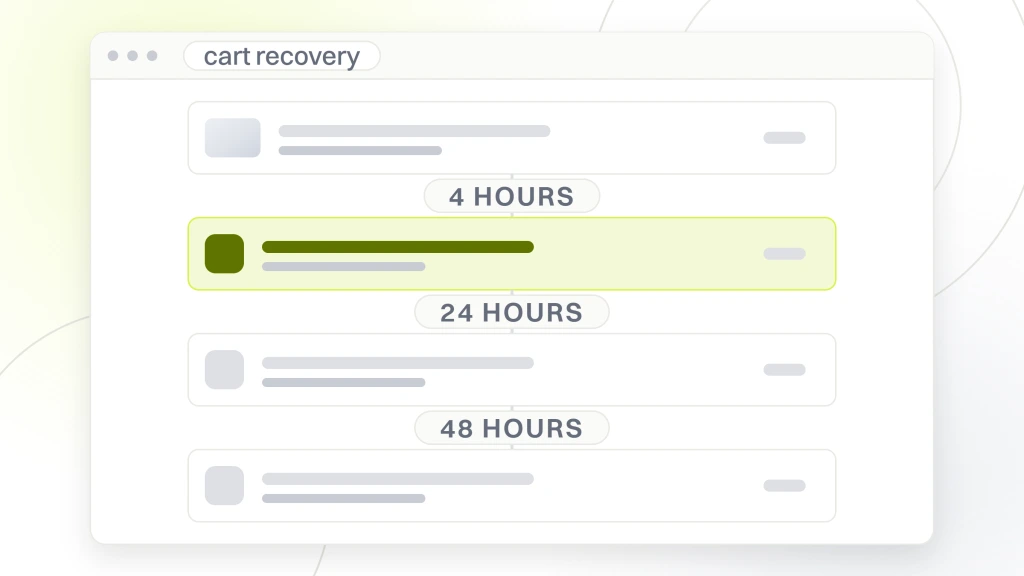
The build structure that works. Message one fires 1 hour after cart abandonment, showing the exact product left behind, no discount yet, tone is helpful rather than pushy. Message two fires at 24 hours, adds social proof (reviews, recent purchases, low-stock signal if honest) and reminds them the cart is saved. Message three fires at 48 hours with a 10 percent incentive or free shipping trigger. Message four fires at 72 hours only if still no purchase, one last chance with a stronger incentive or bundle option. Anything past 72 hours converts under 1 percent and isn’t worth the sender-reputation cost inside a marketing automation ecommerce program.
SMS layered into the cart flow works differently from email. One SMS at 4 hours after abandonment, before any email hits, catching shoppers who prefer text. One SMS at 24 hours as a follow-up reminder. Don’t send SMS on messages 3 or 4. The escalation feels aggressive over text. Brands running cart flows this way typically see the SMS channel contribute 30 to 45 percent of total cart recovery revenue on lists where SMS opt-in rate is above 15 percent of email opt-in rate.
Post-purchase flow build inside ecommerce marketing automation tools
The post-purchase flow is the flow most brands skip. It is also the flow with the highest incremental revenue impact per hour of build time. A well-built post-purchase flow grows repeat-purchase rate by 12 to 28 percent within the first 60 days after order, which drops customer acquisition cost by the same proportion on a lifetime-value basis. If you build one marketing automation ecommerce flow well this quarter, build this one.
Every DTC brand we onboard has a post-purchase flow containing exactly one message. It’s the shipping confirmation from Shopify. Somewhere in a marketing all-hands, somebody said we should really do more post-purchase and the team collectively pretended to write it down. Six months later the flow still contains the shipping confirmation. The retention gap you can’t explain has a name. It is a Google Doc titled Post-Purchase Flow v2 with two bullet points and a last-edited date from 2023.
The build structure. Message one fires the day after purchase, thanking the customer by name, setting expectations on shipping timeline. Message two fires 3 days later, sharing product-use tips or an educational piece. Message three fires 7 days later, asking for a review with an incentive (loyalty points, discount on next order, free gift). Message four fires 14 days after, introducing a complementary product with a targeted cross-sell offer. Message five fires 30 days after, celebrating the customer’s first month and inviting them into the loyalty program if you run one. Message six fires 45 days after with a second cross-sell aligned to the original purchase category. Message seven fires 60 days after, marking the transition to winback readiness if no repeat purchase has happened.
Winback flow inside a marketing automation ecommerce stack
The winback flow re-engages shoppers who haven’t bought in 90 to 180 days. On paper, this list looks like it should convert well. In practice the marketing automation ecommerce winback flow converts at 1 to 4 percent, which sounds low until you realize the alternative is zero. Winback earns 6 to 12 percent of total store revenue on brands that run it consistently and 0 percent on brands that skip it.
The trigger is a lapse in purchase activity plus a signal that the shopper is still engaged with the brand (opened an email in the last 30 days, clicked through, visited a product page). Don’t send winback to totally cold profiles. Send it to warm-but-not-buying profiles. The build has 3 to 5 messages spread over 14 to 21 days. Message one asks a soft question (a “what have you been up to” style opener, low-pressure). Message two shares what’s new since their last order (new product drop, restocked favorites). Message three offers an incentive. Message four, optional, uses a survey or feedback ask. Message five, if you run it, delivers a stronger final offer.
Winback flows need pruning. Brands that don’t sunset unengaged profiles after 3 to 4 failed winback attempts inflate their active-profile count on Klaviyo or Attentive, which inflates their monthly cost. Every 60 days, prune profiles who’ve received the full winback sequence and stayed dormant. Move them to a suppressed list, kept on hand for a re-engagement blast twice a year, but out of the daily send pool. This one hygiene step keeps ecommerce marketing automation software costs in check as your list grows.
Comparing Klaviyo, Attentive, Postscript, Omnisend, Sendlane in detail
The five platforms above aren’t interchangeable. Each one wins on specific store profiles and loses on others. Below is the platform-by-platform verdict from live account setups our team has managed in the last 24 months, not from vendor marketing pages. Every marketing automation ecommerce verdict below sits on live account data.
Klaviyo remains the default answer for DTC brands between $500K and $50M in revenue. Its Shopify sync is the deepest of any platform. The flow builder handles both email and SMS in one canvas since 2023. The reporting UI shows attributed revenue per flow, per message, per segment without a data-warehouse setup. Downsides. Cost climbs steeply above 200K active profiles. The AI-generated subject line tool over-promises. Anything requiring true multi-brand tenancy runs awkwardly.
Attentive owns the premium SMS segment. If your list will cross 40K SMS subscribers and your brand can absorb the $2,500-plus monthly floor, Attentive delivers deeper conversation flows, better opt-in tooling, and cleaner two-way messaging than Postscript. Downsides. Contract structure often includes revenue share, which upsets founders once they read the fine print. Email product launched in 2024 is still catching up on segmentation depth. Not a fit under $2M revenue.
Postscript wins the mid-market Shopify SMS category. Popup builder, keyword campaign, and Shopify Flow integration are the strongest in class. Cost scales linearly with volume rather than jumping in tiers. Downsides. SMS only, so you need Klaviyo or Omnisend for email. Non-Shopify support is nonexistent. Reporting is thinner than Klaviyo. Attentive-level premium features (AI agents, deep segmentation) are lighter.
Omnisend fits smaller Shopify and WooCommerce stores that want email plus SMS in one dashboard at a low starting cost. Its automation editor is genuinely usable for non-technical marketers. Downsides. Deliverability trails Klaviyo on the low tier. Advanced segmentation caps out below what mid-market brands need. Reporting is basic. Best for stores under $3M in yearly revenue, which is where its per-message pricing shines.
Sendlane is the sleeper pick. Its behavior-based triggers are stronger than Omnisend’s, its review-request flow is built in rather than bolted on, and its pricing scales more gently than Klaviyo above 100K profiles. Downsides. Shopify integration is solid but not native the way Klaviyo’s is. Support response times can lag. Brand recognition is low, so agencies and consultants recommend it less often than they should. Worth a serious look for brands running review-heavy or refill-heavy categories like beauty or supplements.
Reporting cadence for marketing automation for ecommerce
Marketing automation for ecommerce fails silently without a reporting cadence. Flows drift, messages break, deliverability slips, and nobody notices for six weeks. The correct cadence is weekly on the four core flows and monthly on the broader program view. Teams that stop at monthly reporting miss the two-week window where a broken marketing automation ecommerce flow is still cheap to fix.
The weekly view tracks six numbers per flow. Total revenue attributed. Revenue per recipient. Open rate on email, click-through rate on SMS. Placed-order rate. Conversion rate against last week. Unsubscribe or opt-out rate. If any number moves 20 percent in either direction week over week, the flow gets audited that day. Klaviyo, Attentive, and Postscript all surface these numbers natively. Omnisend and Sendlane need a lightweight export into Looker Studio or a spreadsheet template.
The monthly view aggregates all flows plus campaigns into a single revenue attribution picture. This view shows owned-channel share of total store revenue, revenue per subscriber per month, active-profile growth, and average lifetime value trend. Teams with a real ecommerce marketing dashboard in place typically catch platform issues within 3 to 5 days. Teams reviewing quarterly catch the same issues at week 12, by which point the fix needs a segment-wide re-engagement send to rebuild deliverability.
The quarterly view is where the strategic work happens. Look at revenue by cohort. Look at time-to-second-purchase by acquisition channel. Look at churn curves by product category. Teams reviewing this data every 90 days spot the flow-level tweaks that add another 3 to 6 percent to owned-channel revenue, on top of the weekly and monthly work. Klaviyo’s Benchmarks feature and Attentive’s Insights dashboard both surface this cohort view without a spreadsheet.
Integrations that extend ecommerce marketing automation software
Your core platform is one layer of the stack. The integrations sitting alongside it decide how far the automation reaches into the shopping experience. Five integration categories matter most.
- Reviews. Yotpo, Okendo, Judge.me. Feed review submissions and average star ratings back into flows as personalization data.
- Loyalty. Smile.io, Yotpo Loyalty, LoyaltyLion. Trigger flows on point balance changes, tier upgrades, and reward redemptions.
- Personalization. Rebuy, Nosto, Fast Simon. Feed browsed-product and recommended-product data into automation triggers for personalized subject lines and product blocks.
- Subscription. Recharge, Skio, Loop. Feed subscription lifecycle events (upcoming charge, skip request, cancellation) into flows so you can save subscribers before they churn.
- Reviews-to-UGC. Photoslurp, Foursixty, Bazaarvoice. Pull user-generated photo content into flow templates for higher engagement.
Not every brand needs every integration. Start with reviews plus subscription if you sell consumables, or reviews plus loyalty if you sell one-time products. Teams bolting on five integrations before the four core flows are live end up with a Frankenstein stack nobody optimizes. Integrations amplify a working marketing automation ecommerce program. They don’t fix a broken one.
The sequencing that works. Month one focuses on the four core flows in the base platform, no integrations added. Month two proves out the flow revenue and identifies which category of integration would compound the results. Month three adds the first integration and measures the incremental gain over 30 days. Month four adds the second integration if the first proved out. Any integration that doesn’t produce a measurable revenue gain inside 60 days gets removed. That discipline keeps the stack lean, keeps monthly fixed costs predictable, and keeps the analytics story clean when the founder asks what each tool actually earned last quarter. Teams skipping the sequencing step tend to add five tools inside a launch quarter and never learn which one is doing the work.
A real marketing automation ecommerce case study
Abigail Ahern, a UK-based luxury home décor brand on Shopify, came to us with a marketing stack that leaned heavily on discount-led email blasts and branded search. The automation layer had a welcome flow (3 messages), an abandoned cart flow (2 messages), and no post-purchase or winback in play. Owned-channel revenue sat around 12 percent of total. The brand needed premium positioning restored, and the automation needed to earn its keep.
Our team kept the platform (Klaviyo) but rebuilt every flow from scratch. Welcome went from 3 messages to 6, opened with brand story rather than discount, moved the incentive to message four. Abandoned cart expanded to 4 messages with product-specific imagery pulled dynamically from Shopify. Post-purchase launched at 7 messages, tuned to the 6 to 12 week decor consideration cycle. Winback launched at 4 messages, triggered on 120 days of no purchase. SMS layered in at welcome message two and cart message one only, deliberately kept minimal to protect premium positioning.
Over the following 12 months, ecommerce revenue grew 179 percent, paid-search return on ad spend climbed to 1,588 percent (more than doubling the previous year), and paid-social return on ad spend hit 3,000 percent through better retargeting audiences seeded by the flows. Owned-channel share of revenue climbed from 12 percent to 34 percent. Discount reliance dropped materially, and average order value on flow-attributed revenue tracked 22 percent above campaign-attributed revenue. The marketing automation ecommerce layer didn’t cause all the gains alone. It made the paid layer more efficient by feeding it higher-intent audiences and by capturing repeat revenue previously lost through discount blasts.
Where marketing automation ecommerce fits the broader stack
Marketing automation ecommerce isn’t a standalone program. It sits inside the broader marketing stack alongside paid acquisition, SEO, content, and CRO work. Brands that treat automation as its own silo end up with a strong retention layer feeding a weak acquisition layer, or a strong acquisition layer losing hard-earned retention revenue. The stack works together as one system or it doesn’t work at all.
Automation gets seeded by acquisition. The subscribers coming into your Klaviyo list from Meta ads convert differently from the ones coming from organic search. Segment them and personalize your welcome flow accordingly. Meta-sourced subscribers respond to social-proof-heavy messaging. Search-sourced subscribers respond to product-specification-heavy messaging. This one segmentation move typically adds 8 to 15 percent to welcome flow conversion rates. If you already run best practices for ecommerce marketing across paid, organic, and CRM, the source data is already flowing into your automation platform. Use it.
Automation also feeds acquisition. The audiences you build from purchase behavior in your automation platform sync back to Meta and Google as custom audiences for lookalike targeting. Klaviyo’s Meta integration and Attentive’s Google integration both do this natively. Teams measuring paid acquisition against ecommerce marketing metrics tied to lifetime value rather than first-order revenue tend to pay 15 to 30 percent more per acquired customer with confidence, since the automation retention curve justifies the higher cost.
Where a marketing automation ecommerce partner fits the picture
You can run marketing automation ecommerce in-house or through an agency partner. Most brands run a hybrid, with an in-house owner setting strategy and an agency team executing the platform work. The split usually breaks down as strategy in-house, flow builds and weekly optimization at the agency, quarterly strategic review together.
The in-house owner is the person who decides which flows exist, what the brand voice sounds like inside messages, and how automation revenue targets get set alongside broader marketing goals. The agency partner is the team that builds the flows in Klaviyo or Attentive, tests subject lines, monitors deliverability, and reports weekly. Brands under $2M revenue usually can’t justify a full agency retainer for this work alone. Brands over $5M in revenue almost always benefit from one, since the marketing automation ecommerce expertise required to keep flows performing at scale is deep enough that a solo in-house marketer can’t cover it alongside other channels.
Our ecommerce marketing agency partners with DTC brands to run this whole layer end to end. The ecommerce marketing retainer starts at $1,499 per month with a 6-month engagement and covers platform setup, flow rebuilds, weekly reporting, and monthly optimization. Growth tiers run at $2,499 and $3,999 per month, with enterprise plans starting at $6,000 per month for brands over $20M in revenue. Brands that add automation as a formal channel see owned-channel share of revenue climb from the 8 to 14 percent range up to 28 to 42 percent inside the first two quarters of a proper build. That gap is the whole reason the work exists.
See our sibling read on content marketing strategy for ecommerce for the framework version of the same playbook.