Email marketing for optometrists is the quiet workhorse behind a full exam schedule. Recall email pays back at 12 to 20 times spend, versus 4 to 8 times on paid search, so the audience already trusts the practice. Winning back an existing patient costs roughly one-tenth of what it takes to win a new one. Set the flows once, keep them clean, and the schedule fills week over week without new ad budget.
This guide walks the 6 automations, the campaign types, the segmentation logic, the deliverability rules, the tool picks, and the cost math behind the returns. Numbers come from Vision Express, Dr Parth Shah, and the working book at our optometrist marketing agency. You get a system that hands cleanly to an in-house coordinator or an agency on Monday morning. The surface is boring, the mechanics are specific, and every optometry practice we onboard runs the same 6-automation baseline before we touch anything else in the mix.
6 core automations behind an optometrist email program
The 6 core automations do 70% of the revenue gain in any optometrist email program. They run on autopilot once built, they touch the right patient at the right moment, and they compound quietly month after month. Build all 6 in the first 30 days, then layer broadcasts on top of a stable base.
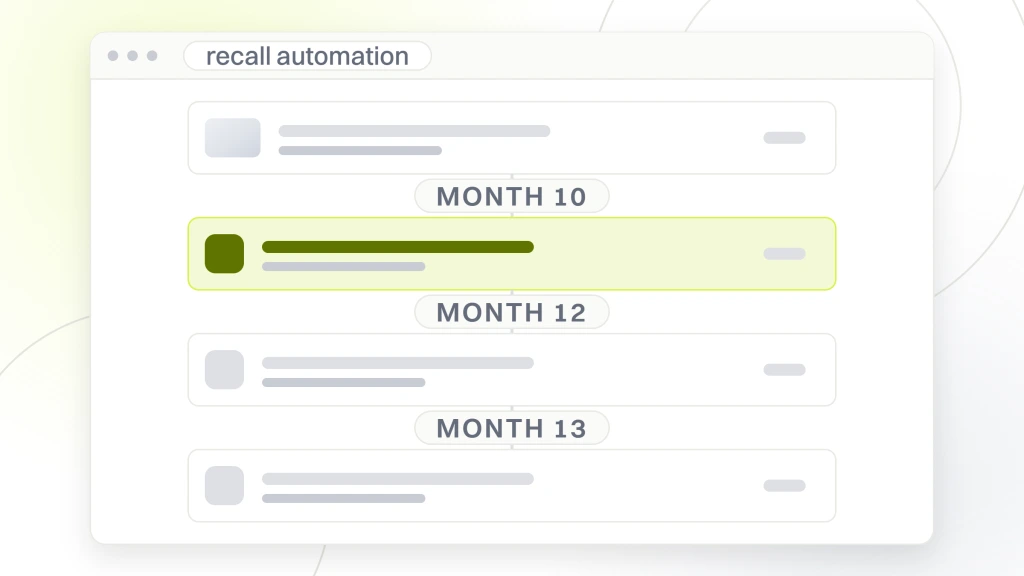
- Recall automation. Fires 11 months after the last exam. This flow alone drives 40 to 60% of email-attributed bookings in a mature program.
- Appointment reminder. 48 hours and 2 hours before the exam. Cuts no-show rates by 25 to 40%.
- Post-exam follow-up. Fires 3 days after the visit. Asks for a Google review and offers eyewear pickup reminders.
- Reactivation flow. Fires at 18 months since last visit. Recovers 8 to 14% of lapsed patients per send cycle.
- Birthday flow. Fires 7 days before birthday with a small discount or free lens cleaning. Drives loyalty at near-zero cost.
- Welcome flow. Fires when a new patient books their first exam. Sets expectations and pre-loads trust before the visit.
Skip any of these 6 and the program loses bookings you already paid to acquire. Recall automation is the highest-ROI single flow. Build it first if bandwidth is short, then add reminder and post-exam in week 2, and finish reactivation, birthday, and welcome by day 30. Every automation gets tested against a seed inbox before going live on the patient list.
List segmentation for email marketing for optometrists
Segmentation sits on 4 axes. Recency of last visit. Product history (frames, contacts, both). Age or demographic. Engagement level over the last 90 days. Every campaign gets sliced across at least 2 of these axes, which is what pushes open and click rates 30 to 60% above the list average.
Recency splits the list 3 ways. Active patients (last visit under 12 months) get the recall flow plus 2 to 4 broadcasts a month. Lapsed patients (12 to 24 months) get reactivation flows plus 1 to 2 broadcasts a month. Dormant patients (24 months plus) get a quarterly “we miss you” send and nothing more. Anything heavier trains the inbox providers to route the whole domain to promotions.
Product history matters, so contact lens wearers and frame buyers respond to different offers. Contact lens patients want quarterly reorder reminders, brand launches, and dry-eye product notes. Frame patients want sunglass-season pushes, new collection drops, and progressive-lens explainers. Both cohorts still get the recall and appointment reminder flows on the same schedule.
Engagement segmentation pulls non-openers off the main list after 90 days of silence. Drop them into a win-back sequence, then move to dormant if they still do not respond. Continuing to hit non-engagers hurts deliverability across the whole list, and inbox providers watch engagement patterns as a spam signal.
Email platforms that fit optometrist marketing
Platforms split into 3 tiers. Basic (Mailchimp, MailerLite) at $30 to $80 monthly. Mid-tier (ActiveCampaign, Klaviyo, Brevo) at $80 to $250 monthly. Enterprise (Salesforce Marketing Cloud, HubSpot Marketing Hub) at $600 to $2,500 monthly. Most single-location practices land in the mid-tier, and that tier clears the automation and segmentation bar without the enterprise price tag.
Basic tools cover simple broadcasts and a light recall flow. They break on branching automations, deep segmentation, and practice-management integration. Practices under 800 active patients can start here without pain. Anything past 1,500 active patients hits the ceiling inside 6 months and forces a migration. Migrating burns 8 to 12 hours of setup work, so picking right the first time saves real money.
Mid-tier is the sweet spot for most single-location optometry practices. ActiveCampaign runs $80 to $220 monthly for typical optometry list sizes, covers all 6 core automations, and integrates with most practice-management systems through Zapier or native connectors. Klaviyo brings stronger SMS integration when the practice runs a heavy retail component. Brevo (formerly Sendinblue) sits at the low end of the mid-tier band with competitive pricing on larger lists.
Enterprise platforms only earn their price at multi-location groups with 8 plus locations, a real CRM strategy, and cross-location patient movement. HubSpot’s Marketing Hub is the most common pick in this bucket. Salesforce Marketing Cloud fits corporate optometry groups already standardized on Salesforce for other operations. The table below matches platform tier to practice size.
| Platform tier | Best fit | Monthly cost | Setup time | Automation depth |
|---|---|---|---|---|
| Basic (Mailchimp, MailerLite) | Under 800 patients | $30 to $80 | 4 to 8 hours | Simple flows only |
| Mid-tier (ActiveCampaign, Klaviyo) | 800 to 5,000 patients | $80 to $250 | 10 to 20 hours | All 6 core automations |
| Enterprise (HubSpot, SFMC) | Multi-location 8+ | $600 to $2,500 | 40 to 80 hours | Deep branching plus CRM |
Practice-management integration decides the automation quality more than any other single call. Practices on RevolutionEHR, Crystal PM, Compulink, or Eyefinity get clean integrations with most mid-tier platforms. Older EHR systems usually need a middleware layer (Zapier, Make) that adds $30 to $80 monthly. Ask any prospective agency which practice-management integration they already have running in production.
Deliverability rules for optometrist email marketing
Deliverability runs on 4 disciplines. An authenticated sending domain. Regular list hygiene. Content that avoids spam triggers. Send-time consistency. Break any one and open rates drop 15 to 40% inside a month. Hold all 4 steady and open rates land 10 to 25 points above the list averages other practices report.
Authentication means SPF, DKIM, and DMARC records set up correctly on the practice’s sending domain. Skip it and Gmail plus Outlook quietly route the practice to the promotions or spam folder. Setup is a 2-hour one-time job for the IT vendor or the email platform’s onboarding team. Any agency that does not verify authentication in month one is skipping the single highest-value setup step.
List hygiene runs quarterly. Hard bounces get removed immediately. Soft bounces move to a suppression list after 3 consecutive failures. Non-openers at 90 days drop into a re-engagement flow, and anyone still silent after that flow moves to suppressed. Clean lists produce open rates 8 to 15 points above dirty lists at the same base engagement level.
Content patterns decide spam filtering. Subject lines stay under 45 characters. Preview text always populated. Body text keeps a 60 to 70% ratio versus images. One primary call-to-action per email. Send from a real person’s name at the practice, not “info@” or “noreply@.” These are boring rules that quietly decide whether the email lands in the inbox or the promotions tab.
Metrics that measure eye care email performance
6 numbers matter. Open rate. Click-through rate. Booking conversion off click. Cost per booked exam. Revenue per email sent. Unsubscribe rate. Track all 6 weekly on a single dashboard and cross-reference against the industry benchmarks below every quarter.
Open rate benchmarks by campaign type. Recall automation 42 to 58%. Appointment reminder 62 to 75% (very high, since opt-in intent is explicit). Reactivation 18 to 32%. Seasonal broadcast 28 to 42%. Educational broadcast 32 to 48%. Product broadcast 22 to 34%. If your numbers sit below the low end of these ranges, deliverability or list quality is the first place to look.
Click-through rate benchmarks. Recall automation 8 to 15%. Appointment reminder 4 to 8% (a click here means opening the booking widget to reschedule). Seasonal broadcast 4 to 8%. Educational broadcast 6 to 12% (higher, since the content pulls curiosity). Product broadcast 3 to 6%. Numbers under the low end usually point at subject line and CTA copy that need iteration.
- Weekly. Opens, clicks, unsubscribes on the last 7 days of sends.
- Monthly. Booked exams attributed to email, cost per booked exam, revenue per email sent.
- Quarterly. List growth, segment engagement rates, automation performance versus benchmarks.
- Annual. Return on email spend, share of monthly bookings coming from the email channel.
Unsubscribe rate is the leading indicator for list health. Target sits at 0.1 to 0.3% per send. Above 0.5% means the content angle is off or the send frequency is too high. Above 1% signals fatigue or broken segmentation. Cut frequency, review segmentation, and rework the content angle before pushing another send.
HIPAA and CAN-SPAM compliance in optometrist email marketing
Compliance is mandatory and straightforward once setup is right. HIPAA covers any content that references specific patient medical details. CAN-SPAM covers unsubscribe mechanics and sender identification on every commercial email. Both apply to every send the practice puts out.
HIPAA discipline keeps specific patient medical details out of every send. Generic categories (contact lens wearer, glasses wearer) are fine. Specific conditions (glaucoma, macular degeneration) require signed patient consent on file to reference in a targeted email. Aggregate content (“tips for our contact lens patients”) is fine. Individualized medical content (“as a glaucoma patient you should know”) requires the release paperwork completed first.
The business associate agreement between the practice and the email platform is non-negotiable. Mailchimp, ActiveCampaign, Klaviyo, and HubSpot each offer a BAA at their business tiers. Some cheaper tiers do not. Before signing with any platform, verify the BAA is included at the tier you plan to pay for. Any platform that does not offer a BAA is not eligible for a practice sending health-adjacent content.
CAN-SPAM basics are boring on purpose. Physical mailing address in the footer of every email. One-click unsubscribe link in every email. Honor unsubscribes within 10 business days. Send from a real business email domain. Skip misleading subject lines or headers. Any modern email platform handles the mechanics automatically once the account is set up correctly.
Subject line templates that grow open rates
Subject line copy sets the ceiling on every flow. 4 template shapes cover 80% of the sends in a working optometrist email program, and each one hits a different psychological cue. Rotate across the 4 so patients see variety, and A/B test one variable at a time (length, personalization, question format) on any broadcast over 500 recipients.
- Reminder shape. “Sarah, your annual exam is due” or “Time for your yearly check.” Personal, factual, no hype. Opens land 45 to 58%.
- Curiosity shape. “Why your prescription changed” or “3 things your eyes are telling you.” Opens land 34 to 42% on educational broadcasts.
- Offer shape. “20% off your next frames” or “Free contact lens trial this month.” Opens land 26 to 36% on product broadcasts.
- Question shape. “Ready for your next exam?” or “When did you last update your prescription?” Opens land 30 to 38% and drive reply rates 2 to 3 points higher than statement subject lines.
Case study on recall email marketing for optometrists at Vision Express
Vision Express, an independent optometry practice, layered the 6 core recall automations on top of a paid and organic push. Bookings rose 62%, organic traffic climbed 135.9%, and overall practice growth landed at 71% inside 6 months. The email flows carried the retention half of that growth, since existing patients booked repeat exams at a much lower cost than any new-patient channel could match.
Cost per booked exam through email settled at $15 blended, versus $87 on paid search and $34 on local search. Revenue per email sent averaged $6.20 across all campaign types, with recall automation at $18 per send and product broadcasts at $2.40 per send. Year-one revenue attributed to email came in around $71,000, against $2,400 in platform costs. That is a 29 times return on the platform bill alone.
The mechanics behind those numbers were not clever. All 6 automations were live by day 30. Weekly send cadence sat at 2 to 4 broadcasts monthly. List hygiene ran on the calendar every quarter. Segmentation stayed simple on recency plus product history. Deliverability authentication was completed in month one and never touched again. Nothing on the plan was novel. What made it work was consistency across every month, quarter after quarter. Dr Parth Shah, a Canberra eye surgeon on a parallel program, saw bookings rise 40% and revenue climb 35% on the same discipline in the same 6-month window.
First 90 days on email marketing for optometrists
The first 90 days cover platform setup, automation build, and the first live broadcasts. Days 1 to 30 handle platform selection, authentication setup, practice-management integration, and building the 6 core automations. Days 31 to 60 launch the first seasonal broadcast plus the first educational broadcast. Days 61 to 90 layer in segmentation and start A/B testing on subject lines against a real send volume.
By day 30 the platform is live, authenticated, and integrated with the practice-management system. 6 automations are built and firing correctly on test patients. Deliverability is verified against a seed inbox test hitting Gmail, Outlook, and Yahoo. Anything missing at day 30 means the setup is behind schedule and the automation returns will slip by 30 to 60 days on the back end.
By day 60 the first broadcasts have gone out. Open rates should track within 3 to 5 points of the benchmarks above. Recall automation should have fired 40 to 80 times on real patients. First bookings attributed to email should be showing up in the reporting layer. Cost per booked exam through email should sit at $18 to $25 (higher than steady state, since volume is still ramping).
By day 90 the full stack is producing 15 to 25% of monthly booked exams. Cost per booked exam should be trending toward the $4 to $12 steady state. For a full budget breakdown, see Optometrist marketing cost. For strategy sequencing, see Optometrist marketing strategy. For digital channel mix, see Digital marketing for optometrists. Text and SMS pair with email to close the recall loop, so read Text/SMS marketing next when your email flows are live. Reference Mailchimp’s benchmarks for industry averages across similar accounts, and the Content Marketing Institute email playbook for editorial cadence patterns.
Book your practice email setup this week
The practices winning at this channel share one trait. They built the 6 core automations early and never let list hygiene slip. Every month past day 30 compounds the returns, since recall bookings from month 3 turn into referral bookings by month 9 and repeat exams by month 15. The math only works when the flows stay live, clean, and consistent across a full quarter of send cadence.
Pick the mid-tier platform that fits your list size. Set up authentication in week 1. Build the recall flow first, layer reminder and post-exam in week 2, and finish the remaining 3 automations by day 30. Then let the flows run for a full quarter before judging performance. The Vision Express and Dr Parth Shah numbers took 6 months to compound. Yours will too, and the schedule fills the whole way in.