
A food influencer marketing agency is the outside team a DTC snack, drink, or CPG brand hires when the in house creator program can no longer scale past 20 campaigns per quarter without a dedicated ops layer. Food is the fastest moving category on TikTok and Instagram Reels, and the same content that racks up 10 million views this week ages out inside 48 hours. Every creator, every brief, every deliverable ties back to a spend plan and a return target, and founders juggling every piece of the pipeline alone are why most emerging food brands stall on the creator channel at $200,000 in annual spend.
This guide walks the field tested food influencer marketing agency scope Redefine Web runs with DTC food brands, beverage startups, and CPG accounts scaling into retail. Shortlist criteria come from our best food marketing agencies roundup on how to vet a shop before signing. You get the creator tiering model, the briefing process, the paid amplification math, and the reporting cadence that ties creator spend to closed orders on the DTC site or the Amazon storefront. If the current retainer only reports impressions and creator counts, this guide is the scope to hand the next partner. See our food and beverage marketing hub for the parent scope on how influencer work fits inside the wider CPG practice.
What a food influencer marketing agency actually does
A food influencer marketing agency covers 4 practice areas across a DTC food or beverage account. Creator sourcing and vetting across TikTok, Instagram, and YouTube. Brief writing plus contract management on every campaign. Content production oversight including brand guardrails and legal review. Paid amplification of the top performing organic posts through Meta partnership ads and TikTok Spark Ads.
Every scope should hit all 4. A shop that only sources creators and sends briefs is a talent booker, not an agency partner. A shop that sends briefs but skips paid amplification is a content agency without a growth engine. A real food influencer marketing agency owns the campaign end to end and reports on closed orders, promo code redemption, and cost per acquisition as the top line numbers on the monthly retainer report.
The scope split matters because organic creator content reaches roughly 10 to 30% of a creator’s follower count on a good week and drops to 3 to 8% on a slow week. The paid amplification layer takes the top performing organic post and pushes it to the brand’s own targeting cohorts, and the reach multiplier lands at 5 to 20 times the organic reach for the same content asset. Skip the paid layer and 80% of creator spend gets wasted on impressions that never reach the buyer.
Who hires a food influencer agency first
The first brands to hire a food influencer agency sit in the $2M to $10M annual revenue band on DTC, running 20 plus campaigns per quarter with a 2 person in house marketing team. Boogie Board, an ecommerce brand we worked with, drove cost per sale down to $31 across the annual curve after tightening its research to creative feedback loop, and the same discipline applies to a DTC snack brand pushing creator content through the funnel. Feed the creator video verbatims into the paid amplification hooks, feed the top comments into the landing page hero copy, and every creator dollar shows up in the CAC curve inside 60 days.
Creator tiering model for a food influencer agency
Creator tiering for a food brand runs across 4 tiers with clear rate ranges and use case fits. Nano creators at 1K to 10K followers. Micro creators at 10K to 100K followers. Mid tier creators at 100K to 500K followers. Macro and celebrity creators at 500K plus followers. Every tier has a different rate structure and a different job on the campaign plan.
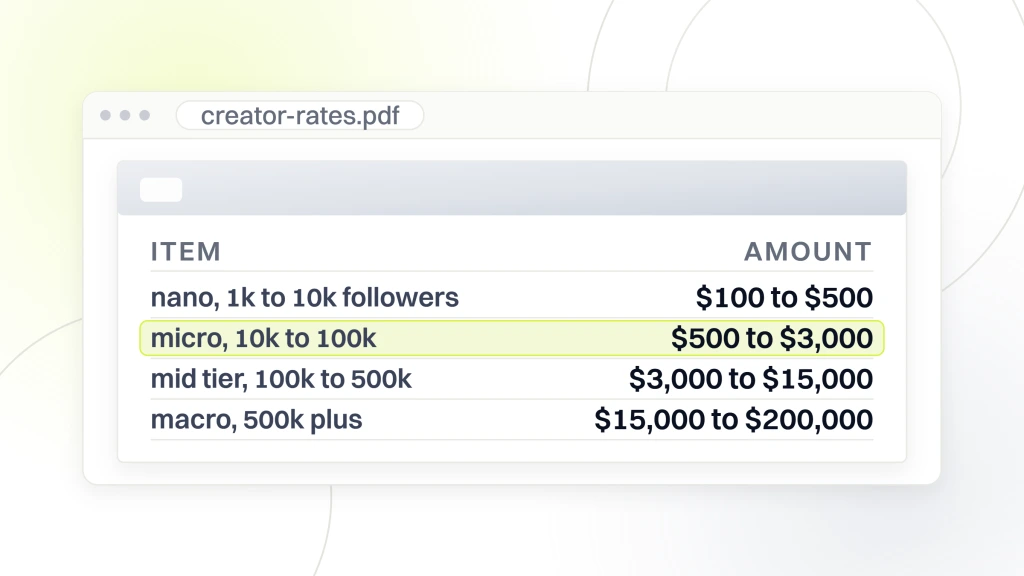
Nano creators run on gifting plus a $100 to $500 activation fee and deliver the highest engagement rate per view at 6 to 12%. Micro creators run $500 to $3,000 per campaign and hold engagement at 3 to 6%. Mid tier creators run $3,000 to $15,000 and hold engagement at 1.5 to 4%. Macro and celebrity creators run $15,000 to $200,000 per campaign and hold engagement at 0.5 to 2%. Rates scale with follower count but engagement scales the other way. See TikTok for Business creator resources for the current platform rate benchmarks every food brand should track.
The right mix for a growth stage DTC food brand runs 60% nano and micro, 30% mid tier, 10% macro. Nano and micro carry the pipeline volume and the user generated content library that feeds the Meta and TikTok Shop paid accounts. Mid tier carries the credibility layer that pulls organic reach outside the existing follower base. Macro carries the awareness spike that opens the top of the funnel for a new SKU launch or a retail expansion push.
- Nano creators at 1K to 10K followers, $100 to $500 plus gifting.
- Micro creators at 10K to 100K followers, $500 to $3,000 per campaign.
- Mid tier creators at 100K to 500K followers, $3,000 to $15,000 per campaign.
- Macro creators at 500K plus followers, $15,000 to $200,000 per campaign.
- Right mix for growth stage DTC food, 60% nano and micro, 30% mid tier, 10% macro.
- Nano feeds the ad library, mid tier carries credibility, macro opens the funnel top.
Why the tier mix beats a single tier bet
A tier mix beats a single tier bet because organic reach and paid amplification return curve differently across the funnel. A macro only bet gets awareness but flat DTC conversion since the follower base skews passive. A nano only bet gets engagement but limited reach since the follower counts cap the total impression pool. Every DTC food brand we advise runs the 60 30 10 mix inside 6 weeks of the first monthly retainer review. Vejrø Resort, a Danish sustainable island resort, drove 66% year over year traffic gain on the same tier mixing discipline applied to lifestyle creator content across a 12 month curve.
Every $1 of organic creator brief spend pairs with $2 to $4 of paid amplification on Meta partnership ads or TikTok Spark Ads. That swings a break even organic play to a 3 to 5x blended ROAS.
Briefing process a dtc food influencer marketing agency runs
The briefing process a DTC food influencer marketing agency uses covers 3 parts. A one page brand and product primer with hero facts, ingredient claims, and legal must avoids. A creative direction section with must hits and freedom to adapt zones. A deliverable and usage section covering post format, hashtag list, disclosure language, and paid amplification rights.
Freedom to adapt is the section most food brands get wrong. The founder wants every brief to script the video line by line and every creator to follow the script exactly. That approach kills the creator voice that built the following, and the content underperforms the algorithm within 24 hours. The fix is a brief that names 3 must hit product facts and 1 legal must avoid and leaves the creative interpretation to the creator.
Paid amplification rights carry more weight than most brands realize during the contract negotiation. A brief that includes 6 months of paid usage rights on Meta partnership ads and TikTok Spark Ads triples the return per campaign versus a brief that only covers the organic post. Every contract should include the paid rights language up front, not as a follow up ask after the post goes live and the brand realizes the paid layer is worth twice the organic reach on the same asset. Read the FTC disclosure guidance for social media influencers for the current sponsored tag rules every US creator campaign has to hit.
The 3 must hits every food brief should carry
The 3 must hits on a food brief are the hero product fact, the differentiator against the closest shelf competitor, and the call to action with the promo code. Every food brief we approve names these 3 first and leaves the visual style, the setting, the recipe context, and the humor to the creator. Abigail Ahern, a home ecommerce brand we worked with, drove ecommerce revenue up 179% over a 12 month curve after tying every creative deliverable to a downstream P and L outcome, and the same discipline applies to a DTC food brief when the must hits tie to a real promo code redemption target.
Paid amplification math a cpg food influencer marketing agency runs
Paid amplification math a CPG food influencer marketing agency runs on a simple ratio. Every $1 spent on the organic creator brief should pair with $2 to $4 of paid amplification spend on Meta partnership ads or TikTok Spark Ads. The blended reach and return math swings from a break even organic play to a 3 to 5x ROAS blended play.
Meta partnership ads pull the creator handle into the brand’s own campaign structure and let the brand run the creator’s video against the brand’s own audience targeting and pixel. The creator content shows up in the feed with the creator’s handle attached, which pushes the click through rate up 20 to 40% versus the same asset run as a brand post. TikTok Spark Ads runs the same model, using the creator’s original post as the ad asset.
The budget split rules of thumb hold across a growth stage DTC food account. Nano and micro creator content amplifies at 2 to 3 times the brief fee. Mid tier content amplifies at 3 to 4 times the brief fee. Macro content amplifies at 4 times or higher because the celebrity association carries a longer decay curve on the creative fatigue side. Every amplification run has to test against a matched brand produced ad on the same targeting to confirm the creator asset is actually outperforming the baseline.
Which platform absorbs the amplification budget first
Meta partnership ads absorb the amplification budget first on a DTC food account with a strong Facebook and Instagram pixel history. TikTok Spark Ads absorb the budget first on a brand with a Gen Z buyer skew and a strong TikTok Shop link setup. YouTube integrations pull ad spend last since the platform’s short form ad product still lags Meta and TikTok on food category conversion depth. Custimy, a Danish DTC data platform, drove 41% cost per acquisition drop on a full paid social restructure that pulled amplification budget across the platforms in the same priority order.
Campaign shapes a food brand influencer agency runs
The table below breaks down 4 common campaign shapes a food brand influencer agency runs on DTC food and beverage accounts. Every row is field observed on real client accounts across snack, drink, and specialty verticals. Every shape has a fit. The mistake is running one shape exclusively for 6 months and missing the compounding return from mixing shapes.
| Campaign shape | Best used for | Creator tier | Budget range | Return target |
|---|---|---|---|---|
| UGC volume play | Meta ad library | Nano plus micro | $2K to $10K monthly | Cost per creative |
| Product launch spike | New SKU or line | Micro plus mid tier | $15K to $50K per launch | 3 to 5x blended ROAS |
| Category authority | Positioning play | Mid tier | $10K to $30K monthly | Brand gain plus reach |
| Awareness spike | Retail expansion | Macro plus celebrity | $50K to $200K per campaign | Awareness plus press |
Two mistakes most food brands make on campaign shape selection. First, running macro campaigns only and reporting impressions as the win metric while the DTC conversion rate stays flat. Second, running nano UGC volume plays only and missing the mid tier layer that pulls organic reach outside the existing buyer cohort. The right mix runs 3 shapes in parallel across the quarter with the volume split by growth stage and current cohort report.
The reporting layer has to tie every campaign shape back to closed revenue or a proxy metric that ties to revenue. Impressions alone are not a return metric. Reach is not a return metric. Blended cost per acquisition, promo code redemption count, and assisted conversion count are the numbers that tie creator spend to real revenue on the account, and every retainer report should name those 3 as the primary KPIs on the monthly review call. See our PPC retainer scope for the paid amplification layer that pairs with the influencer retainer.
Rate benchmarks by platform for a food influencer agency
Rate benchmarks by platform vary by follower count and content format. TikTok in feed videos run $100 to $500 per 10K followers for a single post. Instagram Reels run $150 to $700 per 10K followers. Instagram feed posts run $100 to $400 per 10K. YouTube shorts run $200 to $800 per 10K.
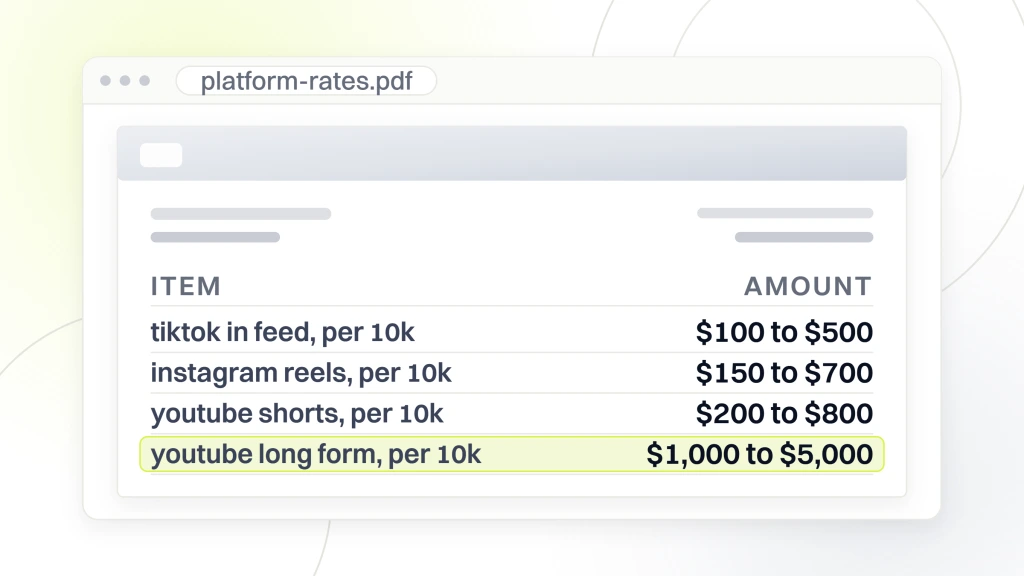
YouTube long form dedicated videos run $1,000 to $5,000 per 10K subscribers because the production time and the content shelf life are both higher than short form content on the same channel. YouTube integrations inside a larger video run $300 to $1,500 per 10K subscribers depending on placement and length of the mention. Every rate quote should include usage rights, exclusivity terms, and whitelisting rights up front, not as add on fees after the contract signs.
Exclusivity terms matter more than most food brands realize. A creator that runs a competitor snack brand in the same category on the same week kills the campaign performance for both accounts because the buyer sees 2 competing pitches in the same feed session. Every contract should include a category exclusivity clause covering the campaign window plus 30 days after the last post goes live. Read the Influencer Marketing Hub rate reports for current benchmark data across every platform and creator tier.
How to negotiate a fair creator rate
To negotiate a fair creator rate, quote the rate range in the first message and ask for the creator’s rate card in reply. Match the mid point of the range against the creator’s average post engagement rate on the last 10 food posts. A creator with a 5% engagement rate on food content on the last 10 posts earns the top of the range. A creator sitting at 1% earns the bottom. BSH Hausgeräte, a global home appliance CPG parent, grew lead generation 15% post launch after tightening its category positioning and paid partnership rate discipline through primary research, and the same discipline applies to a food creator rate negotiation when the engagement rate audit sets the anchor.
Reporting cadence and campaign metrics
Reporting cadence for a food influencer marketing agency covers 3 views. A live campaign dashboard covering creator spend, impressions, engagement, promo code redemption, and paid amplification return. A weekly written pulse covering wins, misses, tests, and asks. A monthly deep review covering the cohort curves and the next quarter plan.
Five metrics carry the weight on the live dashboard. Cost per creative asset generated across the creator roster. Cost per view across the organic plus paid amplification mix. Cost per acquisition on the promo code redemption count. Blended cost per new customer including the paid amplification layer. Assisted conversion count from creator attributed clicks inside GA4 or the DTC platform analytics stack. Every number ties directly to closed revenue, not to impressions or reach alone.
Promo code redemption is the food specific metric that most influencer reports skip. Roughly 50% of the DTC food brand audits we have run in the last 2 years show 20 influencer campaigns a quarter without a unique promo code per creator. The fix is a simple UGC CREATOR NAME code convention that ties every redemption back to the original creator inside the ecommerce platform reporting.
Every retainer should publish a creator level scorecard every month covering promo code redemption count, cost per redemption, assisted conversion count, and content asset yield per campaign fee. That scorecard closes the loop between campaign spend and next quarter creator selection. It also gives the founder a real filter for which creators earn a repeat booking and which drop off the roster after the first campaign.
- Cost per creative asset generated across the roster.
- Cost per view across organic plus paid amplification.
- Cost per acquisition on promo code redemption count.
- Blended cost per new customer with paid layer added in.
- Assisted conversion count from creator attributed clicks in GA4.
- Creator level scorecard published monthly on the retainer review call.
How to run a creator campaign search
A creator campaign search should take 4 to 6 weeks across 3 stages. Sourcing longlist of 30 to 60 creators from category referrals, TikTok search, and Instagram search. Shortlist of 8 to 15 after a fit review on brand alignment and engagement rate audit. Contract and campaign kick off runs with 5 to 10 creators inside the same launch window.
The fit review is where most food brand campaigns win or lose. A creator with 100K followers and a 6% engagement rate on food content will outperform a 500K creator sitting at 1% on the same brief nearly every time. The historical content quality audit catches creators who ran too many brand partnerships in the last 90 days and whose audience is already fatigued.
The contract stage carries the paid amplification rights, the exclusivity terms, and the usage window language. Miss any one of those and the campaign returns half of what it could deliver on the paid amplification side. A real food influencer marketing agency handles the contract language up front and pushes back on creators who cannot deliver the usage rights the brand needs to close the paid amplification math. Read the Later creator marketing blog for current contract templates every food brand should use.
Redefine Web runs SEO retainers at $999, $1,499, $2,499, or from $4,500 per month, and PPC retainers on the same ladder. Food creator scope folds into either track on a locked scope.
Where to start this month by growth stage
Where to start this month depends on the current stage. A pre $1M DTC food brand should start with a UGC volume play across 10 to 20 nano and micro creators per quarter. The output feeds the Meta ad library with fresh creative every week and builds a real content pipeline without a macro campaign fee.
A $1M to $5M DTC brand should layer a product launch spike or a category authority play on top of the UGC volume base. The launch spike hits a new SKU release with 5 to 15 mid tier creators inside a 2 week window. The category authority play runs mid tier creators on a rolling monthly cadence to pull organic reach outside the existing buyer cohort and to build a repeatable content library the brand can whitelist for paid amplification. See our SEO retainer scope for the organic layer that catches the branded search demand after the creator posts run live.
A $5M plus CPG brand pushing into retail should layer a macro or celebrity awareness campaign on top of the UGC volume and category authority base. The awareness spike aligns with a retail expansion moment and pairs with in store activation, retailer digital network placements, and a coordinated press push on the trade publication side. The macro budget runs $50,000 to $200,000 per campaign and should tie to a specific retail milestone, not a general awareness objective.
Which stage should hire an outside agency first
A DTC food brand should hire an outside agency at the point where the in house creator program runs more than 20 campaigns per quarter with a 2 person marketing team. Below that volume, an in house program works. Above that volume, the ops burden crushes the marketing team and every campaign goes live late with a rushed brief. Our food and beverage digital marketing agency guide covers the wider agency scope that pairs with the influencer retainer once the volume threshold hits.
Common food influencer agency pitfalls
Common food influencer agency pitfalls run across 5 categories. Talent booking only scope with no paid amplification. Impression only reporting with no promo code redemption tracking. Macro only creator mix with flat DTC conversion. Missing usage rights that block paid amplification post launch. Category exclusivity gaps that let a competitor run a rival post the same week.
Every retainer contract we scope with a DTC food brand names the fix on all 5 upfront. Paid amplification rights baked into every creator contract for 6 months minimum. Unique promo code per creator with UGC CREATOR NAME convention. Tier mix locked at 60 30 10 for growth stage brands. Written usage rights on every deliverable covering Meta partnership ads and TikTok Spark Ads. Category exclusivity clause covering campaign window plus 30 days.
Ready to scope a food influencer marketing agency retainer
A food influencer marketing agency runs creator sourcing, brief writing, content production oversight, and paid amplification as one coordinated program. Vejrø Resort grew traffic 66% year over year, Custimy dropped CAC 41%, and Boogie Board pulled cost per sale to $31 on the same earned plus paid discipline applied across creator content, paid social, and site work. A DTC food brand that copies the creator tiering, the briefing process, the amplification math, and the reporting cadence lands in the same growth curve inside 2 quarters on the creator channel alone. Pair the creator channel with the wider DTC food brand marketing strategy for the full retention flywheel.
Redefine Web scopes food influencer marketing agency retainers from $999 per month on a starter creator program to $4,500 and up per month on full scope with paid amplification management, promo code tracking, and monthly creator scorecards. Book a scope conversation on the contact page to walk through the current in house program, the target volume, and the paid amplification math on the account.