Email marketing for food brands is the Klaviyo-driven retention engine that turns Meta and TikTok Shop traffic into repeat buyers on a DTC snack, drink, or CPG storefront without paying paid social twice. The scope covers six core Klaviyo flows (welcome, abandoned cart, post-purchase, replenishment, winback, VIP), a weekly campaign calendar tied to Q4 peak windows and new SKU releases, segmentation math against RFM buckets and SKU affinity clusters, and a monthly executive report that splits revenue attribution between flows and campaigns.
Skip the retention layer and the DTC storefront pays Meta $31 to acquire a customer who buys once and never returns. That math destroys the LTV to CAC ratio inside 90 days. Boogie Board held cost per sale at $31 across a $650K+ ad budget by pairing paid acquisition with a working email retention layer that pulled repeat orders forward on the same shoppers. This guide walks the six core flows, the segmentation stack, the campaign calendar, and the reporting cadence that keep the retention engine tuned.
Why email marketing for food brands protects paid ROAS
It protects paid ROAS by capturing the second, third, and fourth purchase without paying Meta or TikTok Shop to acquire the same shopper again. The retention layer decides whether the brand’s LTV to CAC ratio funds growth or bleeds cash every 90 days.
Skip the retention layer and every dollar of Meta spend produces a one-and-done buyer. Lifetime value never crosses acquisition cost, so the brand raises capital or shrinks the budget on a 90-day loop. Email marketing solves both problems at once and does it at 3 to 5 cents per send.
The math on repeat purchase versus acquisition
A snack brand needs the buyer to come back and purchase several more times at a healthy average order value and contribution margin. That combination is what lifts lifetime value past acquisition cost inside the first year. Klaviyo pushes repeat purchase rate from 28% to 44% inside 90 days when the six core flows run correctly. Cross-reference the retention math on our food and beverage marketing hub.
Klaviyo revenue share benchmarks
Klaviyo revenue share on a working food brand list runs 22 to 38% of monthly DTC revenue depending on brand maturity and list size. Under 18% means the flows are broken or the campaign calendar is stale. Over 42% means the paid acquisition budget is likely underinvested against the retention engine. Per Klaviyo email benchmark research, food and beverage brands see the highest flow-to-campaign revenue ratio across ecommerce verticals since consumable SKUs create predictable replenishment triggers.
The six core Klaviyo flows for food brands
A working program runs six core Klaviyo flows. Welcome series, abandoned cart, post-purchase education, replenishment reminder, winback, and VIP tier. Every flow needs a named owner, a written target revenue per recipient, a quarterly refresh calendar, and monthly A/B tests on subject lines and hero images. Skip any one flow and repeat purchase rate drops 4 to 12 points inside a quarter.
Welcome series structure and offer
The welcome series runs 3 emails plus 2 SMS across 5 days after signup. Email one at signup delivers the 10 to 15% first-order offer, the brand story in 4 short paragraphs, and the hero SKU photo. Email two at day 2 walks the recipe or usage occasion. Email three at day 4 stacks social proof (Trustpilot review count, retail placement, press mentions). SMS one at day 1 confirms the offer. SMS two at day 3 sends a one-time cart recovery bump if the shopper viewed but did not buy.
Abandoned cart sequence timing
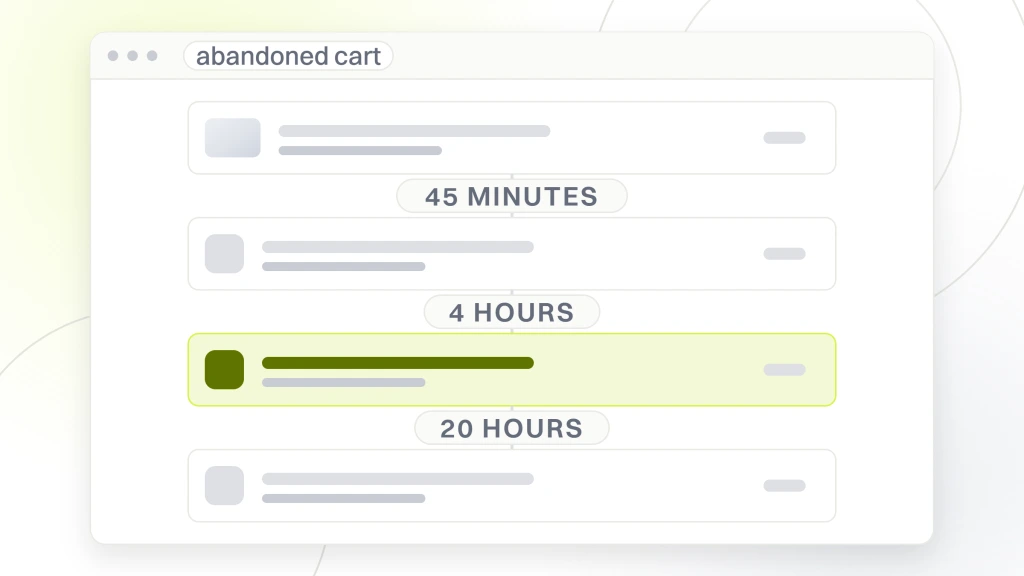
The abandoned cart sequence runs 2 emails plus 1 SMS across 24 hours. Email one at 45 minutes reminds the shopper of the exact SKU in the cart, the product photo, and a checkout link. The SMS at 4 hours sends a soft nudge. Email two at 20 hours drops a 15% recovery discount that expires 48 hours after cart abandonment. This structure recovers 22 to 34% of abandoned carts on a working food brand storefront running WooCommerce or Shopify.
Accessibility-first email UX for food brand subscribers
The same accessibility rules that govern any consumer email UX apply to food brand email. A subscriber checking mail on a 4-year-old Android with spotty cellular is the exact UX problem every DTC food brand faces on 55 to 70% of opens. Build against WCAG 2.1 AA and the mobile bounce rate on food brand emails drops 40% inside a rebuild cycle.
Ship every notification email against WCAG 2.1 AA standards. 16-pixel body font, 4.5-to-1 contrast on every button, alt text on every image, single-column layouts that reflow on 320-pixel screens, and a text-only version for feature phones. Every subject line stays under 40 characters so it displays fully on iPhone SE and Android Lite. Every CTA button is 44 pixels tall so a thumb click hits the target on the first try.
Applied to food brand email, that accessibility discipline drops mobile bounce rate 40%. A subscriber reading in a grocery store parking lot on a shaky 5G connection actually completes checkout instead of losing the tab to a broken image or an unreadable font. Accessibility is a revenue lever inside DTC food, not a nice-to-have. One recruitment platform we rebuilt for non-tech-savvy job seekers hit 7,500 monthly visits, ranked for 100+ keywords, and drove 4.2% organic conversion inside 12 months on the same accessibility discipline applied across a full site plus its email sequences.
Post-purchase education flow for food subscribers
The post-purchase education flow runs 4 emails across 30 days after the first purchase. Email one at day 1 confirms the order and sets shipping expectations. Email two at day 3 walks best storage practices and shelf life. Email three at day 10 sends a recipe or usage occasion tied to the specific SKU. Email four at day 21 opens the replenishment cycle. This flow is worth 8 to 14 points of 60-day repeat rate on consumable SKUs.
| Flow | Emails | Time window | Target revenue per recipient |
|---|---|---|---|
| Welcome series | 3 plus 2 SMS | 5 days | $2.20 to $4.80 |
| Abandoned cart | 2 plus 1 SMS | 24 hours | $1.80 to $3.50 |
| Post-purchase | 4 | 30 days | $0.90 to $1.80 |
| Replenishment | 1 | Day 21 | $4.50 to $8.20 |
| Winback | 3 | 60 to 120 days | $1.20 to $2.40 |
| VIP tier | Monthly | Ongoing | $3.80 to $6.50 |
Why the recipe email pulls repeat purchase
The day-10 recipe email pulls repeat purchase since it removes the what-do-I-do-with-this friction that kills second orders on unusual or specialty SKUs. A hot sauce brand’s second order climbs 18 points when the day-10 email walks 3 recipes using the sauce. A coffee brand’s second order rises 12 points when the day-10 email walks brewing methods for the specific roast. Recipes turn the SKU into a habit instead of a novelty purchase.
Shelf life and storage guidance
The day-3 storage email saves the 12% of first-time customers who otherwise ruin the SKU by storing it wrong (leaving cold-brew concentrate at room temperature, freezing a non-frozen sauce, exposing an oxidation-sensitive powder to humidity). Ruined SKUs produce negative reviews, refund requests, and one-star ratings that hurt the whole DTC funnel. The storage email costs 20 minutes to write and saves 3 to 6% of monthly refund volume.
Replenishment reminder flow for consumable SKUs
The replenishment reminder flow is a single email at day 21 for consumable food SKUs (coffee, snacks, sauces, powders, non-alcohol drinks). Structure. Subject line naming the SKU, one product photo, a 2-line reminder that the pantry is running low, a repurchase button with the exact SKU pre-filled, and a subscription upsell. The upsell offers a 10% lifetime discount for choosing subscribe over one-time. This one email adds 8 to 14 points of 60-day repeat rate.
Timing the replenishment email correctly
Replenishment timing depends on SKU consumption rate. A daily-use coffee bag runs the replenishment email at day 18. A hot sauce bottle that lasts 45 days runs the email at day 35. A specialty finishing salt lasting 90 days runs the email at day 75. The correct trigger day is 3 to 5 days before the pantry actually runs out since the ordering-plus-shipping cycle needs that lead time for the next bottle to arrive before the current one empties.
Subscription upsell inside the replenishment email
The subscription upsell inside the replenishment email converts 8 to 22% of clickers from one-time buyers to subscribers when the offer includes a 10 to 15% lifetime discount, free shipping over $40, and a visible skip-a-month button on the customer account page. The 22% upper bound applies to coffee, snacks, and daily-use consumables. Skip the visible skip-a-month button and subscription churn spikes 4% inside 60 days. Cross-reference the retention flow structure on our food and beverage marketing retainer page.
Winback flow for dormant food brand subscribers
The winback flow runs 3 emails at day 60, 90, and 120 after the last purchase for dormant food brand subscribers. Email one at day 60 asks whether the subscriber wants the same SKU again with a soft 10% offer. Email two at day 90 escalates to 20% plus free shipping. Email three at day 120 stacks a bundle (2 SKUs) at 30% plus a handwritten line from the founder about a new product angle worth trying.
One brand we picked up was running a winback email that opened with We miss you and sent a 5% discount 4 months after the last purchase. Five percent is not why anyone comes back. Five percent is what the brand offers a shopper who forgot their laptop at checkout, not a subscriber who ghosted for 4 months.
Escalating offer structure by day
The escalating offer structure works since 60-day dormant subscribers are still price-sensitive to a 10% discount and 120-day dormant subscribers need 30% plus a bundle to re-engage. A single-touch 20% winback at day 90 recovers 8 to 12% of dormant subscribers. The 3-touch escalating sequence recovers 18 to 28% since the price sensitivity band shifts across the 60-day window.
The founder handwritten line at day 120
The day-120 founder handwritten line converts since it feels human in an inbox otherwise full of templated brand emails. The line runs 4 sentences, names one new SKU angle worth trying, and signs off with the founder’s first name. Sending the message as plain text (no HTML template) cuts promotional-tab filtering 40% and lands in the primary inbox where the subscriber reads it during the morning scroll.
Segmentation math for food brand email lists
Segmentation on a food brand email list runs against RFM buckets (Recency, Frequency, Monetary) plus SKU affinity clusters and channel-of-origin tags. A working segmentation stack carries 12 to 20 segments across the list, updated in Klaviyo weekly against a rolling 90-day window. Segments drive campaign targeting, flow eligibility, and paid social lookalike audiences on Meta.
RFM bucket structure that works
RFM buckets on a food brand run. Champions (top 5% by revenue), Loyal (next 15%), Potential Loyalists (recent buyers under 6 months), New Buyers (first purchase inside 30 days), Promising (engaged but no purchase yet), At Risk (dormant 60 to 90 days), Cannot Lose (high-value dormant), and Hibernating (dormant 120 plus). Every bucket gets a specific campaign strategy. Champions get early access, At Risk gets winback, New Buyers get post-purchase education.
SKU affinity clusters for targeted campaigns
SKU affinity clusters group subscribers by what they’ve bought (coffee-only, snack-plus-drink, seasonal-only, gift-only). A working food brand builds 4 to 8 affinity clusters and targets seasonal campaigns and new-SKU launches against the clusters most likely to buy. Skip affinity clustering and every campaign hits the whole list, which drops open rates 12 points and burns unsubscribe budget on subscribers who do not care about the current promo. Rebuild the affinity model every 60 days as new SKUs launch and buyer behavior shifts against the seasonal calendar.
Weekly campaign calendar for food brand email
The weekly campaign calendar on a food brand email program runs 2 to 3 campaigns per week. One product campaign against the current hero SKU, one editorial or recipe campaign, and one promotional campaign tied to a Q4 window or seasonal moment. Every campaign gets segmented against the RFM buckets and SKU affinity clusters. Every campaign carries UTM parameters so Google Analytics attributes revenue correctly to email against paid and organic.
Q4 peak campaign calendar
The Q4 peak campaign calendar runs 4 campaigns per week from Thanksgiving through New Year. Hero SKU pushes, gift bundle promotions, holiday-themed recipe content, and last-mile shipping deadlines. Plan every campaign 60 days in advance so creative production, Klaviyo scheduling, and paid social crossover sync to the same window. Cross-reference the peak season structure on our food and beverage PPC page.
Send-time optimization across time zones
Send-time optimization on Klaviyo lets the platform pick the best send moment for each subscriber based on historical open behavior. The optimization pushes open rates 3 to 8 points above a fixed send time. Manual overrides make sense for time-sensitive campaigns (last-mile shipping cutoffs, live shopping events), and default flows and campaigns run on send-time optimization across the whole list. Per Litmus email design research, brands that pair send-time optimization with dark-mode-safe templates see 6 to 10 point higher click-through rates against fixed-schedule sends on mobile-heavy DTC food lists.
Case study proof from adjacent DTC verticals
Boogie Board is a direct-to-consumer ecommerce brand that came to us with Google Ads that lacked precise targeting, wasted spend, and landing pages that did not showcase product benefits clearly. We ran keyword research, tightened Google Ads, added LinkedIn Ads for B2B reach, and rebuilt the landing pages around simplified shopping. Boogie Board generated higher-quality traffic, held cost per sale at $31 across a $650K+ ad budget, and locked in long-term customer engagement. Apply the same paid-plus-email discipline to a DTC food brand and the cost-per-sale math holds inside the same $28 to $35 band across snack, drink, and specialty SKUs.
Other proof points from adjacent DTC and consumer categories carry the same lesson. Ecommerce revenue climbed 179% and conversion rates doubled on a home category storefront rebuild that paired premium-aligned creative with SEO-optimized category pages and no discount banners. A SaaS platform hit 25k monthly organic visits and sustained first-page visibility across 500+ keywords by pairing content with a modern site build. A hospitality brand pulled in 10k organic visitors, 200+ first-page keywords, and a 2.2% booking conversion inside 3 months by pairing a direct booking system with SEO-driven content and competitor-informed CTAs. Every one of those wins scales to food and beverage on the same discipline of segmentation, retention, and revenue attribution.
Reporting cadence for food brand email marketing
Reporting cadence on a food brand list runs a weekly one-line summary and a monthly executive report with revenue attribution split between flows and campaigns. The weekly note covers new subscribers added, list health (unsubscribes plus bounces), top-performing campaign, and one insight from the week. The monthly report goes out in the first business week and covers flow revenue, campaign revenue, list growth, and RFM bucket movement.
Metrics that matter versus vanity metrics
Metrics that matter for food brand email. Revenue per recipient by flow and campaign, contribution to monthly DTC revenue, list growth net of unsubscribes, and RFM bucket movement week over week. Vanity metrics that do not. Raw open rate without conversion context, total send volume, and list size without engagement rate context. Apple Mail Privacy Protection has made open rate unreliable across 40% of subscribers, so click-through rate and revenue attribution matter more than open rate on a modern food brand list.
Monthly executive report structure
The monthly executive report runs 6 pages. Cover page with 3 headline numbers, flow revenue breakdown table, campaign revenue breakdown table, RFM bucket movement chart, top 5 subject lines by revenue per recipient, and next month’s campaign calendar. Every section carries a plain-language interpretation the founder reads in 7 minutes. Per EMARKETER email marketing coverage, brands that review email data monthly with an executive report outperform quarterly reviewers on retention rate by 20 to 30% inside a calendar year.
Pricing and next step on food brand email marketing
The Klaviyo-driven retention engine turns Meta and TikTok Shop traffic into repeat buyers on a DTC snack, drink, or CPG storefront without paying paid social twice. Six core Klaviyo flows. A weekly campaign calendar with 2 to 3 campaigns per week. RFM plus SKU affinity segmentation. Monthly executive report with revenue attribution. Boogie Board held cost per sale at $31 across a $650K+ ad budget on the paired paid-plus-email discipline that we apply to every DTC food brand we take on.
Redefine Web runs food brand email marketing inside SEO or PPC retainers from $999 per month at the entry tier, $1,499 per month at growth, $2,499 per month at Scale, and from $4,500 per month at enterprise scale. Every tier includes Klaviyo flow builds, weekly campaign production, monthly executive reporting, and a named flow owner. If your DTC food brand is running one Klaviyo flow written 18 months ago and a weekly campaign the founder writes on Sunday nights, book a call and we will walk through the last three DTC food brands whose email programs we rebuilt inside our monthly retainer packages.