
Real Estate SEO Strategy That Books Buyer and Seller Calls
- Pick a segment before you write the real estate SEO strategy.
- GBP cleanup in week one caps or unlocks the map pack.
- Buyer content plus seller content in a 60 to 40 split.
- 20+ ranking URLs in 90 days on a working plan.
- Track calls with dynamic-number insertion by page source.
- Technical real estate SEO best practices
- Local backlink strategy for SEO for real estate companies
- Comparison of real estate SEO strategies by scope
- Real numbers from real estate SEO strategy accounts
- Common mistakes on real estate SEO strategies
- 90-day plan for SEO for real estate agents
- What to run this week on a real estate SEO strategy
Real estate SEO strategy is not a checklist you download from a portal. It is a compounding practice built on the specific keyword picks, page structures, and local signals that separate agent and brokerage sites that book consults from ones that sit on page four of Google. This guide is the working real estate SEO strategy we run on live accounts, sized for the reality that Zillow, Redfin, and Realtor.com own the head terms and you have to win the modifier layer to get organic traffic that pays back.
You’ll get the ten-step real estate SEO strategies playbook, the 90-day rollout plan, the technical fixes that carry the most weight, the content patterns that book buyer and seller calls, and the budget math behind each stage. We cover SEO for real estate agents at the solo scope, real estate SEO tips for teams, and real estate SEO best practices for multi-market brokerages. Read this against your last 90 days of Google Search Console before you brief the next content sprint or hire a new agency.
Technical real estate SEO best practices
Technical SEO on a real estate site carries more weight than on most verticals because listings sites have unique data-freshness, schema, and IDX integration constraints. Real estate SEO best practices on the technical layer sit in six categories: schema markup, Core Web Vitals, IDX integration, internal link graph, sitemap architecture, and mobile UX.
Schema markup. Every listing page carries schema.org RealEstateListing (or Product with real-estate-specific properties). Every neighborhood page carries LocalBusiness plus Place schema. Every agent profile carries Person plus RealEstateAgent schema. Every review testimonial carries Review schema tied to the RealEstateAgent. This is the schema stack that pulls your listings into rich results and pulls organic clicks away from Zillow. Reference the Google structured data guide for real estate listings.
Core Web Vitals. Real estate sites carry heavy media (property photos, video walkthroughs, IDX search widgets) and load slow by default. Working accounts hit LCP under 2.5 seconds on mobile through image compression, IDX vendor tuning, and a CDN. Every one-second improvement in LCP moves mobile conversion rate 10 to 15 percent on real estate traffic. See the web.dev LCP guide for the technical checklist.
IDX integration. IDX vendors (Showcase IDX, iHomefinder, Homes.com IDX) each render listings differently. Some inline the listing data (great for SEO). Some iframe the listing data (bad for SEO because Google can’t crawl the inside of the iframe). Pick an inline-rendering vendor before you sign a two-year IDX contract. Verify inline rendering by right-clicking a listing page and viewing source: if the listing address and price appear in the HTML, you’re inline; if they don’t, you’re iframed and losing organic traffic.
Internal link graph. Every neighborhood page links to 4 to 6 sibling neighborhood pages plus the top-level industry hub. Every listing page links to its parent neighborhood page. Every seller valuation page links to the recent-sales section on the parent neighborhood page. This graph is what carries link equity through the site and helps neighborhood pages rank without a huge backlink budget. Real estate SEO tips that skip the internal graph produce sites where individual pages rank inconsistently and no page rises above the others.
Local backlink strategy for SEO for real estate companies
SEO for real estate companies pays more attention to local backlinks than most verticals because Google weighs the local-authority signal heavily for real estate SERPs. A brokerage with 40 local backlinks (chamber of commerce, MLS board, local news mentions, community sponsorships) outranks a brokerage with 400 generic backlinks from real-estate-blog swaps every day of the week.
The local backlink targets we prioritize on a new account. Chamber of commerce member listing (free with membership). MLS board news mentions (sponsor a local Realtors event once a year). Neighborhood association newsletters (host a first-time buyer clinic and get mentioned). Local charity sponsorships (sponsor a Little League team, get mentioned on their site). Local news mentions (pitch a market-report angle to your metro’s business journal every quarter). Community event sponsorships (sponsor a local 5K, get mentioned on the event site).
Skip the guest-post-swap circuit that most real estate SEO agencies run. Those links come from thin sites that Google discounts. A single mention in your metro’s business journal or a single chamber-of-commerce backlink beats 20 swap links. Quality of local backlink signal beats quantity every quarter you measure it. Reference our Real Estate SEO Services for Brokerages for the full backlink-outreach playbook.
Also track the backlinks you already have that agents don’t know about. Local news mentions from three years ago, chamber directories from a prior brokerage, real-estate podcast appearances. Audit the existing backlink profile with Ahrefs or the free Google Search Console link report before you spend the first hour building new ones. Most brokerages have 15 to 40 forgotten links that just need reclaim work (broken URLs, wrong anchor text, missing schema).
Comparison of real estate SEO strategies by scope
Solo agent, team, and brokerage accounts run different real estate SEO strategies. The template pattern, budget math, and timeline all shift by scope. The table below sizes the working strategy at each scope so you can pick the row that matches your account before you commit to a plan.
| Scope | Neighborhood pages targeted | Monthly SEO budget | First results window | 90-day content output |
|---|---|---|---|---|
| Solo agent | 3 to 6 | $1,200 < $2,400/mo | 60 to 120 days | 10 to 14 pages |
| Small team (3 to 6) | 6 to 12 | $2,400 < $4,800/mo | 45 to 90 days | 20 to 28 pages |
| Brokerage (10+ agents) | 12 to 25 | $4,800 < $9,600/mo | 30 to 75 days | 28 to 40 pages |
| Multi-market brokerage | 25 to 60 | $9,600 > $18,000/mo | 30 to 60 days | 40 to 80 pages |
Below the solo-agent floor you don’t have the content velocity to rank inside 6 months. Above the multi-market ceiling you cross into a full in-house SEO team plus agency support model. Match the scope to your revenue realistically. Every SEO for real estate agents plan that overcommits to content velocity without the budget produces 6 half-built pages that rank for nothing.
An investor once asked us for the SEO strategy that would rank his three-flip-a-year business next to Zillow inside 30 days. On a $400 total budget. Our response, as gentle as we could make it: “Zillow spends more than that on the coffee for the meeting that decides which Zillow home page test to run this week.” He signed on for a real budget six months later. Some real estate SEO strategy conversations end with a laugh, then a proposal.
Zillow owns 'homes for sale Denver'. You won't win it. Rank for 'homes for sale in Wash Park under 800k' instead. Long-tail closes 4x higher on real intent.
Real numbers from real estate SEO strategy accounts
Working real estate SEO strategy work compounds over multi-year windows. Two case examples from the Redefine Web portfolio show the pattern.
Tilghman Builders scaled from $1.5M to $6.8M in annual revenue over nine years on a combined inbound stack (website, SEO, HubSpot, and paid media). Website traffic grew 784 percent and marketing-qualified leads grew 637 percent across that window. The strategy leaned on neighborhood-plus-project-type pages, a real testimonial layer with named clients and named projects, and a slow-burn local backlink campaign. That is the same strategy shape a residential brokerage runs, ported to residential renovation. The math holds.
A top-tier Los Angeles luxury real estate team ran a fully custom rebuild with refreshed brand identity, IDX integration, and SEO-optimized long-form market-insight content across a decade-long partnership. Users doubled (+100 percent), new-user share doubled (+100.1 percent), and pageviews more than doubled (+102.6 percent) against the prior site baseline. The strategy carrying those numbers led with neighborhood-plus-price-band pages, private consult intake pages, and a market-report content calendar mapped to the top 8 luxury sub-markets in Los Angeles.
Both accounts prove the compounding pattern. Real estate SEO strategy work is not a 90-day campaign that either works or doesn’t. It is a 3 to 5 year practice that either compounds or wastes retainer fees. Every ranking neighborhood page carries the next one. Every backlink to the map pack carries the next. Every real testimonial in the review flow carries the next. Set the plan up right and the account gets easier every year.
Common mistakes on real estate SEO strategies
First mistake: chasing the head term because it looks big on paper. “Houses for sale in [big metro]” is a portal-owned SERP. Every hour spent on that term is an hour not spent on the modifier terms that would rank position 2 for you. Skip the head term in the first year and revisit only if your domain authority passes 40.
Second mistake: no seller-side content in the first 90 days. Every brokerage we audit has 40 buyer pages and zero seller pages. Seller keywords convert at 3 to 5x the buyer rate. Fix the ratio in weeks 3 to 6 or the account underperforms on booked listings for the first 12 months.
Third mistake: skipping the GBP cleanup. A cold GBP with 3 photos and 8 reviews caps map pack ranking at position 8 to 12. No content strategy fixes that ceiling. Do the GBP cleanup in week 1 before the content ramp starts, and the map pack signals compound alongside the content signals.
Fourth mistake: not installing call tracking before the content ramp. Once organic starts producing consults, you need to know which page produced which call. Without dynamic-number insertion by traffic source, you’re guessing at attribution and the retainer budget conversation goes sideways in month 4. Install call tracking (CallRail or the equivalent) in week 3 before the content ramp starts.
Fifth mistake: real estate SEO tips consumed as a list from LinkedIn without connecting to a strategy. A tip about anchor text is useless unless it maps to the specific internal link graph choice you’re making for your neighborhood pages. Read tips as inputs to the plan, not as the plan itself. Every real estate SEO best practices article you consume this week should end with a note in your strategy doc about which template it changes, or it goes in the trash.
90-day plan for SEO for real estate agents
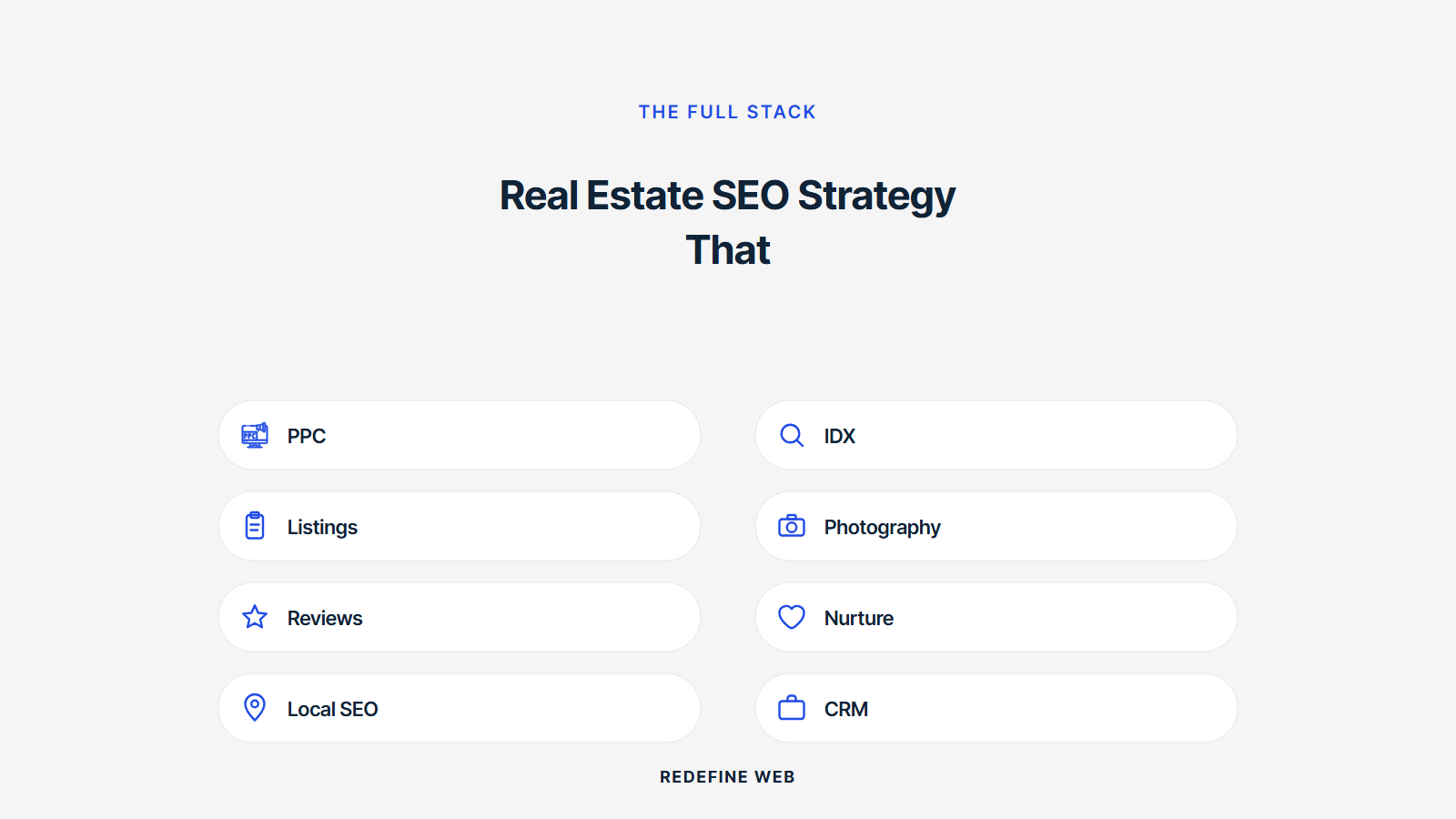
Weeks 1 to 4 (setup). Segment call, GBP cleanup, Search Console sweep, MLS filter cross-reference, call tracking install, technical baseline audit. Deliverable: keyword-to-URL map for the first 20 pages, GBP with 30 photos and 40+ reviews, call tracker live. Setup is where retainer money either buys momentum or gets wasted, and skipping any one of the six actions above forces rework in month two that costs twice as much as doing the setup right the first time.
Weeks 5 to 8 (transactional pages). 6 neighborhood hubs, 6 seller valuation pages, technical fixes (schema, Core Web Vitals, internal links). Deliverable: 12 URLs live, first pages entering position 15 in Search Console, first booked consults from organic. This is the phase where retainer conversations get easier because there is finally something to point at. Every URL is tracked, every call is attributed, and the ratio of booked consults to spent hours starts to look reasonable to the account owner.
Weeks 9 to 12 (portfolio and expansion). 4 market-report pages, 4 buyer guides, 4 price-band variants, first backlink outreach wave. Deliverable: 24 URLs live, 8 to 12 ranking top 20, 2 to 5 booked consults per week from organic, first local backlinks secured. Total 90-day output: 24 pages, 4 to 6 booked consults per week, working attribution loop. From week 12 the model shifts to compounding maintenance: 2 to 4 new pages per week, monthly market reports, ongoing GBP updates, and quarterly technical audits. That is the shape of a working retainer account past the first quarter.
What to run this week on a real estate SEO strategy
Three actions to finish by Friday. Book 60 minutes on your calendar for the segment call: residential agent, luxury agent, urban team, commercial broker, or investor. Pull the last 90 days of Search Console data and highlight queries at positions 5 to 15. Audit your Google Business Profile against the checklist (categories, photos, reviews, service areas).
Those three actions become the foundation for the ten-step playbook. Segment decides the templates. Search Console picks the first quick wins. GBP cleanup sets the map pack ceiling. Do them in that order and week two starts with a keyword-to-URL map you can defend to any stakeholder in the brokerage.
For accounts that want the strategy plus the execution handled together, our Real Estate SEO Services for Brokerages team runs the segment call, the GBP cleanup, the Search Console sweep, and the first 24 pages inside a 12-week engagement. For the wider retainer motion behind a working real estate account, see Real Estate Marketing Agency for Brokerages. And for the PPC layer that pairs with organic on most working real estate accounts, see Real Estate PPC Agency for Brokerages.
Frequently asked questions
What does a real estate SEO strategy actually include?
A real estate SEO strategy includes a segment call to pick residential agent, luxury, urban team, commercial broker, or investor as the primary lane. It also includes a Google Business Profile audit, a Search Console sweep for positions 5 to 15, MLS filter cross-reference for local keyword sizing, technical fixes (schema, Core Web Vitals, internal link graph), a 20 to 30 page content calendar mapped to neighborhoods and price bands, and call tracking install with dynamic-number insertion by traffic source. The strategy is a written document, not a slide deck, and every retainer review checks progress against the same 10 steps.
How long does a real estate SEO strategy take to produce results?
A working real estate SEO strategy produces first ranked URLs at positions 15 to 20 in weeks 4 to 8 and first booked consults from organic in weeks 6 to 14. The 90-day window produces 20 to 30 ranking URLs and 3 to 6 booked consults per week on a healthy domain. Results scale from month 4 onward as the internal link graph strengthens and local backlinks compound. Real estate SEO strategy accounts that promise results inside 30 days are either skipping the technical layer or overpromising, and both stall by month 6.
How much should a brokerage spend on a real estate SEO strategy?
A solo agent runs a working real estate SEO strategy on $1,200 to $2,400 per month. Small teams run at $2,400 to $4,800 per month. Brokerages with 10 or more agents run at $4,800 to $9,600 per month. Multi-market brokerages cross $9,600 into the $18,000 range depending on how many markets and how much content velocity is needed. Below the solo-agent floor there is not enough content velocity to rank inside six months. Above the multi-market ceiling the model shifts to a full in-house SEO team plus agency partnership.
Which real estate SEO best practices carry the most weight in 2026?
The real estate SEO best practices that carry the most weight in 2026 are neighborhood-plus-property-type page templates, seller-valuation pages, GBP with a working review flow, RealEstateListing schema on every listing page, LCP under 2.5 seconds on mobile, and a working internal link graph across neighborhood pages. Skip any of these and the account underperforms. The other 40 items on generic SEO checklists matter, but they matter marginally. These six carry 80 percent of the outcome on a real estate site and deserve 80 percent of the attention.
Can a solo real estate agent do SEO without hiring an agency?
A solo real estate agent can absolutely run a working real estate SEO strategy without an agency, but only if the agent commits 6 to 10 hours per week to content, GBP maintenance, and backlink outreach. The agent needs to be honest about the time cost. Solo agents who commit fewer than 4 hours per week end up with 6 half-built pages and no rankings by month 6. Solo agents who commit the time and follow the ten-step playbook see the same 60 to 120 day results curve as agency-managed accounts. Agency support becomes worth the cost around the point the account crosses 15 ranking URLs and needs specialist help on technical fixes.
How do real estate SEO tips fit into a working strategy?
Real estate SEO tips fit into a strategy as inputs, not as the strategy itself. Every SEO tip you consume this week should end with a note in your strategy document about which template, page, or process it changes. Tips read in isolation produce 40 disconnected optimizations and no compounding results. Tips filtered through a written strategy produce targeted upgrades to specific pages and specific templates over a 90-day window. Treat tips like an email you triage: keep the ones that change a decision in your plan, delete the ones that don't.
Book your free 30-minute strategy call.
No spam, no sales rep. We use your email to schedule your call with a senior strategist. That is it.
More from the blog
View all articles → SEO
SEO Organic Search Engine Optimization Services That Grow Real Traffic
Read article SEO
SEO SEO for Pet Groomers That Fills the Appointment Book Weekly
Read article SEO
SEO