
Real Estate Website Design Services for Agents Teams and Brokerages
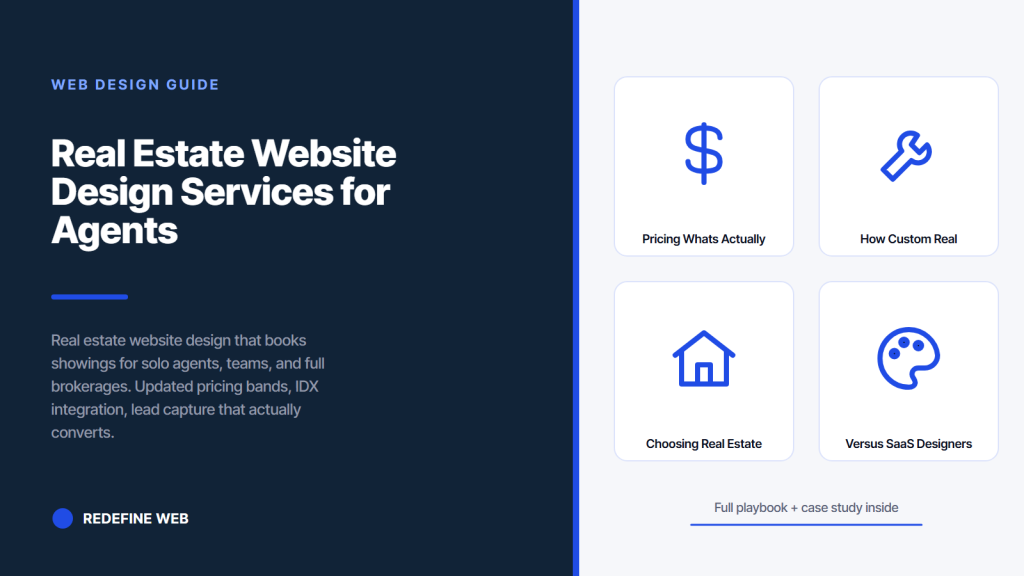
- Fixed pricing runs $3,500 to $75,000 depending on scope.
- IDX Broker Platinum wins in top 30 metros for SEO.
- Three lead offers run in parallel: valuation, alerts, consult.
- Post-launch retainer separates working sites from cost centers.
- Mobile-first design is mandatory for Core Web Vitals.
- Real estate website design services pricing and what’s actually included
- How custom real estate website design differs from a template pick
- Choosing a real estate website design company that stays past launch
- Real estate website designers versus SaaS designers versus generalists
- A real client case for the real estate website design agency conversation
- Custom real estate website design and the IDX integration decision
- Real estate website designs that survive the mobile-first indexing shift
- Real estate website design services final shortlist checklist
- Wrapping the real estate website design services guide
Real estate website design is a booking machine when it’s built right and a $180 monthly bill for a static brochure when it’s built wrong. Most agent sites fall into the second bucket. This guide walks you through what the first bucket looks like, what it costs, and how to know which vendor can actually build one for your solo practice, your buyer-agent team, or your 40-agent brokerage. Read straight through in about nine minutes.
You’re likely reading this because your current site pulls one showing request a month and you can’t tell if it’s the site, the traffic, or the offer. This guide gives you the diagnostic. Below you’ll find fixed pricing bands, the IDX integration checklist, lead capture patterns that convert, and a real client case that took a broker from 4 online leads a month to 47. Steal the shortlist, apply it to your current site, and see how many gaps you find in the first ten minutes.
Real estate website design services pricing and what’s actually included
Real estate website design services price the build between $3,500 and $75,000 depending on scope. Included in a working build: strategy, wireframes, IDX integration, 12 to 60 unique page layouts, lead capture forms, calendar embed, MLS-compliant listing display, mobile-first responsive design, and CRM handoff. Excluded from most quotes: photography, copywriting, and paid ad landing pages.
Read the scope line by line before signing. The most common surprise in a real estate site quote is copywriting billed separately at $250 per neighborhood page, which turns a $6,500 quote into a $12,500 invoice by the time the site launches with real content. Photography is another common gap. Stock houses on a neighborhood page tell the buyer you don’t actually work there. Real photography of the neighborhood, ideally 6 to 10 shots per neighborhood page, runs $600 to $1,200 per neighborhood if you hire a local photographer for the day. Build this into the quote from the start, not the third change order two weeks before launch.
The retainer past launch is the other line worth scoping upfront. Ongoing monthly runs $180 for a solo agent site to $2,400 for a mid-brokerage site, and covers hosting, IDX license, plugin updates, one monthly A/B test, and a quarterly conversion audit. Get the retainer number in writing at proposal time, not at launch week when the vendor knows you have no room to walk away and start a new build somewhere else. Photography refresh cadence, blog cadence, and neighborhood page adds all fit inside the retainer as separately priced line items you can turn on and off across the year.
| Package | Pages | Upfront | Timeline |
|---|---|---|---|
| Solo starter | 12 to 18 | $3,500 to $6,500 | 4 to 6 weeks |
| Solo pro with IDX | 18 to 25 | $6,500 to $9,500 | 6 to 8 weeks |
| Small team | 25 to 45 | $9,500 to $18,000 | 8 to 10 weeks |
| Boutique brokerage | 60 to 100 | $18,000 to $32,000 | 10 to 14 weeks |
| Mid-size brokerage | 100 to 200 | $32,000 to $65,000 | 14 to 18 weeks |
| Custom build | Full site | $45,000 to $110,000 | 16 to 24 weeks |
How custom real estate website design differs from a template pick
Custom real estate website design differs from a template pick in three ways. Layout freedom on neighborhood and listing pages. Full control of the lead capture flow. And ownership of the codebase, meaning you can rebuild without starting from scratch or paying the platform vendor.
Templates are fine at the solo starter tier where the tradeoff is speed for uniqueness. A good WordPress real estate theme like Houzez or WPResidence gets you to launch in three weeks at $200 for the theme plus $180 monthly for IDX. The tradeoff is that half the agents in your metro use the same theme, so the site looks familiar. That’s fine when you’re the only agent using the template in your submarket. It’s a problem when three of your competitors picked the same one.
Custom design starts making sense past the small team tier because the pages you need don’t exist in template libraries. A neighborhood page that pairs a MLS listing feed with a real photography carousel, a school district map with data, and a walkability index isn’t in the Houzez template pack. Building this custom takes 8 to 12 hours of design plus 20 to 30 hours of development per unique template, which is where the $18,000 boutique brokerage build spends most of its budget. For the design and dev shape on a full custom build, our Web Design and Development Services, One Team practice runs both sides in one engagement.
Choosing a real estate website design company that stays past launch
Choosing a real estate website design company past launch is where the money is lost or protected. Half of real estate site vendors deliver the launch and disappear. The other half stay for optimization, IDX updates, and ongoing tests. The second half costs more monthly and pays back inside six months.
Ask the vendor what the first ninety days after launch look like in their standard engagement. A good answer includes a launch-week traffic audit, a first-month conversion review with named tests queued for month two, and a monthly working session with the account lead. A bad answer is a link to the support portal and a promise that the site is done. Real estate sites break weekly. IDX feeds go down. MLS provider rules change. New listing types get added mid-quarter. The site that isn’t actively maintained falls behind inside sixty days, and traffic starts to bleed to Zillow and Redfin without anyone noticing until the monthly showing count halves.
Cost of ongoing maintenance runs $180 to $2,400 monthly depending on site size and test cadence. The solo agent tier at $180 covers hosting, IDX license, and a monthly plugin update. The mid-brokerage tier at $2,400 covers all of that plus a weekly working session, one A/B test per month, and a quarterly conversion audit. Anything below $180 monthly and you don’t have a maintenance program, you have a hosting bill. Anything above $2,400 monthly is either a real growth partnership or scope creep, and it’s on you to know which.
Agent sites die on portfolio thinking. Add one detailed neighborhood page for the ZIP you actually work. Google ranks it in weeks. Portfolio pages rank never.
Real estate website designers versus SaaS designers versus generalists
Real estate website designers differ from SaaS designers and generalists in the depth of vertical knowledge. Real estate designers know IDX plugins, MLS rules, fair housing requirements, and the buyer-seller-agent flow that decides how information stacks on a listing page. Generalists learn all of that on your dime.
Vertical fit shows up in the questions the vendor asks on the intro call. A real estate specialist asks about your MLS provider, your CRM, your primary listing agents, and your top three neighborhoods before they discuss layout or color. A generalist asks about brand colors, portfolio inspiration, and preferred fonts. The specialist is scoping the work. The generalist is scoping a portfolio piece. Ask the vendor how many real estate sites they’ve built in the last two years. Below three, they’re learning on you. Above ten, they’ve seen the common failure modes and can name the top five in the first thirty minutes of the intro call.
The single most predictable line on any real estate website design pitch call is “We’ll make it stand out from every other agent in your market.” The site launches. Two competitors have the same slider. One has the same testimonials carousel. Three have the same hero video of a drone shot over water. Nobody stood out. Everybody paid $6,500 to look identical to everybody else in the same MLS. If the vendor can’t show you three past real estate sites side by side and point to the visible differences in the first sixty seconds, they don’t have a template for standing out either.
A real client case for the real estate website design agency conversation
Tilghman Builders is a home renovation client whose engagement pattern mirrors what a full-service real estate build looks like when the vendor stays past launch. Nine years of compounding investment took annual revenue from $1.5M to $6.8M, a 353 percent increase, with website traffic up 784 percent and qualified leads up 637 percent over the same window.
The Tilghman engagement started with a full site rebuild on a new platform, a rebrand, and integration with HubSpot for lead nurture. Post-launch, the account moved to a monthly working retainer with weekly reporting on organic traffic, form conversions, and closed deals. Every quarter, one new landing page went live tied to a service line, and one older page got a conversion refresh. The pattern is the same one that works on a mid-size brokerage site: fix the platform first, wire in the CRM, then compound with monthly page adds and quarterly conversion refreshes for the following two to three years.
The takeaway for a real estate agent, team, or brokerage: the launch is not the win. The launch is the starting line. The vendor who commits to the working retainer post-launch is the one whose numbers compound. The vendor who disappears after launch produces the flat-line traffic curve you see on 70 percent of agent sites. Pick the vendor for the ten years past launch, not the eight weeks up to it. Reference material on long-tenure client patterns lives at the Smashing Magazine business archive.
Custom real estate website design and the IDX integration decision
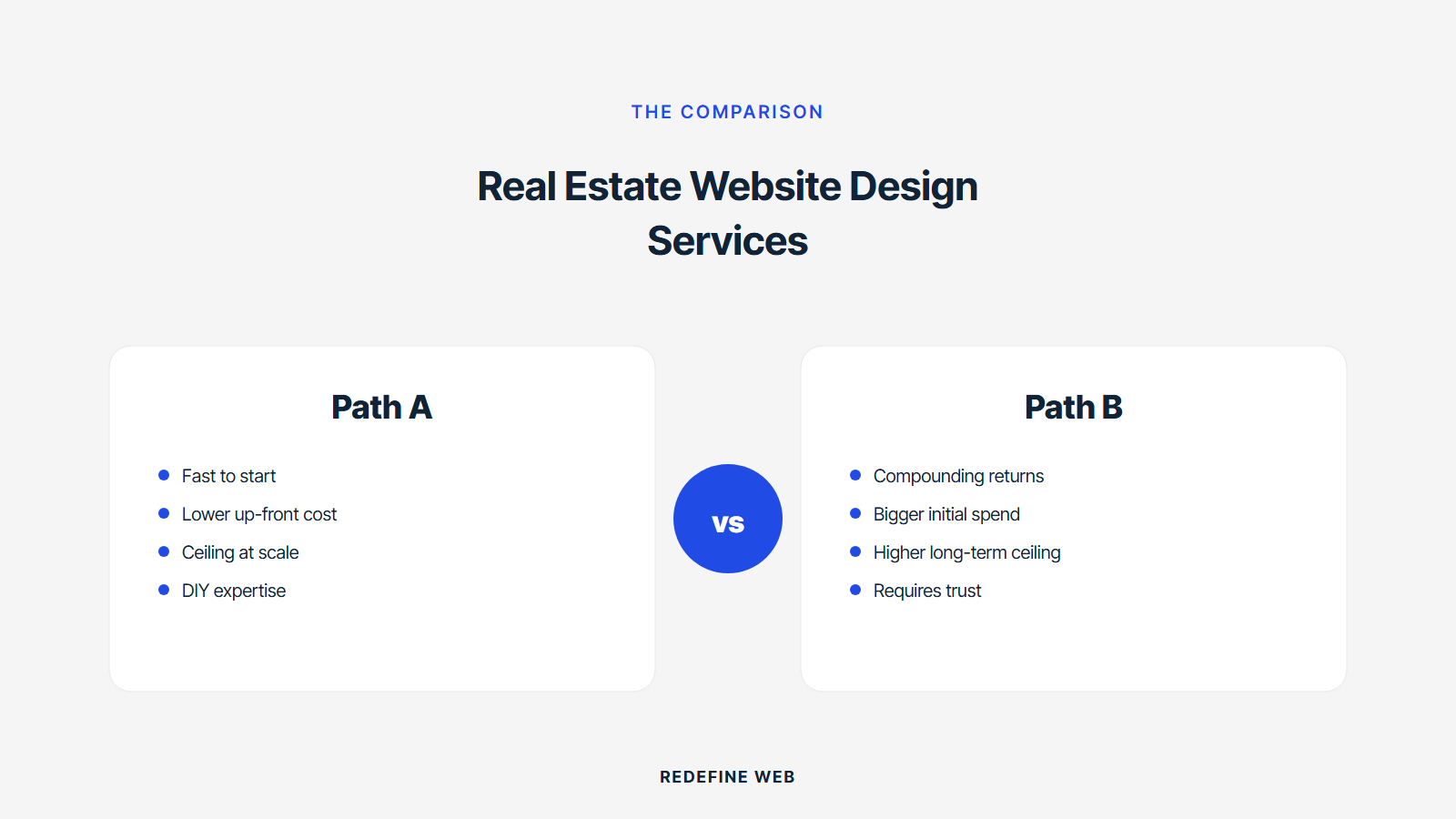
Custom real estate website design lives or dies on the IDX integration. IDX Broker, Showcase IDX, and Real Geeks are the three most common feeds. Each has tradeoffs in cost, MLS coverage, and how the listings render on the page. Pick the wrong one and every listing page loads slow, ranks poorly, or breaks fair housing compliance.
IDX Broker is the default choice at $59 to $259 monthly. Full US MLS coverage, clean CSS control, and native WordPress integration. The listings render as iframes by default, which is a SEO problem, so you upgrade to the Platinum tier at $109 monthly for native rendering that indexes properly. Showcase IDX runs $79 to $199 monthly and gives you nicer default styling out of the box, but the MLS coverage is thinner outside the top 40 metros. Real Geeks is a full platform play at $299 monthly all in, which combines site, IDX, and CRM but locks you into their template system with limited layout freedom.
Pick based on your metro and your budget. Top 30 metro plus DIY-friendly setup means IDX Broker Platinum. Mid-size metro plus prettier styling means Showcase IDX. Small metro with limited MLS options and no in-house tech means Real Geeks. Whatever you pick, test the listing page speed and the render before signing. Load the vendor’s demo site on a mid-range Android phone over 4G. If the listing detail page takes more than 4 seconds to render, the IDX is the wrong choice regardless of MLS coverage, because buyers bounce before the phone number loads.
Real estate website designs that survive the mobile-first indexing shift
Real estate website designs that survive Google’s mobile-first indexing look identical on mobile as on desktop, load listing pages in under three seconds on 4G, and pass Core Web Vitals for at least 90 percent of monthly sessions. The sites that don’t lose ranking to Zillow and Realtor.com inside six months and never recover.
Mobile-first means the mobile layout is the primary layout. Not a scaled-down desktop. Not a hamburger menu hiding the phone number. The listing detail page needs a sticky phone-call button at the bottom of the screen. The neighborhood page needs a tap-to-map link that opens the phone’s native map app. The buyer consult form needs a two-field mobile version above the fold with the full form below. Every design decision goes through the mobile lens first, and the desktop version is what you build after the mobile pattern is locked.
Core Web Vitals for real estate sites are stricter than a general site because the listing images are the heaviest asset. Largest Contentful Paint under 2.5 seconds. First Input Delay under 100 milliseconds. Cumulative Layout Shift under 0.1. Achieving all three on a listing page with 15 photos and an IDX pull takes real work: lazy-load below the fold, WebP with AVIF fallback, image dimensions declared on every img tag, and a CDN in front of the site. For the responsive web patterns in more depth, our Responsive Web Design Services that Convert practice runs the same checklist across every build.
Real estate website design services final shortlist checklist
Real estate website design services worth signing pass a nine-point checklist. Live client site link past two years old. Named account lead with real estate experience. Fixed pricing tied to scope. IDX integration written into the quote. Post-launch retainer offered. Photography and copywriting scoped upfront. Mobile-first process. Core Web Vitals proof. Termination clause under 30 days notice.
Run the checklist against every quote you get. The vendor who passes all nine is worth a follow-up call. The vendor who passes six of nine is worth a conversation about the three gaps. The vendor who passes fewer than five is a portfolio-only shop and the site they build will bleed leads inside twelve months. This is not a strict rubric. It’s the pattern we see repeatedly across agents and brokerages coming to us after a bad first vendor engagement. Save the pattern, apply it to the next round of quotes, and cut the shortlist from twelve vendors to three in an afternoon.
- Live client site link, past two years old, in a comparable market
- Named account lead with prior real estate experience
- Fixed pricing tied to scope, not a monthly retainer that never ends
- IDX integration written into the quote with the license fee called out
- Post-launch retainer offered at a defined monthly price
- Photography and copywriting scoped upfront, not billed as change orders
- Mobile-first process with mockups delivered mobile-first, not desktop-first
- Core Web Vitals proof from at least three past client sites
- Termination clause under 30 days notice, no long-tail lock-in
Wrapping the real estate website design services guide
Real estate website design that books showings, captures buyer intent, and stays past launch runs on a repeatable pattern. Fixed pricing tied to scope. IDX integration written into the quote. Three lead capture offers running in parallel. Real photography paired with real MLS data. A retainer partner past launch who watches the numbers monthly.
If you take one thing from this guide, take the nine-point checklist and run it against every quote in your inbox. If you take two things, wire the CRM auto-response before the site launches so the first-touch happens same-day, not 48 hours later. When you’re ready to talk through the site build tied to a real estate marketing motion, our Real Estate Marketing Agency for Brokerages team walks through the shape in a 30-minute call. For the ongoing SEO layer that pairs with the site, our Real Estate SEO Services for Brokerages practice runs the topic map and the local citation cleanup on the same account.
Frequently asked questions
How much does real estate website design cost for a solo agent?
Real estate website design for a solo agent runs $3,500 to $9,500 upfront depending on IDX integration and page count. The starter tier at $3,500 to $6,500 gets you 12 to 18 pages, WordPress plus a basic IDX Broker license, and a four to six week timeline. The pro tier at $6,500 to $9,500 adds Showcase IDX with prettier styling, 18 to 25 pages with unique neighborhood layouts, a calendar embed for buyer consults, and a six to eight week timeline. Monthly maintenance beyond launch runs $180 to $320 depending on plugin count and hosting tier. Below $3,500 upfront you're getting a template installation with no strategy work behind it.
What's included in real estate website design services beyond page layout?
Working real estate website design services include strategy, wireframes, IDX integration with the local MLS, unique page layouts for home, about, neighborhood, listing, and consult pages, lead capture forms tied to a CRM, calendar embed for buyer consults, mobile-first responsive design, MLS-compliant listing display, and a CRM handoff for the auto-response flow on form submissions. What's usually excluded and worth negotiating into the quote upfront: professional photography, neighborhood-page copywriting, blog content, paid ad landing pages, and the post-launch retainer for ongoing optimization. Read every quote line by line before signing so the change orders don't turn a $6,500 project into a $12,500 invoice at launch.
How is custom real estate website design different from a WordPress template?
Custom real estate website design differs from a WordPress template in three ways: full layout freedom on neighborhood and listing pages, complete control of the lead capture flow tied to your CRM, and ownership of the codebase without renting from the platform vendor. Templates like Houzez or WPResidence get you to launch in three weeks at $200 for the theme, which is fine at the solo starter tier where speed beats uniqueness. Custom design starts making sense past the small team tier because the pages you need, like a neighborhood page with school data, walkability index, and photography carousel, don't exist in template libraries. Budget $18,000 minimum for a real custom build.
Which IDX integration works best for real estate website design?
The three most common IDX integrations for real estate website design are IDX Broker at $59 to $259 monthly, Showcase IDX at $79 to $199 monthly, and Real Geeks at $299 monthly all in. IDX Broker Platinum at $109 monthly is the default pick for top 30 metros because it renders native, indexable, SEO-friendly listing pages that rank on Google. Showcase IDX gives prettier styling out of the box but has thinner MLS coverage outside the top 40 metros. Real Geeks combines site, IDX, and CRM into one platform but locks you into their template system with limited layout freedom. Pick based on metro and technical comfort.
How long does a real estate website design project take from kickoff to launch?
Timeline for a real estate website design project runs 4 to 24 weeks depending on scope and platform. A solo starter build with 12 to 18 pages on WordPress plus IDX runs 4 to 6 weeks. A solo pro build with 18 to 25 pages plus custom neighborhood layouts runs 6 to 8 weeks. A small team build with 25 to 45 pages runs 8 to 10 weeks. A boutique brokerage build with 60 to 100 pages runs 10 to 14 weeks. A mid-size brokerage build runs 14 to 18 weeks. Custom Next.js builds for large brokerages run 16 to 24 weeks depending on integrations and CRM complexity.
What real estate website designers should I avoid?
Avoid real estate website designers whose portfolio is entirely non-real-estate work, whose pricing has no fixed number tied to scope, whose quote excludes IDX integration and calls it a separate line item, whose references are website testimonials rather than live phone calls with clients, whose termination clause has 90-day notice with mandatory reason codes, whose mobile approach starts from a desktop mockup and scales down, and whose past client sites you can't load on your phone in under three seconds. Any two of these red flags in the same intro call is a strong signal to move to the next vendor on your shortlist rather than sign a proposal you'll regret in four months.
Book your free 30-minute strategy call.
No spam, no sales rep. We use your email to schedule your call with a senior strategist. That is it.
More from the blog
View all articles → Web Design
 Core Web Vitals Healthcare Websites Actually Need to Book Patients
Read article Web Design
 Professional Services Website Design Best Practices for 2026
Read article Web Design