
Restaurant SEO That Fills The Reservation Book Every Week
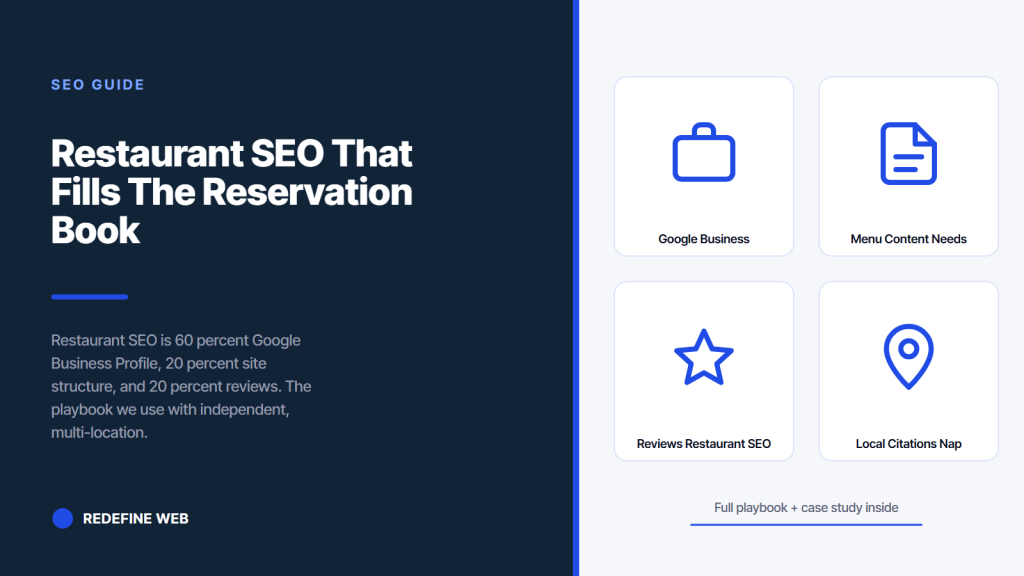
- Google Business Profile drives 60 percent of restaurant SEO results. Fill every applicable category, refresh photos monthly, and publish a Google Post every seven days.
- PDF menus block search. Rebuild the menu as HTML with MenuItem schema and dietary tags to capture dish-specific search queries.
- Review volume, review recency, and response cadence all feed local ranking. A three-touch review workflow (check QR + SMS + email) can 4-6x review acquisition in 90 days.
- Embed the reservation widget on the restaurant's own domain. It lifts measured conversion rate 40 to 80 percent without any traffic change.
- Multi-location restaurants need unique location pages, not a single Locations dump. Every location earns its own GBP, its own citations, and its own local backlink strategy.
- Google Business Profile Is 60 Percent Of Restaurant SEO
- Menu Content Needs To Be Crawlable HTML, Not A PDF
- Reviews Are A Restaurant SEO Ranking Factor, Not Just Social Proof
- Reservation Systems And The Conversion Attribution Trap
- Local Citations, NAP Consistency, And The Sixty-Directory Problem
- Long-Tail Content That Books Reservations Instead Of Just Traffic
- Multi-Location Restaurant SEO Uses A Different Playbook
- Site Speed And Mobile Experience Directly Move Reservation Volume
- Comparison Table: Restaurant SEO Tactics by Cost, Speed, and Ranking Impact
- Case Study: Passion Built Went From Two Broken Sites To A $60K Booking Pipeline
- Voice Notes From Our Restaurant SEO Practice
- FAQs About Restaurant SEO
Restaurant SEO gets confused with restaurant marketing and treated like an afterthought behind Instagram, delivery apps, and paid social. That’s why most independent restaurants show up on page three when a diner nine blocks away searches for something specific like brunch spots downtown. Restaurant SEO is a distinct discipline with its own ranking factors, its own competitive dynamics, and its own return curve.
At Redefine Web we’ve audited enough restaurant sites to spot the same six problems inside twenty minutes. Menu PDFs blocking search bots. Google Business Profiles missing half their categories. Reservation systems trapping the conversion event inside a third-party domain. Reviews sitting untouched because nobody owns the response workflow. Local citation data still pointing at a phone number from two lease renewals ago.
This guide walks through the restaurant SEO playbook we run with independent, multi-location, and hospitality group clients. Every recommendation is ranked by cost against speed against return. You’ll leave with a checklist you can hand a general manager tomorrow, and a clear sense of which ranking factors move the needle first when a restaurant needs to fill weeknight covers by next quarter.
Google Business Profile Is 60 Percent Of Restaurant SEO
The Google Business Profile is the single most valuable ranking asset a restaurant owns. Map pack results dominate restaurant SERPs, and the map pack is entirely driven by GBP signals plus proximity plus reviews. A restaurant that treats GBP as a set-it-and-forget-it listing loses to a competitor who updates it weekly, even when the second restaurant has a worse website and a smaller marketing budget.
A properly configured GBP has one primary category and every applicable secondary category filled. A wine bar that also serves small plates should be listed as a wine bar (primary) with restaurant, tapas restaurant, and cocktail bar as secondary. Categories are not descriptive tags. They’re ranking signals Google uses to decide which search queries trigger the listing. Missing a category means missing every search tied to that category.
Photos matter more than most owners realize. GBPs with 100+ photos receive 520 percent more calls and 2,700 percent more direction requests than listings with fewer than 10, according to BrightLocal local search research. The photo mix should rotate: food shots, interior shots, staff shots, exterior at different times of day, seasonal decor. Upload 8 to 12 new photos per month minimum. The local SEO guide walks through the full GBP optimization checklist.
Google Posts are the underused GBP feature. Posts about weekly specials, chef features, events, and seasonal menu changes signal freshness to the algorithm and appear in the knowledge panel for branded searches. A restaurant publishing a post every seven days will consistently outrank a restaurant that hasn’t posted in six months, even if the second restaurant has stronger review numbers on paper.
Menu Content Needs To Be Crawlable HTML, Not A PDF
Menu PDFs are the single most common restaurant SEO mistake. Google can crawl PDFs, but it treats them as secondary content with weak internal linking, no schema, and no structured data. Menu items sitting inside a PDF miss every dish-specific search query, and dish queries are among the highest-intent searches in the restaurant category.
The fix is straightforward: rebuild the menu as HTML with proper heading structure, item descriptions, prices, and dietary tags (vegetarian, gluten-free, dairy-free, spicy). Every menu section becomes an H2 or H3. Every dish gets a short description that includes ingredients, preparation notes, and any relevant modifiers. This structure lets the restaurant capture searches like truffle pasta downtown, gluten-free brunch near me, or vegan tacos [neighborhood].
Schema markup layered on top of the HTML menu unlocks the rich result treatment. Menu schema (Menu, MenuSection, MenuItem) tells Google the exact structure, letting individual dishes appear in specialized search features. Restaurant schema at the page level covers hours, cuisine type, price range, and accepted payment methods. According to Google’s structured data documentation, restaurants with complete schema are more likely to appear in rich results and voice search responses.
Menu photography needs a home too. A single hero image on the menu page underperforms a grid where every dish carries its own optimized image with descriptive alt text. Alt text should describe the dish and include ordering language a diner would use, not marketing prose. Skip crispy heavenly bites. Use crispy fried chicken sandwich with pickles and honey butter.
Reviews Are A Restaurant SEO Ranking Factor, Not Just Social Proof
Review volume, review recency, and review sentiment all feed local pack ranking algorithms. Google treats reviews as a proxy for both quality and freshness, which means a restaurant with 400 reviews averaging 4.5 stars from the last 12 months will typically outrank a competitor with 800 reviews averaging 4.7 stars from three years ago. Recency compounds.
The review acquisition workflow needs to run every day, not every month. Best-practice implementation: a QR code on the check presenter that opens the Google review URL with one tap, a follow-up SMS 90 minutes after the reservation ends thanking the diner and asking for a review, an email follow-up 24 hours later with the review link and a soft ask. Restaurants running this three-touch workflow consistently pull 15 to 25 percent review conversion from happy diners, compared to 2 to 4 percent from passive requests.
Response cadence matters too. Restaurants that respond to every review, positive and negative, within 48 hours receive higher engagement metrics from Google. A one-line thank you on a positive review is enough. A negative review needs a real response that acknowledges the issue and offers a specific path forward, not a canned we’re sorry to hear that. Owners who respond well to negative reviews often watch the star rating actually climb because prospects read the response as evidence of care.
Yelp still matters in most U.S. markets, particularly in food-focused cities like New York, Chicago, San Francisco, and Los Angeles. Skip aggressive review solicitation on Yelp because their algorithm penalizes it. Instead, focus on making the Yelp profile complete: full menu, updated photos, correct hours, service categories, and accurate cross-links. TripAdvisor still drives real traffic for restaurants near hotels, convention centers, and tourist zones. Every third-party listing needs the same NAP consistency the primary site uses.
Google can't read your menu if it's a PDF. Convert to HTML this weekend. Dishes will start showing in local search results within 30 days.
Reservation Systems And The Conversion Attribution Trap
The biggest silent SEO problem in restaurant marketing is the reservation system. OpenTable, Resy, and Tock are excellent booking platforms. They’re terrible SEO assets because they trap the conversion event inside a third-party domain. A diner clicks Book a Table on the restaurant’s site, gets redirected to OpenTable, completes the reservation, and Google Analytics records the exit, not the conversion.
Two fixes work here. First, embed the reservation widget on the restaurant’s own domain rather than linking out. Every major booking platform offers an iframe or SDK embed. The reservation completes on the restaurant’s site, the conversion event fires against the restaurant’s analytics, and the diner never leaves the domain. This one change often lifts measured conversion rate 40 to 80 percent without any traffic change.
Second, implement server-side conversion tracking for reservation completions. GA4 events can be triggered from webhooks fired by the booking platform’s completion API, capturing the conversion even when the diner completes the booking days later from a phone. This is how a restaurant proves that a Google Ads click drove a Saturday night four-top, not just a homepage visit.
Delivery integrations follow the same rules. DoorDash and Uber Eats convert on their own domains and their own analytics. Restaurants should embed the delivery ordering flow on their site where possible, or at minimum use tracked URL parameters that let analytics tools attribute delivery orders to specific marketing channels. Without that setup, the restaurant is flying blind on which marketing dollars actually drove revenue. The conversion tracking guide covers the specific implementation for restaurant reservation and delivery flows.
Local Citations, NAP Consistency, And The Sixty-Directory Problem
Local citations still matter for restaurant SEO because they feed the local ranking signals Google uses to verify business legitimacy. A restaurant with consistent name, address, and phone (NAP) across 60+ authoritative directories will outrank a competitor with inconsistent citations, even when the competitor has better on-page content. The signal is subtle but persistent.
The problem is that most restaurants change addresses, phones, or names over their lifespan. A restaurant that rebranded three years ago might still have citations pointing to the old brand across 20 directories. Yelp, TripAdvisor, Foursquare, OpenTable, and Google carry the most weight. Yellow Pages, Bing Places, Apple Maps, MapQuest, and Facebook come next. Below that, restaurant-specific directories: Zomato, Eat24, Grubhub, Restaurant.com.
Citation cleanup runs once as a foundation project, then monthly as a maintenance task. Tools like Whitespark, BrightLocal, and Semrush’s local listings feature can identify inconsistencies quickly. Fixing them takes weeks because many directories require manual verification or ownership claims. Budget the cleanup as a 90-day project, not a one-week sprint.
Facebook is often the second-highest driver of local restaurant traffic after Google, and its Places listing needs the same NAP discipline. Hours updates during holidays, photo refreshes, and event listings feed Facebook’s local discovery algorithm and often drive more foot traffic than paid Instagram ads for neighborhood spots.
Long-Tail Content That Books Reservations Instead Of Just Traffic
Blog content on restaurant sites is often either abandoned or misdirected. Recipe posts drive traffic but rarely book tables. Chef backstory posts feel authentic but convert at low single digits. The blog content that actually books reservations answers specific diner questions with high transactional intent: best places for X in [neighborhood], private dining for 20 in [city], pre-theater dinner near [venue], group dining with dietary restrictions.
These posts convert because they intercept diners who have already decided to eat out and are trying to pick a specific venue. A well-written best places for anniversary dinner in Brooklyn post that mentions the restaurant honestly, alongside three or four competitors, will book covers directly. Yes, mentioning competitors matters. It signals trust to Google’s helpful content system and to the reader.
Neighborhood guides work similarly. A restaurant in a walkable food district can build a Where to Eat in [Neighborhood] guide that includes their own venue alongside neighbors, plus notes on what to order, best times to visit, and reservation availability. Guides like this earn shares on local subreddits, tourism site backlinks, and second-tier travel blog citations. The traffic pattern is thin at first and compounds hard over 12 to 18 months.
Event content is the third pattern. Posts covering upcoming holidays, restaurant week participation, seasonal menu launches, and chef collaborations capture time-sensitive intent. These posts should include a working reservation link and structured event schema so they surface in Google’s event carousel and the local knowledge panel. The content marketing strategy guide covers how to structure a long-tail content calendar around booking intent.
Multi-Location Restaurant SEO Uses A Different Playbook
Multi-location restaurants (chains, hospitality groups, franchise models) need a location-page architecture that most SEO agencies get wrong. Every location needs its own page with unique content, its own set of local citations, its own Google Business Profile, and its own review acquisition workflow. Rolling up all locations into a single Locations page kills local ranking potential for every branch.
Best-practice architecture: parent brand page at /locations/, individual pages at /locations/[city]/[neighborhood]/. Each location page carries unique content covering neighborhood context, parking, transit access, private dining options, local awards or press coverage. Copy templating fails here because Google’s local algorithms devalue near-duplicate content across location pages.
Local link building becomes harder at multi-location scale because it can’t be centralized. Every location needs neighborhood-specific backlinks: local chamber memberships, local nonprofit sponsorships, local blog partnerships, local school fundraiser mentions. A hospitality group with 12 locations should have 12 separate local link acquisition campaigns running quarterly.
Franchise models face an extra layer: national brand marketing and local franchisee marketing sometimes conflict. The clean structure is a national brand site at brand.com plus locally-managed microsites or subfolders that franchisees can update. Franchisees who can’t update their own local content will underperform franchisees who can. The multi-location SEO guide details the architecture we recommend.
Site Speed And Mobile Experience Directly Move Reservation Volume
Restaurant sites need to load fast because diners are usually deciding on a phone with weak signal in a moving Uber. A site that takes 4 seconds to load loses roughly 30 percent of mobile visitors before the homepage renders. A site that takes 6+ seconds loses more than half. This isn’t SEO theory. It’s directly measurable in analytics as bounce rate and cart abandonment on reservation flows.
Core Web Vitals thresholds apply here. Largest Contentful Paint under 2.5 seconds, Interaction to Next Paint under 200 milliseconds, Cumulative Layout Shift under 0.1. Most restaurant sites fail LCP because hero photos aren’t compressed or lazy-loaded properly. The fix is straightforward: WebP format, srcset for responsive delivery, lazy loading on below-fold images.
Mobile menu UX matters more than desktop menu UX because 78 percent of restaurant site sessions now happen on mobile according to Think with Google restaurant behavior research. Menus that require pinch-to-zoom, tap-to-expand a PDF, or scroll-locked overlays actively lose reservations. A clean HTML menu with big touch targets and clear section navigation converts better than any beautifully designed PDF spread.
Click-to-call buttons need to be prominent on mobile. A single sticky Call button at the bottom of every page converts phone-preferred diners at high rates. Reservation-preferred diners want the widget above the fold. Serving both audiences means both CTAs live above the mobile fold, ideally side-by-side. Making a diner choose which one to hunt for is how a restaurant loses the reservation.
Comparison Table: Restaurant SEO Tactics by Cost, Speed, and Ranking Impact
Below is the tactic prioritization we use with restaurant clients during the first 90 days. Each row is scored against cost intensity, speed to visible ranking movement, and ranking impact at 6 months. Use it to sequence work if the budget is tight.
| Tactic | Cost | Speed to Impact | 6-Month Impact | Priority |
|---|---|---|---|---|
| Google Business Profile optimization | Very low | 2-4 weeks | Very high | Do first |
| Review acquisition workflow | Low | 3-6 weeks | Very high | Do first |
| HTML menu with schema | Medium | 4-8 weeks | High | Do second |
| Reservation widget embed | Low-medium | Immediate (conversion) | Medium (attribution) | Do second |
| Local citation cleanup | Medium | 6-12 weeks | Medium-high | Do third |
| Long-tail booking-intent blog content | Medium-high | 4-6 months | High (compounds) | Ongoing |
| Site speed and Core Web Vitals | Medium | 4-8 weeks | Medium | Do third |
| Local link building | High | 3-9 months | Medium-high | Ongoing |
| Multi-location page architecture | High (one-time) | 2-4 months | Very high (chain only) | Do if applicable |
Case Study: Passion Built Went From Two Broken Sites To A $60K Booking Pipeline
Passion Built is a Sydney renovation company rather than a restaurant, but the SEO transformation pattern maps directly. They came to Redefine Web with two poorly performing websites, only ranking for their own brand name, and pulling most leads from expensive third-party job boards. Sound familiar to any restaurant owner spending on Grubhub and DoorDash while their own site sits invisible?
The rebuild consolidated to one WordPress site with structured content and clear conversion paths. Service pages got written for both rankings and buyer intent. Google My Business got a full overhaul: categories, services, photos, and reviews. Google Ads campaigns ran with 5 percent-plus CTR tied to specific ad groups. Local citations were cleaned up in parallel.
Over 12 months: keyword rankings expanded from 6 to more than 300, monthly website visitors grew past 800, and the business generated more than $60,000 in bookings directly attributable to the new site. Ten percent of new visitors converted. The same architecture applied to a restaurant would drive reservation volume the same way, because the underlying pattern (fix the local presence, restructure the site around intent, embed conversion tracking) works across local service categories.
Voice Notes From Our Restaurant SEO Practice
Voice note (Local SEO lead): Every restaurant audit I run starts with the GBP. If it’s under-optimized, we can lift map pack impressions 200 to 400 percent in the first 60 days without touching the website. The website work matters, but the GBP work moves faster and cheaper.
Voice note (Technical SEO): PDF menus are the fastest technical win I fix on restaurant sites. Rebuild as HTML with MenuItem schema, add proper dietary tags, and dish-specific search traffic starts arriving inside eight weeks with zero paid spend.
Voice note (Reputation lead): The QR code on the check plus SMS follow-up plus email follow-up plays out the same across every restaurant we’ve worked with. Review volume jumps 4 to 6x within 90 days. It’s the least glamorous SEO tactic and it moves rankings faster than almost anything else.
FAQs About Restaurant SEO
How long does restaurant SEO take to show results?
Google Business Profile improvements produce measurable ranking movement within 2 to 4 weeks. Review acquisition workflows show impact by week 6 to 8. Site content changes and technical fixes typically move rankings between weeks 8 and 16. Long-tail blog content compounds over 4 to 9 months. A full restaurant SEO program usually delivers meaningful traffic and reservation lift within 90 days and hits mature performance around month 9.
Should a restaurant hire an SEO agency or handle it in-house?
Single-location restaurants can handle 70 percent of SEO in-house if the general manager commits 3 to 5 hours per week to GBP updates, review responses, and content publishing. Technical work (schema implementation, site speed, page architecture) usually needs outside help. Multi-location groups almost always benefit from an agency partner because the operational scale exceeds what a marketing manager can maintain alone.
Do delivery apps help or hurt restaurant SEO?
Delivery apps drive orders but do nothing for organic search rankings and often hurt margin. They should be treated as a distribution channel, not a marketing channel. The restaurant’s own site should always convert as many orders as possible through direct delivery integrations, with delivery apps as backup for reach.
How many Google reviews does a restaurant need to rank well?
There’s no fixed threshold. What matters is being ahead of local competitors on review volume and freshness. In competitive urban markets, that often means 300 to 800 reviews at a 4.4-star or better average, with steady monthly acquisition. In smaller markets, 100 to 200 reviews might be enough for map pack dominance.
Does social media help restaurant SEO directly?
Not directly. Social signals aren’t ranking factors. Social media supports SEO indirectly by driving branded search volume, generating shareable content, and building citations through Facebook Places and Instagram location tags. A restaurant should invest in social for reach and community, not for expected SEO benefits.
What’s the single biggest restaurant SEO mistake to avoid?
Treating the website as a brochure instead of a booking engine. Every page needs a clear path to reservation or order, every menu item should be structured HTML with schema, and every marketing dollar should be tied back to attribution. Restaurants that treat the site as a pretty digital menu miss 60 to 80 percent of the revenue their SEO investment could deliver.
Book your free 30-minute strategy call.
No spam, no sales rep. We use your email to schedule your call with a senior strategist. That is it.
More from the blog
View all articles → SEO
SEO Organic Search Engine Optimization Services That Grow Real Traffic
Read article SEO
SEO SEO for Pet Groomers That Fills the Appointment Book Weekly
Read article SEO
SEO