
SEO Ecommerce Category Pages That Grow DTC Revenue
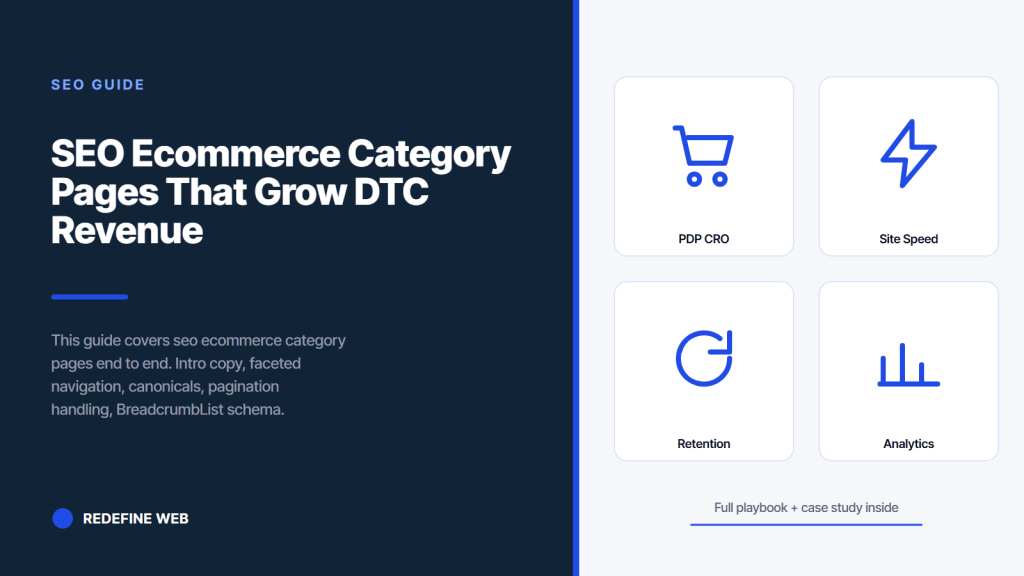
- Category pages drive 30 to 45 percent of DTC organic revenue.
- Intro copy at 150 to 250 words unlocks top-10 ranking.
- BreadcrumbList and ItemList schema qualify for SERP features.
- Facet handling saves crawl budget on large catalogs.
- Self-referencing canonicals on paginated URLs preserve indexation.
Google ranks category URLs for commercial queries, not products. Check your top 10 commercial keywords. If category isn't ranking, products punch above weight.
Frequently asked questions
What are seo ecommerce category pages?
SEO ecommerce category pages are template-level pages that list products inside a category and rank for commercial-intent queries like running shoes for women or waterproof composite decking. They sit between informational blog content and buyer-intent product pages in the DTC ranking stack. Category pages drive roughly 30 to 45 percent of a healthy DTC store's organic revenue when built correctly with proper H1 patterns, 150 to 250 words of intro copy, BreadcrumbList and ItemList schema, canonical strategy across filter URLs, self-referencing canonicals on paginated URLs, and descriptive anchor text in the product grid. Fixing the template once fixes every category URL across the catalog.
How much intro copy does a category page need for SEO?
A category page needs 120 to 220 words of intro copy above the product grid for measurable ranking gain. Below 60 words of intro copy, category pages rarely break past position 15 across DTC verticals we have tested. At 150 to 250 words, ranking climbs into the top 10 range. Above 400 words, diminishing returns kick in and the copy starts pushing the product grid below the fold on mobile, which cuts conversion. Intro copy should answer the buyer-intent query, cover the top 3 buying considerations, and sit visible on desktop with a Read more toggle preserving mobile screen real estate for the product grid.
How do canonical tags work across ecommerce category pages seo?
Every indexable category URL points its rel canonical at itself without query parameters, which is the correct default across every DTC platform. Filter URLs that do not earn indexation point their canonical back to the parent category URL, which consolidates ranking signal on the parent while allowing the filtered URL to still exist for buyers. Filter URLs that earn indexation because they carry distinct search demand canonical to themselves. Getting canonicals wrong splits ranking signal across the whole category tree and caps every URL at the same middling position. Google's guidance on canonical URL selection is the primary reference for engineers implementing this pattern.
What schema markup does a category page need?
A category page needs BreadcrumbList schema listing every level of the category tree from homepage down to the current URL with position numbers matching the visible breadcrumb navigation on the rendered page, plus ItemList schema listing every product on the page in order with position, name, URL, and image. CollectionPage schema wraps the whole category as its own entity Google indexes at the collection level. BreadcrumbList qualifies the URL for the SERP breadcrumb display line replacing the raw URL. ItemList qualifies the category for the Google merchant listing carousel on select verticals like apparel, home goods, electronics, and beauty.
How does meta seo for ecommerce category pages work with pagination?
Meta SEO for ecommerce category pages with pagination uses self-referencing canonicals on every paginated URL, not canonicals pointing back to page one. Canonicalizing every paginated URL to page one tells Google that pages 2 through 12 are duplicates and instructs the crawler to skip them, which hides half or more of catalog SKUs from indexation past 40 products per category. Self-referencing canonicals on paginated URLs preserve product page discoverability and return 8 to 22 percent of catalog products to the index within the following crawl cycle. Page one holds the intro copy and internal links while deeper pages carry only the grid and pagination controls.
Book your free 30-minute strategy call.
No spam, no sales rep. We use your email to schedule your call with a senior strategist. That is it.
More from the blog
View all articles → SEO
SEO Organic Search Engine Optimization Services That Grow Real Traffic
Read article SEO
SEO SEO for Pet Groomers That Fills the Appointment Book Weekly
Read article SEO
SEO