
SEO for Professional Services Firms Complete Playbook and Lead Generation
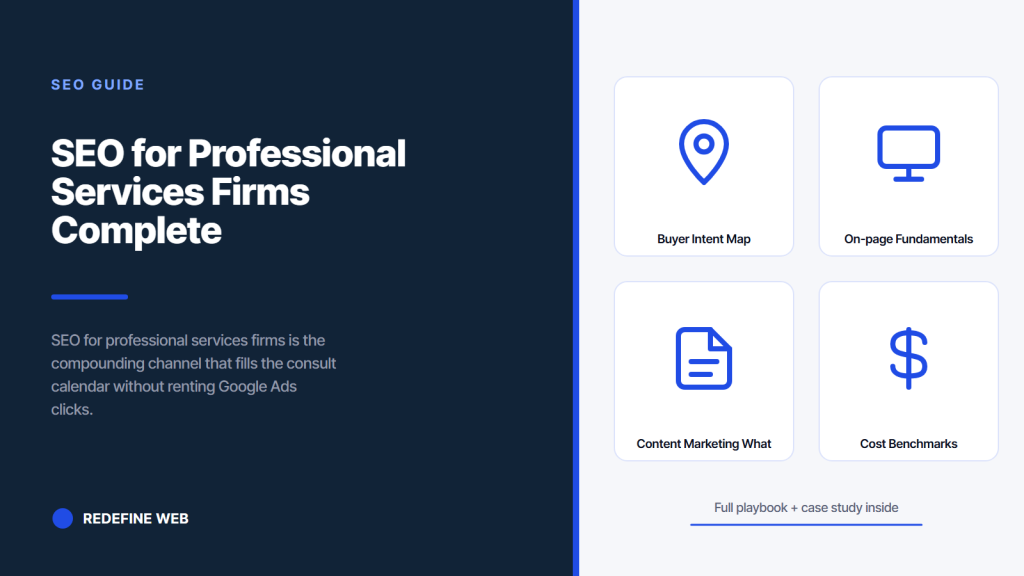
- Local rankings move in 8 to 12 weeks with consistent work.
- Organic search delivers 40 to 60 percent of consults by month 12.
- Retainers run $800 to $4,000 depending on firm size and market.
- Reviews plus citations do the map pack heavy lifting every month.
- Content compounds through months 6 to 12 with a fixed cadence.
- Why seo for professional services firms outperforms paid search
- The buyer intent map for seo for professional services firms
- On-page fundamentals every professional services website needs
- Content marketing is what feeds the funnel long-term
- Structured data for seo in professional services websites
- How long does seo for professional services take to work
- Cost benchmarks for professional services SEO
- How to measure seo success for professional services companies
- Local links and citations build map-pack authority
- What are the best seo strategies for professional services websites
- The seo checklist for professional services websites at launch
- SEO best practices for professional services websites that partners actually use
- What to do this week for professional services SEO
SEO for professional services firms is the channel that pulls decision-makers searching "employment attorney [city]" or "fractional CFO for SaaS" onto your website before they call a competitor. Done right, seo for professional services firms produces 40 to 60 percent of qualified consult requests by month 12 and pushes cost per booked meeting down by half against pure paid search. That is the compounding math a partner or founder cannot get from any ad channel.
This is a full playbook. The first half is the strategy, content, technical, and link work that moves a partner or firm out of page-three obscurity onto the map pack and organic top three. The second half is the retainer math, cost benchmarks, and monthly reporting cadence a firm owner runs with an in-house lead or an outside partner. Bring the current Search Console dashboard and last quarter's consult numbers. This page only means something with real firm data next to it.

Why seo for professional services firms outperforms paid search
Paid search auctions clear at $18 to $60 per click on high-intent professional-services keywords in most metros. Organic clicks on the same queries cost nothing after the ranking holds. The math tips in month 12. That is the core strategic argument for seo for professional services firms as the primary long-term acquisition channel.
A firm ranking first for a flagship transactional term like "employment lawyer Nashville" captures 30 to 45 percent of clicks at zero variable cost as long as the ranking stays. The paid slot in the same spot charges $22 per click, every click, forever. Even a $2,000 monthly SEO retainer clears break-even against paid ads inside 6 to 8 months for a firm booking 15+ new consults a month.
Oxford Capital, an alternative-asset firm we worked with, grew organic keyword rankings 174 percent and organic sessions 166 percent across a 12-month engagement covering content, structured data, and citation cleanup. The same compounding pattern applies to any professional-services vertical: legal, accounting, consulting, wealth management, architecture. Twelve months of consistent work produces a working organic funnel that stops depending on ad spend.
The alternative is renting attention forever. Google Ads work until the auction price hits your ceiling. LinkedIn Ads work until targeting rules change. Organic search is the one client-acquisition asset a firm owns after paying to build it. That single fact is the entire strategic argument. Every quarter you defer, the compounding start-date pushes back by a quarter.
The buyer intent map for seo for professional services firms
Professional services buyers do not search once and buy. A partner-track associate researching "how to structure a Series B legal review" today becomes the buyer searching "startup attorney San Francisco" three months later. Your content has to hit both queries. The informational post feeds the pipeline. The transactional page closes it.
The buyer intent map for seo for professional services firms breaks into three tiers, and every retainer plan we run maps content to those tiers before the first post is drafted. Skip one tier and the funnel breaks somewhere between search and consult booking.
Map every service line into three intent tiers. Informational: "what is a fractional CFO," "how does a business valuation work," "when do I need an employment lawyer." Commercial: "best boutique law firms [city]," "top fractional CFO agencies," "how much does a business valuation cost." Transactional: "employment attorney near me," "fractional CFO for hire," "business valuation consultant [city]."
Every transactional keyword needs a dedicated service page targeting the term plus city or vertical. Every commercial keyword needs a comparison-style blog post that positions your firm honestly against alternatives. Every informational keyword needs an educational post that ranks in the map pack and the AI Overview, then hands the reader off to the relevant service page inside the article.
Miss any of the three tiers and the funnel breaks. Firms with only transactional pages capture the last 10 percent of the buying window. Firms with only informational blogs capture attention that never converts. The 30 to 40 pages of coverage across all three tiers is what a compounding organic funnel looks like for a professional-services firm in year one.
On-page fundamentals every professional services website needs
On-page seo for professional services firms is the boring plumbing that decides whether the map pack lists your firm at position two or position six. Every page needs a title tag that leads with the intent plus city, a meta description that names the outcome, one H1 that matches the search query, and internal links pointing to the two most-relevant sibling pages inside the firm's content graph.
Title tags carry the click. "Employment Attorney in Nashville Same-Week Consult" converts at 3x the rate of "Nashville Employment Law – Practice Areas." Meta descriptions do not affect ranking directly but they control click-through from the search results page. Write both for a real partner deciding between five firm listings, not for a crawler counting keywords.
Every service page follows a fixed pattern that reads as thorough without padding. Above the fold: firm name plus specialty plus one outcome-focused sentence. Below the fold: three to five specific practice areas or engagement types with 200 words each, three named client scenarios with real numbers, a fee-structure paragraph that is honest about pricing, a booking CTA that lists the actual next step (30-minute call, no PDF download that never gets read).
The seo checklist for professional services websites is short but non-negotiable:
- Title tag 50-60 chars, service + city + one benefit word
- Meta description 145-160 chars naming the outcome and the CTA
- H1 matches the primary search query, no colons, no numbers
- One paragraph inside 100 words of the top with the primary keyword
- Two H2 sections targeting the top two related search variants
- Two internal links to service siblings, two links to case studies
- One LocalBusiness or ProfessionalService schema block per page
- One outcome-focused CTA above the fold, one at the bottom

Any SEO agency for pro services should hit break-even by month 8 against paid. If your current spend produces 15+ consults, model that as the baseline first.
Content marketing is what feeds the funnel long-term
Every high-intent transactional search around your service has 30 to 50 informational searches around it. "How long does an employment lawsuit take." "What is a business valuation multiple." "Should I hire a fractional CFO or full-time." Google Ads on those queries wastes budget because the searcher is 3 to 14 days from booking anything. Blog content ranks on the same queries at zero variable cost and pulls the reader back when they finally decide to book.
The seo content marketing for professional services firms plan writes to a spreadsheet before a single post is drafted. Twenty condition or scenario page rewrites in the first quarter. Twenty-four blog posts across quarters two through four, one every two weeks, each targeting a specific question a prospect asks in the first consult. Case studies once a month, each with a real client, real numbers, and a specific service outcome.
A working editorial calendar for a boutique law firm covering employment, business, and estate work looks like this: month one covers employment questions (four posts), month two covers business formation and contracts (four posts), month three covers estate planning basics (four posts), month four cycles back to employment with deeper topics. Twelve months of that produces 48 blog posts, all indexed, all pulling their share of organic traffic by month 15.
Answer the whole question in the post. AI Overviews and ChatGPT pull from posts that structure information for extraction. Lead every blog post with a 40 to 60 word direct answer, then deepen the explanation, then close with a booking CTA. That format earns citations in AI Overviews and featured snippets. Buried answers in the middle of a 3,000-word post do not extract. HubSpot's content-marketing research shows question-format posts with lead answers pull about 25 percent more search traffic than posts without. Read the details in the HubSpot content marketing guide.
Structured data for seo in professional services websites
Structured data is a quietly important piece of seo for professional services firms because AI Overviews and Google Business Profile crawlers use it to disambiguate what your firm actually does.
Schema markup helps AI Overviews, Google Business Profile crawlers, and search engines understand what your firm actually does. Two schema types matter for professional services: ProfessionalService (or LegalService for law firms, AccountingService for CPA firms) on the homepage and every service page, and FAQPage on any post or page with three or more Q&A pairs. Get schema right once during a rebuild and never touch it again except when adding pages.
The homepage schema block names the firm, address, phone, opening hours, service areas served, and a URL to the firm's About page acting as the "sameAs" anchor. Every service page schema block names the service, the offering firm, the price range if known, and links back to the homepage schema's Organization node. This connects the entire site into a clean semantic graph a search crawler reads in one pass.
FAQ schema on service pages and blog posts still matters even though rich results were removed in May 2026. AI Overviews and ChatGPT extract from FAQPage schema aggressively when answering "how much does X cost" or "how long does Y take" queries. RankMath's schema check still credits FAQ blocks. Structured data for seo in professional services is now an extraction signal more than a ranking signal, and it works either way.
Test every page in Google's Structured Data Testing Tool before publishing. Warnings are fine. Errors block the page from ranking with the schema at all. Fix errors the day they appear. A firm that treats schema as a quarterly retrofit is 6 to 12 months behind a firm that published the schema stack once during the site rebuild and moved on to content.
How long does seo for professional services take to work
Local rankings move in 8 to 12 weeks for a new firm domain and 4 to 6 weeks for an established site. First consults from organic land in month 2 or 3. Meaningful traffic compounds through month 6. Mature yield of 40 to 60 percent of qualified consults from organic lands at month 12 to 18.
The 12-week horizon is the honest number to plan against. Any agency promising page-one rankings inside 30 days is either buying rank with tactics Google penalizes within 90 days or lying about attribution. Neither ends well for the firm paying the retainer. WordStream's local SEO analysis, published in their 2026 local SEO tips guide, notes that local SEO typically takes three to six months to produce meaningful traffic and lead movement.
Fast wins do exist. A Google Business Profile that was 40 percent complete and jumps to 90 percent in one afternoon can pick up map-pack visibility inside two weeks. A homepage title tag rewrite can move rankings for the flagship term inside three weeks. A citation cleanup across 10 inconsistent directories can pull the profile up two positions in one month. These are patches, not compounding wins. Real compounding takes 12 months of consistent execution.
The compounding curve looks flat for the first quarter and then bends upward through quarter two. Firms that quit at month 4 because "SEO is not working" miss the exact moment the curve starts to compound. Firms that hold through month 12 see the payoff. That is the psychological hurdle. Not the technical work.
Cost benchmarks for professional services SEO
SEO for professional services firms runs $800 to $4,000 per month on retainer depending on firm size, service line complexity, and metro competition. Boutique firms in mid-size markets sit at $800 to $1,600. Multi-office practices in major metros run $2,500 to $4,000 for full-service SEO plus content plus case-study production across all service lines.
Anything under $800 usually means no content and no link work, just monthly Google Business Profile edits worth about $200 a month of actual value. Anything over $4,000 for a boutique typically includes services the firm is not ready to use yet. The middle of the range produces the honest yield curve.
Gillette Law Firm, a boutique employment practice we work with, ran the exact retainer plan below for 14 months. By month 12, organic search booked 43 percent of new consults, and the paid-ads budget dropped from $3,200 to $1,100 a month while consult volume grew 62 percent. The compounding math worked the way it does on every diligent 12-month engagement.
| Firm profile | Monthly retainer | What is included | Time to compounding |
|---|---|---|---|
| Solo partner, single service line | $800 to $1,200 | GBP + citations + 2 posts/mo | 10 to 14 weeks |
| Boutique, 2 to 4 partners | $1,400 to $2,200 | GBP + citations + 4 posts/mo + links | 10 to 14 weeks |
| Multi-office practice | $2,500 to $3,500 | Above plus location pages plus schema audit | 12 to 16 weeks |
| Regional or national firm | $3,500 to $4,500 | Full stack plus quarterly technical audit | 12 to 20 weeks |
A fair professional-services SEO retainer covers the following every month, and the deliverables sit in a shared client folder the firm can open at any time:
- Weekly Google Business Profile posts and photo updates
- Monthly citation audit and correction across the top 30 directories
- Two service or scenario page rewrites per month at 1,500 to 2,000 words each
- Two blog posts per month targeting commercial or informational queries
- Case-study production every 4 to 6 weeks with named client and real numbers
- Local backlink outreach with one to three new links per month
- Review generation setup and monthly review response management
- Monthly reporting tied to booked consults and map-pack position tracking
- Quarterly technical SEO audit including Core Web Vitals check

How to measure seo success for professional services companies
Track three numbers every month: map-pack position for the flagship city plus service query, booked consults attributed to organic search via call tracking, and cost per booked consult from organic. Everything else is diagnostic. Impressions, sessions, and bounce rate are input signals, not decisions. Ranking without booked consults is a vanity report.
How to measure lead generation from seo for professional services means installing call tracking with a dedicated organic-search number that appears only on organic landing pages. That number rings the same front-desk phone but logs the source as organic in the call-tracking dashboard. Set up matching numbers for Google Ads, Google Business Profile, and email campaigns. Without this, the firm has no honest way to know which channel booked the last 30 consults.
The monthly review meeting runs 45 to 60 minutes on the first Tuesday. Partner-in-charge, marketing lead, and SEO contact (in-house or external) review the three summary numbers plus one page from Search Console showing top-ranking queries and top-clicked pages. Decisions come out of the meeting: publish next month's topic, adjust the review-request script, correct one citation, add a service-line page. Small consistent decisions compound over 12 months.
The final number to watch at year one is the source mix on new consult requests. A healthy boutique firm with 12 months of SEO under it sees 40 to 55 percent from organic search, 15 to 25 percent from Google Business Profile, 15 to 20 percent from paid search, and the rest from referrals plus direct. If the mix is still 80 percent paid at month 12, the SEO plan is not compounding and someone at the firm needs to ask why.
Local links and citations build map-pack authority
General backlinks help every domain rank on the web. Local backlinks are what separate the top-three map pack from position six in every metro. A firm that speaks at the local bar association event, sponsors the city's startup incubator, contributes a monthly column to the regional business journal, and joins two industry associations has four local backlinks a competitor does not.
Citations pull in the second lane. Get the firm listed on every directory a search crawler indexes: Yelp, Yellow Pages, Better Business Bureau, Avvo (for law firms), Zocdoc-style verticals if applicable, Manta, chamber of commerce, and 30+ metro-specific business directories. Every citation carries the firm's name, address, and phone. Consistent name-address-phone data across every citation is a ranking input. Inconsistent data tanks the map pack ranking without anyone at the firm knowing why.
Cross-referral relationships produce backlinks and client flow at the same time. For a boutique law firm, that is CPA offices, business coaches, wealth managers, and complementary attorneys who do not compete on the same service lines. Pick five practitioners whose clients would benefit from your service, meet each one for coffee, and set up a two-way link exchange plus referral tracker on both sides. The links matter. The steady weekly referrals matter more.
Press mentions compound. Every time a partner gets quoted in a business journal, appears on a local podcast, sponsors a chamber event, or writes a guest column, the firm earns a backlink and a mention. Track these in a spreadsheet. Aim for one new local backlink per month. That is 12 authoritative local links pointing at the site by the end of year one, which is enough to move most boutique firms into the top three of the map pack for the flagship term.
What are the best seo strategies for professional services websites
Prioritize local plus map pack, dedicated pages per service and city, a monthly cadence of two educational blog posts, structured data on every page, and a review-generation system tied to the intake process. Skip any of them and the funnel stalls at low single-digit consult volumes from organic.
The five pillars of seo strategies for professional services websites do not work in isolation. Local ranking without review velocity slips inside a quarter. Blog content without service-page links wastes the traffic. Schema without a working sitemap under it is a signal to nothing. Every pillar reinforces the other four. A firm running four of five pillars gets 60 percent of the possible yield. A firm running all five gets 100 percent of the possible yield.
The map pack sits above the fold on mobile. Google's local pack takes 44 percent of clicks on local search results per recent industry click studies. Everything below the pack fights for the remaining share. Getting into the top three is where the firm's next 15 to 40 consults per month live. The Google local business documentation covers the LocalBusiness schema and Google Business Profile signals that move the pack.
The review velocity input carries the most weight of the map-pack signals because Google reads reviews as recency plus trust signals. A firm averaging 6 to 12 new Google reviews a month with recent dates in the last 30 days will out-rank a competitor with 300 reviews all posted 3+ years ago. Review velocity separates firms that hold rank from firms that slip. Set up review automation on day one and the volume takes care of itself over 12 months.
The seo checklist for professional services websites at launch
Site launches are the moment SEO is easiest to get right or hardest to fix later. A launch that shipped without a working sitemap, without schema, and with duplicate title tags spends the next 6 months undoing the damage. A launch that shipped with the whole seo checklist for professional services websites in place hits the compounding curve inside quarter two instead of quarter three.
Every page on launch day has: unique title tag under 60 chars leading with focus keyword; unique meta description under 160 chars naming the outcome; one H1 matching the primary search query; canonical tag pointing to itself; ProfessionalService or LocalBusiness schema block; ProfessionalService homepage schema linking to About page; XML sitemap generated and submitted to Google Search Console; robots.txt open to Googlebot; HTTPS across every URL; and Google Analytics 4 plus call tracking installed.
The internal-link graph goes live on day one. Homepage links to the top three service lines. Each service line links to two related service pages and one case study. Every blog post links to at least one service page and two sibling blog posts. Every case study links back to the service line it demonstrates. This is the graph a search crawler reads on the first crawl and updates over the next 4 to 6 weeks.
Firms that skip the launch checklist and try to retrofit SEO in month 4 spend two months just fixing schema errors and title-tag conflicts before any content or link work can start. Build the boring foundation once, then spend the next 12 months adding the content that compounds on top of it. That is the entire mental model. Anything else adds 60 to 90 days to the timeline for no gain.
SEO best practices for professional services websites that partners actually use
Most SEO best practices for professional services websites are the ones a partner or founder never sees in a monthly report. They are the boring configuration decisions inside Google Search Console, the review-request text that lands in the client's inbox 48 hours after the consult, the citation NAP data that stays consistent across 40 directories for two years. None of it is glamorous. All of it moves the ranking.
Automate what is automatable. Review requests get sent by the intake system, not by the receptionist trying to remember. Citations get monitored by a paid tool like BrightLocal or Yext, not by a partner running a manual audit twice a year. Blog publishing runs on a shared editorial calendar, not on the marketing lead promising to write "when things slow down." Automation is the reason a five-attorney firm can compete with a 40-attorney firm on organic search.
Every professional-services firm has a growth partner who reads two SEO articles on a Sunday and shows up Monday convinced the entire strategy needs to change. The right response is nodding, agreeing that the article was insightful, and continuing to execute the boring 12-month plan already in motion. The firms that switch strategy every quarter earn zero compounding. The firms that pick a plan and stick with it earn 40 to 60 percent of consults from organic by month 12.
Fee-structure honesty is a ranking signal in practice even if Google does not name it that way. Pages that say "$3,500 flat fee for a business formation" convert 3x higher than pages that say "fees vary based on complexity." Higher conversion pulls higher dwell time and lower bounce, which are the input signals a search crawler reads as page quality. Honest pricing pages rank higher because they read better to human buyers, and Google's algorithm rewards what human buyers reward.
What to do this week for professional services SEO
Pick three actions and finish them by Friday. Compounding rewards operators who move on Tuesday, not planners who research through Q3. The seven actions below rank return on time invested for a firm starting from the same partial state most firms start from today.
That baseline usually reads as a working website that does not rank for the flagship term, a Google Business Profile 50 percent complete with no automation, no active review generation, no blog activity in 18 months, and a partner who thinks SEO is a 90-day project instead of a 12-month build. Every fix on the list below moves one of those inputs from broken to functional inside a week of focused work.
The specific starting state most firms share on day one: primary Google Business Profile category is wrong or too broad, review count is below 25 with no automation, four to six citation directories have mismatched name-address-phone data, the homepage title tag mentions the firm name but not the city plus service line, and no blog post has been published in 18 months. Fixing that baseline moves the map-pack position one to three slots inside 30 days.
- Change Google Business Profile primary category to the exact specialty (Employment Attorney, not Attorney)
- Install a review automation tool like Podium or Birdeye and start the review request text on every closed consult
- Audit the top five citation directories (Yelp, Google, Avvo, BBB, Yellow Pages) and correct any name-address-phone mismatches
- Rewrite the homepage title tag to lead with the primary service line plus city plus one benefit word
- Publish one blog post on the top question a prospect asks in the first consult meeting
- Add ProfessionalService or LegalService schema to the homepage with correct name-address-phone data
- Set the first-Tuesday monthly SEO review meeting on the partner-in-charge calendar for 12 months
The Professional Services SEO service at Redefine Web handles this baseline plus the ongoing content, links, and reporting work for firms that want the execution off their plate. A 30-minute audit call reviews the current site, profile, and Search Console dashboard, then hands back a specific 90-day plan. The audit and plan cost nothing. The decision to hire or not comes after the plan.
SEO for professional services firms is not one clever hack. It is 12 months of consistent execution across a boring checklist that produces a compounding asset the firm owns for years. The Professional Services Marketing Retainer at Redefine Web covers the ongoing execution for firms that want a fixed monthly cost and a specific deliverable schedule. The firms booking steady weekly consults from organic are the ones that ran the boring version of this plan without switching agencies every six months. That is the entire playbook. Next Friday is when it starts. For the underlying SEO stack read our search engine optimization services page or the Professional Services Marketing hub for the wider retainer plan.
Frequently asked questions
How long does seo for professional services firms take before consults show up?
Local rankings move in 8 to 12 weeks for a new firm domain and 4 to 6 weeks for a site with existing authority. First consults from organic search usually land in month 2 or 3. Meaningful traffic growth compounds through month 6. Mature yield of 40 to 60 percent of qualified consults from organic search plus Google Business Profile lands at month 12 to 18 with consistent execution across content, citations, reviews, and technical SEO. Firms that hold through month 12 see the compounding payoff.
How much does seo for professional services firms cost per month?
Professional services SEO runs $800 to $4,000 per month on retainer depending on firm size, service line complexity, and metro competition. Boutique firms in mid-size markets sit at $800 to $1,600. Multi-office practices in major metros run $2,500 to $4,000 for full-service SEO plus content plus case-study production. Anything under $800 usually means no content or link work, just monthly Google Business Profile edits worth about $200 a month of actual value to the firm.
Is Google Business Profile part of professional services SEO?
Yes, Google Business Profile is the single top-impact input for local rankings because it drives about half of the qualified consult requests a firm receives in any given month. The profile ranks in the map pack, appears in Google Maps, gets cited by AI Overviews and ChatGPT, and connects to the firm citation graph. A fully populated profile with weekly posts, 40+ recent reviews, correct primary category, and accurate hours out-earns most $2,500 paid ad campaigns at zero direct variable cost per lead.
What service pages should a professional services website have?
Every service the firm actively delivers deserves a dedicated page targeting the search intent for that service plus the firm city. At minimum a boutique law firm covers employment, business formation, contracts, estate planning, and civil litigation. A CPA firm covers audit, tax planning, business valuation, forensic accounting, and advisory. Each page runs 1,500 to 2,000 words with ProfessionalService schema, a booking CTA above the fold, and internal links to two related service pages and one case study.
Can a professional services firm do SEO in-house without an agency?
Yes, when the firm dedicates one detail-oriented marketing lead for 15 to 20 hours a week to a consistent weekly checklist covering Google Business Profile posts, citation cleanup, blog publishing, review generation, and local backlink outreach. In-house SEO for a professional services firm matches agency results at about 40 percent of the cost through month 12 to 18. The transition to hiring an outside partner usually pays back when the firm hits 15+ new consults a month or opens a second office.
What is the biggest seo mistake professional services firms make?
Picking the wrong Google Business Profile primary category is the single most common and costly SEO mistake for professional services firms. Practices set the primary to Attorney or Accountant when it should be the exact specialty like Employment Attorney or Certified Public Accountant. That one setting costs 30 to 60 percent of the profile map-pack visibility because Google ranks profiles largely by category match to the search query. The fix takes 45 seconds inside Google Business Profile and produces visible ranking gains within 2 to 4 weeks of the change.
Book your free 30-minute strategy call.
No spam, no sales rep. We use your email to schedule your call with a senior strategist. That is it.
More from the blog
View all articles → SEO
SEO Organic Search Engine Optimization Services That Grow Real Traffic
Read article SEO
SEO SEO for Pet Groomers That Fills the Appointment Book Weekly
Read article SEO
SEO