
SEO for Real Estate Investors That Books Motivated Seller Calls
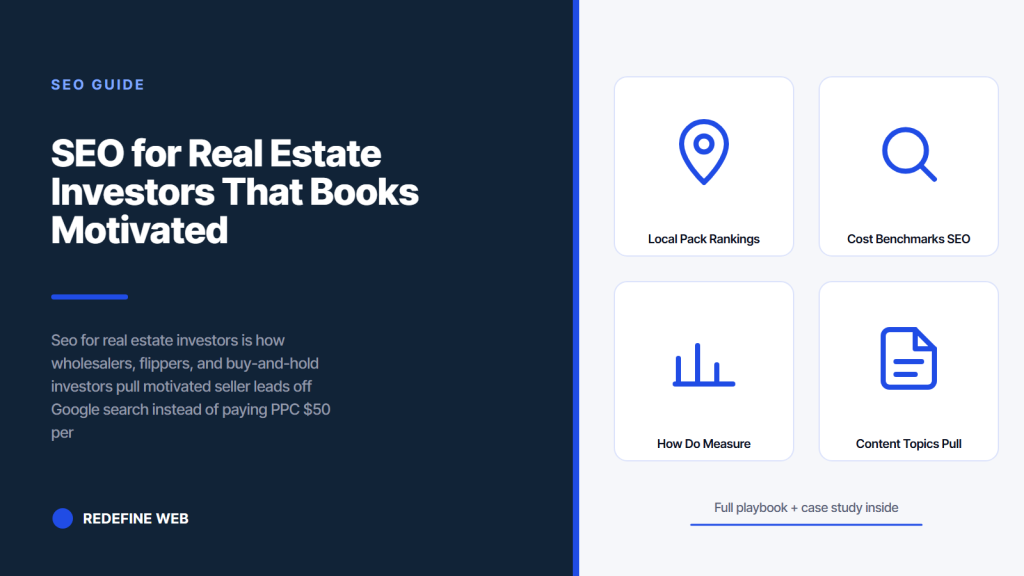
- Investor rankings move in 8 to 12 weeks with consistent work.
- Organic delivers 15 to 40 seller calls per month by month 12.
- Retainers run $800 to $3,500 depending on portfolio and metros.
- Wrong GBP category costs 30 to 60 percent of visibility.
- Pain-point posts rank 3 to 12 months before the seller calls.
- Local pack rankings for real estate investor seo
- How long does seo for real estate investors take to book seller calls
- Cost benchmarks for seo services for real estate investors
- How do you measure roi from seo for real estate investing
- Content topics that pull motivated sellers from Google
- What separates a great real estate investing seo company from a bad one
- What to do this week for seo for real estate investors
Seo for real estate investors is the specific work that pulls motivated seller leads off Google search onto your investor site at zero cost per click. You stop paying PPC $40 to $80 per motivated seller lead. You stop paying $500 per direct mail campaign for a 0.5 percent response rate. The site starts ranking for "sell my house fast [city]," "we buy houses [metro]," and 100 other high-intent motivated seller queries, and by month 12 the phone rings with sellers already convinced they want a cash offer.
This guide is the honest breakdown of seo for real estate investors from a firm that runs the 12-month plan across wholesaler, flipper, and buy-and-hold investor sites. You get the motivated seller intent map, the "we buy houses" page structure that ranks and converts, the local pack signals that move investor rankings, cost benchmarks by portfolio size, and the reporting cadence that ties organic traffic back to closed deals. Bring your last 90 days of PPC spend numbers and direct mail response rates.
Local pack rankings for real estate investor seo
The Google local pack sits above the fold on mobile for every "we buy houses near me" and "cash home buyers [city]" query. The top three profiles capture roughly 44 percent of local search clicks per recent industry studies. Getting into the top three is where your next 20 to 60 motivated seller leads per month live for most active investor markets.
Google Business Profile carries the map pack. A profile that's 40 percent complete jumping to 90 percent in one afternoon can pick up map visibility inside two weeks. Every field matters: primary category set to Real Estate Investor (not Real Estate Agent, not Property Management, not Real Estate Agency), service areas listing every zip code within your buying radius, hours accurate, weekly Google Posts featuring recent closings with the neighborhood and days-to-close, and photos updated monthly with new deals.
Review velocity separates profiles that hold rank from profiles that slip. Google reads reviews as recency plus trust signals. An investor averaging 4 to 8 new Google reviews a month from sellers you've bought from with recent dates will out-rank a competitor with 100 reviews all dated 2+ years ago. Ask every closed seller for a review the day the check clears escrow. Automate it with a simple text template or a Podium sequence. WordStream's local SEO tips guide confirms review velocity is the top-weighted map pack signal for most local queries.
Citation consistency is the quieter input. Get the investor listed on BiggerPockets member directory, the local REIA directory, Better Business Bureau, chamber of commerce, Yelp, and 15+ metro-specific business directories with identical name-address-phone data. Inconsistent NAP across even three citations tanks the map pack ranking without anyone noticing. Fix it once, monitor quarterly, and move on.
How long does seo for real estate investors take to book seller calls
Local pack rankings for investor queries move in 8 to 12 weeks for a new investor domain and 4 to 6 weeks for an established site. First motivated seller calls from organic land in month 2 or 3. Meaningful lead flow compounds through month 6. Mature yield lands at month 12 to 18 with consistent execution.
The 12-week horizon is the honest number to plan against. Any real estate investing seo company promising page-one rankings inside 30 days is either using tactics Google penalizes within 90 days or lying about attribution. Motivated seller queries have lower monthly volume than residential retail queries but much higher commercial value per lead. A single ranking for "we buy houses [metro]" can be worth six-figure annual assignment fees.
Quick wins do exist. A Google Business Profile that was 40 percent complete jumping to 90 percent complete in one afternoon can pick up map visibility inside two weeks. A citation cleanup fixing 10 NAP inconsistencies can pull the profile up two positions in one month. These are patches, not compounding wins. Real compounding takes 12 months of consistent execution.
The compounding curve looks flat for the first month, moves visibly in months 2 to 4, and bends upward through month 6. Investors that quit at month 3 because "seo isn't working" miss the exact moment the curve starts to compound. Wholesalers and flippers that hold through month 12 see the mature yield of 15 to 40 organic seller leads per month at zero marginal cost per lead.
Cost benchmarks for seo services for real estate investors
Seo services for real estate investors run $800 to $3,500 per month on retainer depending on portfolio size, number of metros served, and content investment. Solo wholesalers in mid-size markets sit at $800 to $1,500. Small investor teams with multiple buy boxes (wholesale, flip, buy-and-hold) run $1,500 to $2,500. Multi-metro investor operations pay $2,500 to $4,000 for coverage across submarkets.
Anything under $800 usually means no content and no vacancy-page work, just monthly Google Business Profile edits worth about $200 a month of actual value. Anything over $4,000 for a solo wholesaler typically includes services you're not ready to use yet. The middle of the range produces the honest yield curve every real estate investor seo company delivers when the work stays consistent for 12 months.
Abels Residential, a London lettings agency we work with, ran a similar retainer plan for 12 months on residential rental search queries. Result: 20+ qualified rental leads per month from organic search and 300+ first-page keyword rankings across the London lettings vocabulary. The same math holds for a wholesaler or flipper with matching content and vacancy-page investment on motivated seller queries.
| Investor profile | Monthly retainer | What is included | Time to compounding |
|---|---|---|---|
| Solo wholesaler, one metro | $800 to $1,300 | GBP + citations + 2 posts/mo + cash-offer page | 10 to 14 weeks |
| Small team, one buy box | $1,300 to $2,000 | Above + 4 posts/mo + 5 submarket pages | 10 to 14 weeks |
| Multi-buy-box operation | $2,000 to $3,000 | Above + separate pages per buy box + schema audit | 12 to 16 weeks |
| Multi-metro investor | $2,800 to $4,000 | Full stack + one metro landing page per metro | 12 to 20 weeks |
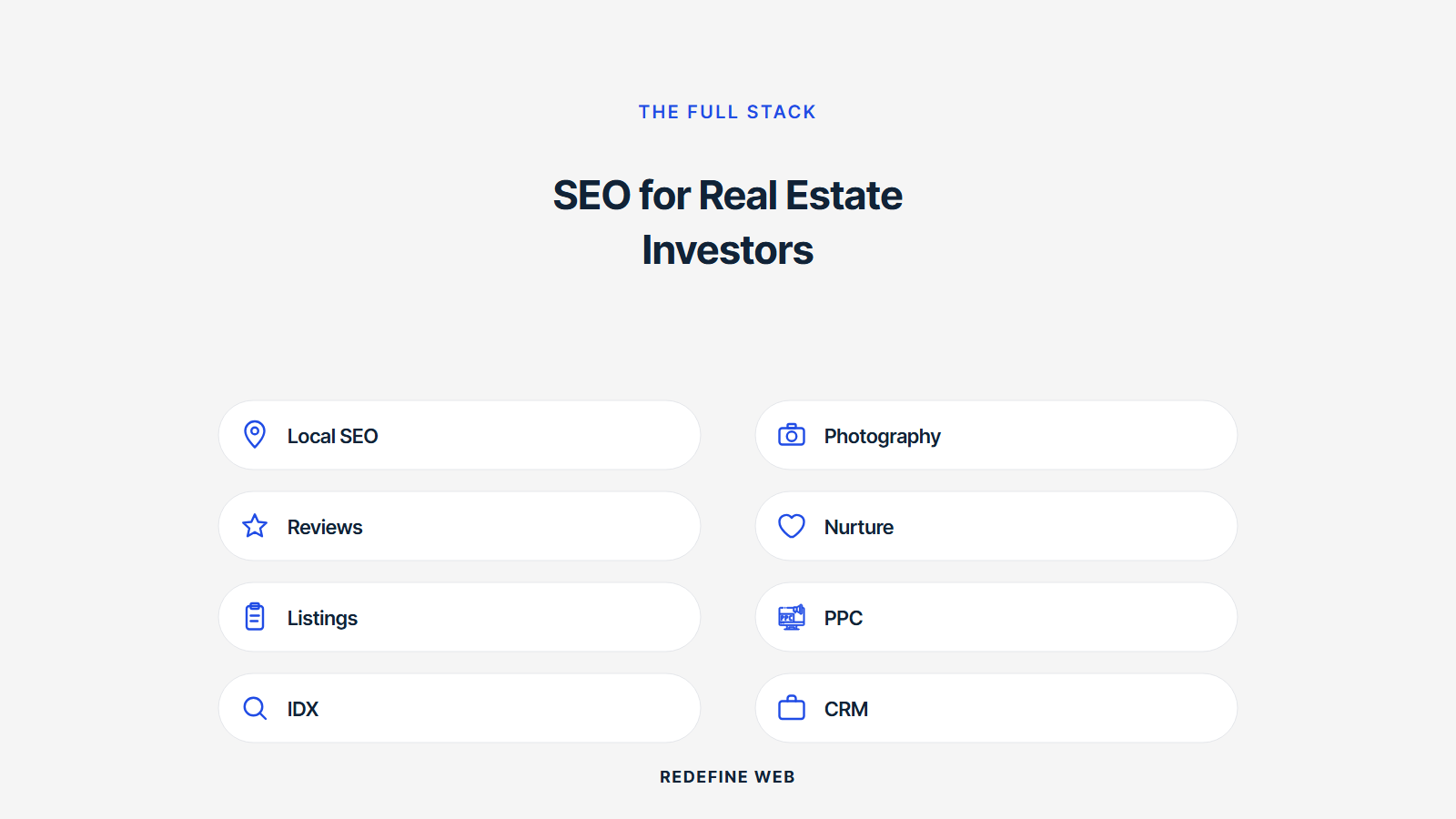
A fair real estate investor seo retainer covers the following every month:
- Weekly Google Business Profile posts featuring recent closings and neighborhoods
- Monthly citation audit and correction across the top 30 investor-relevant directories
- Two cash-offer or submarket page rewrites per month at 1,200 to 1,600 words each
- Two blog posts per month covering seller pain-point queries (repairs, inheritance, foreclosure, tenants)
- Case-study production every 4 to 6 weeks with named seller (first name last initial), neighborhood, offer amount, and days-to-close
- Local backlink outreach with one to two new links per month from local REIA chapters, journalists, and adjacent professionals
- Review generation automation for every closed seller
- Monthly reporting tied to booked seller calls and map-pack position tracking
Search 'sell my house fast [your city]' from an incognito window. If page one is all Zillow + big-brand wholesalers, plan for 8-12 months, not 90 days.
How do you measure roi from seo for real estate investing
Track three numbers every month: map-pack position for the flagship city plus "we buy houses" query, booked motivated seller calls attributed to organic search via call tracking and form source tagging, and closed assignment fees or flip profit tied back to those calls. Everything else is diagnostic. Impressions, sessions, and bounce rate are input signals, not decisions.
Every serious seo for real estate investors campaign needs a dedicated call-tracking number placed only on the Google Business Profile and organic landing pages. That number rings the same investor line but logs the source as organic. Set up matching numbers for PPC, direct mail, and Zillow. Without that setup, the investor has no honest way to know whether the last 15 seller calls came from organic, from PPC, or from a mailer that dropped 8 weeks ago.
The monthly review meeting runs 45 minutes. Investor, marketing lead (if separate), and seo contact review the three summary numbers plus one page from Search Console showing top-ranking queries and top-clicked pages. Decisions come out of the meeting: publish next month's seller pain-point post, adjust the review-request script, correct one citation, add one submarket page. Small consistent decisions compound over 12 months.
The final number to watch at year one is source mix on new seller calls. A healthy solo wholesaler with 12 months of seo under them sees 45 to 60 percent from organic search plus Google Business Profile, 20 to 30 percent from PPC, 10 to 15 percent from direct mail, and the rest from referrals or bandit signs. If the mix is still 70 percent PPC at month 12, the seo plan is not compounding and the retainer needs a hard look.
Content topics that pull motivated sellers from Google
Motivated sellers search Google with pain-point queries first, transactional queries second. That is why seo for real estate investors works best when you publish 10 to 20 pain-point posts before you optimize the cash-offer page. Every post ranks on a query 3 to 12 months before the seller is ready to call, and pulls the seller back through email or retargeting when they're ready.
The top-performing pain-point topics for wholesalers and flippers, ordered by monthly search volume in most US metros:
- How to sell a house that needs major repairs (foundation, roof, plumbing)
- How to sell an inherited house with siblings or probate involved
- How to sell a house with tenants still in it
- How to stop foreclosure and sell the house before auction
- How to sell a house behind on property taxes or with a lien
- How to sell a hoarder house or condemned property
- How to sell a rental property fast without evicting tenants
- What are the tax implications of a cash sale vs listing
- How to sell a house during divorce without listing
- How to sell a house you owe more on than it's worth
Every post lands 1,200 to 1,600 words with a lead-first answer paragraph (40 to 60 words), three named seller scenarios with real numbers, an FAQ block covering the top 4 to 6 related questions, and a cash-offer CTA at the top and bottom. That format ranks in AI Overviews and pulls the seller back through your remarketing 30 to 90 days later. Read Realtor.com's selling guides for the topics they cover, then write the investor perspective on the same queries.
What separates a great real estate investing seo company from a bad one
A great real estate investing seo company quotes 90-day ranking movement, 6-month compounding, and 12-month mature seller call attribution. A bad one promises page-one rankings in 30 days. A great agency reports closed assignment fees or flip profit tied to organic. A bad one reports impressions without tying them to closed deals.
Ask three questions before hiring. First: name a specific "we buy houses [city]" query your last investor client ranks first for and how many seller calls that ranking produces per month. If the answer is vague, walk. Second: what tools do you use for local rank tracking, citation monitoring, and reporting? If the answer is only Google Analytics and Search Console with no BrightLocal, Semrush, or Whitespark, they're operating half-blind. Third: what does a sample monthly report look like?
The best real estate investor seo companies share three habits. They call you the first week of every month to walk through the report, not email a PDF and disappear. They audit competitor map pack positions monthly and flag when a competitor moves ahead. They flag content topics based on the queries you're already ranking on page two for, because getting to page one from page two is faster than starting cold on a new query.
Every wholesaler has hired an seo agency that guaranteed page-one rankings in 30 days, delivered on it by ranking for "[investor name] cash home buyer LLC Sacramento 2018" (three people searched that phrase all year), and cashed six checks before getting fired. The right response the second time around is asking every agency candidate to name the specific "we buy houses" query their last client ranks first for and how many seller calls that ranking books each month. Real answers separate real work from theatre.
What to do this week for seo for real estate investors
Pick three actions and finish them by Friday. Fix the Google Business Profile primary category to Real Estate Investor, install a call tracker on your cash-offer landing page, and audit the top five citations. Those three alone usually move ranking one to two positions inside 30 days on solo investor profiles.
Compounding rewards operators who move on Tuesday, not planners who research through Q3. Every week of delay pushes the ranking start date another week down the road, and the competitor already ranking first pockets those seller calls.
The 30 to 40 seller calls a month a top-three "we buy houses" ranking generates in a major metro compounds to 6 to 12 closed assignments a year at $8,000 to $15,000 wholesale fee each. That is the arithmetic behind treating seo for real estate investors as core infrastructure, not a marketing experiment. For deeper technical seo detail, the Google Search Central starter guide covers the crawl and indexing fundamentals every investor site needs on day one.
- Change Google Business Profile primary category to Real Estate Investor
- Install call tracking on every cash-offer landing page with a dedicated organic-only number
- Audit the top five investor citations (BiggerPockets, Google, BBB, chamber, Yelp) for NAP consistency
- Rewrite the homepage title tag to lead with "We Buy Houses in [City]" plus offer timeline
- Publish one blog post on the top seller pain point in your metro (repairs, inheritance, foreclosure, tenants)
- Add RealEstateAgent or LocalBusiness schema to every service page with correct NAP data
- Set the first-Tuesday monthly seo review meeting on your calendar for 12 months
For the wider retainer work covering content, links, and reporting, the real estate seo service at Redefine Web handles the ongoing execution off your plate. For investors that want paid coverage during the 90-day ranking build, the real estate ppc service runs Google Ads campaigns alongside the seo work.
Seo for real estate investors is not one clever hack. It is 12 months of consistent execution across a boring checklist that produces a compounding asset your investor business owns for years. The real estate marketing retainer at Redefine Web covers the ongoing execution for investors that want a fixed monthly cost across seo plus paid. See the wider real estate marketing agency playbook for context. Next Friday is when the work starts.
Frequently asked questions
How long does seo for real estate investors take to book seller calls?
Local pack rankings for investor queries move in 8 to 12 weeks for a new investor domain and 4 to 6 weeks for an established site. First motivated seller calls from organic land in month 2 or 3. Meaningful lead flow compounds through month 6. Mature yield of 15 to 40 organic seller calls per month at zero marginal cost per lead lands at month 12 to 18 with consistent execution across content, citations, reviews, and technical seo. Wholesalers that hold through month 12 see the payoff.
How much does seo for real estate investors cost per month?
Seo services for real estate investors run $800 to $3,500 per month on retainer depending on portfolio size, number of metros served, and content investment. Solo wholesalers in mid-size markets sit at $800 to $1,500. Small investor teams with multiple buy boxes run $1,500 to $2,500. Multi-metro investor operations pay $2,500 to $4,000 for coverage across submarkets and separate cash-offer landing pages per metro. Anything under $800 usually means no content or link work, just monthly Google Business Profile edits worth about $200 a month.
Can seo replace PPC for real estate investors?
Not immediately, but it should replace 60 to 80 percent of PPC spend by month 12 to 18 on most investor markets. Seo takes 90 days to move rankings and 6 months to compound to meaningful lead flow. PPC produces leads on day one but at $150 to $600 per motivated seller lead. The right sequence is running PPC and seo together for months 1 through 6, then throttling PPC spend as organic lead flow ramps up. By month 12 most investors run PPC at 30 percent of the original budget while organic delivers 50 to 60 percent of total motivated seller calls.
What is the biggest seo mistake real estate investors make?
Setting the Google Business Profile primary category to Real Estate Agency (residential broker) instead of Real Estate Investor is the single most common and costly seo mistake for wholesalers and flippers. That one setting costs 30 to 60 percent of the profile map-pack visibility because Google ranks profiles largely by category match to the search query. Every "we buy houses [city]" and "cash home buyers" search filters out profiles categorized as residential brokers. The fix takes 45 seconds inside Google Business Profile.
Do real estate investors need a website for seo to work?
Yes, you need a working website with at least one cash-offer landing page per service area, one blog for pain-point content, and RealEstateAgent or LocalBusiness schema on every page. Google Business Profile alone can rank in the map pack, but a site is what captures the click and converts it into a lead form submission. Investors that try to run seo purely through Google Business Profile without a site cap out at map-pack traffic and miss the 40 to 60 percent of motivated seller queries where the searcher clicks through to a website before submitting a form.
How do I choose a real estate investing seo company?
Ask three questions before hiring. First, name a specific we buy houses query your last investor client ranks first for and how many seller calls that ranking produces per month. Second, what tools do you use for local rank tracking and citation monitoring (BrightLocal, Semrush, or Whitespark alongside Google Search Console). Third, what does a sample monthly report look like — does it name decisions and next steps, or is it just impression charts. A good real estate investor seo company answers all three in under five minutes with specific numbers.
Book your free 30-minute strategy call.
No spam, no sales rep. We use your email to schedule your call with a senior strategist. That is it.
More from the blog
View all articles → SEO
SEO Organic Search Engine Optimization Services That Grow Real Traffic
Read article SEO
SEO SEO for Pet Groomers That Fills the Appointment Book Weekly
Read article SEO
SEO