Web design packages are tiers of a fixed build sold off a price card, and the published numbers are far wider apart than the deliverables behind them. WordPress.com publishes a 5 page Express site at $499. Sprout Media Lab publishes a 5 page Starter Website at $4,500. Both describe the same thing in almost the same words.
That is why the quote on your desk feels impossible to grade. Almost nothing you have read puts a price beside a count you can check. This article sets seventeen published tiers from nine sellers side by side, names the publisher of every figure, and hands you four divisions to run on your own quote. If you are weighing the build and the search work as one purchase, start with what a website design and SEO package is made of.
What web design packages actually contain when someone publishes the details
Web design packages contain whatever the seller decided to put in them, so the only sheets worth studying are the ones where somebody published the counts as well as the price.
Five counts decide what a tier is worth and hardly any quote carries all five. Pages. Revision rounds. Hours. Days or weeks to launch. And the length of the support or contract term. A seller who publishes all five has told you what you are buying. One who publishes a price alone has told you nothing.
Ivory House Creative publishes a $1,750 Basic Web Design Package against a 5 page website with an average timeline of 10 to 12 weeks and a named list of inclusions, and publishes no revision count anywhere. WordPress.com publishes something rarer, an exclusion, stating that revisions are not included in its Express plans and that only its Custom Development service carries them. An exclusion you can read beats an inclusion you cannot count.
GoTechArk publishes the opposite gap, three tiers at 9 to 16 pages, 10 to 50 pages and 50 or more, with hosting, maintenance and training listed across all of them, and no price at all. A count with no price and a price with no count are two halves of one technique, and you need both halves to judge anything. Every figure below was published by the seller who sells it, on one page, where you can check it.
Website design packages and the page count that separates one tier from the next
Website design packages nearly always use the page count to separate one tier from the next, which makes cost per page the one number that carries across sellers who agree on nothing else.
Below are seventeen published tiers from nine sellers. Every price and count in a row comes from that seller’s own page, and the last column is that row’s price divided by that row’s count.
| Seller | Published tier and price | Published count | Price divided by count |
|---|---|---|---|
| ZacLab | Startup, $240 | Up to 7 pages, 7 days support and updates | $34.29 |
| WordPress.com | Express, $499 | 5 pages, 4 business days | $99.80 |
| Bright Space Creative | Startup, $1,750 to $3,250 | Up to 3 pages | $583.33 to $1,083.33 |
| Ivory House Creative | Basic package, $1,750 | 5 pages, 10 to 12 weeks | $350.00 |
| Succeeding Small | Web design package, $2,500 | 5 pages, named | $500.00 |
| Logical Position | Starter, $3,000 | 1 to 10 starting pages | $300.00 at 10 pages |
| Ravenous Raven Design | Launch, $3,997 | 8 pages | $499.63 |
| Bright Space Creative | Small Business, $4,250 to $6,500 | Up to 10 pages | $425.00 to $650.00 |
| Sprout Media Lab | Starter Website, $4,500 | 5 pages | $900.00 |
| Logical Position | Standard, $4,500 | 11 to 20 starting pages | $225.00 at 20 pages |
| Amy Wright | Design and Development, $4,750 | Up to 7 pages and blog, 2 revisions | $678.57 at 7 pages |
| Ravenous Raven Design | Momentum, $4,997 | 15 pages | $333.13 |
| Logical Position | Premier, $6,000 | 21 to 40 starting pages | $150.00 at 40 pages |
| Sprout Media Lab | Custom WordPress, $7,500 | 15 pages | $500.00 |
| Sprout Media Lab | eCommerce, $8,000 | 20 pages | $400.00 |
| Amy Wright | Light Strategy, $9,750 | Up to 12 pages and blog, 2 revisions | $812.50 at 12 pages |
| Ravenous Raven Design | Market Leader, $9,997 | 20 pages | $499.85 |
Four of those sellers publish a five page build, and their own arithmetic runs from WordPress.com’s $99.80 a page to Sprout Media Lab’s $900 a page.
Now run the same division on the document in front of you. Divide the project fee by the page count written on that same document and find the rows your answer sits between. If your quote carries no page count at all, that is the most important thing about it, because every seller above publishes one.
Why a five page website is published at three very different prices
Website packages for a five page build are sold in near identical language at prices that differ by a factor of five, and this is the clearest place on the market to watch it happen.
WordPress.com publishes a 5 page Express site at $499, delivered within 4 business days of receiving your content. Ivory House Creative publishes a 5 page website at $1,750 with an average timeline of 10 to 12 weeks. Succeeding Small publishes a 5 page website at $2,500 and names the five as home, about, services, contact and blog. That is a five-fold spread between WordPress.com’s $499 and Succeeding Small’s $2,500.
The spread stops being mysterious once you read what each sheet leaves out. WordPress.com publishes that revisions are excluded from Express and included only in its Custom Development service, published at a starting price of $5,000. Succeeding Small publishes website copywriting at $900 and blog creation at $300 as add-ons, which tells you its $2,500 buys the build and not the words in it.
So the question is never whether a five page price is high. It is which of the four things that genuinely vary has gone missing from yours. Who writes the copy, how many revision rounds you get, whether the design is assembled on a set layout or drawn for you, and how long the build takes.
Turnaround is the cleanest of the four because nobody can fake a calendar, and no process language closes the gap between the 4 business days WordPress.com publishes on Express and the 10 to 12 weeks Ivory House Creative publishes on its $1,750 package.
What the next page costs once you are inside the package
The next page almost never costs what the pages already in the package cost, and one seller publishes both numbers on one sheet so you can see the gap without asking anybody.
Sprout Media Lab publishes its Starter Website at $4,500 for 5 pages, which is $900 a page by its own two numbers, and on the same sheet publishes additional pages at $250 each. The page already in the bundle costs more than three times the page you add to it.
That is not a trick, it is what a package is. Most of the money goes into the design system and the setup, and that happens once however many pages sit on top.
Ravenous Raven Design publishes the same shape without commenting on it, listing Launch at $3,997 for 8 custom built pages and Momentum at $4,997 for 15, so seven more pages cost $1,000 on that seller’s own sheet. Northwoods Web Designs publishes a $150 fee per page after 5 on its BUSINESS plan, the only place a page count appears near that price.
So ask what page six costs before you sign. If the answer is a fraction of the cost per page you computed, you are buying a bundle rather than a build, which is fine once you know it. If there is no answer, the count was never priced.
Small business website design packages and where the tiers stop making sense
Small business website design packages break down at the point where a published band is wider than the distance between two tiers.
Logical Position publishes Starter at $3,000 total due for 1 to 10 starting pages, Standard at $4,500 for 11 to 20, and Premier at $6,000 for 21 to 40, with no ecommerce features. Read the first band twice. One page and ten pages carry the same published price, so where your site lands inside it decides whether Logical Position’s published $3,000 bought you one page or ten.
Bright Space Creative publishes the same problem differently. Its published Startup band runs from $1,750 to $3,250 for up to 3 pages, a $1,500 spread inside one Bright Space Creative tier, and its Small Business band runs from $4,250 to $6,500 for up to 10 pages. Nothing says what moves you from the bottom of a band to the top, and that is the question to ask before you ask anything about tiers.
Keo Marketing, publishing tier ranges rather than a price card, puts a budget package at $2,000 to $4,000 for 5 to 7 pages and a professional package at $4,000 to $8,000 for 8 to 12 pages. Its own argument is the useful part, that tier descriptions use near identical language across wildly different quality, which is what happened to you if two pricing pages left you no wiser.
Business website packages and what a site actually has to do
Business website packages are sold as categories and bought as counts, and the space between the two is where the money goes missing.
A category is a heading like responsive design, search setup or content. A count is a number attached to that heading. WebFX publishes component prices with no counts anywhere, including website size at $1,000 to $10,000 and style design at $2,000 to $15,000, published numbers you can do almost nothing with because nothing says how many pages, templates or hours sit inside either range.
What a business site has to do is a shorter list than any tier suggests, and every item on it carries a number you can count yourself.
- Pages, by name. Write down every page you need before you read a tier. A range is the seller’s unit, a named list is yours.
- Forms, counted. Name the person who answers the inquiries from each one, and how fast.
- Products or services, listed individually. A catalog of forty is a different build from a catalog of four.
- Integrations, counted one by one. A booking system, a payment processor and a mailing list are three items, not one line reading integrations.
- The person who updates it afterward. Sprout Media Lab publishes website training of up to 3 hours depending on tier, one of the few sheets that counts it.
Take that list to a seller and the conversation stops being about tiers, because a seller who prices properly changes the number when your list changes.
WordPress website design packages and what the platform does and does not cover
WordPress website design packages split into two products that barely resemble each other, the managed service sold by the platform itself and the build sold by an agency on top of open source WordPress.
WordPress.com publishes both ends of its own range, Express at $499 for a 5 page website delivered within 4 business days of receiving your content, and Express Store at $499 for a 5 page website with the essential WooCommerce pages in the same window. WordPress.com publishes Custom Development at a starting price of $5,000 with no page limit.
The part buyers miss sits underneath the build price. WordPress.com publishes its Express design fee on top of a required annual plan that it prices separately on the same page. Sprout Media Lab publishes hosting at $49 or $99, or free with its marketing services.
ZacLab publishes the floor of this market, its Startup package at $240 for up to a 7 page business website with 1 year of web hosting and 7 days of support and updates, and its Growing Business package at $480 for up to 15 pages with 15 days of support and updates. The support window sits beside the price, which tells you what happens in week three.
OuterBox, writing by project type rather than by package, puts a template site at $100 to $1,000 or more in the first year and a small business site at $2,500 to $10,000 or more, with no page counts attached to either, and those are OuterBox’s stated ranges rather than a benchmark. OuterBox also puts hosting at $25 to $350 a month in an ecommerce context, so ask whether your quote includes it.
Monthly web design packages and what the twelve month term really totals
Paying monthly for a web design package looks cheaper than a one-off build because the total is never printed, and the sellers who publish a minimum term have handed you everything you need to print it yourself.
Northwoods Web Designs publishes STARTER at $79 a month, BUSINESS at $169 a month and ECOMMERCE at $289 a month, each against a published minimum 12 month term. Multiply Northwoods’ published monthly price by its own published term and the committed first year is $948, $2,028 and $3,468.
Set that against a build sold once. Ivory House Creative publishes $1,750 for a 5 page website. Northwoods publishes a BUSINESS plan whose own minimum term commits you to $2,028 before a single month of year two exists. That is not the trade the monthly price implies.
Northwoods also publishes the exit, and that is the line people sign past. Northwoods publishes a pro rated lump sum of $2,000 if you cancel before the 12 months are up, more than twice the $948 its own STARTER plan commits you to across the same year.
JJ Web Services publishes the same structure smaller, a Monthly Budget option at $30 a month on a 1 year contract with no website support and a Monthly option at $60 a month with 30 minutes of monthly support, with no setup fee on either. Run the same multiplication and the year JJ Web Services commits you to is $360 or $720.
Website care is a third thing again. Succeeding Small publishes a $175 a month care tier including 30 minutes of monthly edits and a $75 a month tier covering plugin and software updates. That is maintenance on a site you already own rather than a payment plan for building one, and the two get merged on any quote showing one monthly figure.
Website design and SEO packages, what happens when the two are sold as one
Website design and SEO packages bundle a one-off build with search work done during that build, and the sheets that publish detail show the second half is smaller than the label sounds.
Amy Wright publishes the clearest example on this market, Design and Development at $4,750 for up to 7 pages and a blog with two revision sessions, Design, Development and Light Strategy at $9,750 for up to 12 pages and a blog with 2 revision sessions, and Design, Development and Deep Strategy at $14,750, also for up to 12 pages and a blog and also with 2 revision sessions.
Read the last two again. The same published page count, the same published revision count, and a $5,000 gap between Amy Wright’s published $9,750 tier and her published $14,750 tier. The extra money does not buy more site. It buys depth of thinking, disclosed as a longer list of named deliverables, seven in total across the packages, including a post-launch SEO audit.
Other sellers fold the search work in without breaking it out. Ivory House Creative lists SEO among the named inclusions in its $1,750 package. JJ Web Services publishes it as time instead, 1 hour of search engine optimization programming inside its $415 Basic Website Design Package and 3 hours inside its $715 Standard package, the only sheet here that prices the search half in a unit you can count.
An hour is long enough to set titles on a handful of pages and submit a sitemap, and not long enough to research what your buyers type. That is an argument for publishing the hour, because a seller who writes SEO included with no number has told you less. To see who performs that work once a build is finished, read our explanation of what search engine optimization companies do.
SEO packages for small businesses, what belongs in the build and what is a separate bill
SEO packages for small businesses are two purchases wearing one label, the search work that belongs inside a build and the search work that only exists as a bill afterward.
An ongoing monthly engagement is normally sold as some mix of technical work, content and links, and what one should contain and what it runs is the subject of our guide to what SEO pricing packages really cost each month, a different purchase from the one this article prices.
What belongs in the build is everything cheaper to do while a site is being made than after it launches. The URL structure, the page titles, a sitemap on day one, and redirects from the old site mapped before the new one goes live. Ivory House Creative publishes URL setup or transfer inside its $1,750 package, the sort of line that costs a seller little during a build and costs you a great deal to unpick later.
What does not belong in a build is anything that has to keep happening, because positions move when somebody keeps working on the site, not because a build shipped with a box ticked. If you are not certain what any of it is yet, our explanation of how SEO search works is the place to start, and if you serve customers in one area, what local SEO costs is a separate line again.
The trap inside a bundled sheet is the word included, which means it happened once. A seller who publishes hours, as JJ Web Services does with 1 hour of search engine optimization programming in its $415 package, has told you how much once means. Treat the ongoing half as a separate decision, and our guide to how to pick an SEO provider sets out the questions that belong to it.
How to read a web design quote that has no numbers in it
Copy every line of the quote into four columns. Line item. Unit. Count. Who does it. The unit is whatever that line is measured in, pages, hours, revision rounds, days of support, months of term. Then fill in the count column, and every row you cannot fill is a category heading rather than a deliverable.
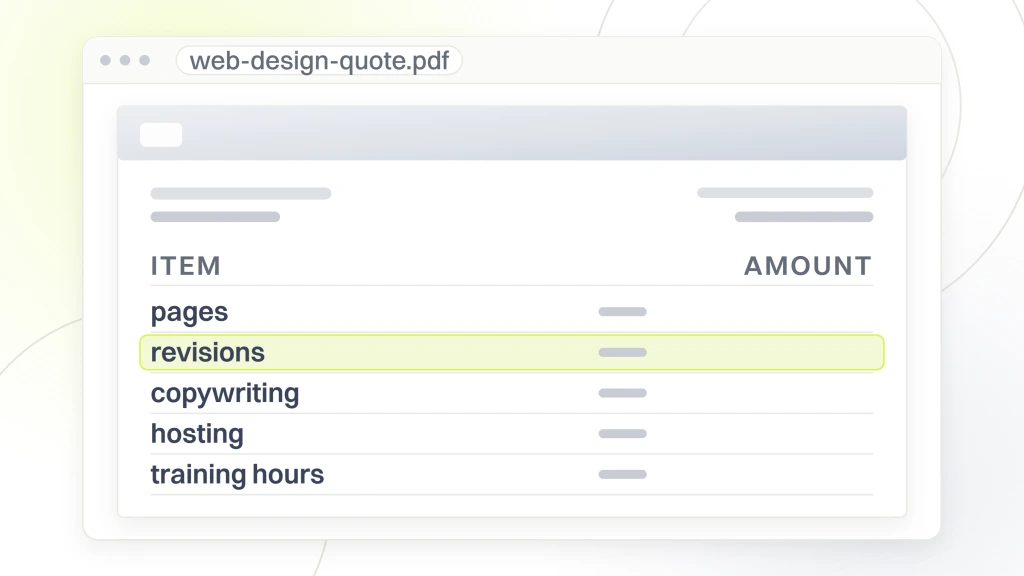
Published sheets show both failure modes in isolation. WebFX publishes component prices with no counts anywhere, listing responsive design at $3,000 to $25,000 and database integration at $2,000 to $25,000. WebTek publishes a monthly plan at $495 with a published setup fee of $1,000 on all plans and attaches no page, post, hour or link count to any of it, which is a published price with no published count and the exact shape of quote nobody can grade.
GoTechArk shows the mirror image, publishing 9 to 16 pages on one tier and 50 or more on another with no price at all. Half a disclosure either way leaves you guessing, so four things are worth a direct question.
- A total with no line items. You cannot compare or negotiate what you cannot see broken out.
- Pages given as a range. Ask which pages, by name, and get the list into the document before you agree the count.
- Revisions with no number. WordPress.com publishes an outright exclusion on Express, which is more useful to a buyer than leaving the question blank.
- A term buried in the terms. Logical Position publishes a 6 month minimum commitment in its published terms and conditions.
Then send the sheet back and ask the seller to fill it in, and ask who designs it, who writes the copy and who deploys it. Judging the firm is a different job from judging the package, and our guide to picking an SEO web company covers the first one.
How to work out the cost per page and the hourly rate your quote implies
Four calculations turn a quote into something comparable, and all four run on the document you already have. Start with cost per page. Say your quote reads $2,400 for five pages, both numbers from your own document, which divides out to $480 a page. Against the table above it sits between Ivory House Creative’s published $1,750 for 5 pages, which is $350 a page on its own count, and Succeeding Small’s published $2,500 for 5 pages, which is $500 a page on its own. So stop asking whether the price is right and start asking what those two publish that yours does not.
Then the marginal page. Ask what one more page costs and hold it against the figure you just computed. Sprout Media Lab publishes a $4,500 Starter Website at 5 pages, which is $900 a page, and additional pages at $250 each on the same sheet. A seller who will not answer never priced the count.
Then the year. If any part of your quote is monthly, multiply it by the minimum term and add any cancellation charge. Northwoods Web Designs publishes every input on one page, a STARTER plan at $79 a month, a minimum 12 month term, a committed $948, and a pro rated $2,000 charge if you leave early.
Last, the hourly rate. Ask how many hours sit behind the fee, divide, and set the answer beside published reference points. Clutch, drawing on a database of over 79,260 web design agencies, publishes $100 to $149 an hour for web design companies and $25 to $49 an hour for website builder services. Bright Space Creative publishes a retainer base fee of 3 hours at $270, which is $90 an hour by its own two numbers. ZacLab publishes a developer rate of $16 an hour and sells its $240 Startup site with 7 days of support and updates.
A low implied rate is not wrong on its own, but if a seller will not put an hour count on paper, you have your answer without any arithmetic at all.
Clutch also publishes an average project cost of $38,105.39 and, on the same page, states that most projects come in under $10,000. Both are theirs and they do not resolve into one number, so treat either one on its own as a fragment.
After launch, a free rank tracker shows movement on the queries you agreed to target, which is the cheapest way to find out whether the search work inside your build meant anything. Our comparison of free SEO tools sets out where each free tier stops.
What we would do first with two quotes on your desk
We would not start with the prices. We would put both quotes into the same four column sheet, fill in every count either seller published, and send the empty cells back as questions to both sellers in the same hour. The answers come back in different shapes, and that difference is usually the decision.
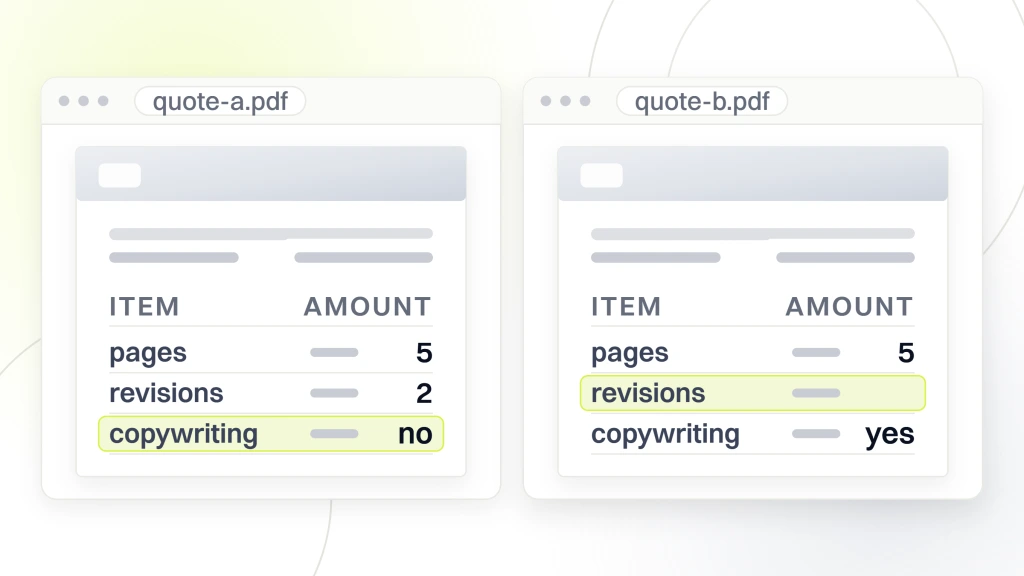
Then we would run the divisions on both. Cost per page, the marginal page, the committed first year if either is monthly, and the implied hourly rate. A quote that survives the first three and still cannot say how many hours sit behind the fee is holding something back, and that test applies to us as much as to anyone named on this page. Ask us for an hour count and we should be able to give you one.
The judgment nobody can make for you is the last one. Between two sellers whose numbers both hold up, pick the one whose questions about your business were better than your questions about their price.
So the next move costs nothing. Write the page count on your quote if it is not there, run the division, and place the result among the published rows above. Then ask three questions. What page six costs, how many revision rounds are included, and how many hours the fee represents.
If you would rather know what your current site needs before taking any of that to a seller, run a free website audit and bring the findings into both calls.