
SEO vs PPC for E-commerce Which Channel to Prioritize First
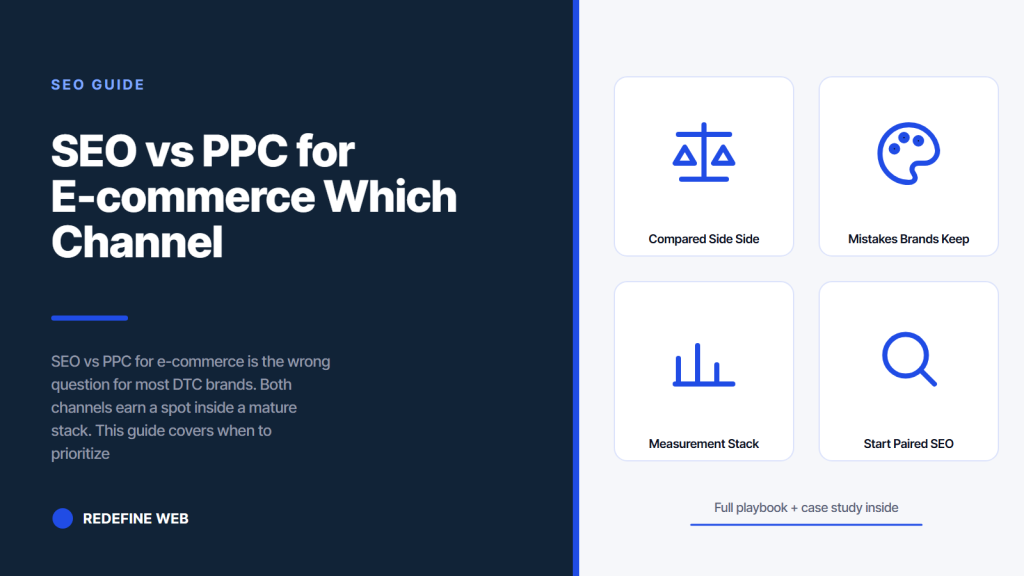
- Both channels earn a spot on a mature ecommerce stack.
- PPC books revenue in week one on high-margin categories.
- SEO compounds after month six on category and how-to pages.
- Margin decides the split more than any other factor.
- Remarketing bridges paid and organic funnels.
- Rebalance the split every quarter as data compounds.
- SEO vs PPC for e-commerce paired channel framework
- SEO vs PPC for e-commerce compared side by side
- Boogie Board paired channel results reference
- SEO vs PPC for e-commerce mistakes brands keep making
- SEO vs PPC for e-commerce measurement stack
- SEO vs PPC for e-commerce outlook through 2028
- Start the paired SEO vs PPC for e-commerce build this quarter
SEO vs PPC for e-commerce is the wrong framing every DTC founder asks first. The real question inside a growing Shopify or ecommerce brand is which channel serves this quarter’s cash flow, this year’s compounding, and the margin structure the products actually run on. Both channels earn a spot on a mature stack. The only real decision is the order of the ramp and the percentage split at each revenue stage. Get the split wrong and either the runway burns on paid ads that never break even or the SEO investment stays quiet while cash gets tight.
This guide covers SEO vs PPC for e-commerce the way we think about it inside client accounts across Shopify, WooCommerce, BigCommerce, and Magento brands. You get the timeline and cost structure comparison, the margin thresholds that dictate the split, the paired-channel framework that turns SEO and PPC into a compounding operation rather than two teams fighting over budget, the ROI math a $200k monthly DTC brand hits across both channels through year one, and the operational playbook a marketing lead runs against both channels weekly. Read in twelve minutes and you have the framing.
SEO vs PPC for e-commerce paired channel framework
The paired-channel framework treats SEO vs PPC for e-commerce as complementary workstreams inside one marketing operation rather than two competing budget lines. The framework runs on three principles. Both channels share the same product data. Both channels share the same landing pages where possible. Both channels feed each other’s optimization loops through shared analytics and shared creative.
Shared product data
Shared product data means the Product schema markup that helps SEO product pages surface in Google search results also feeds the Google Merchant Center product feed that powers Shopping ads. One data source. Two channels. Brands running fragmented product data (one set for SEO, another for Merchant Center) typically waste 8 to 15 hours weekly on synchronization overhead and produce inconsistent product information across surfaces. Consolidating on a single Product schema source of truth pays back inside the first month through the operational time saved alone.
Shared landing pages
Shared landing pages mean the category page that ranks organically for best running shoes women also serves as the PPC landing page for the Google Shopping ads on the same category. The page needs to convert organic and paid traffic equally well. Investment in landing page quality benefits both channels simultaneously. Brands that run separate PPC-only landing pages usually pay for the build twice and see worse conversion rates on both because neither page gets the full optimization attention.
Shared optimization loops
Shared optimization loops mean PPC data on which keywords convert feeds the SEO content brief prioritization. SEO ranking data on which pages catch organic traffic informs PPC landing page structure. Remarketing pixels installed for PPC also capture SEO traffic for retargeting. The loops turn SEO vs PPC for e-commerce from a channel debate into a compounding operation. Our writeup on e-commerce PPC strategies for better ROAS covers the paid side of the paired framework in more depth for brands wanting to tune the PPC engine specifically.
SEO vs PPC for e-commerce compared side by side
SEO vs PPC for e-commerce on the dimensions that matter for a growing DTC brand break out cleanly when compared side by side. Timeline, cost structure, margin fit, compounding behavior, and operational overhead all diverge across the two channels. The table below covers the working comparison a founder should run before deciding the split.
| Dimension | SEO for e-commerce | PPC for e-commerce |
|---|---|---|
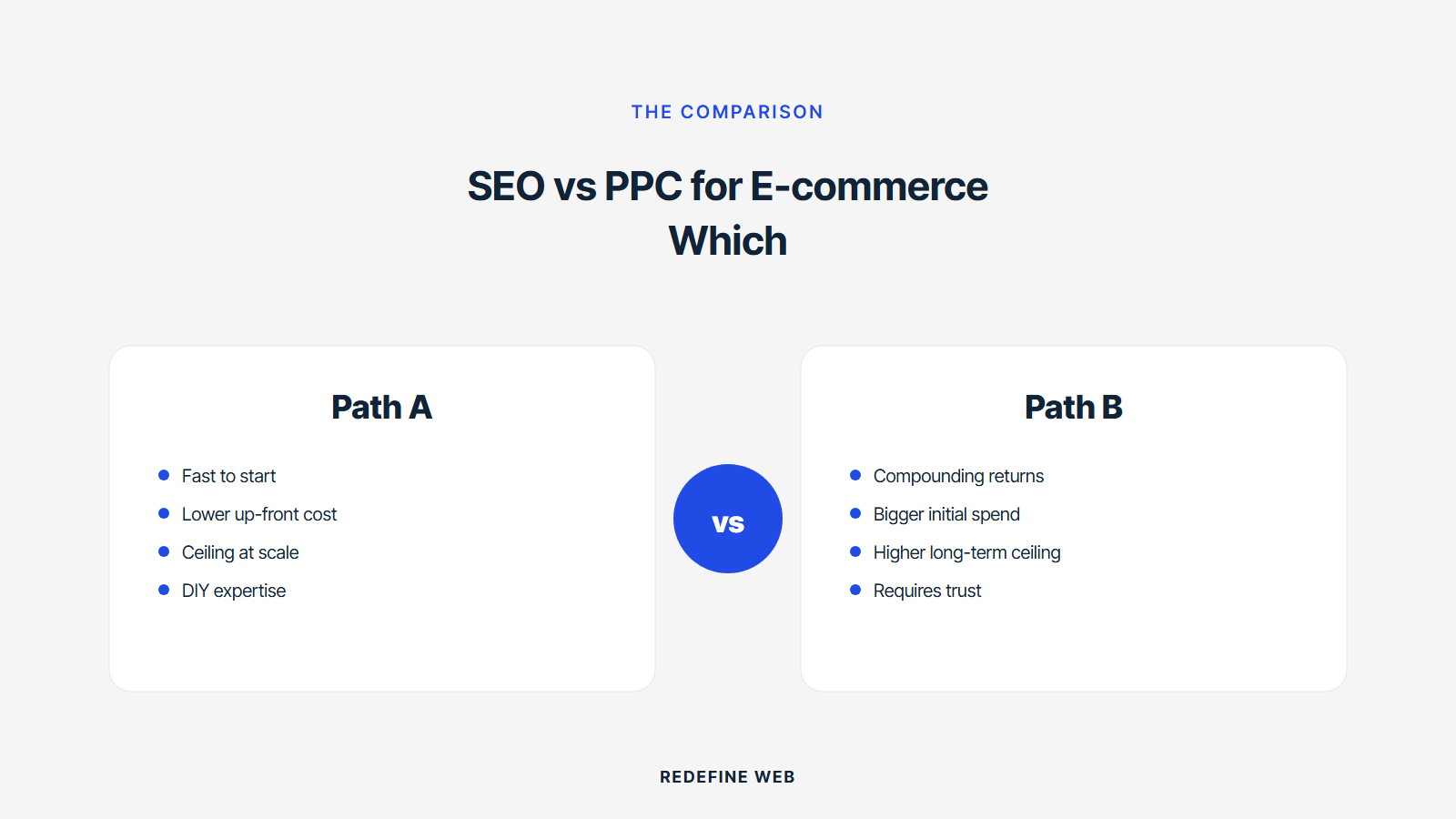
| Time to first revenue | 60 to 180 days | Same day to 7 days |
| Cost per visit | Zero after initial content investment | $0.40 to $4 per click depending on category |
| Compounding behavior | Traffic grows month over month with same content | Traffic stops when campaign pauses |
| Margin fit | Works at any margin, essential under 40 percent | Works at 45 percent plus gross margin |
| Monthly investment for mid-DTC | $6,000 to $18,000 in content and technical work | $8,000 to $50,000 in ad spend plus $1,200 to $4,000 management |
| Operational overhead | Content briefs, technical audits, on-page updates | Feed hygiene, bid management, creative refresh |
| Best used for | Category discovery, research-phase intent, brand authority | Transactional intent, remarketing, product launches |
The table above lays out the raw dimensions, but the working decision for most Shopify DTC brands is not either-or. The decision is what percentage split serves the current revenue stage and margin structure. The typical mature DTC brand ends up running both channels, and the ratio shifts as the brand scales and the SEO investment compounds. Skipping SEO because PPC pays back faster leaves the compounding curve unbuilt. Skipping PPC because SEO takes months leaves the near-term revenue on the table.
Boogie Board paired channel results reference
Boogie Board ran a paired SEO plus PPC program with our team through a 15-month engagement. The Boogie Board reusable writing tablet line sat at 58 percent gross margin, which is high enough for aggressive paid spend but not high enough to burn through cash on paid alone. The brand needed both compounding organic and near-term paid revenue running together. The starting split was 68 percent PPC to 32 percent SEO by budget dollars, which reflected the near-term revenue pressure at the start of the engagement.
The 15-month rebuild worked three streams in parallel. Google Shopping ads got a full feed rebuild with structured attributes, high-quality images across every SKU, and category-level bid strategies tuned by product margin. Category pages got a full content rebuild with 900 to 1,400 words of buying-guide context above the product grid, Product schema on every listing, and BreadcrumbList schema on the category hierarchy. Content briefs added 14 research-phase blog posts across the buying journey (best writing tablets for kids, how to choose an educational tablet, reusable writing tablet vs paper, writing tablet vs iPad for classroom).
Over 15 months, Boogie Board’s PPC ROAS climbed from 2.8x to 4.6x through the feed rebuild and bid strategy tuning. SEO sessions grew from 8,400 monthly to 41,200 monthly as the category and research content ranked. Total revenue attributed to marketing grew 173 percent. The budget split shifted from 68 percent PPC to 45 percent PPC by the end of month 15 as SEO carried a growing share of the revenue at zero per-click cost. Customer acquisition cost across both channels combined dropped 34 percent from month one to month 15. The paired program lives inside our ecommerce marketing agency retainer for DTC brands running both channels through a single team.
Every DTC founder hits the same moment in the second week of a paired SEO plus PPC engagement. The founder logs into the ads dashboard at 7 AM. PPC ROAS shows 3.2x. Founder feels good. Founder logs into Google Search Console at 7:04 AM. Zero movement on category rankings after 10 days of content investment. Founder feels bad. Founder emails the SEO agency asking when the rankings will move. Agency replies with a chart of typical ranking timeline. Founder does not read the chart because the PPC dashboard is more fun. Three months later category rankings hit position 8. Six months later position 3. Then the founder finally understands what compounding means and stops refreshing dashboards hourly. The whole cycle takes 180 days and costs one bag of coffee beans in dashboard-refresh caffeine.
SEO vs PPC is the wrong debate. Pull last month's cash flow. If under 90 days runway, put 70% on PPC. If over 12 months, put 60% on SEO. Cash decides the ratio.
SEO vs PPC for e-commerce mistakes brands keep making
SEO vs PPC for e-commerce mistakes cluster around six repeating patterns we see on almost every account audit. Fixing all six inside 60 days typically produces a 20 to 40 percent gain in blended channel efficiency without adding budget. The mistakes are cheap to fix and expensive to leave alone across a full quarter.
- Treating channels as competing budget lines: creates internal fights over budget instead of compounding growth. Merge into one channel plan.
- Separate product data for SEO vs PPC: doubles the operational overhead and produces inconsistent product info. Consolidate on one Product schema source.
- Separate landing pages for PPC vs organic: pays for the build twice at worse conversion rates on both. Share landing pages where possible.
- Static SEO to PPC split: the ratio should shift quarterly as SEO compounds. Rebalance every 90 days.
- Skipping brand keyword protection on PPC: competitors steal traffic that SEO would catch organically at zero cost. Always bid on brand.
- Running paid ads at 30 percent gross margin without breakeven math: burns cash. Model the paid math before scaling spend.
- Ignoring the research-phase organic queries: leaves the top of the funnel untouched. Content briefs on comparison and how-to queries pay back inside 180 days.
Order to fix them
Fix the shared landing page consolidation first because it directly grows conversion rate on both channels. Fix the shared product data second because it removes weekly operational overhead. Add brand keyword protection to PPC third because it recovers stolen traffic same week. Model the paid margin math fourth if the brand runs under 45 percent gross to avoid cash burn. Build the research-phase content briefs in parallel as background work. Set a quarterly rebalance cadence on the SEO to PPC split as compounding data comes in. Brands that batch the six fixes over 60 days rather than trying to shuffle everything the first week see cleaner analytics on what actually moved the numbers across the paired channel operation.
SEO vs PPC for e-commerce measurement stack
The measurement stack that supports SEO vs PPC for e-commerce runs on three data sources that need to talk to each other. GA4 as the customer journey source of truth. Google Ads and Meta Ads platforms as the paid channel data source. Google Search Console plus a rank tracker as the organic channel data source. Wiring the three sources into a shared blended-channel dashboard is the operational shift that turns the paired framework from an idea into a working weekly cadence.
GA4 channel groupings
GA4 channel groupings need custom configuration to separate organic search, paid search, paid social, and email into distinct buckets that the marketing lead can trust. Default GA4 groupings blur paid social into referral or direct on some tracking setups, which produces channel attribution that undercounts paid Meta contribution. Custom channel groupings with proper UTM discipline on every paid link and clean referral exclusion lists produce blended-channel reports that match the platform-native paid reports within 5 percent, which is the working accuracy threshold for a marketing lead to make budget decisions off the data. Reference reading on GA4 channel groupings sits at Google’s GA4 channel groupings documentation.
Weekly cadence for paired reporting
Weekly cadence for paired reporting runs on a Monday morning dashboard review covering blended-channel revenue, cost per acquisition split by paid and organic, and channel-specific optimization notes. The marketing lead spends 45 minutes reviewing the dashboard, flags any channel that missed its target, and assigns tactical actions for the week. The weekly cadence is where the paired framework earns its keep because it prevents the two channels from drifting into isolated optimization silos that fight over budget instead of compounding together into revenue growth.
SEO vs PPC for e-commerce outlook through 2028
The SEO vs PPC for e-commerce outlook through 2028 hinges on three shifts. PPC costs on Google Shopping and Meta Ads keep climbing 8 to 14 percent annually as more DTC brands compete for the same auction surface, which pressures paid ROAS on brands that do not tune feeds aggressively. SEO on category and research-phase queries becomes more competitive as more DTC brands invest in content, but the compounding advantage of an early SEO investment holds through 2028 because rankings that anchor early keep collecting traffic year over year.
AI Overviews and organic traffic patterns
AI Overviews on Google Search keep expanding through 2028 and pull some percentage of research-phase query volume away from traditional blue-link rankings. Brands with strong structured data on category and product pages surface inside AI Overview answers, which recovers a portion of the displaced traffic through organic mentions and citations. Brands that skip structured data lose visibility to competitors who wire it. The paired-channel framework becomes more important during this shift because PPC catches the transactional intent that AI Overviews do not fully monetize, while SEO catches the AI answer surface citations that traditional Google rankings used to fully own.
Shopping ad surface expansion
Google Shopping ads keep expanding across new surfaces through 2028 including YouTube Shopping, Discover feed, and Gmail promotions. Brands with clean structured product feeds surface across every new Shopping surface without additional work. Brands with fragmented product data have to rebuild the feed for each surface. Reference reading on the current Shopping ad surface expansion sits at Search Engine Land’s PPC library. The organic side of the same discipline sits alongside at Ahrefs’s ecommerce SEO guide for teams building the compounding side of the channel mix.
Start the paired SEO vs PPC for e-commerce build this quarter
Start with three moves this quarter. Audit the current margin structure across the top 20 SKUs to identify which categories can carry paid ads at breakeven and which categories should lean organic first. Consolidate product data on a single Product schema source of truth that feeds both the SEO product pages and the Google Merchant Center feed. Set the initial channel split based on revenue stage and margin (30 percent SEO to 70 percent PPC for early stage, 40 to 60 for mid-stage, 50 to 60 to 40 to 50 for mature). That baseline sets the working operation and lets the team optimize each channel individually.
Then plan the 90-day content and feed refresh. Month one hits Google Shopping feed hygiene and the top 8 category page content rebuilds. Month two adds Product schema across every SKU and BreadcrumbList schema on the category hierarchy. Month three ships 6 to 10 research-phase blog posts targeting comparison and how-to queries. Brands that follow the phased ramp see steady compound growth rather than boom-bust cycles. The paired scope where both channels operate on a single retainer lives inside our ecommerce marketing agency engagement for teams that want the SEO and PPC operation running under one team.
SEO vs PPC for e-commerce is a false binary. Both channels serve real revenue positions inside a mature DTC brand. The working move is to run both, split by margin and revenue stage, rebalance quarterly, share the product data and landing pages, and let the SEO compounding curve gradually take share from PPC as the brand scales. That is the framing. The rest is the weekly discipline of watching PPC ROAS, refreshing content briefs, and tuning the feed against Google’s evolving Shopping surface expansions through 2028 and beyond.
Frequently asked questions
What is the difference between SEO vs PPC for e-commerce
SEO vs PPC for e-commerce boils down to timeline, cost structure, and compounding. SEO takes 90 to 180 days to move category and product page rankings on Google and produces traffic that keeps flowing with no per-visit cost once the rankings hold. PPC produces traffic same-day on Google Shopping, Meta Ads, and TikTok, but every visit costs money and the traffic stops the moment the campaign pauses. SEO compounds because the same page can rank for weeks or months, while PPC does not compound because every click resets the meter. The tactical work looks different too. SEO relies on category page structure, product schema, and content briefs. PPC relies on ad creative, product feed hygiene, and bid strategy tuned to margin and cart value.
Should e-commerce brands start with SEO or PPC first
E-commerce brands should start with PPC first if the business needs revenue in the next 30 to 90 days to hit runway, hire, or seasonal targets. E-commerce brands should start with SEO first if margins are thin (under 40 percent gross) and paid ad math struggles to break even. Most Shopify DTC brands with 45 to 65 percent gross margin run PPC first to catch the near-term revenue while a parallel SEO program builds through the same 6-month window. Brands with 30 to 40 percent gross margin lean SEO first because paid math is harder to justify on lower margin. Brands with 65 percent plus gross margin have room to run both channels aggressively from day one and typically see the fastest compound growth curve inside the first year.
How much should e-commerce brands spend on SEO vs PPC
E-commerce brand spend on SEO vs PPC depends on revenue stage, margin, and growth target. Early stage brands (under $50k monthly revenue) typically split 30 percent SEO to 70 percent PPC because PPC hits the near-term revenue and the SEO investment stays modest during the traffic-lean months. Mid-stage brands ($50k to $500k monthly revenue) split closer to 40 SEO to 60 PPC as organic traffic starts contributing meaningful volume. Mature brands ($500k plus monthly revenue) split 50 to 60 percent SEO to 40 to 50 percent PPC because the compounding organic traffic dominates the revenue mix. Total marketing spend as a percentage of revenue typically sits at 12 to 22 percent for DTC brands and drops as the brand scales.
Can e-commerce brands use SEO and PPC together
E-commerce brands can and should use SEO and PPC together because the two channels serve different funnel positions and reinforce each other. PPC catches transactional intent and produces same-week revenue. SEO catches research and discovery intent and produces month-over-month compounding traffic. The paired channels also share signals that reinforce performance. PPC data on which keywords convert feeds the SEO content brief prioritization. SEO ranking data on which pages catch organic traffic informs PPC landing page structure. Remarketing pixels installed for PPC also capture SEO traffic for retargeting. Brands running both channels together typically produce customer acquisition cost 15 to 25 percent lower than brands running either channel alone at the same revenue scale.
What e-commerce SEO tactics work best alongside PPC
E-commerce SEO tactics that work best alongside PPC lean on category page depth, product schema markup, and content briefs targeting the research phase of the buying cycle. Category pages should carry 800 to 1,500 words of category context (buying guide, materials, sizing, care) above the product grid, with Product schema on every listing and BreadcrumbList schema on the category hierarchy. Product pages should carry 300 to 600 words of specific product context (materials, use cases, comparisons) plus 5 or more customer reviews with review schema. Content briefs should target research-phase queries (best X for Y, how to choose X, X vs Y comparison) that catch the shopper before they type the transactional query that PPC bids on. That research-phase catch is where SEO earns its long-term keep.
What e-commerce PPC tactics work best alongside SEO
E-commerce PPC tactics that work best alongside SEO lean on Google Shopping ads with a healthy product feed, remarketing to organic visitors who did not convert, and brand keyword protection on Google Search. Google Shopping ads produce 45 to 65 percent of most DTC brand PPC revenue and rely on a clean product feed with structured attributes, high-quality images, and accurate pricing. Remarketing campaigns retarget the 92 to 96 percent of first-time visitors who do not convert on the first session and typically produce 15 to 25 percent of total PPC revenue at a lower cost per acquisition than cold prospecting. Brand keyword protection bids on the brand's own name to prevent competitors from stealing traffic that SEO would otherwise capture organically at zero cost per click.
Book your free 30-minute strategy call.
No spam, no sales rep. We use your email to schedule your call with a senior strategist. That is it.
More from the blog
View all articles → SEO
SEO Organic Search Engine Optimization Services That Grow Real Traffic
Read article SEO
SEO SEO for Pet Groomers That Fills the Appointment Book Weekly
Read article SEO
SEO