
Shopify PPC Management What E-commerce Brands Should Look For
- Shopify ppc management needs Shopify pixel, feed, and Flow expertise.
- Shopify's server-side pixel restores 15 to 25 percent of matched conversions.
- Triple Whale is the default attribution tool for Shopify stores under 5M.
- Abigail Ahern hit 179 percent Shopify revenue growth on restructured paid media.
- Rewrite the top 100 Shopify product titles before scaling ad spend.
- Product feed hygiene on Shopify
- Attribution stack every Shopify ppc management engagement uses
- Red flags in an e-commerce ppc agency for shopify stores pitch
- Reporting cadence on a Shopify PPC retainer
- Timeline to see real results from Shopify ppc management
- In-house versus outsourced Shopify ppc management
- Wrapping up shopify ppc management as a discipline
Shopify ppc management is paid ad management for a Shopify or Shopify Plus store where the specialist owns Google Shopping and PMax, Meta Advantage+, TikTok Ads, and sometimes Amazon Ads inside one weekly budget, with the Shopify pixel and Shopify server-side tagging wired to feed clean events into every platform. In 2026, most Shopify stores past 20,000 dollars a month in ad spend need a Shopify-first specialist who understands the checkout, the product feed, and the Shopify Flow automations, not a generic PPC agency running the same playbook they use on WooCommerce or Magento.
You’ll get the anatomy of a Shopify-based e-commerce ppc management company scope, what the Shopify-specific technical setup covers, retainer math by monthly revenue, red and green flags in a Shopify PPC pitch, and how Abigail Ahern pushed Shopify revenue up 179 percent and paid social ROAS to 3,000 percent through a Shopify-first paid media rebuild without a single discount banner. Read this before you sign a scope with any e-commerce ppc agency for Shopify stores promising 10x ROAS in 60 days. Our writeup on ecommerce ppc services covers the retainer tiers and honest deliverables every DTC brand should scope against.
Product feed hygiene on Shopify
Shopify pushes the product catalog into Google Merchant Center and Meta Commerce Manager automatically through the official channel apps. The sync handles attributes, images, price, and inventory. What the sync does not handle is title quality. Product titles pulled directly from Shopify usually lead with the brand or a SKU code, which caps Shopping impression share below 40 percent regardless of bid.
Title rewrite patterns for Shopify
The working Google title order is brand plus category plus attribute plus size and color, inside the first 70 characters. Shopify stores gain from a written ppc strategy for ecommerce covering budget splits, MER targets, and shift triggers alongside the platform-specific overlays. Rewrite either through Shopify metafields and a script, through DataFeedWatch rules, or through Shopify Flow automation. Skip generic SKU codes and internal category names. Match the way a shopper types the query into Google, not the way the merchandising team categorizes the SKU internally. Every serious ppc for e-commerce websites engagement rewrites the top 100 Shopify titles inside week one.
Feed tools worth the license on Shopify
DataFeedWatch, Feedonomics, and GoDataFeed sit between Shopify and the ad platforms to transform, split, and enrich the feed without touching Shopify product data. License cost runs 100 to 800 dollars a month depending on SKU count. Shopify Plus stores past 500 SKUs almost always need one. Below 500 SKUs the specialist can maintain the feed manually inside Shopify metafields plus a Google Sheet. Working retainers bundle the tool license at cost.
Attribution stack every Shopify ppc management engagement uses
Every Shopify store past 15,000 dollars a month in ad spend needs a blended ROAS view pulled from Triple Whale, Northbeam, or Polar Analytics. Last-click platform ROAS overstates each platform’s contribution by 30 to 60 percent. Blended ROAS reads Shopify total revenue against total paid spend across every platform, which is the number the founder actually pays the mortgage with.
Triple Whale is the Shopify default
Triple Whale is the default attribution tool for Shopify stores under 5 million in annual revenue. It plugs directly into Shopify Admin, pulls order data, and matches it against Google Ads, Meta, TikTok, and Amazon reporting. Northbeam serves 5 to 50 million in revenue with more granular custom modeling. Polar Analytics serves the 50 million plus tier. License cost sits at 199 to 2,900 dollars a month depending on store revenue and connectors. Every working Shopify retainer either bundles Triple Whale or names it as a separate line the client owns.
How blended ROAS changes budget decisions
Google Ads reports itself as last-click on any converting Shopify session that touched a Google ad. Meta does the same. TikTok on its side. Add all three last-click reports up and you get a total ROAS 30 to 60 percent higher than actual Shopify total revenue. Blended ROAS from Triple Whale avoids the double-count. That is the number the retainer gets priced against on any serious Shopify PPC engagement. Skipping blended ROAS is the single biggest reason mid-market Shopify stores over-invest in Meta and under-invest in Google Shopping.
Red flags in an e-commerce ppc agency for shopify stores pitch
Every Shopify founder reads a proposal that promises 10x ROAS in 60 days. The red flags below catch most pitches that do not survive contact with a real Shopify account. Watch for these in any first call with a shopify based e-commerce ppc management company you have not worked with before.
- No week-one Shopify pixel and checkout QA in the scope. The platforms cannot outrun broken data.
- Retainer under 750 dollars a month with a promise of full multi-platform coverage. That budget covers 4 hours of specialist time. The tool licenses alone eat 200 dollars.
- Vague description of which specific Meta Advantage+ or PMax bid strategies sit in the plan.
- Account owned by the agency instead of the client through shared Google Ads MCC and Meta Business Manager access. Ownership transfer takes 48 hours on cancellation.
- No mention of Triple Whale, Northbeam, or Polar Analytics for blended ROAS. Last-click platform ROAS overstates by 30 to 60 percent.
- Guaranteed ROAS numbers on the first call. No serious specialist guarantees a return before seeing 60 days of Shopify data.
Every Shopify founder also gets one really tempting pitch a quarter: a proprietary AI-powered PPC tool the agency invented last month that promises to run every Shopify platform on autopilot for 199 dollars a month with zero human labor. The math says the tool is Smart Bidding with a rebranded PowerPoint, the specialist is a ChatGPT tab in a browser somewhere, and the 199 dollars barely covers the Zoom subscription. Neither scales past month two.
Green flags in a real Shopify PPC pitch
A written scope naming Shopify pixel QA plus one or two attribution tools. A tracking audit inside week one. A client-owned MCC and Meta Business Manager link with 48-hour termination. A weekly Loom or Slack summary format sample. A monthly one-page report sample. Case studies with named Shopify brands, real ad spend, real ROAS across at least 12 months. Any pitch that hits five of the six is worth a follow-up call, and any pitch that hits all six is worth a same-week scope negotiation before the specialist gets snapped up by another Shopify brand.
Every Shopify PPC scope hinges on server-side tagging. Ask the agency to verify Shopify's server-side pixel is live in your admin. If not, event data is broken.
Reporting cadence on a Shopify PPC retainer
Every Shopify ppc management engagement runs on a reporting rhythm the client and specialist agree to in week one. Daily is too much. Monthly is too little. Weekly plus monthly plus quarterly is the pattern most working Shopify retainers land on. Reporting cadence is where cheap retainers fall down first because the specialist has 3 hours a week and none of it goes to summarizing.
Weekly Loom or Slack summary
Weekly is a 5-minute Loom or a 300-word Slack summary covering blended ROAS on Shopify total revenue, top-spending campaign, biggest creative winner, biggest creative loser, and one action planned for the next week. Not a PDF. Not a dashboard link. A human-written summary in the client’s inbox by Monday lunch. That single artifact separates an engaged Shopify agency from a set-and-forget vendor. Founders who receive it stay on retainer 3 to 5x longer than founders who receive a monthly PDF only.
Monthly one-page report
Monthly is a one-page PDF or Notion page covering Shopify blended ROAS by channel, top 3 wins, top 3 losses, next month plan, and a small budget reallocation recommendation. One page. Not 12 pages. The one-page constraint forces the specialist to name the two or three signals that actually mattered. Twelve-page reports read as busywork and Shopify founders skim them. Every serious e-commerce ppc agency for Shopify stores uses the one-page format after 2023.
Timeline to see real results from Shopify ppc management
Shopify founders arrive at ppc management with wildly different timelines in mind. Some expect a 5x ROAS in week one because the proposal promised it. Others expect nothing because prior vendors let them down. Real outcomes sit in a narrow window shaped by category, ad spend, and how clean the Shopify pixel wired up on day one.
Month-by-month what to expect
Month one covers Shopify pixel QA, feed audit, campaign restructure, and first creative refresh. Blended ROAS often dips 10 to 20 percent while learning phases reset. Month two shows the first real signal as the platform models learn on cleaner Shopify data. Month three is where most Shopify stores hit break-even against retainer plus ad spend. Months four through six are where compounding kicks in and blended ROAS climbs 30 to 60 percent above the pre-engagement baseline. Skip the Shopify pixel audit in month one and every downstream number lands 3 to 5 months late.
Returns by Shopify category
Apparel and lifestyle Shopify stores: 3x to 5x blended ROAS by month 6. Home decor and furniture Shopify: 4x to 8x by month 6 given higher average order value. Beauty and skincare Shopify: 2.5x to 4x on first purchase, 6x to 10x on lifetime value once subscription flows work. Consumer electronics Shopify: 3x to 5x on high-margin SKUs, 1.8x to 2.5x on commodity items. According to Think with Google’s paid search benchmarks, e-commerce accounts running Smart Bidding on clean tracking outperform industry averages by 40 to 60 percent on cost per acquisition.
In-house versus outsourced Shopify ppc management
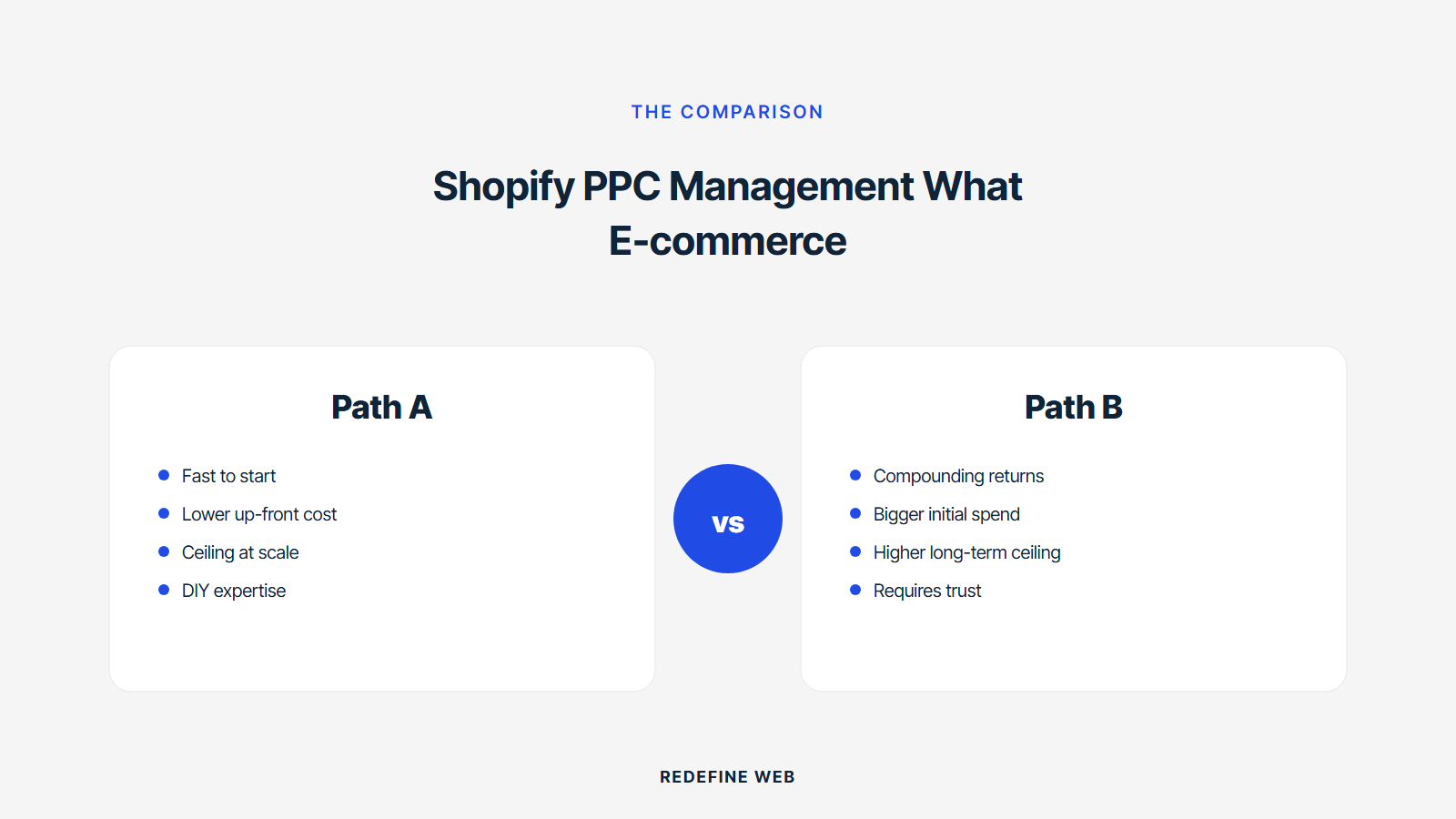
Every Shopify founder eventually asks whether to run paid media in-house or hire a Shopify PPC agency. The honest answer depends on ad spend, in-house creative capacity, and whether the founder has time to review reports every Monday. Below 15,000 dollars a month in ad spend, an agency retainer wins on math because the tool licenses alone eat 500 to 900 dollars. Above 100,000, a hybrid model with an in-house lead plus agency oversight usually wins.
Tool license math for in-house Shopify PPC
Triple Whale (199 to 900 dollars a month), DataFeedWatch (100 to 800), Optmyzr (250 to 500), and Adalysis (150 to 300) sit at 700 to 2,500 dollars a month in stack costs for a single in-house Shopify lead. Agencies spread those license costs across 15 to 20 Shopify accounts, so per-account share drops to 50 to 130 dollars. That is one of the biggest cost efficiencies an agency delivers on Shopify work. Founders who insist on in-house tooling below 30,000 dollars in monthly ad spend usually spend 3x what they need to.
When in-house wins on Shopify
In-house wins on Shopify when the store spends over 100,000 dollars per month, custom conversion logic needs daily internal collaboration with the Shopify development team, and the founder wants a permanent Shopify paid media capability. Even then an agency oversight arrangement catches blind spots a solo in-house lead misses. Full replacement of external oversight rarely pays off below 300,000 dollars in monthly spend. Our PPC management services team runs into this decision often with Shopify Plus mid-market clients.
Wrapping up shopify ppc management as a discipline
Shopify ppc management in 2026 is a stack of platforms (Google Shopping and PMax, Meta Advantage+, TikTok, Amazon) that a Shopify-first specialist orchestrates on top of the Shopify server-side pixel, a clean product feed pushed from Shopify to every ad platform, and a creative refresh cadence baked into the retainer. Every Shopify hook matters. Skip the pixel QA and the models overspend. Skip the feed rewrites and Shopping impression share caps at 40 percent.
Real Shopify accounts see 3x to 8x blended ROAS inside 6 months when the specialist, the Shopify pixel, and the creative rotation all show up every week. Abigail Ahern pushed Shopify revenue up 179 percent, paid search ROAS to 1,588 percent, and paid social ROAS to 3,000 percent through restructured Shopify ppc management on a positioning-first paid stack. Ask three vendors for line-item scopes, look for the Shopify-specific technical setup they name in writing, and pick the one that gives you full account ownership on both the MCC and Meta Business Manager side. Redefine Web offers a fixed-scope Ecommerce PPC Agency for DTC Brands package with the full Shopify stack included, plus a Google-first Google Ads Management Services program and a broader Ecommerce Marketing Agency for DTC and Shopify Brands retainer.
Frequently asked questions
What is shopify ppc management?
Shopify ppc management runs paid ad accounts for a Shopify or Shopify Plus store across Google Shopping and PMax, Meta Advantage+, TikTok Ads, and sometimes Amazon Ads inside one weekly budget, with the Shopify pixel and server-side tagging wired to feed clean events into every platform. The specialist owns feed hygiene, campaign structure, bid strategy per platform, creative rotation, checkout and pixel QA, and post-purchase measurement. The Shopify-specific technical setup (pixel API, Flow automations, server-side pixel) separates a Shopify-first shop from a generic paid media plan running the same playbook on WooCommerce or Magento.
How much does an e-commerce ppc agency for shopify stores cost?
Shopify ppc management retainers run 1,000 to 12,000 dollars per month as flat fees for stores spending under 100,000 dollars on ads. Percent-of-spend pricing sits at 10 to 15 percent of monthly ad budget for stores past 100K a month. Enterprise Shopify Plus stores past 500K a month usually pair a flat fee of 12K to 25K with a percent-of-spend override on incremental growth. Tool licenses like Triple Whale, DataFeedWatch, and Optmyzr add 200 to 500 dollars a month bundled inside a working retainer at agency-negotiated rates. Below 750 dollars a month is not real Shopify ppc management.
What Shopify-specific technical setup does a PPC specialist need?
The Shopify pixel API, Shopify Flow automations, and Shopify's built-in server-side pixel that shipped in 2023 all matter for how clean the data flows into Google Ads, Meta, and TikTok. Server-side pixel forwards checkout events directly from Shopify's servers to Google Ads and Meta CAPI without needing a GTM server container, which restores 15 to 25 percent of matched conversions lost to iOS 14. Shopify Flow lets the specialist automate paid media hooks like auto-pausing campaigns on out-of-stock SKUs. Every Shopify store past 15,000 in monthly ad spend should have both server-side pixel enabled and 5 to 8 Flow automations feeding the paid media specialist.
How does Google Shopping work for Shopify stores?
Shopify pushes the product catalog into Google Merchant Center via the official Google Sales Channel app. The feed sync happens on catalog change and pushes attributes, images, price, and inventory. What the sync does not handle is title quality. Product titles pulled directly from Shopify usually lead with the brand or a SKU code, which caps Shopping impression share below 40 percent regardless of bid. Rewrite the top 100 titles to lead with brand plus category plus attribute plus size and color inside the first 70 characters, either through Shopify metafields, DataFeedWatch rules, or Shopify Flow automation.
How does Meta Advantage+ work on Shopify?
Shopify's official Meta channel app pushes the product catalog and pixel events into Meta Business Manager automatically. Advantage+ Shopping campaigns pull from the catalog and rotate creative and product overlay per user. The specialist uploads 6 to 10 creative assets per active ad set and refreshes them at 4 to 6 new assets per week. Meta ad performance decays 40 to 60 percent inside 14 days on the same creative, so the refresh cadence carries the campaign. Catalog retargeting flows for cart abandon, browse abandon, and post-purchase upsell recover 15 to 30 percent of abandoned Shopify sessions at 3x to 5x lower cost per acquisition than cold prospecting.
What attribution tool should Shopify stores use for blended ROAS?
Triple Whale is the default attribution tool for Shopify stores under 5 million in annual revenue. It plugs directly into Shopify Admin, pulls order data, and matches it against Google Ads, Meta, TikTok, and Amazon reporting. Northbeam serves 5 to 50 million in revenue with more granular custom modeling. Polar Analytics serves the 50 million plus tier. License cost sits at 199 to 2,900 dollars a month depending on store revenue and connectors. Every working Shopify retainer either bundles the tool license or names it as a separate line the client owns, because last-click platform ROAS overstates each platform's contribution by 30 to 60 percent.
What are red flags in a shopify based e-commerce ppc management company pitch?
No week-one Shopify pixel and checkout QA in the scope is the biggest red flag. Retainer under 750 dollars a month with a promise of full multi-platform coverage is the second. Vague description of which specific Meta Advantage+ or PMax bid strategies sit in the plan is the third. Account owned by the agency instead of the client through shared MCC and Meta Business Manager access is the fourth. No mention of Triple Whale or Northbeam for blended ROAS is the fifth. Guaranteed ROAS numbers on the first call is the sixth. Any pitch that hits three or more of these red flags is worth walking away from before signing.
Book your free 30-minute strategy call.
No spam, no sales rep. We use your email to schedule your call with a senior strategist. That is it.
More from the blog
View all articles → PPC
PPC Healthcare PPC Advertising Channels Compliance and Targeting
Read article PPC
PPC Dental Facebook Ads Guide for Practices That Book Patients
Read article PPC
PPC